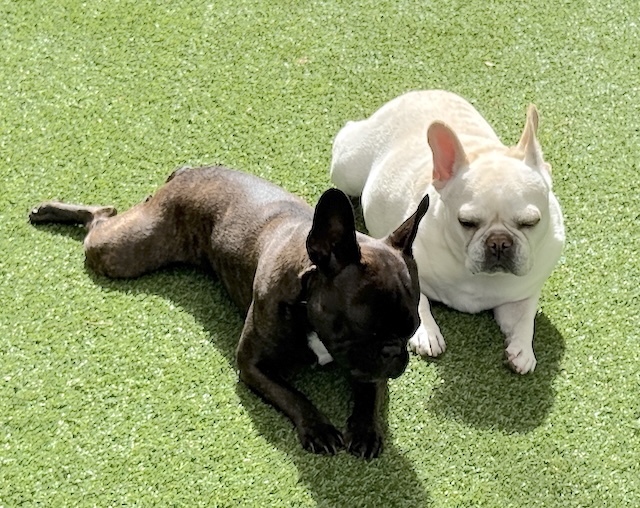
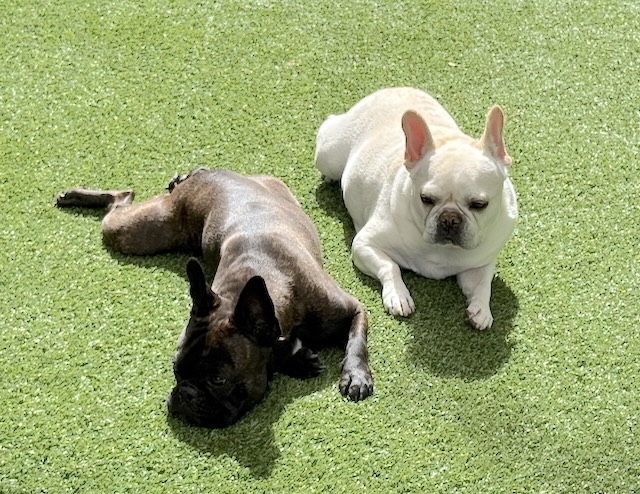
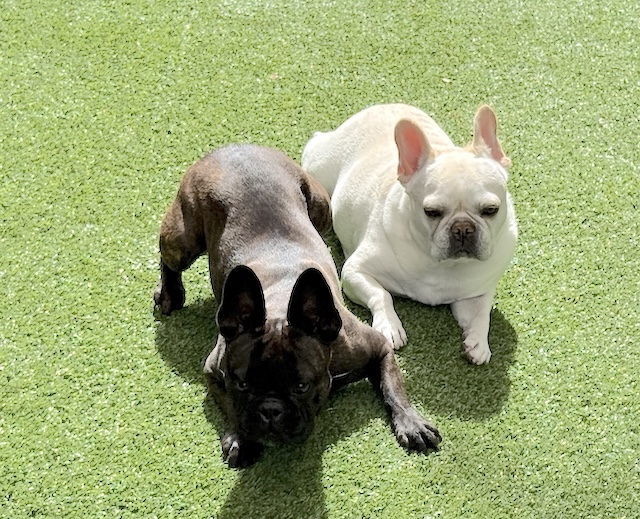
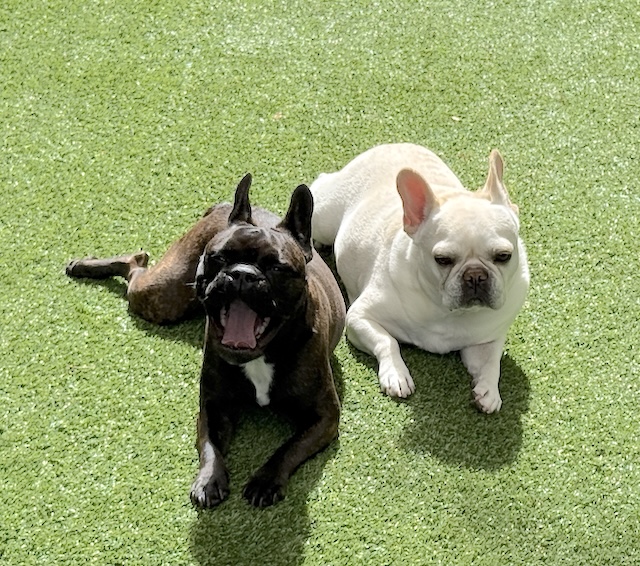
This post ran on March 24th, 2014, and was written by Marie Ann Bailey and me. I hope you like it.
Top Ten Things Not To Do When Choosing To Adopt a Pet
10. When choosing to adopt a pet, do not go to the animal shelter without your significant other to help you make a decision. If you do go without your significant other, at best, your significant other will forgive you for bringing home a cat with an ear-piercing howl and buy you both a lifetime supply of earplugs so you can at least sleep through the night. At worst, your significant other may start talking about the need to “see other people, particularly people without cats.”
9. When choosing to adopt a pet, do not assume that just because Newfoundland puppies are cute and a perfect size for cuddling, they will always be a perfect size for cuddling. If you do, at best, you may learn to not mind when you get pushed off the bed when your grown-up, 130-pound Newfoundland stretches out next to you. At worst, you may have to design a harness and pulley system to get your grown-up, 130-pound Newfoundland off your lap.
8. When choosing to adopt a pet, do not think that just because the ferrets at the pet store were all asleep during your visit, the one you picked will spend most of its time sacked out. If you do, at best, you won’t mind playing daily games of hide-and-seek as your ferret playmate finds new places to hide in your home. At worst, you may find that the new places to hide involve the ferret eating holes in your upholstery, forcing you to buy a new suite of living room furniture every week.
7. When choosing to adopt a pet, do not think that your regular vacuum cleaner will suffice for cleaning up the hair shed by the white Himalayan cat you desire. If you do, at best, you will be properly advised, causing you to purchase a top-of-the-line model. At worst, you may have to learn to live with your brown velour furniture looking like it’s been blanketed in snow.
6. When choosing to adopt a pet, do not think that bringing home a python will do much to improve your social life. If you do, at best, you and the animal control officer who was called out to your house after your neighbors complained may fall in love, and together you will find a proper home for the python. At worst, you may be confronted by a mob of your neighbors after your python repeatedly escapes and the small animals in your neighborhood disappear.
5. When choosing to adopt a pet, do not think that cats are more hygienic than dogs. While that may be true in general, at best, you may find your new cat poops outside its litter box only when you provide food it doesn’t like (and thereby quickly trains you to give it what it wants when it wants it). At worst, your cat may eventually eschew the litter box altogether, causing you to invest heavily in wee-wee pads and kitty diapers and daily meditations of “Fluffy is a good kitty. Fluffy is a good kitty.”
4. When choosing to adopt a pet, do not assume that little Fido’s incessant yipping is something he will simply outgrow. If you do, at best, you may wind up deciding that you no longer need a security system for your home since Fido emits a series of high-pitched yips at every movement behind your door or window. At worst, you may invest in a series of expensive sessions to train Fido not to yip only to learn that Fido is as Fido does—YIP!
3. When choosing to adopt a pet, do not assume that simply training your German Shepherd Gunther to obey commands gets you a pass at keeping your dog on a leash in public places. If you do, at best, joggers will quickly learn to stop running when they see Gunther, so he will not chase them as you call in vain for Gunther to “Heel!” At worst, the next jogger whose crotch Gunther sticks his nose into will be an employee of the police force who will be more than happy to write up a series of citations against you and to confiscate Gunther for conscription into the police dog unit.
2. When choosing to adopt a pet, do not assume fish would be a good choice if you live in an apartment where pets are not allowed. If you do, at best, your landlord never visits your apartment, and you manage to keep your relationship with George, your Oscar cichlid, a secret. At worst, your landlord may catch you in the elevator with the new aquarium for George, which you had to buy because he doubled in size, and your landlord doesn’t buy the story that you plan to use the aquarium for a sitz bath.
1. When choosing to adopt a pet, do not think you will be able to stop at just one. If you do, at best, you may learn to accept the fact that animals will gravitate toward a warm heart and a safe home, meaning you and yours. At worst, you will find yourself having to make accommodations for your pets in your will, since, as you get older, your willingness to rescue abandoned animals has grown.
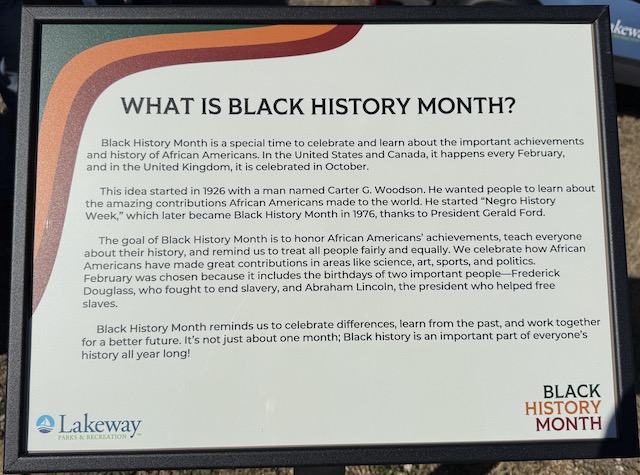
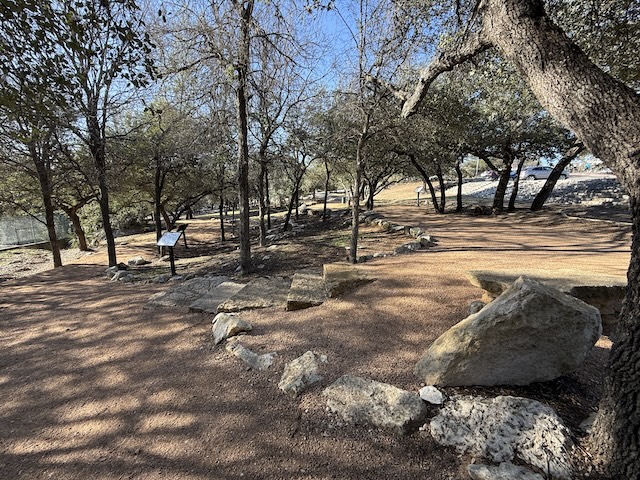
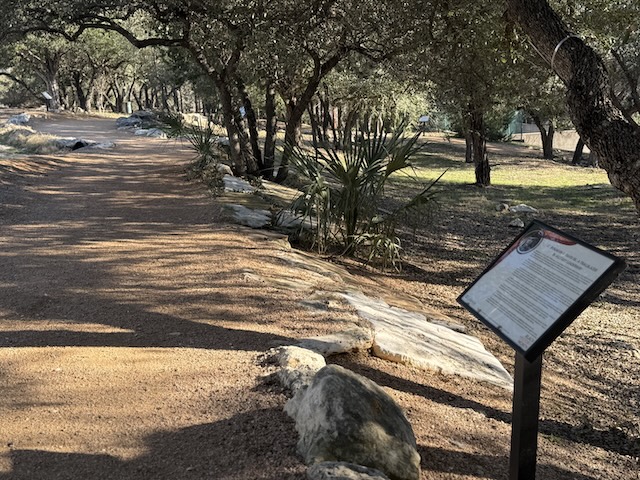
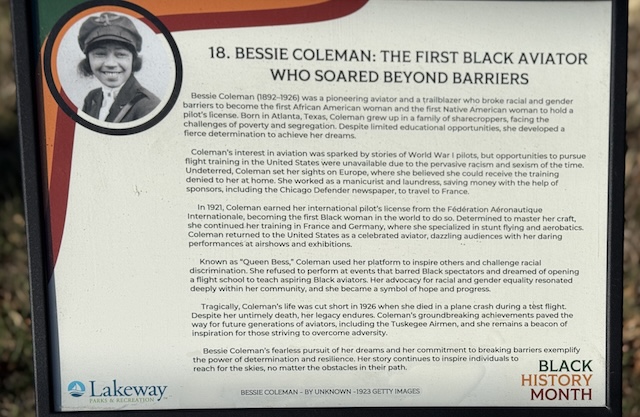
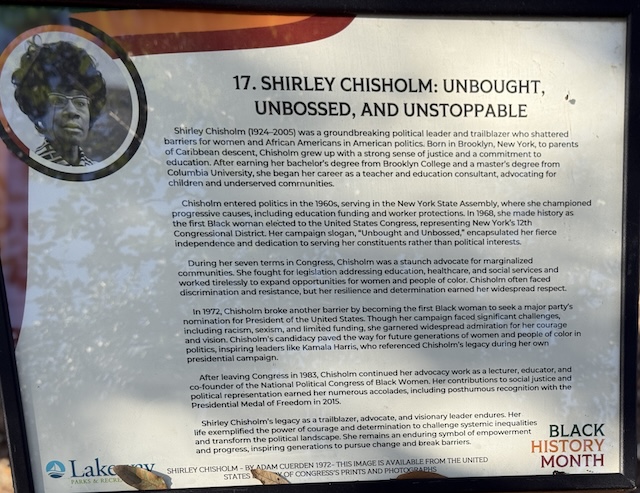
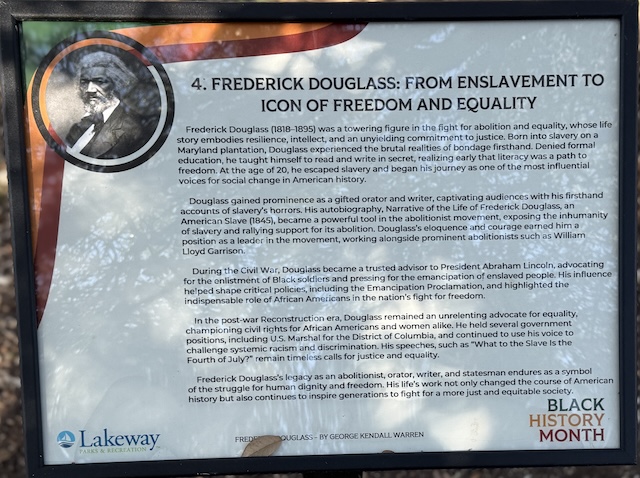
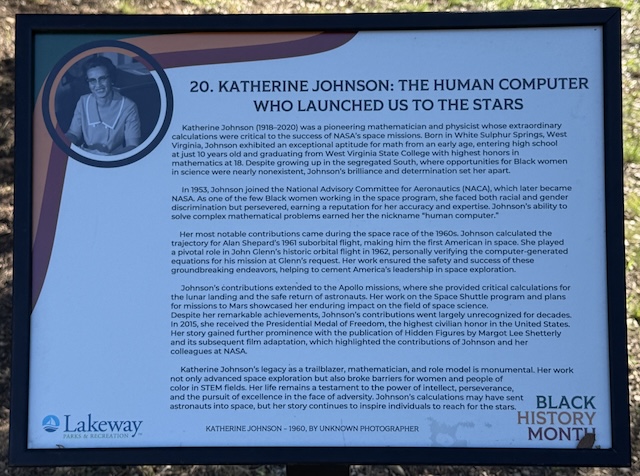
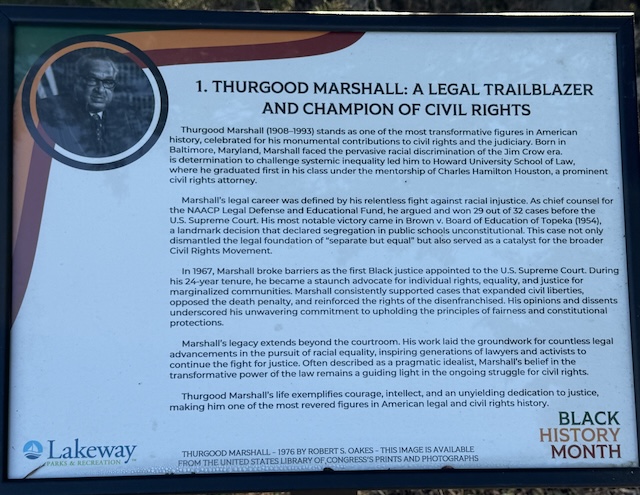
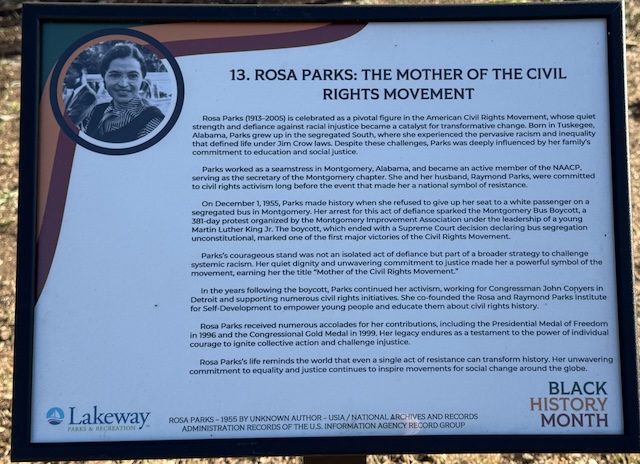
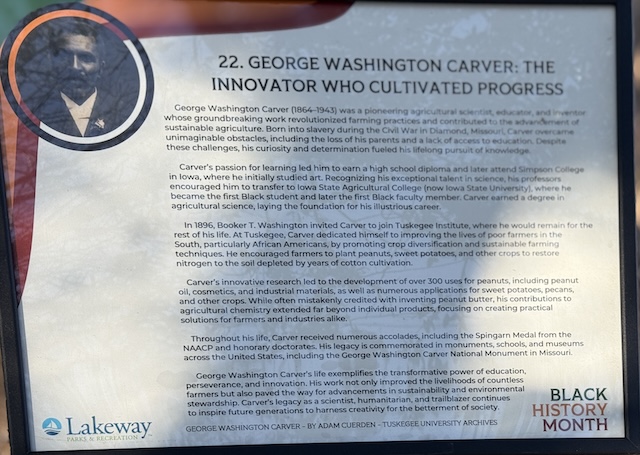
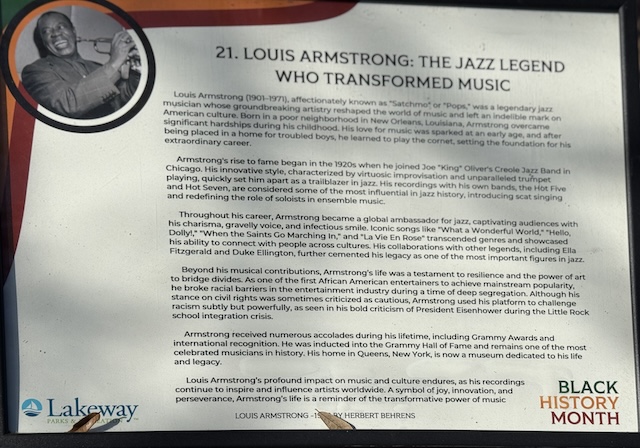
Today, we are going to take a brief walk in the park to celebrate Black History Month. Lakeway has 27 stations on the walk. Time and space will only allow us to give you a taste of what is available. If you want to see them all, you can go hereand here. We are catered by Corner Restaurant of Austin.
Menu
All American – scrambled eggs, crispy breakfast potatoes, sausage or bacon, sourdough toast
A smooth Cappuccino is on the brain today. A light touch of the menu screen starts the delivery process. Milk, coffee, and then foam create the elixir that will quell the low caffeine warning buzzer in my head. One sip begins recovery. The second sip ushers in the jarring sound of the Westminster chimes, proving once again that no one can read the “Do not ring the doorbell” sign. A knuckle bone tossed into the soundproof room and a slam of the door ensure that Tempeste and Twiggy will not bark me to St. Louis.
With peace restored, the monitor shows a large sheepdog that looks like Sam and a Wolf that looks like Ralph. Skipping the usual dialogue about leaving whatever the dog is delivering, the security shutdown process is begun.
The SWAT team needs to be put on standby. A quick text to the leader confirms that status. Also, the flight of A-10 Warthogs must be diverted. Another call to the commander puts that worry to rest. The SEAL team needs to be called off, and a call to the leader makes that possible. The MH-60 Jayhawk Helicopter hovering over the house is diverted. A call to the tow truck driver stops the deployment of an M1A1 Abrams Tank. The control panel simplifies the shutdown process of the security system. The boiling oil vats are put on standby, the turret mortars disengaged, the Trebuchet on safety, the concertina wire rolled, the Claymore mines reset, the tower Gatling guns on safety, the moat net dropped, the alligators fed, and the IEDs and shoulder-held rockets put away. The Proton torpedoes switched off. The gamma ray beams covered. The high-powered maser guns switched to standby, and the nanorobots were chained in the basement. The Klingons are called back, and the Targ is caged. Robbie’s Bot is sent to the basement. The Tasmanian Devil is directed to the food in his cage, and the door drops. The locks on the door are thrown. And the door opened.
The sheepdog has an envelope and a clipboard, which he hands to the wolf, looking like Ralph. Ralph hands both to me and points to the place to sign. After signing and handing the clipboard back, the sheepdog grabs me and turns me upside down. Several coins and a few bills drop to the porch. The wolf picks up a couple, and Sam says, “We know how you are and thank you for your generous gift.” Placed upright, my next move is to pick up the remaining money and head indoors quickly.
The envelope is from Linda Hill. Inside is a message which reads: Your Friday prompt for Stream of Consciousness Saturday is “smooth.” Use it any way you’d like. Have fun!
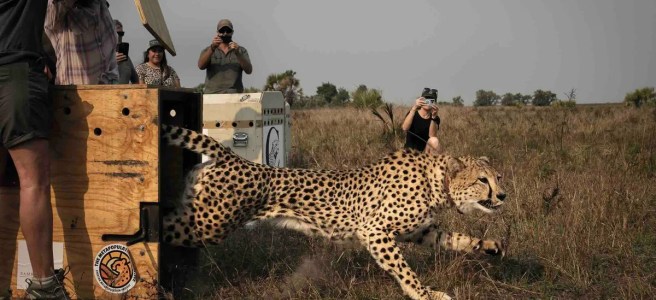
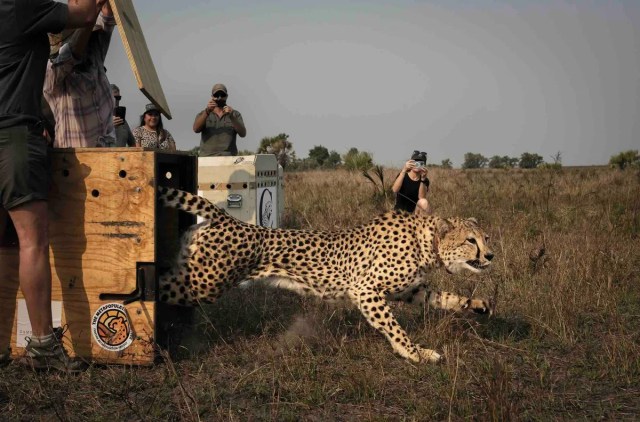
In the Zambezi Delta, the first cheetah releases were made in 2021. Credit: Jim Tan
Today’s good news story comes from the BBC Wildlife Magazine. I want to thank Noelle Granger for sending it to me.
“It’s a kind of Tinder for big cats.” Cheetahs were dying out in Africa, so conservationists tried something new
By Graeme Green
The cheetah is back – thanks to a smart release project that now sees populations flourishing in South Africa and beyond
When four sub-adult cheetahs arrived at Kuzuko Private Game Reserve, South Africa, in 2023, there were high hopes that the female among them would breed. There was just one snag: it turned out that all four were, in fact, male.
A gender mix-up was the least of the quartet’s concerns, as their mother had been killed at Karongwe Private Game Reserve.
“To increase their chances of survival, they came to live in our boma facilities,” explains Jim Tan, CEO of Kuzuko, referring to the traditional fenced animal enclosure.
“We looked after them into adulthood. Two went off to Lolelunga Private Reserve, Zambia, in 2024; the other two were set to go to Mozambique, but were jumped by lions – sadly, one was killed.”
Kuzuko is one of more than 70 reserves across South Africa currently involved in the metapopulation management of cheetahs. It’s a modern, more holistic approach to cheetah conservation that has taken shape over the past 15 years and has been a remarkable success story.
As the fastest land animal on the planet – the cheetah can accelerate to 110kph in just three seconds when hunting – this is one of Africa’s most iconic species. It is a beautiful feline, instantly recognisable by its lean appearance, delicate ‘teardrop’ facial markings, and long legs built for running.
Conserving cheetahs
Once widespread across Africa and Asia, the cheetah is now largely confined to southern Africa, with a tiny remnant population of Asiatic cheetahs surviving in Iran. Globally, just 6,500 to 7,100 individuals remain in the wild.
Listed as Vulnerable by the IUCN since 1986, the species has suffered a dramatic decline over the past century and today roams less than 10 per cent of its historic range. For decades, efforts have been underway to restore South Africa’s cheetah populations, but the initial focus was on growth across all populations.
“This is not what the metapopulation approach is about,” says Sam Ferreira, large mammal ecologist at South African National Parks.
A metapopulation is a network of small, separate populations that, together, act as one larger population. In the wild, cheetahs would naturally disperse and connect these groups, sharing genes and boosting resilience.
But with fences and other human infrastructure now blocking that movement, conservationists have stepped in, mimicking those processes using translocations. It’s a kind of Tinder for big cats.
Fencing became an increasingly common feature of South Africa’s landscape after the country’s political transformation in 1994, when wildlife tourism surged and private reserves multiplied.
While these barriers helped to reduce human-wildlife conflict and poaching, they also impeded the natural movement of cheetahs, which depend on vast, open spaces. A growing human population has also impacted the landscape.
“Protected areas have become more fragmented,” says Olivia Sievert, cheetah range expansion co-ordinator for the Endangered Wildlife Trust (EWT).
“As a result, you don’t have the natural dispersal that allows gene flow between populations, so there’s more inbreeding. This impacts cheetah health, including reproductive health. Litters can be smaller, and the animals can be more susceptible to disease. It becomes dangerous.”
“Metapopulation management is also about source-sink dynamics,” adds Sievert.
“If you have a population that’s acting as a ‘sink’ for a species, because of disease or predation, the natural metapopulation dynamics of dispersal allow a ‘source’ that has good breeding to rescue it. Fences and other human impacts mean you lose these dynamics. That’s why we do this work.”
Conservationists prepare to transport a tranquillised cheetah to its new home – Jim Tan.
The Cheetah Metapopulation Project
In 2011, the EWT launched the Cheetah Metapopulation Project (CMP), driven by conservationist Vincent van der Merwe. Today, two other organisations in South Africa are successfully working on cheetah metapopulation management and range expansion: Ashia Cheetah Conservation, founded in 2016, and The Metapopulation Initiative (TMI), founded in 2022 by van der Merwe, after he left EWT.
“Cheetahs play a big role,” says Sievert. “When we introduce them to a new area, the number of scavenging birds increases, especially vultures. Cheetahs leave a lot of food in the landscape, thereby promoting the scavenging community, which is critical for controlling disease. It all has a knock-on effect.”
The cheetah is also a charismatic species, attracting tourists. As well as coordinating translocations from one location and population to another, both within and outside South Africa, metapopulation management involves extensive monitoring of population dynamics and the maintenance of a national studbook and DNA database.
“The biggest challenge is habitat and finding suitable homes for surplus cheetahs,” says Kulani Nyakane, cheetah metapopulation manager for TMI.
“In South Africa, we’ve done well, and we’re running out of space. We want to ensure we relocate the cheetahs to an ecosystem, such as in Zambia.”
It’s not only wild cheetahs that are moved. Zoo-born and captive-bred animals are also translocated, increasing genetic diversity within the wider metapopulation.
The Aspinall Foundation helped to send Edie (a female born at the Wild Cat Conservation Centre in Sydney, Australia) and Nairo (a male born at Howletts Wild Animal Park in Kent, UK) to live wild in South Africa.
Nairo, now based in Mount Camdeboo Reserve, has sired more than 15 descendants, dispersing his genes into the wider metapopulation.
Kuzuko has supported metapopulation projects over the years with the EWT and other organisations. “For captive-born cheetahs, we are a halfway house,” Tan explains.
“We’ve got small, medium, and large bomas, so we can monitor them at every stage. They might not adapt immediately, so we intervene if necessary. If they’re struggling to hunt, we can see if they need assistance. If they’ve never been exposed to a lion, we can see their reaction.”
Since 2010, 32 cheetahs have moved from Kuzuko to other locations, including 10 born on the reserve. Seven captive-born females and nine males have been ‘wilded’ at Kuzuko since 2018, and all the females have gone on to breed.
“Without this metapopulation management work, we could lose a very special species,” says Tan. Translocating any animal is fraught with risk. With cheetahs, it’s possible they won’t adapt to their new environment, struggling to navigate unfamiliar vegetation, find water, and avoid predators.
“We’re operating in tourist areas that are often overstocked with lions and leopards, which hurts cheetahs, because lions prey on cheetahs,” adds Nyakane. The move itself is stressful. “Cheetahs are sensitive,” says Nyakane.
“If you capture them, their stress levels can result in mortality. Being shot with a dart gun is stressful, and they’re not used to being handled by humans or put in crates. If they get too cold or too hot, they could die.”
Giraffes keep a wary eye on a cheetah, but the cat preys on much smaller animals, from warthog to impala – Buena Vista Images/Getty Images.
A success story?
Despite the challenges, the initiative has seen great success. In 2011, when EWT’s metapopulation work first began in South Africa, an estimated 217 cheetahs lived across the 41 CMP reserves.
By the end of 2023, there were 455 known cheetahs, including 264 breeding adults, across 67 reserves. And numbers continue to increase.
“Cheetahs are now doing very well in South Africa,” says Sam Ferreira. “We can produce cheetahs to support other parts of Africa if we need to.”
The success now extends beyond South Africa’s borders. In 2017, the EWT led the first international reintroduction under the CMP initiative (now the Cheetah Range Expansion Project), sending four cheetahs to Malawi’s Liwonde National Park, where the species had been absent for nearly two decades.
This led to reintroductions in Malawi’s Majete Wildlife Reserve, Zambia’s Bangweulu Wetlands, Mozambique’s Maputo National Park, Kariengani Game Reserve, and Zambezi Delta.
Between the three main cheetah organisations, hundreds of translocations have now been successfully completed, including to eight locations outside South Africa where the animals were previously extinct. TMI also worked on Project Cheetah, the high-profile reintroduction of the species to India.
Last year, a new national Biodiversity Strategy and Action Plan came into effect in South Africa, which included cheetah management. The Cheetah Advisory Group, coordinated by Sievert, is hoping to make the metapopulation effort more cohesive.
“We need a coordinated effort and information-sharing,” Sievert says. “New organisations are coming in and learning the same lessons we learned 10 years ago. Why have that gap? Why not work together and make sure we’re all moving forward for cheetahs?”
EWT plans to work with partners in Zambia and Mozambique on cheetah relocations, restoring cheetahs to larger ecosystems to allow for more self-sustaining populations.
Ashia is currently focusing on the Free-Roaming Cheetah Census, a three-year project to study wild cheetahs that live outside protected areas in South Africa. For TMI, it’s currently a transition period after Vincent van der Merwe took his own life in March 2025.
“Vincent dedicated his life to cheetah conservation,” says Nyakane. “He was always looking at ways things could be improved. He had some failures, but many successes for cheetahs in South Africa fall under his name.”
Van der Merwe worked on TMI’s Project Cheetah, which in 2022 translocated 20 cats from South Africa and Namibia to Kuno National Park in India.
It was the first large carnivore translocation between continents. It marked the cheetah’s first presence in India in more than 70 years (India had previously been home to Asiatic, not African, cheetahs).
The project has been criticised for its fatalities, and for the cost – a reported £9.98 million over five years.
“With Project Cheetah, losses were expected, though you try to ensure the animals survive,” says Nyakane. “It was a new ecosystem for them, and they needed to adapt. But rather than focus on losses, we should focus on recovery. Of the 20 individuals introduced to India, eight died, but the population has now increased to 29.”
Two males from Kuno were translocated to a second location in India – Gandhi Sagar Wildlife Sanctuary – to boost numbers there, and were joined by a female in September 2025. Eight cheetahs from Botswana are due to be transported to India.
TMI is working in an advisory role to protect the Critically Endangered Asiatic cheetah in Iran, where fewer than 20 individuals are thought to remain in the wild.
Van der Merwe had started collaborating in an independent capacity with the government of Saudi Arabia on its cheetah reintroduction programme, which saw the birth of four cubs in 2024.
The successful cheetah metapopulation strategy could be applied to other species. Similar work is underway with South Africa’s lions; EWT has launched the Wild Dog Range Expansion Project, and there’s potential for giraffes, elephants, rhinos, buffalo, and hyenas.
“We’re open in terms of how we can apply this strategy,” says Nyakane. “When you see a species back and breeding in its rightful ecosystem, it’s the happiest you can feel. We need to restore what we’ve lost.”
Graeme Green is a British photographer and journalist with a passion for wildlife and conservation.
The good news in today’s story is that, although conserving Cheetahs takes a long time, efforts are successful. Today’s JohnKu talks about patience. I hope you have a wonderful weekend.
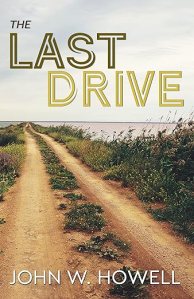
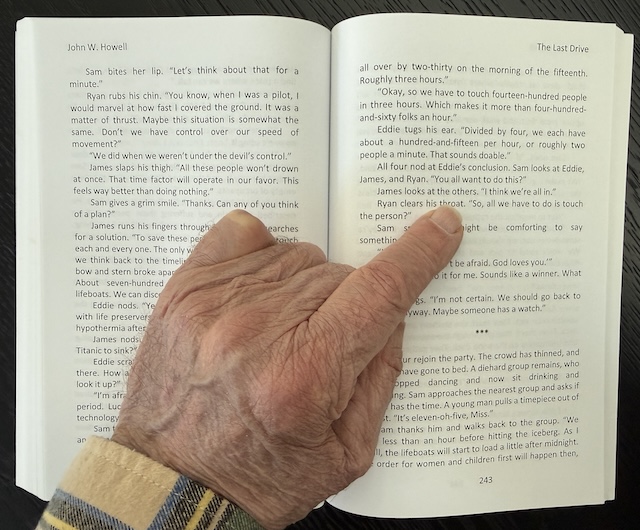
Today I opened The Last Drive randomly to Page 243. With eyes closed, I pointed to the page. The word closest to my finger is “throat.” That is our prompt today.
This post was first written and published on February 17th, 2014, by Marie Ann Bailey and me. Since death and taxes are always with us, I hope you will be entertained.
Top Ten Things Not To Do While Doing Your Taxes
10. While doing your taxes, do not allow the cat to sit on your keyboard. If you do, at best, you may miss a couple of deductions. At worst, your kitty may just add a few zeroes to your tax bill.
9. While doing your taxes, do not have a hot drink sitting on some of your worksheets. If you do, at best, you could tip it over and ruin the papers. At worst, you could tip it into your lap and jeopardize your love life till you heal.
8. While doing your taxes, do not allow your dog to play with the computer cord. If you do, at best, you may run out of battery. At worst, you may need to run out to the vet to help Fido overcome his electric shock treatment
7. While doing your taxes, do not allow the family to play video games on your computer between sessions. If you do, at best, some memory may disappear. At worst, the IRS may get a Madden football game instead of your 1040.
6. While doing your taxes, do not leave your computer without saving your file. If you do, at best, you might have to remember all your half-truths all over again. At worst, you may be unable to reconstruct your perfect return and might end up owing more than you had planned.
5. While doing your taxes, do not think the IRS is okay with rough guesses or estimates of the numbers. If you do, at best, you will never hear from the IRS. At worst, you will have to explain your numbers during an audit to a disbelieving agent with a cattle prod.
4. While doing your taxes, do not forget to sign your return even if you don’t believe it to be true. If you do at best, the return will bounce back. At worst, the lack of a signature will trigger a visit from the NSA, which will want to know all about you.
3. While doing your taxes, do not try to get away without attaching a check if you owe money. If you do, at best, the government will send you a nasty note. At worst, you will find out how little sense of humor the IRS really has.
2. While doing your taxes, do not drink alcohol even if you think it will help. If you do, at best, you might be shocked by the amount you deducted. At worst, you may be shocked to find you have already mailed the return on which you took too many deductions.
1. While doing your taxes, do not be discouraged enough to decide not to file. If you do at best, you will never sleep again. At worst, you may get your living expenses paid, but you will have a roommate who wants to go steady.
As you all know, Sally is the most supportive person on the planet for Indy Authors. She is an author herself so she knows how getting the word out is important. I am very grateful to her for choosing Detour on the Eternal road to feature. A visit to her site will give you an idea of all the services she offers to Indy authors. While there give her books a look see. You won’t be disappointed.
A precursor to a good day must be a cup of the steaming stuff. It not only sets the positive vibe, but also quells the steelworker hammering in my head. A touch of the two coffee selection on the machine set the curative process in motion. The aroma of the beginning streams into the cup is enough to awaken the will to live. One sip turns off the klaxon horn and sends the steelworkers home for the day. A second sip is accompanied by the much-too-loud Westminster chimes of the doorbell. That sound is joined by the crystal-cracking cacophony of Twiggy and Tempest as they try to warn me that a Tyrannosaurus Rex is trying to breach the security system. Two toys tossed into the soundproof room ensure that the slamming of the door will silence my faithful furry companions, who can’t resist chasing them.
Once done, a glance at the security monitor reveals the likeness of a creature that looks very much like Sylvester the Cat. A conversation ensues, predictably leading to the need to open the door. With a sigh, the security shut-down process begins.
The SWAT team needs to be put on standby. A quick text to the leader confirms that status. Also, the flight of A-10 Warthogs must be diverted. Another call to the commander puts that worry to rest. The SEAL team needs to be called off, and a call to the leader makes that possible. The MH-60 Jayhawk Helicopter hovering over the house is diverted. A call to the tow truck driver stops the deployment of an M1A1 Abrams Tank. The control panel simplifies the shutdown process of the security system. The boiling oil vats are put on standby, the turret mortars disengaged, the Trebuchet on safety, the concertina wire rolled, the Claymore mines reset, the tower Gatling guns on safety, the moat net dropped, the alligators fed, and the IEDs and shoulder-held rockets put away. The Proton torpedoes switched off. The gamma ray beams covered. The high-powered maser guns switched to standby, and the nanorobots were chained in the basement. The Klingons are called back, and the Targ is caged. Robbie’s Bot is sent to the basement. The Tasmanian Devil is directed to the food in his cage, and the door drops. The locks on the door are thrown. And the door opened.
“Sufferin succotash. You sure have a lot of security here. Here is an envelope, sign on the dotted line.” Taking the clipboard and envelope, I sign and return the clipboard to the cat. He holds out a paw in the classic way for a tip. “Oscar Wilde once said, ‘To love oneself is the beginning of a lifelong romance.'” The door is quietly closed with me behind it. The envelope is from Linda Hill, and the message inside says,
Your Friday prompt for Stream of Consciousness Saturday is “starts with ‘pre’.” Find a word that starts with “pre” and use it any way you’d like. Enjoy!