This list was published by Marie Ann Bailey and me in August 2013. It might be handy if you plan to visit an undeveloped country.
Top Ten Things Not To Do When Traveling Through the Countryside of An Underdeveloped Country
10. When traveling through the countryside of an underdeveloped country, do not forget to bring flip-flops or some such protection for your feet if you choose to stay at quaint inns. Often, you will find yourself in a long line of other travelers and locals waiting to use the single shower in the multi-story building. Besides standing in other people’s wet dirt, you may also encounter microscopic critters that tend to linger along the tiled floors and are happy to ride your feet back to your country of origin.
9. When traveling through the countryside of an underdeveloped country, do not forget to practice squats several times a day to build up your quadriceps to prepare you for the inevitable pit toilet located in the backyard of the local inn. Do not assume that you will always have the advantage of something to hang onto while you try to find that happy balance of getting your bum directly over the pit without getting it directly into the pit.
8. When traveling through the countryside of an underdeveloped country, do not forget to carry at least two rolls of toilet paper with you. One roll for the inevitable pit toilets that never have toilet paper anyway, and the other roll for when you do manage to find a private bathroom where you can spend the next several hours wishing you hadn’t drunk that tap water, even though you were outrageously thirsty at the time and nothing else was available.
7. When traveling through the countryside of an underdeveloped country, do not drink tap water (see #4). You may drink anything in a bottle, which means you may be drinking a lot of beer, leading us to the following item on the list.
6. When traveling through the countryside of an underdeveloped country, do not allow yourself to be over-served even if you are feeling only mildly inebriated at the time and dining on a full-course meal. Chances are, some amoebas are lingering on your plate (which was probably washed with tap water) or within the food, and you may eventually find yourself in the predicament of trying to balance your bum over a pit toilet while simultaneously trying not to throw up on your flip-flops.
5. When traveling through the countryside of an underdeveloped country, do not expect that everyone will speak English, and you will not have a need to know the local language. For example, learn to ask “Where is the bathroom?” If you’ve read this far into the list, you know why you need to know this.
4. When traveling through the countryside of an underdeveloped country, do not take a room in a hotel or inn directly across from a church. After a few days of church bell ringing to announce the time (6 AM, noon, 6 PM), funerals and weddings (often on the same day), you may wind up with a loss of hearing to rival Quasimodo.
3. When traveling through the countryside of an underdeveloped country, do not forget to also practice squats several times a day to prepare yourself for the strenuous hikes you may encounter, especially on rainy days when the landscape becomes wet and muddy. You do not want a team of local boys to have to push on your bum to get you up the steep hill that was supposedly a shortcut to the inn where you’re staying.
2. When traveling through the countryside of an underdeveloped country, avoid spending the evening with a U.S. expat who grows and smokes his own marijuana. While it may seem safe at first, you run the risk of your host being a paranoid madman who may at any moment start ranting about the U.S. government and the CIA and the FBI and their collusion with the Peace Corps. You will suddenly be wishing you could slip away during those few all-too-brief moments when your host is not staring at you with wide, bloodshot eyes while sharpening his machete.
1. When traveling through the countryside of an underdeveloped country, beware of clear liquids served by young children at a roadside stand, especially at night. Chances are they are not selling lemonade, but instead are selling “firewater.” The upside is that the firewater may kill all the amoebas that have taken up residence in your stomach. The downside is you may become too quickly inebriated to appreciate it.
Tajin-Spiced Fruit Salad – Tree fruit, melons, lime, cotija cheese
Let’s get rolling.
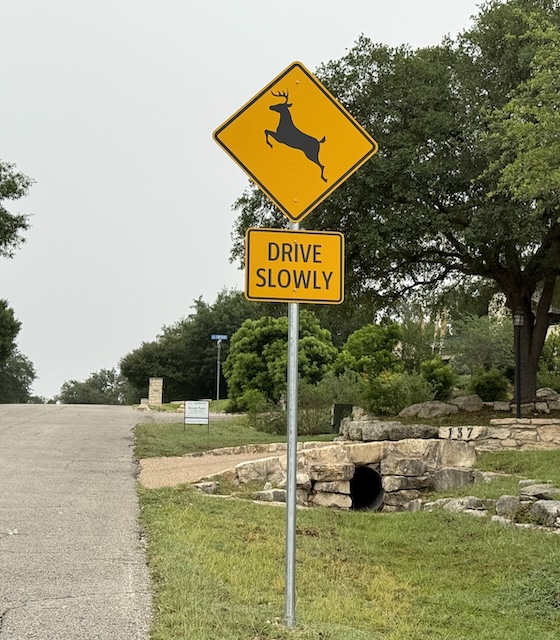
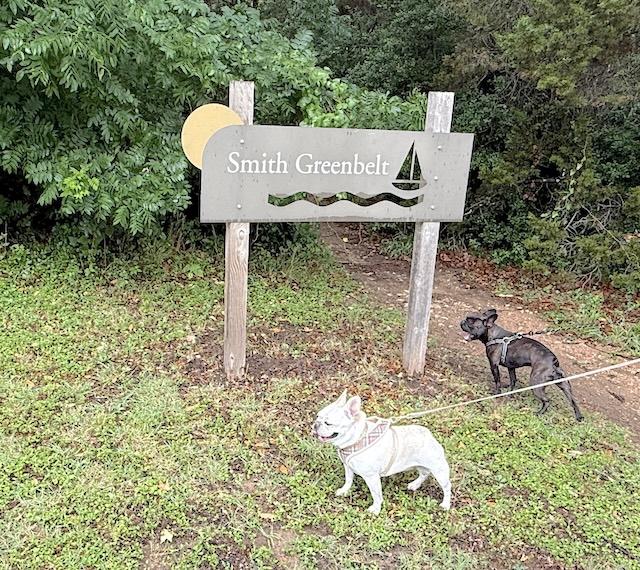
The sign reminds us that it is fawn season.
Here on our front porch is a less-than-day-old fawn.
The mother and the day-old on the driveway.
The baby has yet to have a drink of milk.
Three weeks later, baby and mom are doing breakfast. The two in front are yearlings.
A mother and fawn in the greenbelt.
Another mother and fawn in a neighborhood.
Mothers place their babies during the day and tell them to stay put. She is one in a yard.
The fawn on the porch is now three weeks old.
A buck with his velvet-covered antlers.
Another buck helping himself to some plants.
Here is a yearling we have named Sprinkles since he had the misfortune of stepping onto an irrigation cover which became stuck to his hoof when he was just a fawn.
Here is Sprinkles after The Producer enlisted the Game Warden to remove the irrigation cover. You can see that his hoof is a little misshapen, but he is doing well. He visits every evening for his carrots.
Signs throughout Lakeway warn motorists to be cautious regarding our precious deer.
A last shot of Tempeste keeping a watch on the deer. The doe is the fawn’s mother, reminding us it is carrot time.
Time now to enjoy the food and music. I hope you have a great week.
It is a long walk from the bedroom to the kitchen. Well, let’s say it seems like a long walk when the caffeine-deprived brain is screaming behind the eyeballs for immediate relief. To quiet the banshee inside my head, I choose two cups of that second export from Colombia. A finger touch is all it takes, and the steaming frothy cup is delivered post haste.
The first sip quelled the roaring neurons, and the room color went from pink to white. The realization that my burning eyes were giving the room the pink hue dawned on me just as the doorbell tripped the Westminster chimes. The quiet air was shattered with what sounded like a 747 in dire trouble, only to realize that a knuckle bone would be needed to restore the peace. Said bone was tossed into the soundproof room, followed by the Baskerville hounds and a door slam. Once the chimes finished their routine, the quiet almost made the ears hurt.
Checking the camera, a lone Rooster image holding a sign that reads Message from Linda Hill greets the eye. “Just leave it,” is the instruction through the intercom. “Can’t,” came the reply. “It’s verbal.” “Then say it,” is the response. “Can’t. Need to verify your identity.” A big sigh while moving to disengage the security system. The SWAT team needs to be put on standby. A quick text to the leader confirms that status. Also, the flight of A-10 Warthogs must be diverted. Another call to the commander puts that worry to rest. The control panel makes the shutdown of the security system process simpler. The boiling oil vats are put on standby, the Trebuchet on safety, the concertina wire rolled, the Claymore mines reset, the tower Gattling guns disengaged, the moat net dropped, the alligators fed, the IEDs and shoulder-held rockets put away. The locks on the door are thrown.
The tall thing before me looks very much like Fog Horn Leghorn. He goes on about needing an ID before stating the message. Showing him my driver’s license finally gets him talking. “I say. I say there, John, your Friday prompt for Stream of Consciousness Saturday is “walk.” Use it any way you’d like. Have fun, I say.” A quick thank you and a ten-dollar tip send the rooster on his way.
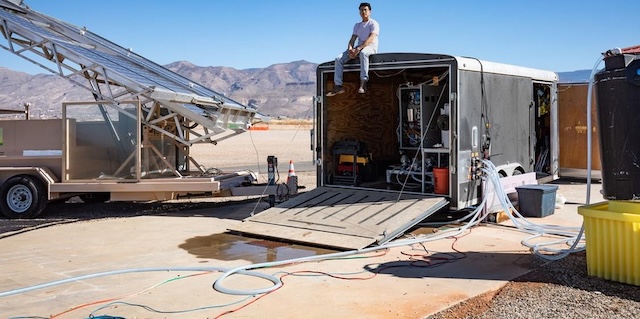
An engineering team from MIT has designed a solar-powered groundwater desalination device that could supply over 1,000 gallons per day and doesn’t require batteries.
Envisioned as a way to provide water to communities whose groundwater is too brackish to drink, the device’s real trick is adjusting its desalination activity in response to the amount of solar power it produces.
Multiple times every second, the central control module takes readings of the strength of the sunlight and pumps correspondingly more or less water through the electrodialysis membrane stack. This innovation allows the whole package to skip the necessity for battery storage for times when the panels are producing more energy than the system is using.
No batteries means much lower costs and shipping weight, making it ideal for rural communities in arid parts of the Global South or southern United States with ample yearly sunshine and brackish groundwater.
Electrodialysis is one of two methods for desalinating water, with the other being reverse osmosis. Both have drawbacks at both the micro and macro scale, and in the case of electrodialysis, it requires electricity, which is typically produced by fossil fuels. Renewables have replaced them before, but challenges persist.
“The majority of the population actually lives far enough from the coast that seawater desalination could never reach them. They consequently rely heavily on groundwater, especially in remote, low-income regions,” says Jonathan Bessette, MIT PhD student in mechanical engineering and co-author on the project.
“[U]nfortunately, this groundwater is becoming more and more saline due to climate change. This technology could bring sustainable, affordable clean water to under-reached places around the world.”
For Bessette and the team behind the invention, their biggest challenge was establishing feedback mechanisms in the system that were sharp enough to detect minute changes in sunlight, for example, if a whisp of cloud passes by.
Over months of testing and improvements, their “flow command-current control” module gradually reached the point at which 94% of the solar power generated by the panels was utilized immediately to pump water through the desalination system without any lag and any transfer of power to a battery.
During a 6-month field trial at the Brackish Groundwater National Desalination Research Facility in Alamogordo, New Mexico, the system produced 5,000 liters of water per day despite large swings in weather and available sunlight.
“Conventional desalination technologies require steady power and need battery storage to smooth out a variable power source like solar,” explains Amos Winter, a decorated professor of mechanical engineering at MIT. “Being able to make drinking water with renewables, without requiring battery storage, is a massive grand challenge. And we’ve done it.”
Amos and Bessette are now looking to form a company to develop the technology into a product to help water-stressed communities worldwide.
The good news about this story is that fresh water can be made without using fossil fuels. Today’s JohnKu talks about chipping away at innovation. I hope you have a wonderful weekend.
Today, I randomly opened Circumstances of Childhood to page 159, pointed to the page with my eyes closed, and my finger fell on the word “laundering.” This will be the prompt today.
As in years, past I firmly believe that we should not forget the sacrifices of those who have died in service to this country. All the ten points are the same.
Do not forget those who gave their lives so you may live in freedom.
Our flag in honor of those who sacrificed their lives for our freedom.
Today, we are visiting the Lakeway City Hall to view the high school students’ art exhibition. We are catered by the Cypress Grill in Austin. Our entertainment is Alice Cooper.
Menu
Creole Eggs Benedict – English muffin, poached eggs, Cajun tasso ham, Creole hollandaise, served with one side (also available with classic hollandaise sauce)
Eggs Napoleon– English muffin, poached eggs topped with crawfish etouffee and cheddar-jack cheese, served with choice of one side
Loaded Biscuit – Buttermilk biscuit open-faced, topped with Cajun tasso ham, andouille sausage gravy, and two eggs your way
Shrimp & Grits – Gulf shrimp, andouille sausage, and red peppers in a traditional low country gravy, atop our creamy garlic cheese grits with crumbled bacon
Spanky Special – Sandwich with fried egg, American cheese, bacon, lettuce, tomato, red onion, and mayo on toasted whole wheat
Jambalaya -Country-style – Jambalaya with chicken and andouille sausage. Add two eggs any way you like them to make the Jambalaya Breakfast Bowl, add $2.50
Trout Meuniere – Fresh rainbow trout, dusted in seasoned flour, pan-sauteed, topped with lemon-parsley-butter sauce, served over white rice with choice of one side and garlic bread
Let’s go
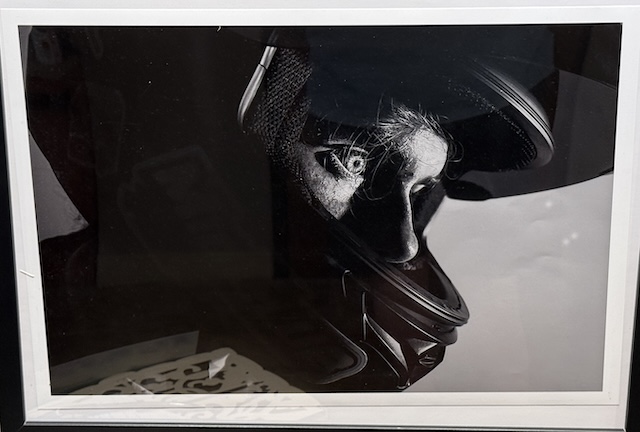
Here we are at the full exhibition. We need to look closer at each. A word about the photos. The lighting in the city hall is conducive to art photos, especially if the pieces are under glass. Also, the art is hung at different heights, so it is challenging to get a straight-on shot. (Crawling on the floor is not in my toolkit.) So I have cropped the pieces as best I can to eliminate glare while trying not to eliminate large portions of the art. I mentioned to The Producer that this may be my last art feature from City Hall.
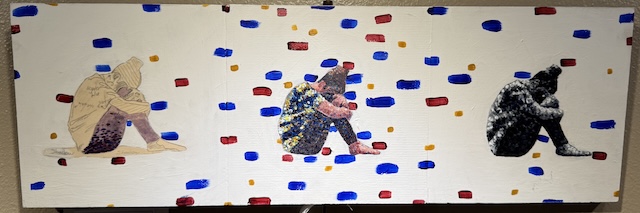
Split Identity by Sunetra Rho
The Peacock by Vaishnavi Senthil
The Magpie by Joy Zhou
Self Reflections by Carolyn Hall
Parade of Onion by Harper Garrison
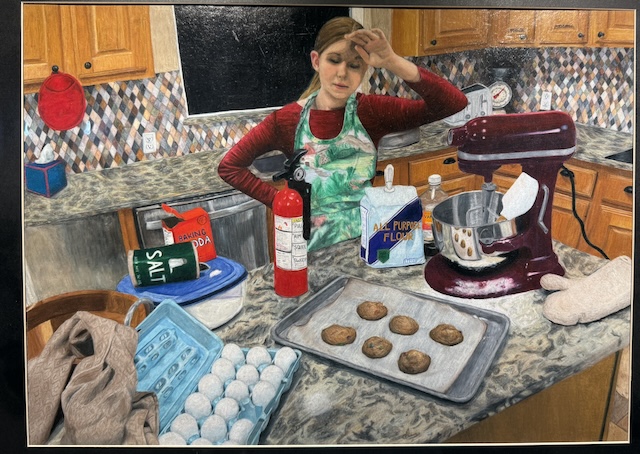
A Sweet Mess by Carolyn Hall
Late Night Ride by Vincent Sullivan
Unholy War, Holy Light by Daryna Singh
The Apple of His Eye – Charlotte Ahrendt
Fractured Intentions by Harper Garrison
Mother’s Love by Caitlyn VanderMeer
Ofa by Sunetra Rao
Illuminated by Pretty Green Lights – Sunetra Rao
Perfectionist by Caitlyn VanderMeer – No description of materials
Becoming Still by Harper Garrison
Nyxaros by Ayushi Sampath
Our Heroic Journey by Ayushi Sampath
I hope you enjoyed the art and are impressed with these high school students’ work. It is time now ro relax and have some food and listen to the music.