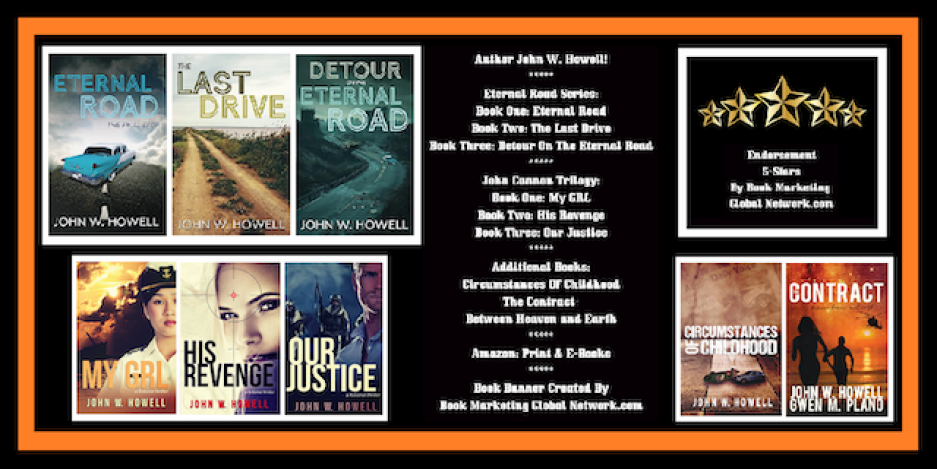
Here is the 24th installment of Ten Top Lists of What Not to Do by Marie Ann Bailey of 1WriteWay at http://1writeway.com and John W. Howell of Fiction Favorites at http://johnwhowell.com. These lists are simu-published on our blogs each Monday. We hope you enjoy.
Top Ten Things Not To Do When Traveling With a Cat
10. When traveling with a cat by car, do not assume that your cat will not get car sick. Take it for a short spin first. Usually five minutes is long enough to determine if you will need to pull over to the side of the road and empty the pet carrier of the results of a double end evacuation response while keeping kitty contained in the car.
9. When traveling with a cat by car, do not assume that because your cat sleeps all day, it will also sleep through a two-day trip up the coast. At best, your cat will keep a running commentary in cat-speak attempting to convince you to provide a release from the confining pet carrier. At worst, your cat will scream like a banshee and you’ll end up with hearing loss as a lasting souvenir of the trip.
8. When traveling with a cat by car, and your cat is behaving in the worst-case scenario of #9, do not let your cat out of the pet carrier thinking it just needs a little room to stretch out. At best, your cat will simply continue to howl, but now with the added advantage of being to do so directly into your ear. At worst, your cat will nose-dive to the floor on the driver’s side, and you will narrowly miss a few or more accidents as you keep stepping on your cat while feeling for the brake.
7. When traveling with a cat by train, do not try to sneak your cat on board what you know is a non-pet-friendly train. Just because you’ve trained your cat to lay across your shoulders like an overfed mink stole, doesn’t mean that the conductor will be fooled. One growl from Fluffy might be enough to find yourself and your cat dropped off at the next station, if you’re lucky. If you’re not lucky, you’ll be charged with animal abuse and Fluffy will have the satisfaction of seeing you take the perp walk off the train.
6. When traveling with a cat by train, do not think that your fellow travelers will find your cat’s antics as amusing as you do. Hiding under your seat and swiping at every foot that passes by within an inch of Smoky’s nose is at best annoying to passengers trying to walk the aisle unmolested. At worst, you will have forgotten to clip Smoky’s claws and so those needle-sharp claws will snag on every sock or exposed skin that passes by.
5. When traveling with a cat by train, do not think it is okay to allow your cat to use the seat upholstery as a scratching post. At best, you’ll simply be admonished by the conductor to put Tigger back in his pet carrier (providing that you are not guilty of #7). At worst, you will be made to take a pair of scissors and needle and thread and attempt to repair the damage done by Tigger (and he will watch you the whole time with great satisfaction).
4. When traveling with a cat by plane, do not think that once the seatbelt sign has been turned off that you can let Kitty out of the pet carrier stowed under the seat in front of you. While you may think Kitty won’t bolt the second she senses freedom, in fact, she will. In the best case, she’ll get no farther than the passenger next to you who just happened to bring a chicken sandwich on board. In the worst case, she will go careening down the aisle and into First Class, lost to you forever.
3. When traveling with a cat by plane, do not assume that Felix, who had never worn a leash and harness before, will remain calm while going through the security checkpoint. At best, Felix will simply attach himself to your leg like Velcro and the TSA will defer giving you a full body scan. At worst, Felix will make the Tasmanian devil seem meek by comparison and you will be held financially responsible for the “pain and suffering” of the TSA agents if not tasered first.
2. When traveling with a cat on a cruise ship, well, first ask yourself why you would do that. Then, if Merlin manages to escape from your cabin, the best you can hope for is someone finding Merlin huddled in the kitchen, sampling the chicken being prepared for that evening’s meal. In the worst-case scenario, the ship’s crew will have found a new mascot.
1. When traveling with a cat on a cruise ship, don’t let the staff talk you into working Snowy as a mouser in return for a discount on your ticket. For one thing, there probably aren’t any little mice on the ship and what she comes across may just catch her instead. For another, Snowy prefers Fancy Feast’s Beef and Cheddar Cheese Feast and will undoubtedly go on a hunger strike if she is served anything different.
Here is the Seventeenth installment of Ten Top Lists of What Not to Do by Marie Ann Bailey of 1WriteWay at http://1writeway.com and John W. Howell of Fiction Favorites at http://johnwhowell.com. These lists are simu-published on our blogs each Monday. We hope you enjoy. This list is in recognition of Halloween which will be celebrated this week.
Top Ten Things Not to Do on Halloween
10. If you decide to dress up for Halloween, do not take this opportunity to show the world parts of your body that should be kept completely private. At best the parts that are visible will only lead the viewer to believe you are older, more out of shape, or hairier than you really are. At worst you end up trying to explain to a judge why you don’t need psychological care.
9. If you decide to take your kids trick or treating, try to refrain from going through the treat bag for the sole purpose of pulling out all the full size Twix and Snickers bars. Oh sure, you can pretend to inspect the candy for safety, just don’t get caught with that Hershey bar in your back pocket.
8. While trick or treating with the kids, try to refrain from making comments about the treats being handed out. When you least expect it, the spouse of the person handing out the treats will be behind you trick or treating at their own house. At best you may not know they are there. At worst you’ll find yourself groveling in front of your own children.
7. While handing out treats at your own house, refrain from asking the bigger kids about how old they are. It could be one of them is a parent accompanying a child or, worse, a disturbed teen just looking for an excuse to let the air out of your tires.
6. If you are invited to a Halloween party and the invitation clearly says “please come in costume,” refrain from ignoring that part of the invitation. Showing up and explaining that you are dressed for work won’t go over well with the hosts. Of course, the only exception to this would be if you are unemployed.
5. When dressing up for Halloween, refrain from wearing a costume that could interfere with the triage process at an emergency room. You never know what may happen but you certainly want the emergency room personnel to believe you are human and not a piece of food.
4. If you should run out of treats on Halloween, do not try to pass off leftovers, boxes of cereal, or fruit of any kind as your offering for trick or treat. If you try, at best you will look like a cheapskate. At worst you may need a power washer to get all the soap off your windows,
3. If you decide to set up an elaborate scheme to haunt little kiddies as they come to your house to trick or treat, try to understand that a child’s digestive system will take only so much surprise. After this amount is exceeded, the natural tendency is for the body to lighten its load to prepare for the flight response. Just dropping bags of candy will probably not be the sole items of evacuation.
2. When you decide to carve your pumpkin for Halloween, refrain from carving words that you would not be proud to carry into next Sunday’s church service. Although it is pretty fun to invent new things to say on a pumpkin carving, little minds may have way too many questions for their parents about what you have written and the parents may come to you for answers.
1. When helping the children trick or treat, refrain from drinking every drink that is offered to you by friendly neighbors. Time does get away from us while having fun and more than an ounce of alcohol per hour tends to impair certain judgment factors such as: when to go home and where to sleep. At best you may spend time stumbling around. At worst you may forget where you live and have to ask your kids for directions
This week is to see what everyone can do with the word “Yesterday …”
Interpret it as you will, but the word yesterday must appear somewhere in your work, be it the title or in the middle of a sentence. Write poetry, prose, fiction, or memoir it is yours to create.
I don’t know if you have seen the commercial where the camel wanders around an office asking various workers, “What day is it?” Finally one of the staff mumbles, “its Hump Day.” The camel is very happy to be a visible part of what has become the second most important work day of the week. For those of you who defected to Red China during the Korean War and have just come back, let me make sure you know the meaning of Hump Day. Hump Day is the arrival of the day where one has survived two days of work which could be considered the uphill phase of the week. The downhill phase, being the last two days of the week; doesn’t start until Hump Day is over. For the folks who work a traditional Monday through Friday routine, Hump Day is Wednesday. For all others it is the day that separates the beginning of the work week from that downhill slide to the days off time. If you work seven days a week or are a writer this is all theory and really doesn’t exist for you.
What makes Hump Day so special? Well it’s like you are on a journey, you finally get to the point of no return and the next major milestone is the destination. The fact that your destination is closer than your point of departure makes it almost appear as if you will actually get there. How many times have we heard a child ask, “are we there yet?” when the trip is only minutes old. It is the same with the work week. Monday begins the journey to Friday. The destination is Saturday and on Monday it seems like getting there is about as possible as walking to Europe from the United States or vice versa. So when the workers of the world reach Wednesday and they are still viable; the prospect of reaching Friday has an exponential increase in odds. The odds increase so much that the day itself becomes a cause for celebration. It is sort of like celebrating being on a like raft when a ship sinks. You are not completely safe but a hell of a lot safer than when the whole mess started.
Since this is Wednesday I wrote a little Haiku that I hope captures the essence of the feeling for getting this far in the week.
There is a Winter Texan writing group in which I have the pleasure of participation. This group meets during the months of December through March ( all go back up north) and each week we would do a writing prompt. Most of the prompts are flash fiction and carry a theme. The one below was to be less than three hundred words and include only dialog. I thought maybe you would enjoy this fiction favorite prompt. It is titled John Howard.
“Can I help you young man?”
“Yes I am here to see the president.”
“Is he expecting you?”
“He should be. I sent him a letter and said I was going to stop by.”
“A letter?”
“Yes.”
“When did you send a letter?”
“I guess it was about a month ago. The letter asked that my correct name be used since there has been a computer error and the University keeps calling me Howard instead of Howell.”
“Did Dr. Hannah respond to the letter?”
“Yes he did. I got a nice letter back. Here is a copy read it for yourself.”
“Humm. Dr. Hannah specifically thanked you for your correspondence and indicated that he would look into your problem. You say that your name is Howell and not Howard?”
“Yes it has been Howell for the last nineteen years.”
“Yet the letter from Dr. Hannah is addressed to John Howard.”
“This is why I need to see him.”
“Wait here Mr. Howard. Let me see if I can find someone to help.”
“It’s Howell.”
“Excuse me?”
“My name is Howell not Howard.”
“Oh yes that is what I said. Howard.”
“Howell.”
“I said Howard not Howell.”
“I know.”
“Very well Mr. Howard, I will be right back.”
“Howell.”
“I am only trying to help.”
“I’m sure.”
“I think you should call for an appointment. Good day Mr. Howard.”
Café les Deux Magot – Boulvard Saint-Germain – Paris (Photo credit: Wikipedia)
I was reminded by the WordPress elves that I have received 500”likes” from you lovely people as of last Friday. I just want to thank you all for taking the time to signal an approving gesture and will take these approvals as a vote to continue along the same path. If you have an opinion that is contrary please express it. *silence* Okay well I guess I will continue along the same path.
***
I was wondering the other day if there was such a thing as a top ten list of literary cities. The reason for this wonder? I wanted to publish an informal travel suggestion (since summer is almost here) for those who want to take in the sights and sounds of places that have some fiction favorites literary interest as well as the obvious destination appeal. Well…I went to my trusty Google search machine and came up with the Top Ten Literary cities according to National Geographic Traveler writers. I am telling you there is nothing we can’t find in this wide digital universe. So without further ado; *drumroll* *cymbal* *rim shot* here they are directly from the September 2011 issue of National Geographic Traveler magazine and I quote:
Edinburgh, Scotland
It’s practically mandatory that visitors to Edinburgh travel by the book. The atmospheric city—which has inspired more than 500 novels—passionately keeps its written tradition alive, from the verse of 18th-century bard Robert Burns (who even merits an iPhone app) to the works of modern-day writers like Ian Rankin and Alexander McCall Smith. On tap are two different pub crawls, a walking tour, and excursions specific to Rankin’s Inspector Rebus and Irvine Welsh’s Trainspotting.
If you’re short on time, head straight to the Writers’ Museum located in a 17th-century building reached by a narrow stone passageway. Exhibits are devoted to a powerhouse literary trio: Burns, Sir Walter Scott, and Robert Louis Stevenson. For more adventures in Edinburgh and beyond, VisitScotland.com offers “A Traveller’s Guide to Literary Scotland.”
Dublin, Ireland
In the Irish capital, the written word is as celebrated as a pint of Guinness. Join the revelry on the Dublin Literary Pub Crawl as spirited actor-guides serve up entertaining facts in taverns where James Joyce and other scribes sought sustenance and found inspiration. Follow famed Joycean character Leopold Bloom through the city with VisitDublin.com’s “In the Steps of Ulysses” self-guided tour (audio or print).
The Dublin Writers Museum celebrates the spectrum of the country’s literary heritage, beginning with its roots in Irish poetry and Celtic storytelling. The Abbey Theatre, founded by poet W.B. Yeats in 1903, is still going strong with productions by classic and contemporary playwrights. Don’t leave town without being dazzled by the Book of Kells, an illuminated manuscript from the Middle Ages housed in the Old Library at Trinity College.
London, England
Listing London’s literary-related sites and pastimes could fill a book even lengthier than Harry Potter’s seven wizardly adventures combined. For starters, get out and about on one of London Walks’ lively jaunts. More than a hundred are offered every week, among them Shakespeare’s and Dickens’ London and the Literary London Pub Walk. Be sure to get an up-close look at the Bard’s First Folio at the British Library, unusual in that its literary gems are on display and not tucked away in a vault.
For Sherlock Holmes fans, VisitLondon.com has an itinerary for following in the sleuth’s footsteps. If your style is more suave James Bond, stop by Dukes Bar, where the martinis inspired Ian Fleming to make it 007’s signature drink. Before strolling the city’s streets, download the Get London Reading app, or check out the interactive map version, featuring more than 400 books associated with specific locales around town.
Paris, France
Pucker up and leave a lipstick print on Oscar Wilde’s tomb in Père-Lachaise Cemetery. The Irish playwright, whose grave is a magnet for zealous mourners, was one of many expatriate writers who sought inspiration and joie de vivre in the City of Light. Would-be Hemingways can polish up their own masterpieces at a sidewalk table at Les Deux Magots, a St. Germain café he frequented, or explore the literary side of the Latin Quarter, his onetime home, with Paris Walks.
French writers, though, have pride of place here with house-museums devoted to Victor Hugo and Honoré de Balzac. Bibliophiles will feel right at home at the hotel Le Pavillon des Lettres, where each of the 26 rooms is dedicated to a letter of the alphabet and represents a famous writer.
St. Petersburg, Russia
This vibrant baroque- and neoclassical-style city in western Russia has a dark side to its literary history. Trace the route of Crime and Punishment’s murderous Raskolnikov from his abode to the unlucky pawnbroker’s storefront with Peter’s Walking Tours (by private booking; there’s a forum for finding fellow travelers to split the cost). Visit the residence of the epic’s author, Fyodor Dostoyevsky, where he spent his final years and penned The Brothers Karamazov.
The Aleksandr Pushkin Memorial Apartment Museum marks the spot where the 37-year-old author died in the study and plunged the country into mourning. Like an unfortunate character in his most famous work, Eugene Onegin, Pushkin was fatally wounded during a duel. At the nearby Literary Café, he dined for the last time before meeting his tragic end.
Stockholm, Sweden
Inventor Albert Nobel put Stockholm on the international literary map a century ago with the Nobel Prizes, which laud the achievements of writers along with those of scientists and peace activists. Head to City Hall, site of the annual December awards banquet and an iconic landmark in its own right. In the on-site restaurant Stadshuskällaren, savor the cuisine served at the most recent Nobel dinner.
For a not-so-highbrow thrill, take the Stockholm City Museum’s guided Millennium Tour to see places depicted in Stieg Larsson’s bestselling crime novel The Girl With the Dragon Tattoo and its two sequels. Before tattooed computer hacker Lisbeth Salander turned up, spirited children’s book character Pippi Longstocking was Sweden’s most famous fictional lass. A statue in Tegnérlunden park honors her creator, Astrid Lindgren.
Portland, Oregon
If it weren’t for a color-coded map, customers might get lost among the stacks at Powell’s City of Books. Spanning an entire city block, it’s the largest new-and-used bookstore in the world and stocks more than a million volumes.
Nearby Heathman Hotel’s “Books by Your Bedside” package includes a personal tour of the lodging place’s 4,000-volume library, made up entirely of signed books by author guests (other package perks are a hardcover tome, a travel reading light, overnight lending privileges, and a donation to a children’s literacy organization).
For more literary immersion, see what’s scheduled at the renowned Portland Arts and Lectures series (September through May). A Portland tradition, it’s one of the biggest lecture events in the country and draws heavyweight headliners like Annie Proulx and Sebastian Junger.
Washington, D.C.
Start uncovering the capital city’s bookish side at the Library of Congress, founded in 1800 and still the world’s largest library. A free guided tour of this grandiose edifice illuminates its literary and architectural significance and offers a look at the opulent Main Reading Room with its stained glass, marble, and murals.
A gratis audio walking tour by the Poetry Foundation visits sites associated with Walt Whitman, Langston Hughes, and other bards who found inspiration in the city. At indie bookstore Politics and Prose, sit in on a book group discussion or attend one of the regularly held author events. Kramerbooks and the adjoining Afterwords Café and Grill are open 24 hours on Fridays and Saturdays. Pick up some bedtime reading such as The Camel Club or another one of David Baldacci’s D.C.-set thrillers.
Melbourne, Australia
Founded as a frontier outpost in 1835, Melbourne flourished during a gold rush and has since blossomed into Australia’s cultural capital. Check out the State Library of Victoria, constructed in the mid-1800s and declared by its founding president to be free to everyone over age 14 “if only his hands are clean.” View exhibits in three different galleries, attend a talk at the Wheeler Centre in the south wing, and marvel at the domed, octagon-shaped La Trobe Reading Room adorned with quotes by famous writers.
Explore “Melbourne by the Book” on a walking excursion with Hidden Secrets and browse at the sizeable weekly book market on Saturdays in Fed Square. When you need a respite, Narrelle M. Harris, author of the Melbourne Literary app, recommends the Drunken Poet, where portraits of Oscar Wilde and other scribes line the walls.
Santiago, Chile
Revered “people’s poet” Pablo Neruda, best known for his romantic verse, secretly rendezvoused with his mistress and muse at his home, called La Chascona. The bright blue-and-yellow domicile is located in the hilltop Bellavista neighborhood, which can be explored with La Bicicleta Verde tours. Chile honors another Nobel Prize–winning bard, Gabriela Mistral, with an elaborate mural in Cerro Santa Lucia Park—and with her visage on the 5,000 peso note.
The exorbitant cost of new books in Chile has resulted in a robust market for secondhand publications. Peruse the offerings at the weekend market on Lastarria Street near the Museo Nacional de Bellas Artes, or visit the numerous merchants in the small shopping center near the intersection of Providencia Avenue and Miguel Claro Street. Java-seeking bibliophiles should head to one of several branches of the library Café Literario, including an outpost in Balmaceda Park that has 30,000 books.
So pack your bags and let us all know how it went. Oh by the way a round trip ticket will set you back over 10,000 bucks which is a lot of royalties.
I was sitting around with some writer friends having a cocktail (okay… cocktails) the other day and the subject of books happen to come up (you think?). The discussion began with a question around what does the group (as individuals) think are the best books we have read. Although more scholarly people have offered their opinion on book quality, it takes a group of five writers (who happen to be gathered together and have begun the fueling process that will guarantee brilliant opinions) to really begin to hone the particulars to consider the question.
I recall (not an easy task the morning after) that one writer felt; quality was in found in how well the plot came to resolution. He cited James Patterson’s books as examples. Another felt dialog separated the good from not so good and used Norman Mailer’s books as his proof. The better the dialog the better the book would sum his thinking. The third thought complexity of character and strength of voice marked the difference. He brought up James Joyce as the icon for his rationale. The fourth felt that the number of books sold was the benchmark. He used the rationale that if a book sold well then it was probably a good book. He picked the Grey series as his hallmark
After about three drinks it was finally my turn to proffer an opinion. I simply said (I needed to choose words that I could use without slurring) that the enjoyment factor went a long way in my mind to distinguish a good book from those that are not as good. I was thinking in particular about Stieg Larsson and the Millennium series. (Could qualify under the number of books sold criteria at 65 million) I remember hardly being able to wait to read each of the three books. Is the Millennium series a collection of fiction books that could be considered among the top books? I am not sure. To me they offered plot resolution, great dialog, complex characters and a strong voice, and as I have pointed out, sold a lot.
By the fifth drink (I know there were more, I just lost count) none of us could agree on a finite set of great books. We argued, discussed and finally must have gone home. (ahem… this is a fuzzy part).
The next morning I fished out of my shirt pocket a napkin from the bar and on it was written in blurred ink (I was trying to use a Sharpie that I borrowed from a guy at the next table who was a school teacher) I am uncertain if this was the final list but certainly is my top ten fiction favorites.
Rather than have the whole event pass without any utility, I am publishing my list right here. I would love to know your thoughts as well so if you would like to chime in please do so. (Please be careful though, my head is killing me)
Thomas Wolfe has won a chest full of awards and honorary doctorate degrees for his work. Most of the recognition came as a result of his non-fiction work, (The Right Stuff; for example) although he did manage to pick up recognition for his fiction work as well. Not all the recognition for his fiction was positive and his major critics (Especially of AMan in Full) were fellow authors like; John Updike, Norman Mailer and John Irving. Their beef can be boiled down to an opinion that Thomas Wolfe’s books were entertainment and not literature.
Wolfe has written (so far) four fiction novels: The Bonfire of the Vanities in 1987, A Man in Full in 1998, I am Charlotte Simmons in 2004, and Back to Blood in 2012. As you can see, the minimum time between books is six years with the longest at eleven. In today’s environment, where an author like James Patterson publishes fourteen books in a given year, the question comes up as to why so long between books?
I have not interviewed Thomas Wolfe so I can’t actually provide the real reason, but I’ll bet it has something to do with patience. If you have read his books it is very apparent that the words are collected and crafted very carefully to convey the scene or mood being described. This kind of attention to detail cannot be done by all authors, and most specifically, almost impossible in a rushed situation. Wolfe has always aspired to document modern society in the tradition of John Steinbeck, so I believe he forces himself to exercise extreme patience to ensure that each paragraph lives up to his personal benchmark. This kind of self discipline takes time. As we all know when writing, time is the resource that we believe works against our goals. We feel we waste time if we don’t make deadlines that are self imposed. Can you imagine sitting down to begin your next novel and know that it will be eleven years until it is published. If you are like me; you would rather put a stick in your eye then to contemplate that reality.
On the other hand, if you were told that your novel done properly would earn you the recognition and honor you feel you deserve, would you be more content to take your time? I’ll bet you would. So why are we all in a hurry? Do we think someone else is going to scoop our plot or capitalize on our character development?
I think we should all ask ourselves a simple question when we feel that time is getting away from us; WHAT IS THE RUSH? Don’t we know a well-developed chapter is so much better than just getting the chapter finished? Don’t we know by now, a query letter done right is so much better than just getting it done? Don’t we know taking time on a well thought out synopsis is better than rushing a submission? A lot of questions I know, but the answer has to be that we know full well the need to be patient.