Today I randomly opened The Last Drive to page 259 and, with eyes closed, pointed to the page. My finger fell closest to the word “everyone.” This is our prompt today.
This post ran on September 10, 2018, and is part of the historical top ten things not to do lists. I hope you enjoy it.
10 If you are in Rome and it’s burning, do not practice your Lyre. If you do, at best, you might be mistaken for a leader. At worst, the number one Lyre player might think you are mocking him. (I see a few centurions at your gate, Finnobar. Time to move out.)
9 If you are in Rome and it’s burning, do not try to ignore Tiny the WWF champ when he yells instructions. If you do, at best, Tiny will only grab you and toss you over the wall. At worst, Tiny, who just graduated from Gladiator school, will take the opportunity to hone his skills. (Looks like you have the net and Trident Flynn. It might not be a match for the mace and double-edged sword. I would suggest begging.)
8 If you are in Rome and it’s burning, do not wear your I’m a Happy Christian t-shirt today. If you do, at best, no one will notice it. At worst, since the fire is being blamed on Christians, you may meet a lion up close and personal. (I think you need to do more than the “nice kitty” statement, Flannagain.)
7 If you are in Rome and it’s burning, do not try to get a refund on your Circus Maximus tickets. If you do, at best, no one will be at the ticket office. At worst, you will be last in a line of 10,000. (Not to worry, Flin. There is always a fire-check for the next show.)
6 If you are in Rome and it’s burning, do not walk around town with that torch. If you do, at best, people will think you are connected. At worst, someone will get the idea you had something to do with the fire. (Now it looks like you really have to leave town, Fonzell. Wonder what’s happening in Naples?)
5 If you are in Rome and it’s burning, do not show people in the pub the plans for Domus Aurea, Nero’s palace, to be built on the ruins. If you do, at best, no one in the pub will understand what you have. At worst, one of the customers is a senator. (Looks like you are on the hook as the source of the fire, Forba. I think you ought to ask for a little traveling music and move on.)
4 If you are in Rome and it’s burning, do not try to put out the flames if thugs are warning you not to do it. If you do, at best, you might get a black eye. At worst, you might need to answer to Nero as to why you tried to stop the fire. (Not known for his largess, Nero may have you on the next train to Lionsville, Fortino.)
3 If you are in Rome and it’s burning, do not set up a smores stand. If you do, at best, you’ll have a few customers. At worst, folks will take your cavalier attitude to heart. (Looks like a gang of residents heading this way has blood in their eyes, Franko. Maybe it’s time to pack up.)
2 If you are in Rome and it’s burning, do not wait to evacuate. If you do, at best, you might have to run for your life. At worst, you might get cut off and have to take a leap into the Tiber River. (Sad thing about that sundial, Frang. Shoulda checked to see if it was waterproof before making the leap.)
1 If you are in Rome and it’s burning, do not think your hotel still offers room service. If you do, at best, you’ll be disappointed. At worst, you’ll wait too long for service and forget to check out when your room starts burning. (Don’t think the bill will be overlooked, Frans. They will find you no matter how far and no matter how long.)
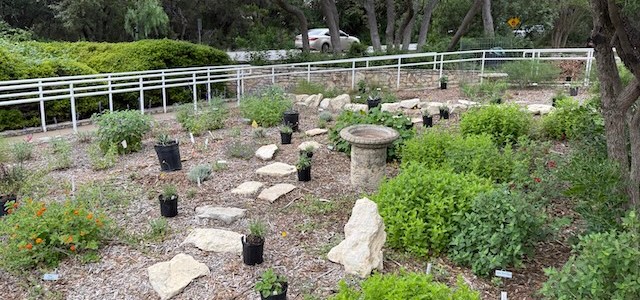
Today we are going to go to the Lakeway Municipal Utility District to see the garden planting and plant
swap. We are catered by Lutie’s of Austin, and our entertainment is Alan Jackson.
Menu
Beef Tartare, Romaine, Dandelion
Chickpea and Green Corn Salad
Roasted Lettuces, Avocado, Pumpkin Seed, Radish
Grilled and Marinated Beets, Black Garlic, Dill
Yonderway Pork, Pickled Cabbage, Creamer Peas
Delta Blues Rice, Market Fish, Smoked Trout Roe
Green Dish, Carrot.
Royal Red Shrimp, Daikon, Celery
Charcoal Grilled Chicken, Leeks, Hominy
Whole Roasted Black Sea Bass, Choi Sum, Mustard
Texas Beef, Radish, Marrow, Sweet Potato
Let’s get rolling
There is the Lakeway Municipal Utility District
Lake Travis Middle School National Junior Honor Society (NJHS) students are signing up for community service hours.
The garden plants are laid out ready for holes.
The swap plants are ready, too.
Lots of mulch.
Plenty of tools.
My kind of participation place.
The work begins.
Watch those cactus paddles.
Students and adults work side by side
That mulch pile is going down.
And here is Stephanie Threinen, CPC, Public Information Liaison for the Lakeway Municipal Utility District and the driving force behind various LMUD activities. She reports that over 80 native plants were planted by students and volunteers.
Time now for some food and entertainment. I hope you have a great week.
The neat part of having a coffee robot is the availability of that soothing syrup, available night or day, 24/7. Having to wait for an extended brewing process for more than one minute might mean the difference between calmed neurons or a catastrophic brain bleed. The first sip stops the auto production line cacaphony of the caffeine addition screaming for relief. The second sip brings the dreaded doorbell Westminster chime and Cerberus duet, which threatens to break glass or cause eardrums to bleed. Two fresh Benny bones are tossed into the soundproof room, followed by the door slam, bringing golden silence to the room.
A check of the security monitor shows Smoky the Bear standing on the porch. He has an envelope and, of course, a clipboard. Rather than argue about leaving the delivery with a sign, the security shutdown process begins.
The SWAT team needs to be put on standby. A quick text to the leader confirms that status. Also, the flight of A-10 Warthogs must be diverted. Another call to the commander puts that worry to rest. The SEAL team needs to be called off, and a call to the leader makes that possible. The MH-60 Jayhawk Helicopter hovering over the house is diverted. A call to the tow truck driver stops the deployment of an M1A1 Abrams Tank. The control panel simplifies the security system’s shutdown process. The boiling oil vats are put on standby, the turret mortars disengaged, the Trebuchet on safety, the concertina wire rolled, the Claymore mines reset, the tower Gatling guns on safety, the moat net dropped, the alligators fed, and the IEDs and shoulder-held rockets put away. The Proton torpedoes switched off. The gamma ray beams covered. The high-powered maser guns switched to standby, and the nanorobots were chained in the basement. The Klingons are called back, and the Targ is caged. Robbie’s Bot is sent to the basement. The Tasmanian Devil is directed to the food in his cage, and the door drops. The electronic jammer is kept active, given a situation with a robot not too long ago. The locks on the door are thrown. And the door opened.
The bear hands me the envelope and the clipboard. After signing and returning it, it’s obvious the bear is looking for a tip. “If what you have done yesterday still looks big to you, you haven’t done much today.” Mikhail Gorbachev said that, and that’s my tip as I slam the door.
The message in the envelope is from Linda Hill. Your Friday prompt for Stream of Consciousness Saturday is “neat.” Use it any way you’d like. Enjoy!
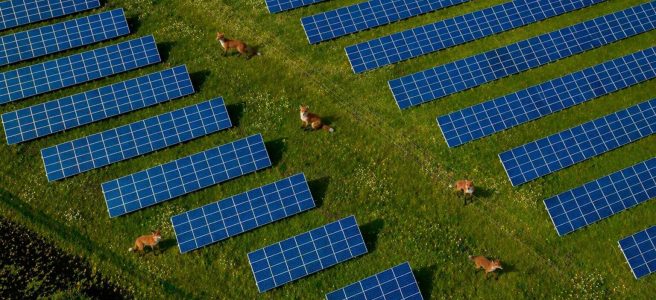
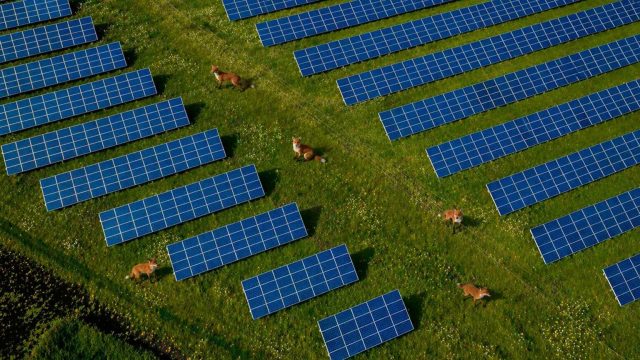
Solar farms were built to generate clean energy, not to host wildlife. Large, fenced-off areas filled with panels don’t exactly look like a natural habitat.
But when a small, endangered fox was allowed into one of these sites, something unexpected happened.
Instead of struggling to survive, it adapted—quickly. And what researchers saw next began to change how these spaces are understood.
How solar farms started behaving like ecosystems
At first glance, solar farms seem simple. Rows of panels. Open land. Minimal human presence. But that last detail turned out to matter more than expected. Because once construction ends, these areas become relatively undisturbed. No heavy traffic. No constant noise. Limited human activity.
Over time, that creates stability. Vegetation begins to grow beneath the panels, often encouraged by design. Native plants take hold, insects follow, and small prey species begin to appear. It doesn’t happen overnight.
But slowly, these sites begin to resemble something else. Not just infrastructure—but a habitat. And for some species, that shift is enough to create an opportunity.
A species on the edge finds an unlikely refuge.
The San Joaquin kit fox has been struggling for decades. Native to California’s Central Valley, this small canid has lost more than 95% of its natural habitat due to agriculture and development. Survival has become increasingly difficult. It relies on space, cover, and access to prey. And it moves constantly, often using dozens of dens to avoid predators.
So when conservationists began exploring whether solar farms could support wildlife, the idea seemed uncertain. Could a human-made environment really replace what had been lost? The only way to know was to try. And when the foxes entered these sites, their behavior was closely monitored.
What researchers found wasn’t hesitation. It was an adaptation.
What actually happened inside the solar farms
The foxes didn’t just pass through these areas. They started using them. Solar farms provided something rare: protection and resources in the same place. The perimeter fencing, originally designed to secure the site, acted as a barrier against larger predators. Inside, the environment was rich with small animals—rodents and insects that thrive under the panels. That meant food was readily available.
The panels themselves created shade, helping regulate ground temperature and making conditions more stable during extreme heat. And perhaps most importantly, human disturbance was minimal. The foxes began establishing dens within the solar farms, using the land as part of their regular territory.
In some cases, according to the Bren School of Environmental Science & Management, they returned repeatedly, treating these sites as reliable habitat. What was meant to be an energy facility had become something more.
Why this changes how we think about how energy and wildlife interact
For years, one of the biggest concerns about renewable energy projects has been land use. Building large-scale solar farms requires space—and that space often overlaps with natural habitats. But this example suggests a different possibility. With the right design and management, these sites don’t have to displace wildlife. They can support it. That doesn’t mean every solar farm will have the same effect. Conditions matter. Location matters. Planning matters. But the success of the San Joaquin kit fox shows that coexistence is possible. And in some cases, it may offer a second chance for species that are running out of options.
The idea is still evolving.
But one thing is becoming clear. What looks like a field of solar panels from the outside might be something very different on the inside—a place where technology and nature are starting to share the same ground.
The good news in this story is that conservation of resources does not have to come at the expense of native species. Today’s JohnKu talks about smart conservation. I hope you have a wonderful weekend.
Today I randomly opened The Last Drive to page 225. With eyes closed, I pointed to the page. The word closest to my finger is “privacy.” That is our prompt today.
This edition continues the historical background on the Top Ten feature. I hope you like it. This post ran on September 1, 2018
Top Ten Things Not to Do During the 1849 California Gold Rush
10 If you are near the gold rush, do not sell everything to go mine for gold. If you do, at best, you will break even. At worst, you’ll find that you have blown your life savings chasing a dream. (Seems you could have found a better way to blow your money, Farquharson. You could try self-publishing.)
9 If you are near the gold rush, do not move that stake at the corner of Tiny the WWF champ’s claim. If you do, at best, Tiny will let you put it back. At worst, Tiny figures you are jumping his claim. (No use even putting up a fight, Farrin. I would just lie there. Tiny is bound to lose interest sooner or later.)
8 If you are near the gold rush, do not hide your gold under the straw mattress on your cot. If you do, at best, the lump will keep you awake. At worst, sadly, that’s the first place a thief will look. (Well, now you need to start over, Farrs. With any luck, you get that gold dust back in another six months of panning.)
7 If you are near the gold rush, do not describe someone to his face as a sourdough. If you do, at best, the person is too new to know that a sourdough is someone from Canada who has come to California in search of Gold. At worst, the person might take exception to being called dough. (Might as well take it back, Farson. Looks like he is mighty angry.)
6 If you are near the gold rush, do not wear your Amiri jeans to work. If you do, at best, you will attract many stares. At worst, the Levi-Strauss salesperson might decide a gunfight is in order. (I guess you didn’t realize that Levi’s are the official jeans of the gold rush, huh, Favian. No worries, just buy a pair and all will be forgotten.)
5 If you are near the gold rush, do not announce any discoveries of gold. If you do, at best, you’ll have more friends. At worst, the mob scene that will transpire is more than you can handle. (Your claim needs to be defended, Fedyenka. But do you really want to shoot someone?)
4 If you are near the gold rush, do not complain about the cost of food. If you do, at best, you’ll be told to go elsewhere. At worst, the cook may decide that serving you requires a higher reimbursement and raise his prices again. (Funny, Felix, but you are the only one paying more for everything.)
3 If you are near the gold rush, do not think you can set up a get-rich-quick wagon and tool rental business. If you do, at best, all your tools will be rented out, and you’ll need to get more. At worst, none of the devices will be brought back, and the rentals do not cover the cost. (This was not how it was supposed to work, Fergus.)
2 If you are near the gold rush, do not drink whatever is in that bottle in the saloon. If you do, at best, you won’t go blind. At worst, you might lose track of time and wake up three weeks from now broke and homeless. (Imagine if you’d had enough money to buy two bottles, Fiacre. You might not be with us right now.)
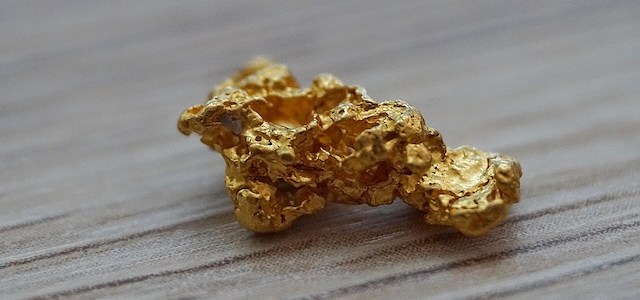
1 If you are near the gold rush, do not pan for gold. If you do, at best, you won’t find any. At worst, you might pull a couple of specks out of the sand, which will cause an extreme attack of gold fever. (Well, that does it, Fidelis. You are hooked. See you in a couple of years when your money runs out.)
Today, we are visiting Lakeways historic Liebelt Cabin. We are catered by Crown and Anchor Pub of Austin. Our entertainment is The Foggy Mountain Boys.
Menu
Classic Hamburger & Fries – The tried-and-true original, 100% Fresh, Never Frozen Patty cooked to perfection. For those who don’t want to mess with a good thing!
Mushroom Swiss Burger & Fries – Topped with sautéed mushrooms and melted Swiss cheese.
Cheeseburger & Fries – Our Classic Hamburger with American cheese.
Double Cheeseburger & Fries – Our Classic Hamburger, double patty with American cheese.
Jalapeño Cheeseburger & Fries – Cheeseburger topped with sliced jalapeños.
Bacon Cheeseburger & Fries – Add two strips of bacon to the cheeseburger.
Veggie Burger & Fries – Award-winning! A crispy veggie patty on a wheat bun with lettuce, tomato, onion, pickle, mayo, and mustard.
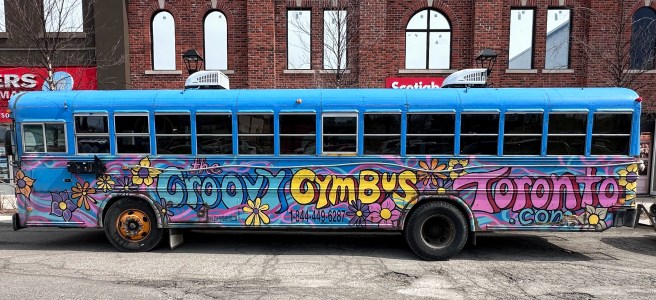
Hop on the bus and let’s go.
There’s the historical marker explaining that the cabin was relocated to the city hall area in 2011. It is over 150 years old.
Vintage farm equipment around the cabin.
More farm equipment.
A replica of the marker for August Liebelt, who built and lived in the cabin.
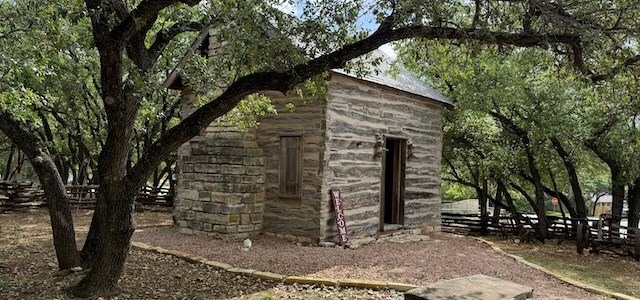
One view of the cabin.
A closer look.
The stove was used for cooking and heating.
A view toward the fireplace and dining area.
Artifacts from the era.
Looking back toward the stove and at the ladder to the second story. Note that the cabin had three doors, which provided plenty of ventilation.
A close-up of more artifacts. Great needlepoint, but spelling not so much.
The old rocker and cane. The framed photos are of members of the Historical Society at various functions in the cabin.
Now it’s time for food and music. I hope you have a great week.
A simple Saturday would include a calm cup of coffee, peace, and quiet. Of course, around here, the coffee is available, but peace and quiet? A touch of the two-coffee button sets in motion a chain of events destined to see me admitted to a special care facility or an order for a tun of wine. The coffee smells like redemption to a caffeine-starved brain. The first sip stops the nails-on-the-chalkboard low-caffeine warning alarm. The second sip is accompanied by the Westminster chime of the doorbell, joined by the baying of my own hounds of Baskerville – Twiggy and Tempeste. Their sound is like ten ton of tin falling from a church rafter just before the benediction. A quick toss of two new identical tan colored squeaky toys into the soundproof room, and the door slam brings back the Songs of Silence.
A check of the security monitor shows me an image of a person dressed in a Bugs Bunny suit. Since my curiosity is raised, with a sigh, the security shutdown process begins.
The SWAT team needs to be put on standby. A quick text to the leader confirms that status. Also, the flight of A-10 Warthogs must be diverted. Another call to the commander puts that worry to rest. The SEAL team needs to be called off, and a call to the leader makes that possible. The MH-60 Jayhawk Helicopter hovering over the house is diverted. A call to the tow truck driver stops the deployment of an M1A1 Abrams Tank. The control panel simplifies the security system’s shutdown process. The boiling oil vats are put on standby, the turret mortars disengaged, the Trebuchet on safety, the concertina wire rolled, the Claymore mines reset, the tower Gatling guns on safety, the moat net dropped, the alligators fed, and the IEDs and shoulder-held rockets put away. The Proton torpedoes switched off. The gamma ray beams covered. The high-powered maser guns switched to standby, and the nanorobots were chained in the basement. The Klingons are called back, and the Targ is caged. Robbie’s Bot is sent to the basement. The Tasmanian Devil is directed to the food in his cage, and the door drops. The electronic jammer is kept active, given a situation with a robot not too long ago. The locks on the door are thrown. And the door opened.
The guy in the Bugs Bunny suit has a clipboard and a letter, which he passes to me. After signing and passing the clipboard back, the question has to be asked, “What’s with the Bugs Bunny outfit?” He explains that he took his uniform to the dry cleaners and picked it up last night. When he went to put it on today, there was an obvious mistake, so he had to wear the Bugs Bunny outfit that the cleaners mistakenly gave him.
“Why not just wear normal clothes?”
“Then I would be out of uniform, which is against company rules.”
“But you look out of uniform right now.”
“No. You see, I have the receipt that clearly says this is my uniform.”
The conversation is going nowhere, and the guy has his Bugs paw outstretched for a tip. Feeling sorry for him, he gets a tenner. Back inside, the letter is a message from Linda Hill that reads:
Your Friday prompt for Stream of Consciousness Saturday is “tan/ten/tin/ton/tun.” Use one, use ’em all, use ’em any way you’d like. Bonus points if you manage to get four of them into your post. Have fun!