An intuitive piece of hardware collects days’ worth of renewable energy from airplane engine exhaust before takeoff from a Dallas airport.
“Boarding is completed” is a common refrain heard over the intercom system in the moments before taxiing to the runway.
At that moment, the pilot will begin a series of engine tests and pre-flight checks, during which the turbine engines will idle with their ferocious noise and exhaust fumes.
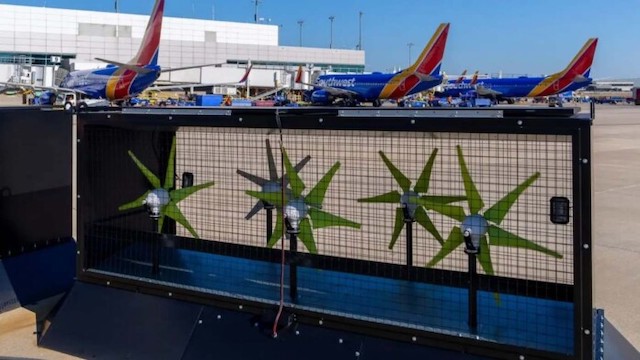
A company called JetWind has realized that all that idling force is like the strong winds needed to power a wind turbine and has built a series of pods that can capture it during the 5-10 minutes the aircraft is sitting at the gate waiting for clearance to taxi.
“The main goal of our project is to harness the consistent wind created by jets and convert it into an eco-friendly energy source,” JetWind’s founder and president, Dr. T. O. Souryal, told Interesting Engineering.
“What was once considered wasted energy can now benefit energy grids, ultimately promoting smarter and more sustainable infrastructure across the globe.”
Three years of testing between 2021 and 2024 have informed the official deployment of JetWind’s flagship product at Dallas Love Field airport. 13 sets of pods will sit beneath the gate hooked up to external batteries that connect to the grid the airport uses. Solar panels add to the energy generation, and the whole set can create about 30 kilowatt-hours of renewable energy, enough to power a family home for a few days.
While it isn’t nearly what the average airport will consume during a day of operations, when combined with 12 other systems like it, it can make a big difference in reducing the building’s carbon footprint.
“Dallas Love Field has always been a hub of progress, and the introduction of JetWind’s Energy Capturing Pods reinforces its position as a testing ground for innovative technologies,” said former Dallas Mayor Tom Leppert.
“By converting man-made wind into energy, we highlight Dallas as a leader in sustainable solutions and prove that cities can take significant steps toward tackling global energy challenges.”
The debut of the JetWind pods at Love Field has attracted attention from around the globe, including companies and governments from Switzerland, Brazil, Saudi Arabia, Ecuador, the UK, France, and Australia.
The good news in today’s story is that not all energy projects are enormous. Even the little ones count. Today’s JohnKu is about little steps. I hope you have a beautiful weekend.
A PET bottle made from recycled plastic (The Ministry of Science and ICT) 출처 : Businesskorea(https://www.businesskorea.co.kr)
Today’s Good News story comes from the Business Korea periodical and was brought to my attention by Noelle Granger.
Groundbreaking Bio-catalyst Developed for Efficient PET Plastic Decomposition
by Michael Herh – January 2025
The Ministry of Science and ICT (Information and Communication Technologies) has announced a groundbreaking development in the field of plastic recycling. A joint research team, led by Prof. Kim Kyung-jin of the Department of Biotechnology at Kyungpook National University and CJ CheilJedang, has developed a bio-catalyst with the world’s highest performance for decomposing PET (polyethylene terephthalate) plastic under industrial conditions. The research results, announced on Jan. 3, were published in the prestigious international journal “Science” on the same day.
PET plastic is a ubiquitous material found in everyday items such as PET bottles, clothing, seat belts, disposable cups, and car mats. Traditionally, PET plastic is recycled through mechanical processes that involve label removal, crushing, washing, and reprocessing. However, this method often results in a decline in the quality of the recycled material, leading to its eventual incineration or disposal in landfills. Chemical catalysts, which induce chemical reactions to break down plastics, have been considered an alternative, but they come with their own set of limitations, including raw material contamination and waste generation.
To address these issues, the research team developed a high-performance bio-catalyst named “KUBU-M12.” Unlike chemical catalysts, bio-catalysts decompose plastics through biological reactions akin to the natural decay of wood. This process results in less waste and raw material contamination, thereby maintaining the quality of the recycled material. KUBU-M12 has demonstrated remarkable efficiency, capable of decomposing 1 kilogram (kg) of PET by 45% in just 1 hour, over 90% in 8 hours, and almost completely in 12 hours with only 0.58 grams (g) of the catalyst. The research team emphasized that this is the highest performance recorded among bio-catalysts for plastic decomposition globally.
Prof. Kim highlighted the importance of this development, stating, “This is a groundbreaking technology that enables permanent recycling of even contaminated plastics that cannot be recycled.” He further added, “Innovations applying bio-catalysts will occur in various chemical industries.”
The development of KUBU-M12 is expected to revolutionize the recycling of difficult-to-recycle waste plastic, contributing to various chemical industry innovations and addressing critical environmental issues such as carbon neutrality and climate change. The eco-friendly nature of this technology aligns with global efforts to reduce plastic waste and improve recycling efficiency, ultimately mitigating the environmental impact of plastic pollution.
The achievement of world-class performance in eco-friendliness and the ability to decompose waste plastic in just 12 hours using a small amount of bio-catalyst marks a significant milestone in the field of biotechnology and materials science. The publication of these findings in “Science” underscores the importance and credibility of the research, highlighting the potential for widespread application and impact.
The good news in this story is the issue of plastic pollution is being addressed in many countries. Today’s JohnKu talks about technology. I hope you have a super weekend.
Today’s good news comes from The News Tribune in Tacoma, Washington.
A bald eagle was found ‘frozen’ and unable to fly. See the rescue with the ‘best ending ever.’
Story by Sara Schilling
First responders in Alaska had an unusual overnight guest: a juvenile bald eagle needing help.
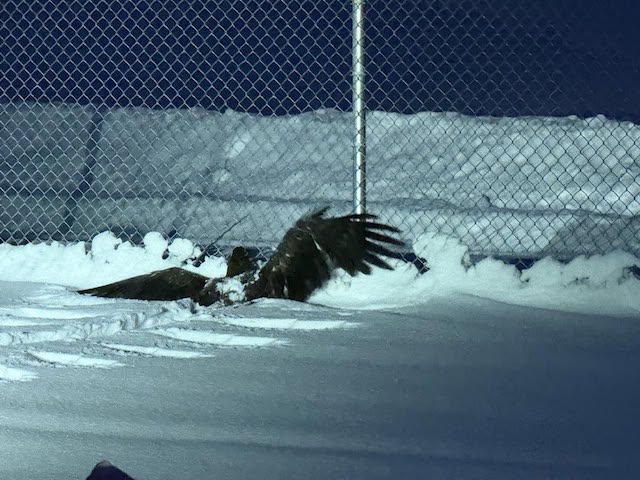
A good Samaritan came across the “quite frozen” eagle that couldn’t fly on the evening of Jan. 11 and waved over a Fairbanks International Airport police officer, the Fairbanks Airport Police and Fire Department wrote in a Facebook post.
According to the post, after checking with the Alaska Raptor Center, first responders put the eagle in a patrol car to keep it out of the cold.
A quote from the Facebook post “Dispatch, we’ve got one detained…
While we normally wouldn’t release the name of those we take into protected custody, we figured this time it would be ok!
One of our officers was flagged down this evening by a Good Samaritan who found a juvenile bald eagle who was quite frozen and unable to fly. After consulting with representatives of the Alaska Raptor Center, the decision was made to secure the little guy or gal in the backseat of the patrol car till it could thaw out and get dry. It’s now resting peacefully in a dark, quiet corner of the station until tomorrow when representatives from Alaska Fish & Game and the US Fish & Wildlife Service help us release it back to the wild as long as it’s not showing signs of illness or injury. (Hint…keep an eye our page tomorrow) “
The eagle spent the night munching on fatty steak and salmon and “resting peacefully in a dark, quiet corner of the station,” officials said.
Officials said the eagle was assessed with help from the U.S. Fish and Wildlife Service, the U.S. Department of Agriculture Wildlife Services, and the Alaska Department of Fish and Game, and it was determined to be in great shape.
The Fairbanks Airport Police and Fire Department said in a follow-up Facebook post on Jan. 12 that the bird was released back into the wild, declaring it “the best ending ever.”
People can be heard celebrating in the background.
“Oh yeah, he soars,” someone said as the eagle fled.
Another person said, “He’s super strong. That’s wonderful.”
In the follow-up Facebook post, officials thanked “everyone who showed concern, especially the Good Samaritan who called in the frozen bird and helped (rescue) it. We wish every day could be as exciting as this one was!”
The good news in this story is that someone cared enough to report a bird in distress, and as a result, it was saved. Today’s JohnKu talks about involvement. I hope you have a great weekend.
Research team makes surprising discovery after planting multiple crops in the same field: ‘It’s a promising combination’
Today’s good news comes from The Cool Down newsletter. Thank you, Noelle Granger, for spotting it and making me aware.
Research team makes surprising discovery after planting multiple crops in the same field: ‘It’s a promising combination.’
Leslie Sattler,
A new study from the University of Alberta points to an exciting way farmers can grow better crops while spending less on fertilizer.
The secret? Planting certain grains and legumes side by side in the same fields.
Researchers from the university planted two perennial grains—rye and wheatgrass—alongside three legumes—alfalfa, white clover, and sainfoin. According to the results published in the Journal of Animal Science, this combination produced high-quality crops that could more effectively feed livestock.
“The legumes naturally supply nitrogen to the soil, improve the organic matter, and improve the forage quality for livestock. At the same time, perennial cereal plants have deep root systems, which helps sequester more carbon and makes them more drought-resistant than annual crops, which is important in Alberta’s dry climate,” Cosmas Ugwu, who led the study, said in a post by the university.
“It’s a promising combination that can potentially help crop performance, reduce dependence on synthetic fertilizers, lower costs for farmers, and promote environmental sustainability,” Ugwu added.
This planting method offers several benefits for farmers. The combined crops are more drought-resistant and provide better nutrition for cattle, making them easier to digest.
The research team tested two planting patterns across Alberta. Both methods worked well, but planting in alternate rows yielded slightly better results, producing about 5% more crops in the first year of harvest in 2023.
This farming approach could help build a more sustainable food system. When farmers spend less on fertilizer, food prices can stay lower. Plus, reducing synthetic fertilizer use helps clean our air and water, creating healthier communities.
The research team continues to study how this planting method affects soil health and carbon storage. It’s working closely with farmers to help them adopt these practices, which could start showing up in fields across North America in the coming growing seasons.
The good news in this story is that more effort is being put into finding more natural ways of growing healthy crops. Today’s JohnKu talks about farming. I hope you have a beautiful weekend.
Believing that books save lives, international best-selling author James Patterson is taking the reins for dozens of American booksellers this year and giving their employees a $500 holiday bonus.
To protect the beloved industry and its bottom line, Patterson’s donations totaled $300,000 this holiday season and were divided between 600 bookshop workers.
According to the American Booksellers Association (ABA), workers either submitted an application for the bonus or were nominated by their colleagues, friends, or perhaps even an author.
“Booksellers save lives. Period,” Patterson said in a statement to ABC News. “I’m happy to be able to acknowledge them and all their hard work this holiday season.”
People Magazine reports that Alabama’s Thank You Books, Iowa’s The Nook, and San Francisco’s City Lights Books are just some locations that have witnessed Patterson’s gifts.
“We appreciate Mr. Patterson’s financial generosity as well as his generosity of spirit. We all continue to be awed by, and grateful for, Mr. Patterson’s continuing support of independent booksellers,” Allison Hill, CEO of the ABA, also said in a statement.
“It means everything to have him recognize and reward booksellers’ valuable role in the industry.”
This is just one of many large donations offered by Patterson to bookstores, totaling over $1.5 million of personal wealth over the last 20 years. This included a $500,000 donation during the opening salvos of the COVID-19 pandemic when enforced lockdowns and business closures threatened small businesses in many states.
“The White House is concerned about saving the airline industry and big businesses — I get that. But I’m concerned about the survival of independent bookstores, which are at the heart of main streets across the country,” Patterson said in a statement at the time.
“I believe that books are essential. They make us kinder, more empathetic human beings. And they can take us away momentarily from feeling overwhelmed, anxious, and scared.”
The good news in this story is that an author who has significantly benefitted from bookstore employees is willing to give back in recognition of those benefits. Today’s JohnKu talks about payback. I hope you have a wonderful weekend.
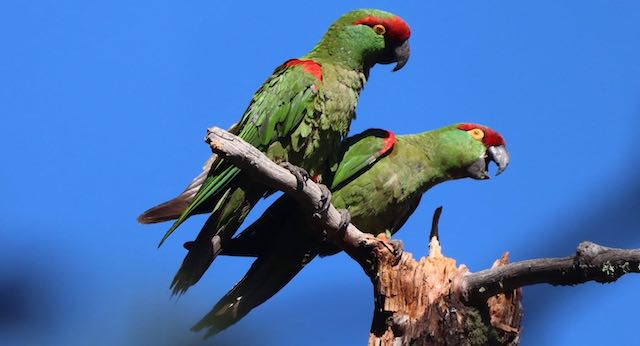
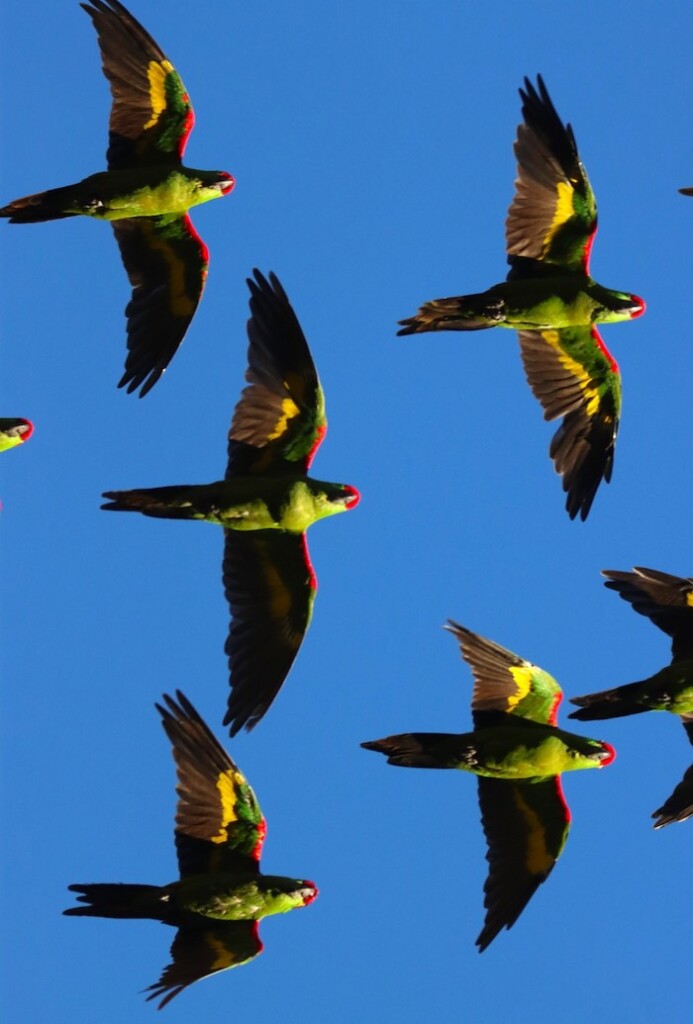
A public-private partnership in Mexico just announced that the population of thick-billed parrots is approximately 2,500 individuals—at least 10% higher than that recorded 12 years ago.
The number was determined in a recent population survey in a protected area in the state of Chihuahua, where this charismatic species once roamed north into the United States.
The thick-billed parrot is an emblematic species of the temperate forests of the Sierra Madre Occidental, once found in Arizona and New Mexico.
Since 1995, this species, listed in danger of extinction by the Mexican government, has been the subject of numerous studies and actions for protection and management, while the mountain forests on which it depends have been the focus of extensive reforestation.
These efforts, led by the National Commission of Protected Natural Areas (CONANP) and the civil organization Organización Vida Silvestre (OVIS), along with the participation of local communities and other organizations in the US and Mexico, are yielding encouraging results as demonstrated by the increase in population, a statement from OVIS details.
“This emerging success story reflects the importance of collaboration between society and government and a vision of healthy ecosystems and sustainable communities, which is in line with the policies and practices that CONANP will strengthen in the following years,” said the head of CONANP, Pedro Álvarez-Icaza.
Credit: Ernesto Enkerlin / OVIS
The census data suggests that the population of thick-billed parrots will continue to increase as the region’s communities consolidate sustainable forestry management practices.
Sergio Jiménez, OVIS’s executive director, thanked the various institutions’ support.
“This multi-institutional effort led by Ernesto Enkerlin Hoeflich, scientific director of OVIS, is bearing fruit after three decades, which gives us hope for other species at risk and points to the need for cooperation, persistence, and long-term planning to produce results and effective conservation.”
A significant effort was undertaken in the 1980s to restore populations of this parrot among the sky islands of Arizona. These dramatic, short, squat mountain chains amid the scorching lowlands were perceived as perfect havens for the reintroduction. Still, the problem was that predatory species like the American goshawk had already returned in large numbers to these hills, and their take of the parrots proved unsustainable.
In October 2020, it was announced that a higher elevation among the sky islands, including the Chiricahua mountains, would be sought to form the basis for a new reintroduction attempt.
If populations recover substantially enough in Mexico, the bird may recolonize its former haunts in the Southwestern US without the need for scientists’ intervention.
The good news in this story is that species on the verge of extinction can recover with concerted effort. Today’s JohnKu talks about efforts. I hope you have a wonderful weekend.
American scientists have proposed a new method for recruiting trillions of microscopic sea creatures and their insatiable appetites to fight climate change.
The technique harnesses the animals’ daily habits to accelerate the ocean’s natural cycle for removing carbon from the atmosphere, known as the biological pump, according to the paper in Nature Scientific Reports.
The study, published by researchers at Dartmouth College, reported that spraying clay dust on the ocean’s surface converts carbon into food the animals eat, digest, and send deep into the sea as carbon-filled feces.
They explain that the process would begin with spraying the clay dust at the end of algae blooms. These blooms can grow to cover hundreds of square miles and remove about 150 billion tons of carbon dioxide from the atmosphere each year, converting it into organic carbon particulates. But once the bloom dies, marine bacteria devour the particulates, releasing most of the captured carbon into the atmosphere.
The researchers found that the clay dust attaches to carbon particulates before re-entering the atmosphere. It redirects them into the marine food chain as tiny sticky pellets the ravenous zooplankton consume and later excrete at lower depths.
“Normally, only a small fraction of the carbon captured at the surface makes it into the deep ocean for long-term storage,” says Mukul Sharma, the study’s corresponding author and a professor of earth sciences. Sharma presented the findings on December 10th at the American Geophysical Union annual conference in Washington, D.C.
“The novelty of our method is using clay to make the biological pump more efficient—the zooplankton generate clay-laden poops that sink faster,” says Sharma, who received a Guggenheim Award in 2020 to pursue the project.
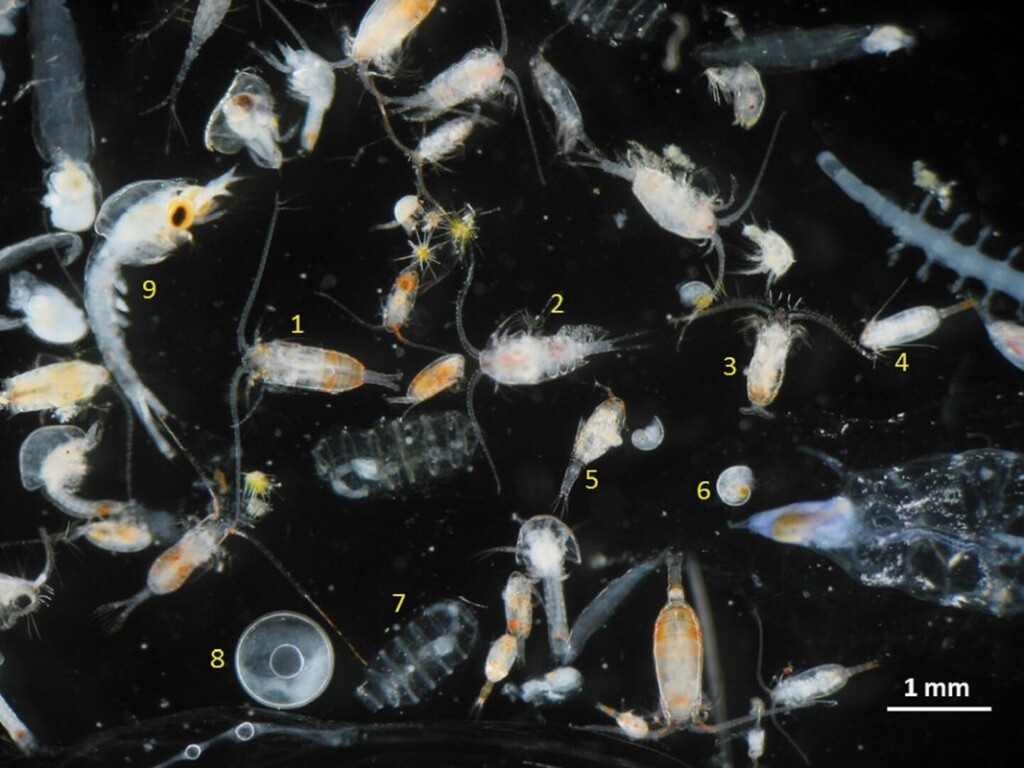
A mixed zooplankton sample including common species – Credit Adriana Zingone, Domenico D’Alelio, Maria Grazia Mazzocchi, Marina Montresor, Diana Sarno, LTER-MC team CC 4.0. BY-SA (John’s note – I don’t have the number key for the photo)
“This particulate material is what these little guys are designed to eat. Our experiments showed they cannot tell if it’s clay and phytoplankton or only phytoplankton—they just eat it,” he says. “And when they poop it out, they are hundreds of meters below the surface, and all that carbon is, too.”
The team conducted laboratory experiments on water collected from the Gulf of Maine during a 2023 algae bloom. They found that when clay attaches to the organic carbon released when a bloom dies, marine bacteria produce a kind of glue that causes the clay and organic carbon to form little balls called flocs.
The researchers report that the flocs become part of the daily smorgasbord of particulates that zooplankton gorge on. Once digested, the flocs embedded in the animals’ feces sink, potentially burying the carbon at depths where it can be stored for millennia. The uneaten clay-carbon balls also sink, increasing in size as more organic carbon, as well as dead and dying phytoplankton, stick to them on the way down.
In the team’s experiments, clay dust captured as much as 50% of the carbon released by dead phytoplankton before it could become airborne. They also found that adding clay increased the concentration of sticky organic particles—which would collect more carbon as they sink—by 10 times. At the same time, the populations of bacteria that instigate the release of carbon back into the atmosphere fell sharply in seawater treated with clay, the researchers report.
Sharma says that in the ocean, the flocs become an essential part of the biological pump called marine snow. Marine snow is the constant shower of corpses, minerals, and other organic matter that falls from the surface, bringing food and nutrients to the deeper ocean.
“We’re creating marine snow that can bury carbon at a much greater speed by specifically attaching to a mixture of clay minerals,” Sharma says.
Zooplankton accelerate that process with their voracious appetites and incredible daily sojourn, known as the diel vertical migration. Under cover of darkness, the animals—each measuring about three hundredths of an inch—rise hundreds, and even thousands, of feet from the deep in one immense motion to feed in the nutrient-rich water near the surface.
When the day breaks, the animals return to deeper water, depositing the flocs as feces. This expedited process, active transport, is another key aspect of the ocean’s biological pump that shaves days off when it takes carbon to reach lower depths by sinking.
Sharma plans to field-test the method by spraying clay on phytoplankton blooms off the coast of Southern California using a crop-dusting airplane. He hopes that sensors placed at various depths offshore will capture how different species of zooplankton consume the clay-carbon flocs so that the research team can better gauge the optimal timing and locations to deploy this method—and exactly how much carbon it’s confining to the deep.
“Finding the right oceanographic setting to do this work is significant. You cannot go around willy-nilly dumping clay everywhere,” Sharma told Dartmouth Press. “We need to understand the efficiency first at different depths to understand the best places to initiate this process before we put it to work. We are not there yet—we are at the beginning.”
The Good News in today’s story is that scientists continue to work to make our oceans healthier. Today’s JohnKu talks about the oceans. I hope you have a super weekend.
It’s new news, old news, and news that can never be repeated too often: spending time in nature reduces emotional distress among troubled 10-—to 12-year-olds.
The Canadian researchers behind the new study say their findings suggest that an inexpensive school-based, nature-born program may help the most vulnerable youngsters.
Canadian researchers discovered that spending two hours a week of class time in a natural environment can reduce emotional distress among child participants who had the most significant mental health problems before the program began.
The research, published in the journal JAMA Network Open, follows the recent publication of a UNICEF report pointing to the importance of green space for children’s development.
The Canadian team looked at the effects of spending time in nature on the behavior and mental health symptoms of more than 500 schoolchildren across Quebec in the spring of 2023.
“The idea for the project came up during the pandemic when people were worried about the health risks of children spending so much time inside the school each day,” said study senior author Professor Marie-Claude Geoffroy of McGill University.
They found that at the end of three months, teachers noted that the most significant changes in behavior occurred in children with the most important problems at the outset. These included anxiety and depression, aggressivity and impulsivity, and social issues relating to interaction with their peers.
Interviews with the teachers following the program also suggested that children were calmer, relaxed, and attentive in class after spending time in nature.
“This suggests that nature-based programs may offer targeted benefits for children with higher levels of mental health vulnerabilities and potentially act as an equalizer of mental health among school-age children,” co-author Professor Sylvana Côté from the University of Montreal added.
The research builds on earlier observational studies but is the first to use a randomized controlled trial—the gold standard of medical research—to provide concrete information about the benefits to children of spending time in nature.
All the schools involved in the study were within a mile of a park or green space, and half of the children stayed in school while a similar number took part in the nature-based intervention.
“My kids and I spend lots of time in parks, so I’ve seen the benefits of spending time in nature, both for myself and them,” added Professor Geoffrey. “So, I thought maybe we can have a free and accessible intervention where school children can spend time in nature, and we can measure the effects this has on their mood and behavior.”
During the two hours they spent in the park each week, teachers were asked to offer regular classes in math, languages, or science.
They were also asked to incorporate a 10—to 15-minute activity to promote mental health, using examples drawn from a teachers’ kit designed by the research team.
The activities included drawing a tree, writing haikus, and mindful walking.
Study first author Tianna Loose, a post-doctoral fellow at the University of Montreal, added that the intervention was low-cost, well-received, and posed no risks, making it a promising strategy for schools.
The good news here is something we all could have guessed, but it is now a matter of science. Today’s JohnKu talks about intuition. I hope you have a glorious weekend.
After a pod of more than 30 pilot whales were stranded on a New Zealand beach, over a thousand volunteers and professionals organized to save them by carrying them back out to sea on sheets.
The sheets were suspended from the prow of a boat operated by New Zealand’s Department of Conservation (DoC).
The stranding happened on Ruakākā Beach near the city of Whangārei in New Zealand’s north island, a particularly prolific stranding location for pilot whales. DoC agents routinely survey the beach and ask the public to report any whales coming too near.
Rescue efforts saw almost all of the pilot whales survive, while three adults and one calf perished. A Māori ceremony was held to honor their spirits, as the Māori believe the animal to be a sacred cultural treasure.
“It’s amazing to witness the genuine care and compassion people have shown toward these magnificent animals,” Joel Lauterbach, a Department of Conservation spokesperson, said in a statement. “This response demonstrates the deep connection we all share with our marine environment.”
The good news in this story is seeing folks pull together to save other Earth residents. The JohnKu talks about thinking of others as more than just animals. I hope you have a super weekend.
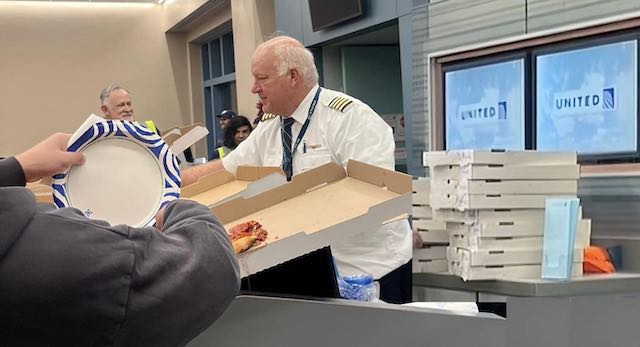
United Pilot Scott Wardle buys pizza for passengers – By Tanya Stamos via FB.
Today’s good news comes from the Good News Network. You may have seen this story, but I think Captain Wardle’s action is worth another look. Today is also the anniversary of the assassination of John F. Kennedy in Dallas Sixty years ago. I think he would like this story as well.
United Pilot Orders 30 Pizzas to Feed Passengers After Emergency Landing for Medical Care
A United Airlines pilot has become a social media sensation after personally overseeing the order and distribution of 30 pizzas to 155 passengers on his flight.
Now monikered the “Pizza Pilot,” Scott Wardle says that after 30 years of piloting for the Air Force and as a civilian, he knows what it feels like to be stuck at the airport and that he just “had to do something to show we care.”
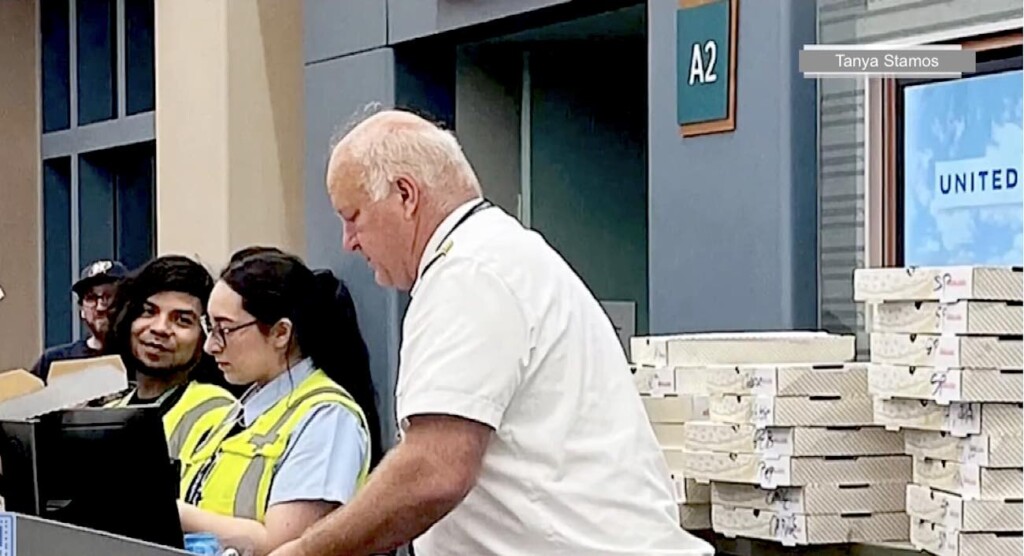
United Pilot Scott Wardle serving dinner he bought for passengers – Tanya Stamos via FB.
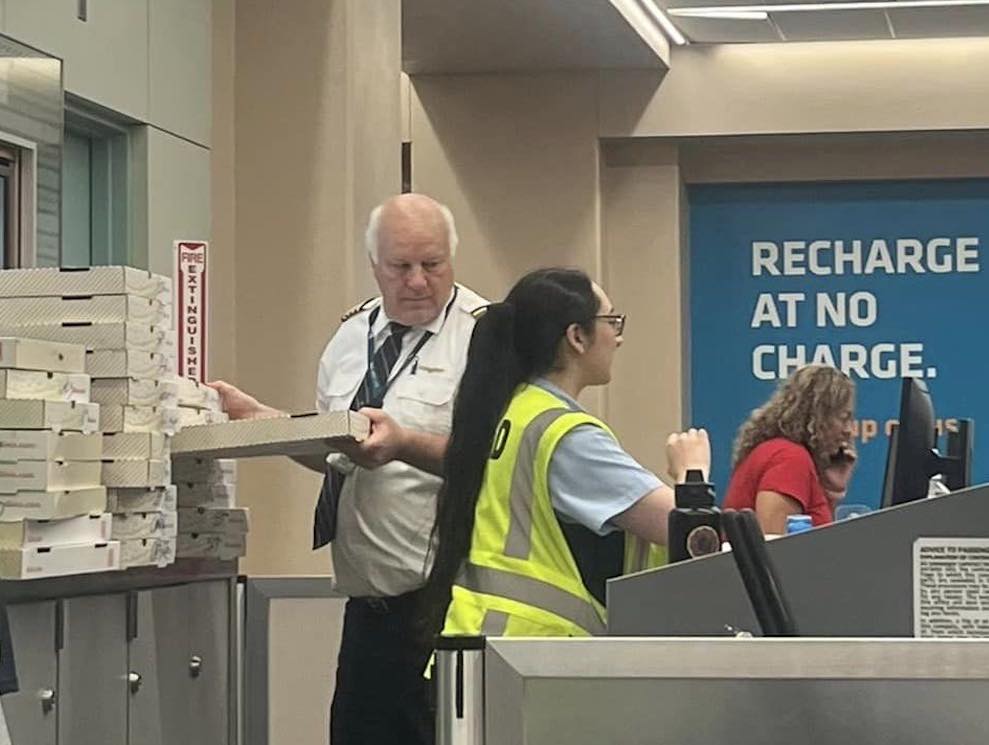
Well, that care took off, with posts and photos of Wardle handing out pizzas using the check-in counter at the gate as a kitchen counter going viral.
The story began when the Boise-based Wardle was all set for a flight to Phoenix via Houston. About 45 minutes into the trip, the flight crew called to inform him that a patient had fallen unconscious.
Though two nurses and a medic were on board, Wardle felt he couldn’t take any chances, so he came in for an emergency landing at Albuquerque.
Hoping to get the passengers back underway as soon as possible, he suddenly received word that his cabin crew had maxed out their hours, meaning he had to wait for a new set of attendants.
“I made sure to confirm they were on the way with the company, and then I thought, I got to do something with all these people,” Wardle told KTVB 7. “So, I started exploring some options at that point for what I want to do. I came up with the idea of doing pizza for everyone. It’s an easy thing. Most people like pizza.”
Wardle says he loves his job, and the only burden he felt during the whole ordeal was compassion and sympathy for the passengers. He picked up the phone and started ordering dozens of pizzas.
As he began passing them around with plates and napkins, the passengers took notice.
The viral photos and videos reached virtually every corner of Wardle’s social life, with old Air Force buddies and even his graduation class of 1984 and phoning him to say they saw him serving pizza in his pilot uniform.
Pilot Scott Wardle ‘recharges with pizza for free’ – Tanya Stamos via FB
“I didn’t think it was that big of a deal. I just did my thing,” Wardle said. “Many pilots in our company do this sort of thing; I just happened to get my picture taken.”
United Airlines insisted on reimbursing him for the pizzas. They applauded a hero of the friendly skies who waited until every passenger had a slice before sitting down for a pie.
The good news in this story is one person cared about the care and comfort of others. Today’s JohnKu talks about caring. I hope you have a peaceful weekend.

 “
“