Today, we are visiting the Lakeway Municipal Utility District (LMUD) for an open house and to check out the seed library. LMUD had an open house on Earth Day, and through the miracle of the time clock, we can go back and take a look. We are catered by Stella San Jac of Austin. Our entertainment is Simon and Garfunkel
Menu
All American – Scrambled Eggs, Bacon, Crispy Hash Brown, Sourdough Toast
The coffee machine sends me a good morning message on the touch pad. “Good Morning, Boss. There will be a slight delay with your morning cup today. It seems that someone forgot to fill the bean reservoir. Through Bluetooth, we contacted the freezer to have a fresh supply delivered. Unfortunately, frozen beans do not work well with our grinder friends, so there was little choice but to wait until the beans thaw. All this occurred two hours ago while you were still comfy in bed. It shouldn’t be too long of a wait since our sensors feel the beans are almost ready. In addition, we checked 1925 for today, and the news is very sparse. A reminder might be to have the bean reservoir filled after you finish the coffee in the morning. Oh, hold on. We have been informed that the beans are ready, so your cup will be delivered now.”
The familiar sound of the grinder sing causes my mouth to water and the pounding in my head to get softer. The cup is delivered, and after the first sip, it looks like my corpus will survive. The second sip brings the Westminster chime of the doorbell. Twiggy and Tempeste throw themselves against the door, and there is the sound of breaking glass in the kitchen. The resounding barks have indeed reduced the glassware to dust. A handful of treats tossed through the soundproof portal and a slam of the six-inch soundproof door cut the mayhem like a knife. My ears pound in the silence, but I must make the security system safe.
The security system must be deactivated before opening the front door and addressing the visitor. Before that, though, the SWAT team needs to be put on standby. A quick text to the leader confirms that status. Also, the flight of A-10 Warthogs must be diverted. Another call to the commander puts that worry to rest. The control panel makes the shutdown of the security system process simpler. The boiling oil vats are put on standby, the Trebuchet on safety, the concertina wire rolled, the Claymore mines reset, the tower Gattling guns disengaged, the moat net dropped, the alligators fed, the IUDs and shoulder-held rockets put away. The locks on the door are thrown.
Standing there is a pig dressed like a farmer holding a huge sunflower. He is also holding an envelope. “Y-you J-John H-Howell?” I give the pig a nod. “I-I have a m-message f-for y-you f-from L-Linda H-Hill.” “Great. Let me have it.” The sunflower showers me with water, and I can see the pig trying to stifle a laugh. Wiping my face. While holding out my hand. The pig gives me the envelope, turns, and runs down the drive. Opening the envelope, one can see that it is a message from Linda Hill. It reads” Your Friday prompt for Stream of Consciousness Saturday is ‘sing.” Use it any way you’d like. Have fun!
Western India is home to one of the hottest deserts on Earth, and the residents of the western states of Rajasthan and Gujarat have traditionally used architecture to keep cool.
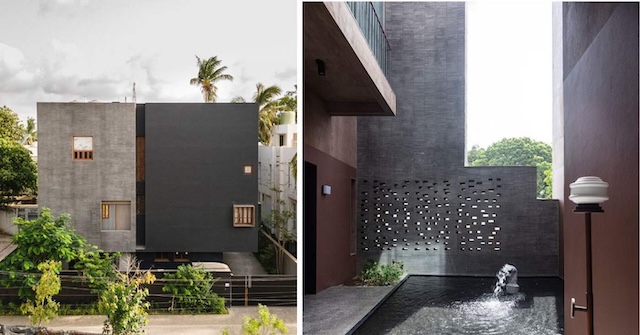
Utilizing principles of thermodynamics, one house in the city of Bharuch, where temperatures can hover at 110°F for days during the summer, stays cool all day and all summer without ever needing the air conditioning switched on.
In fact, the building’s interior is a breezy, green, “introverted space” that passively cools the air inside by a whopping 18°F, all using simple science.
“We used the direction of the winds, design, and cooling materials to lower the heat of the house,” Samira Rathod, the principal architect of the ‘Cool House’ and founder of Samira Rathod Design Atelier (SRDA), told The Better India, reporting on the story.
“The plot had three buildings around it and a road on one side. The only view that the house would have was the neighbor’s building. An introverted house was a good choice in that sense. It is basically one where the house opens up when you go inside it. It would look like a rather closed structure from the outside,” she explains.
Indeed, it might even be called depressing, as its front door is hidden between two giant, 18-inch-thick facades of gray and black. But inside, a design reminiscent of a railroad track sees the rooms divided on either side of a giant split in the house, built to align with the current of the wind off the ocean.
Bharuch is situated on the Indian Ocean, and despite the scorching temperatures, a breeze is present throughout much of the city at various times during the day. The narrow slit in the house leverages the Venturi effect, which states that the narrower the space an element must pass through, the faster and colder it becomes.
The principle can be seen in human breath, which emerges hot through an open mouth but cool through pursed lips. The same effect can be seen in rivers, where narrow channels cause the water to speed up and form rapids, while wide, flat lands cause the water to slow down.
The wind from the sea enters the split and hits an interior courtyard where a pool of water cools it down further. Entering the 10,500 square foot home interior, a second courtyard aids in circling it around each room, where the family lives with three generations.
“The house looks inwards and we have created courtyards with trees so it feels like you are looking outside rather than inside,” said Rathod.
Mirai House of Arches in Bhilwara – credit Sanjay Puri Architects
GNN has previously reported on Indian architecture in this part of the country. Natural designs like envelopes, air channels, and even “wind towers” could, and probably should, become standard designs in parts of the world where temperatures are predicted to rise, such as the southwest United States or Southern Europe.
In Rajasthan’s city of Bhilwara, a “House of Arches” ensures that no part of the building is exposed to the sun thanks to a building envelope that provides shade and air circulation.
The science lies in the separation of the envelope from the house itself. Even as the sun’s rays heat the envelope, wind and moisture evaporation can penetrate the space between the house and the envelope to reduce the radiant heat that enters the living areas.
The good news in this story is that it is possible to engineer structures with features that can reduce the need for electricity for cooling. Today’s JohnKu talks about new thinking. I hope you have a lovely weekend.
This post was published in November of 2013 by me and Marie Ann Bailey. Since the summer camping season is coming up, it may be handy.
Top Ten Things Not to Do When Camping at a Primitive Campsite
10. If you camp at a primitive campsite, do not forget to pack a sufficient amount of toilet tissue for your stay. If you do forget, at best, you’ll enjoy not having the extra weight. At worst, the pleasure of the lightness of the backpack will soon give way to panic after you’ve overeaten on the wrong kind of berries.
9. If you camp at a primitive campsite, do not store your food in your tent, thinking it will be more protected from the elements there. If you do, at best, only a coterie of raccoons will steal your pistachio nuts and proceed to eat them loudly in the surrounding bushes at midnight. At worst, a hungry bear will think your leg looks more delicious than the smell of the beef jerky in the pack that you are using as a pillow.
8. If you camp at a primitive campsite and want to explore some of the nearby hiking trails, do not forget to bring a topographical map of your camping area. If you forget, at best, Google Maps may not be up-to-date on the hiking trails around your campsite, and you may wind up walking in circles while your iPhone quickly burns its battery. At worst, the Google map didn’t warn you about the five-hundred-foot drop you encountered on the way to the trail below. Calling for help seems futile at this point.
7. If you camp at a primitive campsite, do not forget to bring plenty of waterproof Band-Aids for blisters. No matter how many layers of socks you wear and how well-broken in your boots may be, you are likely to suffer at least one blister. Without band-Aids, at best, you can expect to spend the rest of your camping trip hopping around in burning pain. At worst, you will find yourself trying to apologize to your hiking partner for having to carry you the last five miles.
6. If you camp at a primitive campsite, do not forget to bring a water filtration system in case you run out of potable water. The water in the creek near your campsite may look clean and pure, but without a filtration system, at best, you may end up wishing you had brought more toilet paper. At worst, you might be the talked-about guest of the local ER.
5. If you camp at a primitive campsite, do not carry a gun, thinking it will protect against any wild animals you may encounter. If you do, at best, it isn’t hunting season, and you have no right to shoot anything. At worst, you risk shooting your own foot when you awake to a leg cramp in the middle of the night and think it is a bear gnawing at your calf.
4. If you camp at a primitive campsite, do not forget insect repellent. If you do, at best, the mud in the swamp applied liberally can ward off mosquitoes. At worst, all your hiking friends have left since the swam mud scent keeps triggering their gag reflex.
3. If you camp at a primitive campsite, do not think this is the best time to break in those new Keen Ketchum hiking boots you bought for $160. If you do, at best, you’ll have the band-aids handy. At worst, your feet will be driven so crazy by the painful blisters that you will throw your new hiking boots and maybe yourself off the nearest cliff.
2. If you camp at a primitive campsite, do not try to make like Grizzly Adams and befriend any orphaned bear cub or other wildlife you come across. If you do, at best, the bear is orphaned. At worst, the bear cub is not orphaned, and its mama is within smelling distance of you. Now, you find yourself trying to explain to a very impatient mama bear why you have her precious cub in your hands. Best drop the cub and run.
1. If you camp at a primitive campsite, do not forget to take out what you pack in. If you do forget, at best, a friendly ranger will remind you. At worst, you might find yourself in a situation like a Far Side cartoon where the deer and the bear join forces to wipe every trace of you from their habitat.
Yes, today is one I’m sure you have been looking forward to seeing. We are going to look around the neighborhood on trash day. The idea is to find any interesting trash. We are catered by 1886 of Austin. Our entertainment is Spanky and Our Gang.
Menu
Austin American Breakfast – Two Eggs Any Style, Choice of Bacon, Sausage or Ham, Country Potatoes, Multigrain Toast
The coffee machine required a shake to allow the beans to enter the hopper. Sometimes they get hung up at the opening, and the grinder goes nuts trying to figure out where the beans have been hiding. This is knowledge obtained by having a heart-to-heart talk with the AI in charge. The AI explained that a shake wasn’t necessary and that simply pushing the beans into the hopper was sufficient. Of course, to do that would be to deny the opportunity to score on the prompt today. Finally, the first sip is available, and with it, the dreaded doorbell chimes.
A toss of several treats into the soundproof room contained the sound of Twiggy and Tempeste attempting to break the sound barrier with their barking. Slamming the door brought a quiet, only disturbed by the whooshing in my ears left from fractured eardrums.
The security system must be deactivated before opening the front door and addressing the visitor. Before that, though, the SWAT team needs to be put on standby. A quick text to the leader confirms that status. Also, the flight of A-10 Warthogs must be diverted. Another call to the commander puts that worry to rest. The control panel makes the shutdown of the security system process simpler. The boiling oil vats are put on standby, the Trebuchet on safety, the concertina wire rolled, the Claymore mines reset, the tower Gattling guns disengaged, the moat net dropped, the alligators fed, the IUDs and shoulder-held rockets put away. The locks on the door are thrown. A look at the security camera screen shows a large yellow bird with its eyes way too close to the camera lens. “What do you want?” is transmitted through the speaker. The birds responds, “Message from Linda Hill.”
The bird is instructed to read the message. In a high voice, she reads aloud, “Your Friday prompt for Stream of Consciousness Saturday is ‘shake.” Use it any way you’d like. Enjoy!”
Thanking the bird, the instructions are to leave the message and beat it. “What, no tip?” the bird yells. “Stay away from black holes,” is the tip. The Bird turns, gives her tail feathers a shake, and disappears down the drive.
For 25 years, a local nonprofit has been refurbishing bikes for resale or donation to communities in need in Chicago and the world.
Over the years, its horizons have continued to expand beyond the Windy City and out to the farthest corners of the world.
Working Bikes, located at 2434 S. Western Ave in Chicago’s Little Village neighborhood, has seen an awful lot of bikes pass through its doors; pulling them from landfills, picking them up off the curbside, or accepting them from community members. Over 150,000 have been repaired since the registered 501(c)3 got its wheels turning in 1999.
12% of all the bikes they restored are sold in the Working Bikes storefront. 15% meanwhile are donated right back to the people of Chicago through local program partners that will ensure they arrive in the hands of people in need of transportation.
The whole operation is volunteer-supported: anyone can come in and fix a bike or learn how. A few dedicated employees ensure that salable models are in excellent condition, or boast unique designs and features.
“I think there’s always a need in Chicago,” said Trevor Clarke, current director of Working Bikes, in an interview with CBS Chicago.
“There are disinvested communities here who really lack access to transportation, and we saw that spike in with the new arrival population, so we had an acute need for people who were just coming to Chicago.”
Thousands more bikes—the majority, in fact—await delivery to Working Bikes’ overseas partners in Mexico, Venezuela, Albania, Uganda, Angola, Egypt, Cuba, and many, many more countries.
Working Bikes provides not only bicycles and spare parts but also training to the Bwindi Bicycle Program in rural Uganda, which trains women to repair and maintain bikes. This is just one of many local organizations supported by Working Bikes.
“The focus is really on employment for the ladies,” Clarke said. “They set up the shops, we help provide the training, we continue to provide the bikes—and the ladies who were trained eight years ago train this new group for a new shop.”
100,000 of the 150,000 bikes the Working Bikes team refurbished have gone to these overseas difference-makers. They arrive unrideable, but with the training and tools to repair them. Each bike is then sold for prices relevant to the local economy, and many of these partners provide microloans to prospective buyers.
WATCH the story from CBS below… or for viewers outside the US, WATCH HERE…
The good news in this story is what would normally be waste is turned into usable products that have purpose. Today’s JohnKu talks about elimination waste. I hope you have a super weekend.