Today’s good news story comes from the Good News Network
School Hosts Students on Opposite Ends of Violent Conflict–Teaching Reconciliation Over Revenge
In Italy, a one-of-a-kind school sees Palestinians graduating alongside Israelis, Americans with Tribal origins alongside those with European origins, and Bosnian Muslims next to Orthodox Serbs—all in the name of creating a generation of interfaith peacebuilders.
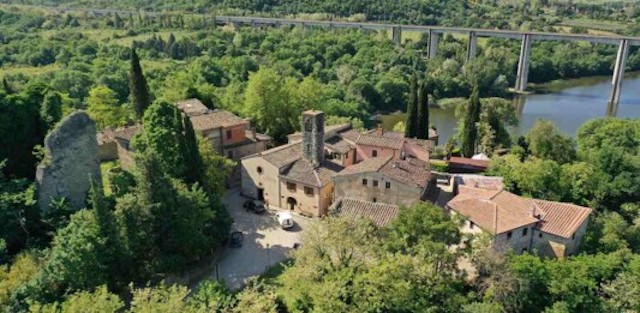
The Swallow Citadel of Peace, located in a medieval campus in the hills of Tuscany near the city of Arezzo, offers a variety of higher educational programs and degrees, but it comes with a catch.
Prospective students must live with the “enemy”—either those of a domestic ethnic group or a neighboring nation—all in the name of deconstructing the reasons behind their hatred and conflict, breaking the trance of viewing people as the “other,” and returning to their nations as peace leaders.
In this time of ethnic conflicts all over the world, where a generation has been brought up tending plants sewn by seeds of conflict four or five generations in the past, it could be the most important school on Earth.
“We didn’t want to build a Utopian place where students could pretend war doesn’t exist,” explains Franco Vaccari, co-founder and president of Rondine. “We wanted, rather, to create a neutral ground, away from the chaos of their homelands and bigger Western cities, where our students could focus on a peaceful dialogue.”
The school, called Rondine, which means the swallow in Italian, offers various degrees like a master’s program in conflict management and humanitarian action. Students arrive and begin an intensive course in the Italian language and then proceed to study interfaith dialogue, methodological, and leadership skills to deconstruct the idea of “the enemy” and reconciliation.
At the end of their journey, they are required, as per the scholarship, to go back to their country of origin and lead a peacebuilding and reconciliation program for 1 year.
Ruzica Markovic is one such student who spoke to the Christian Science Monitor about her progress. A Bosnian Croat born in the aftermath of the Balkans War, which saw the ethnically motivated killing of 100,000 people across the region, she has since graduated and returned home to hold interfaith cafe events, conferences, and summer camps focused on reconciliation.
“I learned to see the other person as myself: a being with emotions, challenges, pain, frustrations, maybe some traumas. That’s the lesson I brought back home,” Ms. Markovic told CSM in a video call from Sarajevo.
It’s not as easy a mission as it might seem when walking through the veritable medieval castle that makes up the Rondine campus, filled with gnarled oaks and beautiful Tuscan food, and educators at the Citadel of Peace said that sometimes the news gets turned on and arguments flair up that haven’t been expressed in months.
But many opportunities like shared study, communal dorms, and sporting events all help to reinforce the idea, nay the truth, that the students there are just people, not enemies.
This year’s new class will include Armenians and Azerbaijanis—hot on the heels of the latter’s seizing, and some say ethnic cleansing, of the former’s presence in the disputed territory of Artsakh-Nagorno-Karabakh. It will include Russians and Ukrainians, hot on the heels of the latter’s recent defeat by the former in the Donbas and Kherson.
It will include Canadians and Americans of tribal origin, European origin, and Palestinians and Israelis.
The good news here is a proactive program working on understanding and peace at the grassroots level. Today’s JohnKu talks about getting along. I hope you have a fabulous weekend.
Peace by John W. Howell © 2023
Peace is not easy,
It takes a lot of hard work . . .
And understanding.