The message on the coffee machine’s screen is very clear: No coffee until we are clean. Throwing hands up in the air, all peace seems lost until the second message flashes: It only takes two minutes; press start. Grabbing a piece of courage, pressing start saves the day. There is some noise, and then the magic message: All Clean.
The first sip brings the brain to life and reminds us to grab the clock. The time is set for September 20th, 1924, and the location is Washington, D.C. When the plunger is pulled, we find ourselves on the corner of Rhode Island Avenue N.W., M Street, and Connecticut Avenue N.W. in Washington, D.C. Here, the dedication of the Nuns of the Battlefield is a public artwork made in 1924 by Irish artist Jerome Connor.
The artwork honors the more than 600 nuns who served as nurses to both the Union and Confederate injured and ill troops during the US Civil War.
The lower right side of the relief is signed: JEROME CONNOR 1924
The lower left side of the relief is inscribed: BUREAU BROS. BRONZE FOUNDERS PHILA. ENN
On the granite above the relief is inscribed: THEY COMFORTED THE DYING, NURSED THE WOUNDED, CARRIED HOPE TO THE IMPRISONED, GAVE IN HIS NAME A DRINK OF WATER TO THE THIRSTY.
On the granite below the relief: TO THE MEMORY AND IN HONOR OF THE VARIOUS ORDERS OF SISTERS WHO GAVE THEIR SERVICES AS NURSES ON BATTLEFIELDS AND IN HOSPITALS DURING THE CIVIL WAR.
On the rear of the slab near the base is inscribed: ERECTED BY THE LADIES AUXILIARY TO THE ANCIENT ORDER OF HIBERNIANS OF AMERICA. A.D. 1924 BY AUTHORITY OF THE CONGRESS OF THE UNITED STATES
Just before the Temperance Union served lemonade, our alarm goes off, and we are in the comfort of the couch. A text has arrived from Linda Hill. It reads:
Your Friday prompt for Stream of Consciousness Saturday is “peace/piece.’” Use one, use them both (for bonus points), use them any way you’d like. Enjoy!
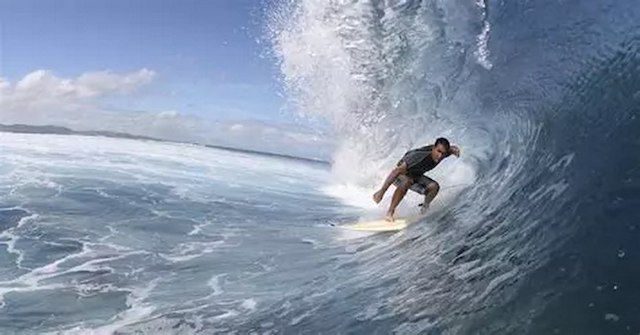
Nearly 90 million metric tons of planet-warming carbon have been found surrounding surf breaks worldwide, making these coastal locations essential climate allies and ideal locations for conservation efforts.
The news came from a groundbreaking study by conservationists examining forests, mangroves, and marshes around surf breaks—submerged features like rocks or reefs that create great surfing areas.
This is all the better for surfers themselves. Protecting these coastal ecosystems from development means more space and more waves for them.
Researchers analyzed more than 4,800 popular surf spots across 113 countries for the study. They found that immediately surrounding areas (within 0.6 miles or 1 kilometer of the waves) store over 88 million tons of irrecoverable carbon. That’s roughly equivalent to the annual emissions from 77 million gas-powered cars.
When the surrounding area is expanded to 3 kilometers or 1.8 miles, the amount of carbon stored in the ecosystem doubles to 191.7 million tons. According to the most up-to-date models, irrecoverable carbon refers to the carbon-rich lands humanity must protect to prevent the worst impacts of climate change.
“This research demonstrates the enormous role that protection of surf breaks and surrounding coastal areas can have in our global fight to reverse biodiversity loss and combat climate change,” said Scott Atkinson, a surfer, senior director of surf conservation at Conservation International, and an author of the study.
“Our study shows where we must now focus on legally protecting these areas. Surfers worldwide are fantastic allies for efforts like this—they love the ocean, know it is threatened, and are extremely motivated to protect it. They’ve been ‘on board,’ so to speak, helping to lead the establishment of all the Surf Protected Areas we’ve partnered to create.”
To date, Conservation International, which partners with surfers from the Save the Waves Coalition, has contributed to the establishment of 30 Surf-Protected Areas in Indonesia, Costa Rica, and Peru. These Areas are centered on surf breaks and seek to protect their larger surrounding ecosystems, including coastal forests, mangroves, beaches, seagrass, coral reefs, and the waves themselves.
Over half of these (23 Surf Protected Areas) have been established in Indonesia, which was used in the paper as a case study in creating an effective network of community-based protections. Collectively, the 23 locations form Indonesia’s initial Surf Protected Areas Network, covering more than 148,000 acres. This network can be expanded to hundreds of world-class surf sites across the incredibly biodiverse and carbon-rich country.
Atkinson also highlighted the positive impacts of the community-based Surf Protected Areas on Morotai Island in Indonesia, which is the focus of the paper’s case study.
“They protect precious marine and coastal ecosystems and strengthen community bonds and cultural heritage. Local people on Morotai have surfed on handmade wooden boards since at least World War II and have a strong surf culture,” he said.
“Additionally, local surf and conservation-related livelihoods are flourishing, with eco-friendly tourism and sustainable fishing practices becoming the norm. The community’s involvement in conservation efforts has fostered a sense of pride and ownership, showcasing the power of grassroots initiatives in achieving lasting environmental and social benefits.”
The good news in this story is that vital areas of conservation are being protected. Today’s JohnKu talks about the need for protection. I hope you have a wonderful weekend.
This post ran on August 25, 2017. It may still be helpful.
* * *
Top Ten Things Not to Say to a Contractor
This list was inspired by a number of discussions held with contractors lately. I hope you like it.
10 Do not say to a contractor, “I’m in no rush.” If you do, at best, the job will take longer than you could conceive. At worst, you’ll be at the bottom of the list of clients, and your job might get done before you retire. (The fact that you are only forty is not comforting, Desmond.)
9 Do not say to a contractor, “I want your best price.” If you do, at best, the bid will be only ten percent more than it would have been. At worst, your bid will come out somewhere North of what you expected to pay to rebuild the house, let alone do repairs. (Hang on to that defibrillator, Dalton. You may need it when the actual bill is presented, given all the change orders.)
8 Do not say to a contractor, “I have another bid to compare with yours.” If you do, at best, you will actually get his bid. At worst, you will wait for a bid that will never come since the contractor figured you would take the other one anyway. (That strategy didn’t work well, did it, Darren?)
7 Do not say to a contractor, “I really don’t know what I want.” If you do, at best, it will cost plenty to find out. At worst, you may spend a lot of money and finally know what you don’t want. (That is sure an ugly addition, don’t you think, Dustin?)
6 Do not say to a contractor, “Do what you think is best.” If you do, at best, what is best for the contractor is best for you. At worst, what is best for the contractor is to send his child to college on the proceeds from your job. (You should have asked more questions, Davis.)
5 Do not say to a contractor, “I don’t mind a little dust.” If you do, at best, your vacuum will keep up. At worst, you’ll find yourself in the ER with advanced symptoms of asthma. (You should have known when all the workers were wearing respirators, Deacon.)
4 Do not say to a contractor, “We get up early.” If you do, at best, it is early, at eight o’clock, to the contractor. At worst, the first light will bring you the wake-up sound of a Skill saw in the next room. (Establishing the work hours might have been wise, Dwayne.)
3 Do not say to a contractor, “We can do without water for as long as it takes to fix.” If you do, at best, the fix will be quick. At worst, the water will be shut off on Friday at three in the afternoon, and the job will be finished that next Monday at nine o’clock AM. (A nice long weekend without water for a three-hour repair is not a bad trade-off, right, Darrell?)
2 Do not say to a contractor, “Help yourself to soft drinks and water.” If you do, at best, they will be used only when needed. At worst, you didn’t realize that the contractor’s city-wide crew numbered thirty, and you were out of liquid by noon. (Should we have set a limit, huh, Devan?)
1 Do not say to a contractor, “Sure, you can return later and finish that little job.” If you do, at best, you’ve held back some money, and it gets done. At worst, you paid the whole bill, and it has been three months without a return phone call. (Good luck with that little job. Maybe you can hire another contractor to do it, Duane.”
Today, we are going to Lakeway Park for Spikeball Day. What is Spikeball? (Or Roundball as it is known too) It is a game with four players, a ball, and a trampoline. The idea is to bounce the ball off the trampoline toward the opposite two-person team. They have to return it back by bouncing it off the trampoline. If you want to know more, here is a link. https://spikeball.com/pages/official-rules
We are catered by Odd Duck of Austin. Our entertainment is (who else) Spike Jones.
The wait for coffee has my nerves on edge. I check my phone for messages, but there are none. That process took ten seconds of waiting time, so it is pure downtime until the soothing brew hits my cup. Ah, there they are, the first drops of the life-giving fuel followed by a full cup. With my brain fully functioning, it is time to turn to the clock. The year is 1924, and the day is September 13th. The location is Washington, D.C. The plunger is pulled, and we find ourselves at the retirement announcement of General Pershing.
General of the Armies John Joseph Pershing GCB (September 13, 1860 – July 15, 1948), nicknamed “Black Jack”, was a senior American United States Army officer. He served most famously as the American Expeditionary Forces(AEF) commander during World War I from 1917 to 1920. In addition to leading the AEF to victory in World War I, Pershing notably served as a mentor to many in the generation of generals who led the United States Army during World War II, including George C. Marshall, Dwight D. Eisenhower, Omar Bradley, Lesley J. McNair, George S. Patton, and Douglas MacArthur.
Upon reaching the age of 64 (as required by Department of War regulations at the time), The General was granted full pay and allowances for the rest of his life, as well as continued use of his office at the SWAN Building in Washington, which served as the headquarters of the Department of State, the Department of War, and the Department of the Navy. Pershing was succeeded as Army Chief of Staff by Major General John L. Hines.
Before the drinks were served, the alarm went off, and back on the couch, we landed. Checking my phone, a text has come in from Linda Hill. It reads:
Your Friday prompt for Stream of Consciousness Saturday is “phone.” Use it any way you’d like. Have fun!
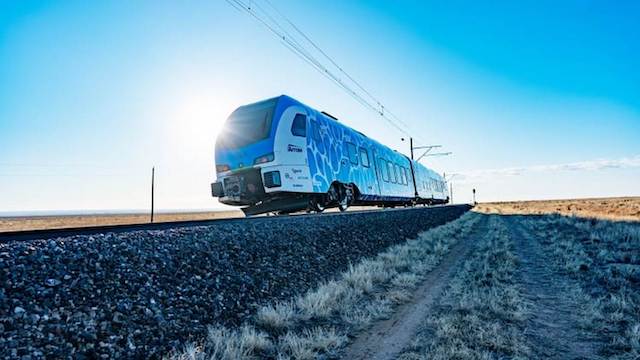
In Los Angeles County, a new, low-emissions commuter train is powering itself with hydrogen fuel cells to combat local and global smog.
Liquid or gaseous hydrogen is considered the best green alternative to the heavy fuels that power society’s largest machines, and this ZEMU train is just a few months away from starting routine service from San Bernadino and Redlands to LA proper.
ZEMU stands for zero-emissions multiple units and possesses several advantages over other decarbonized rail transport. Electric trains recharge via overhead powerlines, which require millions in funding to install and maintain and aren’t practical for long distances.
“The reality is it can be used anywhere existing rail happens now,” says Tim Watkins, chief of legislative and public affairs at the San Bernardino County Transit Authority, the agency behind the project. “It doesn’t require a new capital investment into infrastructure.”
Manufactured by the Swiss company Stadler, ZEMU trains take on hydrogen fuel split into hydrogen molecules, generating energy that recharges an electric battery that powers the train’s motors. The battery is also recharged by breaking, and the only emission of any sort is water vapor.
“I think it’s going to enable a lot of places to decarbonize without having to make costly investments in infrastructure,” Watkins told Fast Company Magazine.
The trains are currently undergoing the final testing phase on local tracks, and service is slated to begin in early 2025. At the moment, they use hydrogen created via fossil fuels, so while the localized emissions are still zero, the trains still have a carbon footprint.
Green hydrogen, made using renewable energy sources, is expected to be available in the not-too-distant future. However, as Adele Peters at Fast Company details, even if the trains lead to CO2 entering the atmosphere, San Bernadino needs zero-emissions transport quickly.
A leading air quality index survey recently gave the San Bernadino area an ‘F’ grade for air quality. The city suffers from more days of smog than almost any other city in America.
The good news in this report is that hydrogen fuel cell practicality is now a reality. Today’s JohnKu talks about exploring alternatives. I hope you have a terrific weekend.