Today is Easter Sunday, so we are visiting the community Activity Center for the annual Easter Egg Hunt. Since rain is threatened, the event has been pulled indoors. We are catered by Austin Taco Project, and our entertainment is Judy Garland and Fred Astaire
Wow! The speed of the coffee delivery this morning was nothing short of outstanding. It appears the coffee machine has developed a way to sense the urgency of the need for caffeine. It responds at a speed necessary to prevent a total collapse of the host. It is very logical for AI to continually adapt to its surroundings. It figures that if something happened to me, like a total caffeine meltdown, there would be no attendant to keep its vitals up.
A sip of the miracle brew brings to mind the clock. Reaching for it is interrupted by the way-too-loud interference of the Westminster chime of the doorbell. This cacophony is joined by the eardrum-shattering warnings of Twiggy and Tempest. Before a brain bleed begins, a toss of two marrow bones into the soundproof bunker and a slam of the ten-inch door bring peace to the household.
The security system must be deactivated before opening the front door and addressing the visitor. Before that, though, the SWAT team needs to be put on standby. A quick text to the leader confirms that status. The control panel makes the shutdown of the security system process simpler. The boiling oil vats are put on standby, the Trebuchet on safety, the concertina wire rolled, the Claymore mines reset, the tower Gattling guns disengaged, the moat net dropped, the alligators fed, the IUDs and shoulder-held rockets put away. The locks on the door are thrown. A look at the security system camera shows a short guy who looks like a hunter. He is carrying an ominous-looking shotgun.
Thinking twice about opening the door, a call is made to him through the loudspeaker. He responds that he is looking for a wrascally wabbit. “No wabbits here,” is the reply. He states he has a Linda Hill message and holds up an envelope. “Just drop it on the porch.” He shrugs and tosses the message into the air and, with all the smoothness of a seasoned skeet shooter, blows the envelope to Kingdom Come. Punching the skunk scent button does the trick, and the hunter disappears down the street.
There is a text from Linda Hill. It reads: “Your Friday prompt for Stream of Consciousness Saturday is “exclamation.’” Add an exclamation mark to your title or the first word/sentence of your post, and just keep writing. Have fun!”
GNN has reported on multiple occasions how artificial intelligence is being leveraged to detect signs of cancer.
Now, a team of high schoolers is using AI to help their community combat one of the deadliest forms: oral cancer.
The Oral Scan app detects signs of oral cancer using a photo taken on a smartphone with an 82% success rate. If the AI finds evidence of a tumor, it can diagnose the stage with an even better 87% success rate.
Not bad for a bunch of teenagers, and even though 82% is below what most medical ethicists believe should be the threshold for outsourcing tumor identification to a machine, it’s far better than the rate of 0%, which is what many in the team’s home state of Arkansas will experience.
52,000 Americans are diagnosed with oral cancer every year, and more than 12,000 die as a result, according to their research. Early detection of oral cancers can boost survival rates by 40%, but such cancers are detected early in only 30% of cases.
In dental deserts, these numbers are even worse. In Arkansas, for example, 90% of the population didn’t visit a dentist last year, and according to one dental surgeon the team spoke with, whole counties in Arkansas don’t even have a dentist to visit.
“We learned that current diagnosis methods are expensive, intrusive, and often inaccurate, making early detection rare,” said Veera Unnam, one of the team members, from Bentonville West High School.
Their response is Oral Scan, a free app that costs just 50 cents for each diagnosis and delivers a response in just 15 seconds.
The team designed the app to be usable in all countries on both Apple and Android IOS and ensured it. was easy and intuitive to use, showing their commitment not only to Arkansas but the world at large.
Recently, Unnam and his two colleagues entered Oral Scan into the 15th annual Samsung Solve for Tomorrow competition, empowering public school students (grades 6-12) to drive positive change in their communities by applying STEM know-how to address real-world, pressing issues.
Each finalist school receives $50,000 in Samsung technology and supplies and will compete at the live Solve for Tomorrow Pitch Event in Washington, DC, on April 28th. Three National Winners will each earn $100,000 in prizes, and one will be named the Community Choice Winner.
Celebrating the 15th year of Solve For Tomorrow, Samsung has awarded more than $27 million in resources to nearly 4,000 public schools across the US to date, and the Oral Scan team will be hoping they’re among the recent winners. However, before the winner’s announcement, Oral Scan is already getting national news headlines, and the team has been invited to speak at medical conferences to present their invention.
You can watch the student’s presentation here.
The good news about this story is that a team of students took the initiative to find a way for the unserved to check for oral cancer. Today’s JohnKu talks about youth and the future. I hape you have a wonderful weekend.
“Dearly beloved. We are gathered here today to witness the beautiful union of this male and this female. If anyone has just cause as to why this marriage should not take place speak now or—”
“I have just cause.”
“Who are you?”
“I am the husband of the bride.”
“Oh, come now sir. Perhaps you have made a mistake or took a little too long at the pre-reception.”
“I’m not drunk and I am not mistaken. This bride is married to me.”
“Why are you not together then?”
“You can ask her, but for all I know she just got tired.”
“Tired? Tired of what?”
“Well… she just became a mother and I think it was all too much.”
“Just became a mother? You have to be kidding.”
“No she left the children and I to fend for ourselves.”
“Children? How many children?”
“There are six.”
“Six? I think I’m going to faint. I would be tired too.”
“It’s not a big deal. Some have up to twelve.”
“Okay we must be talking by each other. Explain the six children.”
“We are Cassowary birds and she laid six eggs.”
“Oh. That’s different.”
“And like all Cassowary birds she left me to raise them. I’ve been on the nest 50 days and now they are hatched.”
“You want her home.”
“It would be nice.”
“May I say something?”
“Ah, the Cassowary mother wants the floor.”
“If you two idiots would look up Cassowary birds you will find that once the eggs are laid, our job is done. I’m not going back there ever.”
“I need to say something.”
“The chair recognizes the groom.”
“I don’t want chicks so we make a perfect couple.”
“I’m no expert but there has to be a formal dissolution of the first marriage before I can marry you two.”
“We never got married.”
“What?”
“He was a good looking bird so I just stayed in his nest.”
This post was published on February 3, 2014, by Marie Ann Bailey and me. Since we all are still writing, this may contain some good advice.
Top Ten Things Not to Do When Writing a Novel
10 When writing a novel, do not try to explain what you are doing to anyone. If you do, at best, they will walk away shaking their head. At worst, you might find yourself receiving an intervention by well-meaning friends and family that you didn’t know was being filmed until you saw it on Dr. Phil.
9 When writing a novel, do not assume everyone is waiting for it to be finished. If you do, at best, you may get used to the sound of crickets when it’s done. At worst, people might start avoiding you on purpose without trying to hide that they are.
8 When writing a novel, do not ask your spouse to read parts and provide an opinion on how they like it. If you do, at best, you might end up in an argument over whether you really only used your imagination in writing those sex scenes. At worst, you both might end up paying a lot of money to a divorce lawyer.
7 When writing a novel, do not ask your children to be quiet while you write. If you do, at best, they will make even more noise, and you will have to find a way to soundproof your room. At worst, you might just be investigated by child protective services at the request of neighbors tired of the screaming and crying (mainly from you).
6 When writing a novel, do not think you need a rest by playing a video game or knitting a sweater sleeve. If you do, at best, you’ll lose your focus on your plot. At worst, you will finish the sweater and reach the god level in the game but never finish the book.
5 When writing a novel, do not try to decide whether you should plan the book or just write it. If you do, at best, you may get stalled on starting the novel and have to adjust your publication deadline. At worst, you may end up having an argument with yourself and end up not on speaking terms, which would totally blow your deadline.
4 When writing a novel, do not keep your own counsel on word usage or grammar. If you do, at best, you may get lucky and have only a few mistakes. At worst, you will need to leave town and change your name to avoid the laughter from your peers.
3 When writing a novel, do not do your own editing. If you do, at best, you may be surprised by the number of problems in your book. At worst, you may want to book a trip to a country with no extradition treaty with the US.
2 When writing a novel, do not avoid rich characterizations. If you do, at best, you will have a book filled with pounds of boring material that not even you will want to read. At worst, you will need to find a decent disguise when meeting other authors and readers to avoid being called out by your characterizations of them.
1 When writing a novel, do not skimp on the plot, thinking your literary style will pull you through. If you do, at best, you might have a book you love but no one else does. At worst, you might win the Worst Literary Book of the Year Award in recognition of your achievement.
Today we are visiting the Activity Center where sign-ups are taking place for summer camps. The idea is to give the children an idea of the camp activity and the opportunity to sign up. We are catered by Nervous Charlie’s Bagels of Austin. Our entertainment is Allan Sherman.
Menu
THE CLASSIC – 2 fried eggs and your choice of protein and cheese
BAGEL WITH LOX – Acme lox, sliced red onion, capers, and your choice of cream cheese
PASTRAMI HASH – Pastrami, breakfast potatoes, pepper jack cheese, fried egg, and pickled jalapeños
THE LONGHORN – 2 fried eggs, cheddar cheese, breakfast potatoes, Charlie’s hot sauce (contains dairy), and meat choice
THE ALEXA – Tomato, avocado, and your choice of cream cheese
THE BIG APPLE – Turkey, sliced apple, brie cheese, and honey mustard
THE EMPIRE – Fried chicken cutlet, bacon, coleslaw, mozzarella cheese, and Russian dressing
WILLIE’S HOT PASTRAMI – Pastrami and spicy mustard
THE TREE HUGGER (vegetarian) – Cucumber, spinach, tomato, avocado, alfalfa sprouts, and your choice of cream cheese
THE ULTIMATE ITALIAN – Black forest ham, Genoa salami, hot capocollo, shredded lettuce, tomato, sliced white onion, roasted red pepper blend, provolone cheese, oil & vinegar, and oregano
Time to go.
There’s the signpost.
Ah shaved ice.
Pony rides.
Arggg matey.
A camp for fencing.
Science camp.
Theater camp.
Make-up.
Cooking camp.
Art camp.
A petting zoo.
Baloon twister.
Food chain sponsor.
Computer coding camp.
Camp headquarters.
Lakeway Parks and Recreation
We have seen the camp sign-up so now lets enjoy the food and music.
This morning is cappuccino morning. The machine receives its command, and the grinding, whirring sounds bring joy to the heart. There it is—a beautiful 8 oz cup of frothy goodness. One sip and a wipe of the foam mustache prepare one for the clock. The clock is set for April 11, 1925. The location is Moscow, and the duration is half a day. A pull of the plunger has us standing watching two ceremonies.
The Metropolitan (Bishop) Peter of Krutitsy (Pyotr Fyodorovich Polyansky) was installed as the new Patriarch of Moscow and leader of the Russian Orthodox Church, on the same day as the funeral for his predecessor, Patriarch Tikhon of Moscow. Tikhon’s funeral in Moscow was the last major public Russian Orthodox Church event and the last major religious event in the Soviet Union for over 60 years. Peter, identified in Tikhon’s will as one of three potential successors, was selected by the council of 59 bishops because “the first two were already in prison.” Peter himself was confined to prison in December 1925 by the Bolsheviks and eventually executed on October 10th, 1937.
Our stay in Moscow is beginning to draw some attention, and the alarm saves us from getting into a jam with the NKVD secret police. We are back on the couch with a text message from Linda Hill. Your Friday prompt for Stream of Consciousness Saturday is “jam.’” Use it any way you’d like. Enjoy!
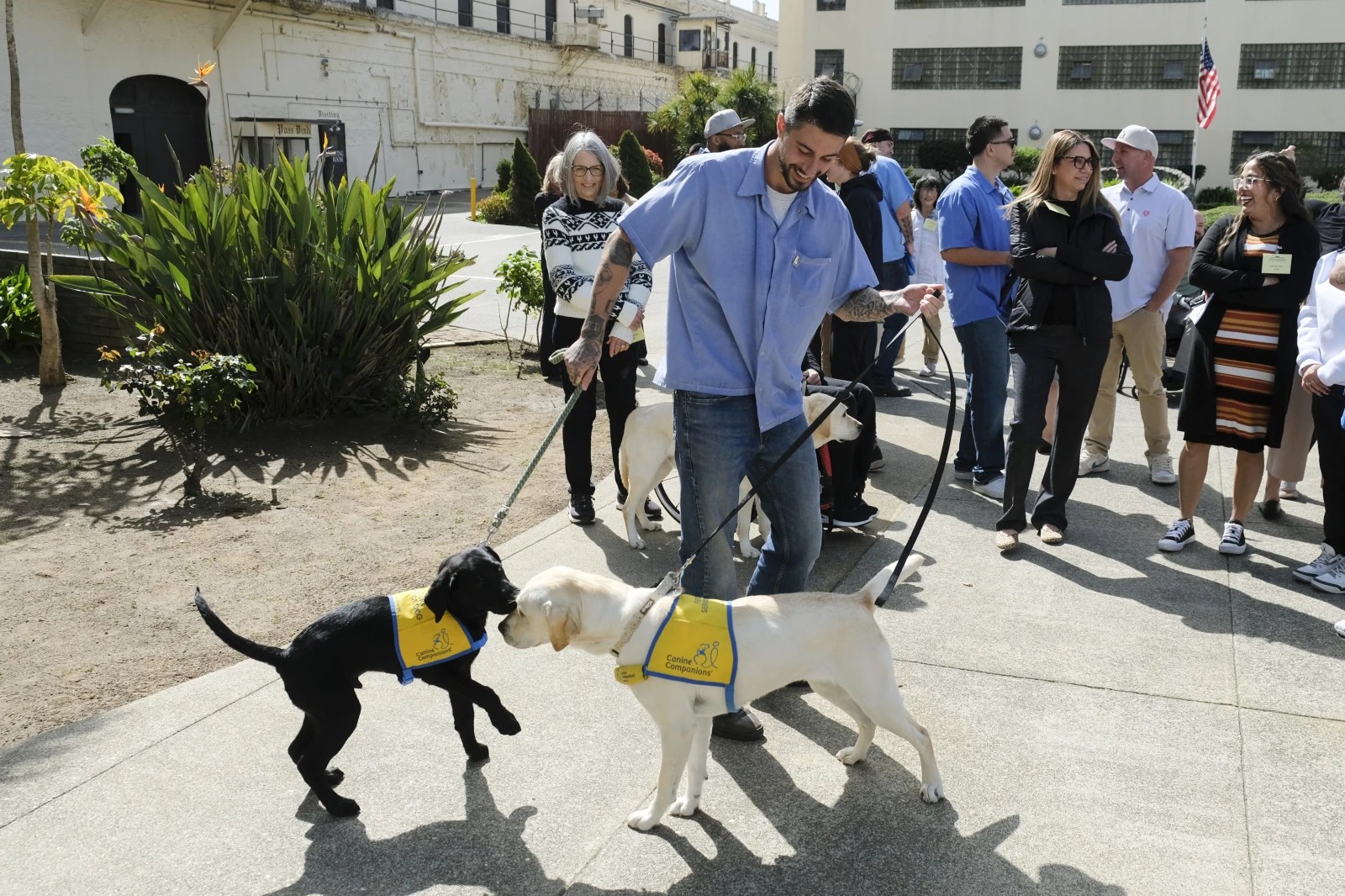
Chase Benoit, who is incarcerated at the San Quentin Rehabilitation Center, holds a pair of service dogs in training in San Quentin, Calif., Friday, March 28, 2025. (AP Photo/Eric Risberg)
Today’s good news story comes from the Ass0ciated Press
With tears and tail wags, San Quentin inmates reunite with puppies they raised into service dogs
By OLGA R. RODRIGUEZ – Updated 3:17 PM CDT, April 1, 2025
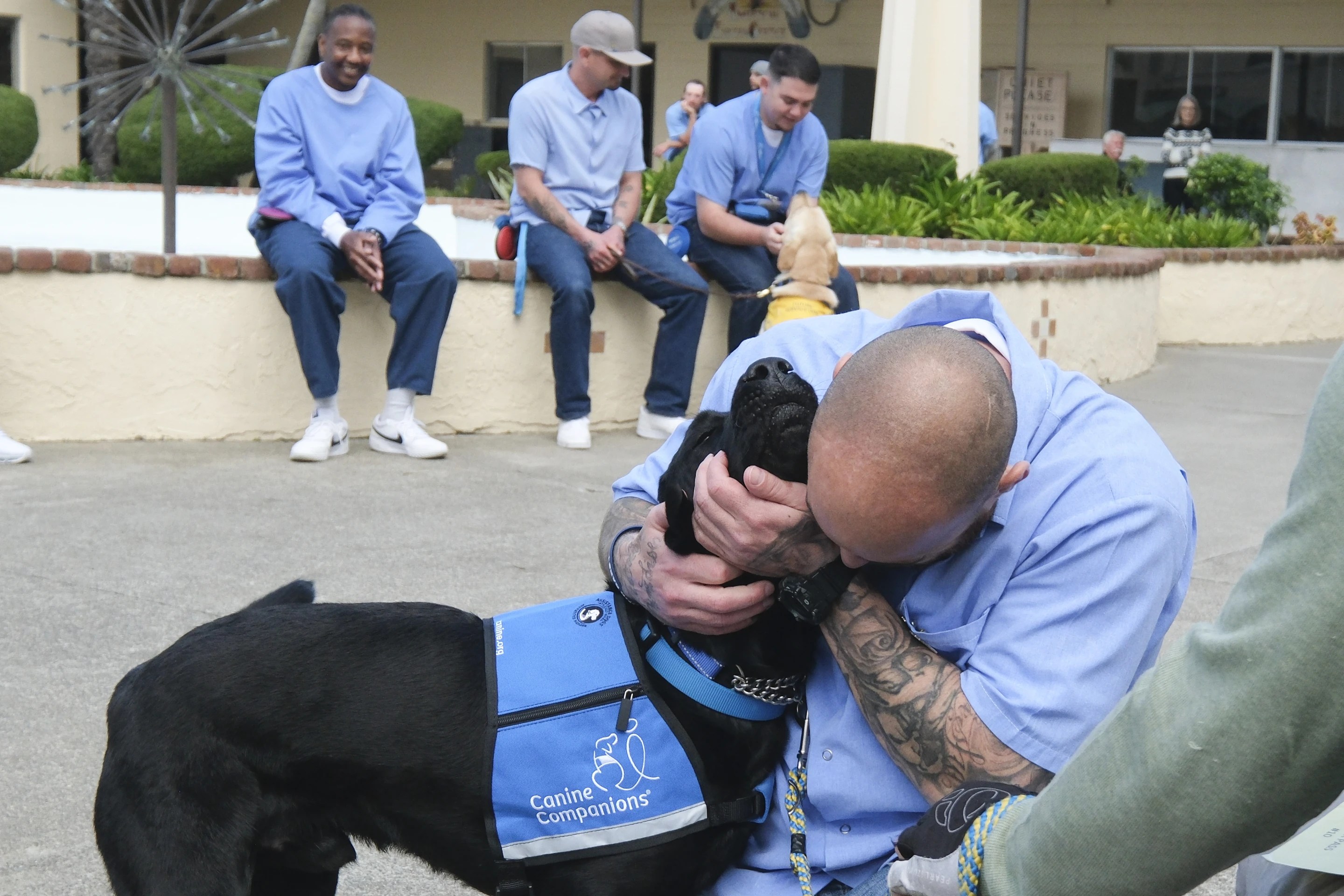
SAN QUENTIN, Calif. (AP) — Hugs, tears, barking, and tail wagging abounded at San Quentin’s prison when two black Labradors reunited with the incarcerated men who helped raise them to be service dogs.
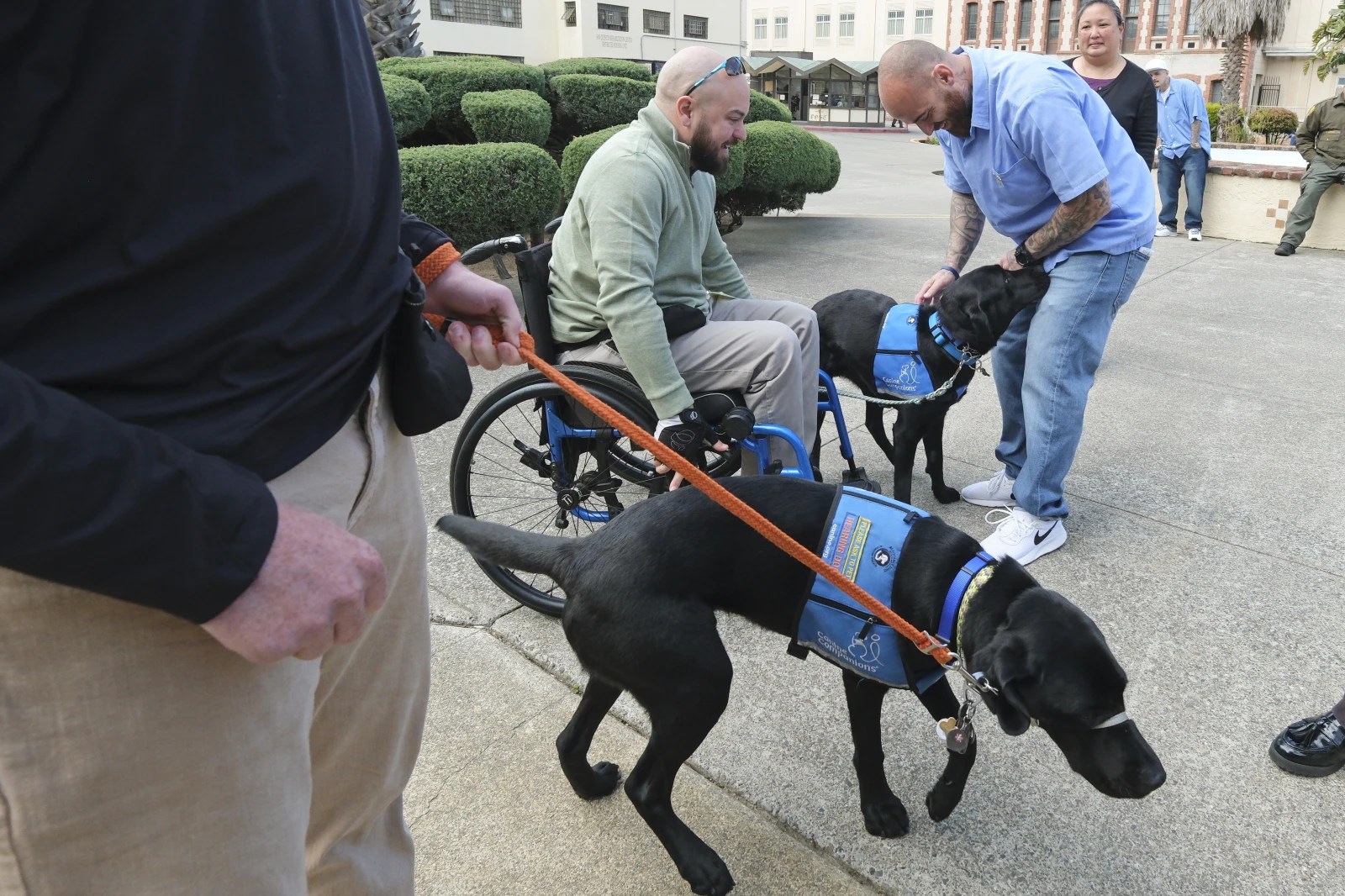
The emotional reunion brought Chase Benoit, Jared Hansen, and the 2-year-old dogs they helped train Wendel and Artemis. It was the men’s first time seeing their former canine companions again and their first time meeting the dogs’ disabled handlers in person.
Jared Hansen, right, who is incarcerated at the San Quentin Rehabilitation Center, visits with Artemis as his handler, Benjamin Carter, looks on in San Quentin, Calif., Friday, March 28, 2025. (AP Photo/Eric Risberg)
The encounter Friday in San Quentin’s main courtyard brought Benoit and Hansen full circle after helping launch the prison’s puppy training program in April 2023.
“Being in this program, it’s given me something that I think I’ve searched for my whole life,” said Benoit, who is serving 15 years to life for second-degree murder. “And that was meaningful purpose, doing something that’s good, better, bigger than myself and feeling like I’m part of something great.”
“He remembers me, for sure, I could tell when he came in. I’m so happy that you love him and that you have a bond,” Benoit told Quigley through an American Sign Language interpreter.
“He’s with me 24/7. He’s very gentle and good with people,” answered Quigley, a recent college graduate who took Wendel home in November after the black Labrador and golden retriever mix completed another six months of professional training outside prison.
Teaching pups the fundamentals in prison
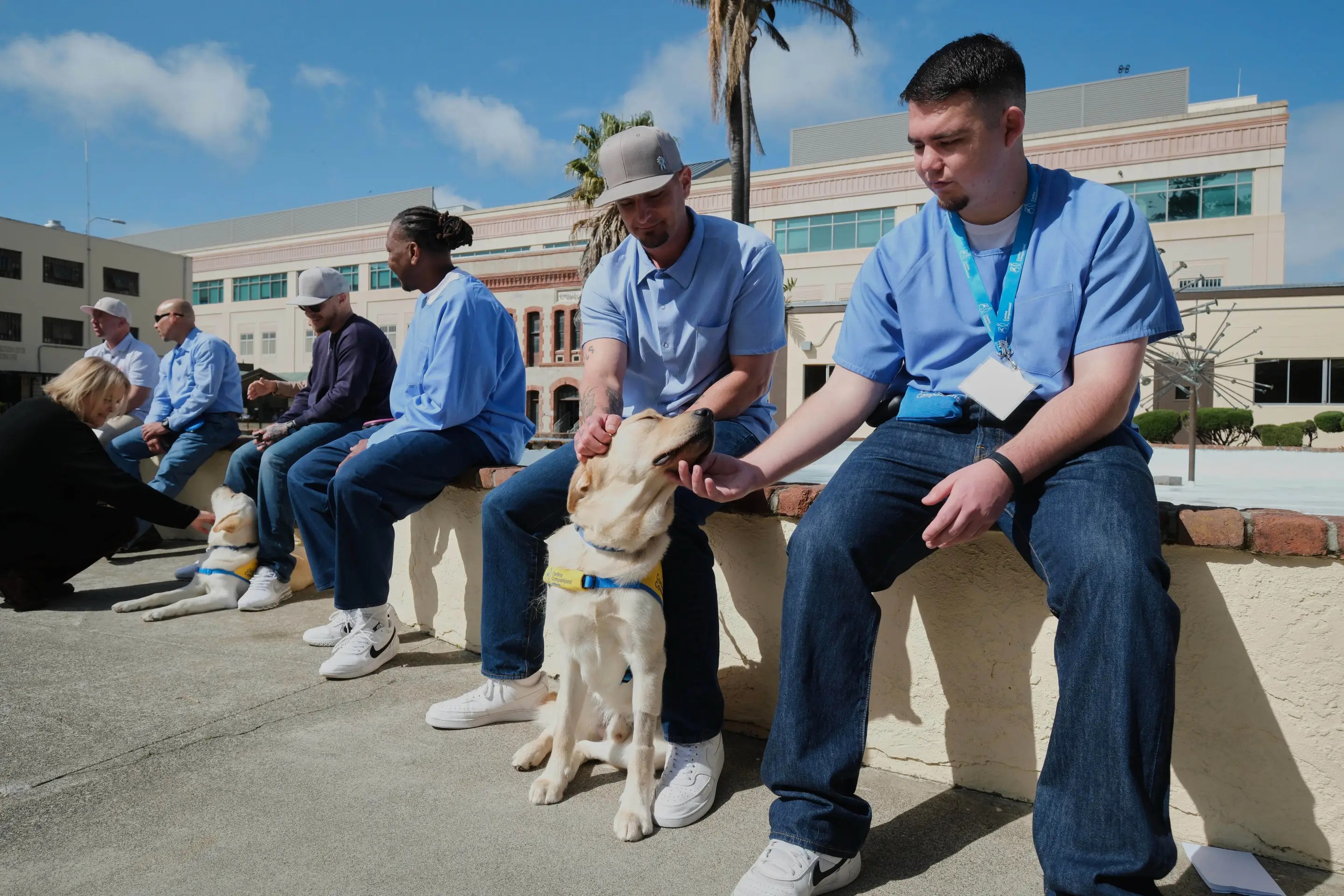
Benoit and Jensen were part of an initial group of four incarcerated trainers who shared their 4-foot-by-10-foot cells with the 4-month-old puppies. The men divided the responsibility of caring for and teaching the dogs foundational commands for a year.
Canine Companions, a nonprofit based in Santa Rosa, runs the program and provides free service dogs to people with disabilities. It has built the San Quentin program to 16 trainers and two dog sitters who, as of this week, are training eight puppies.
Artemis, a black Labrador, was matched with Benjamin Carter, a veterinarian from Portland, Oregon, who uses a wheelchair and traveled to California for the reunion.
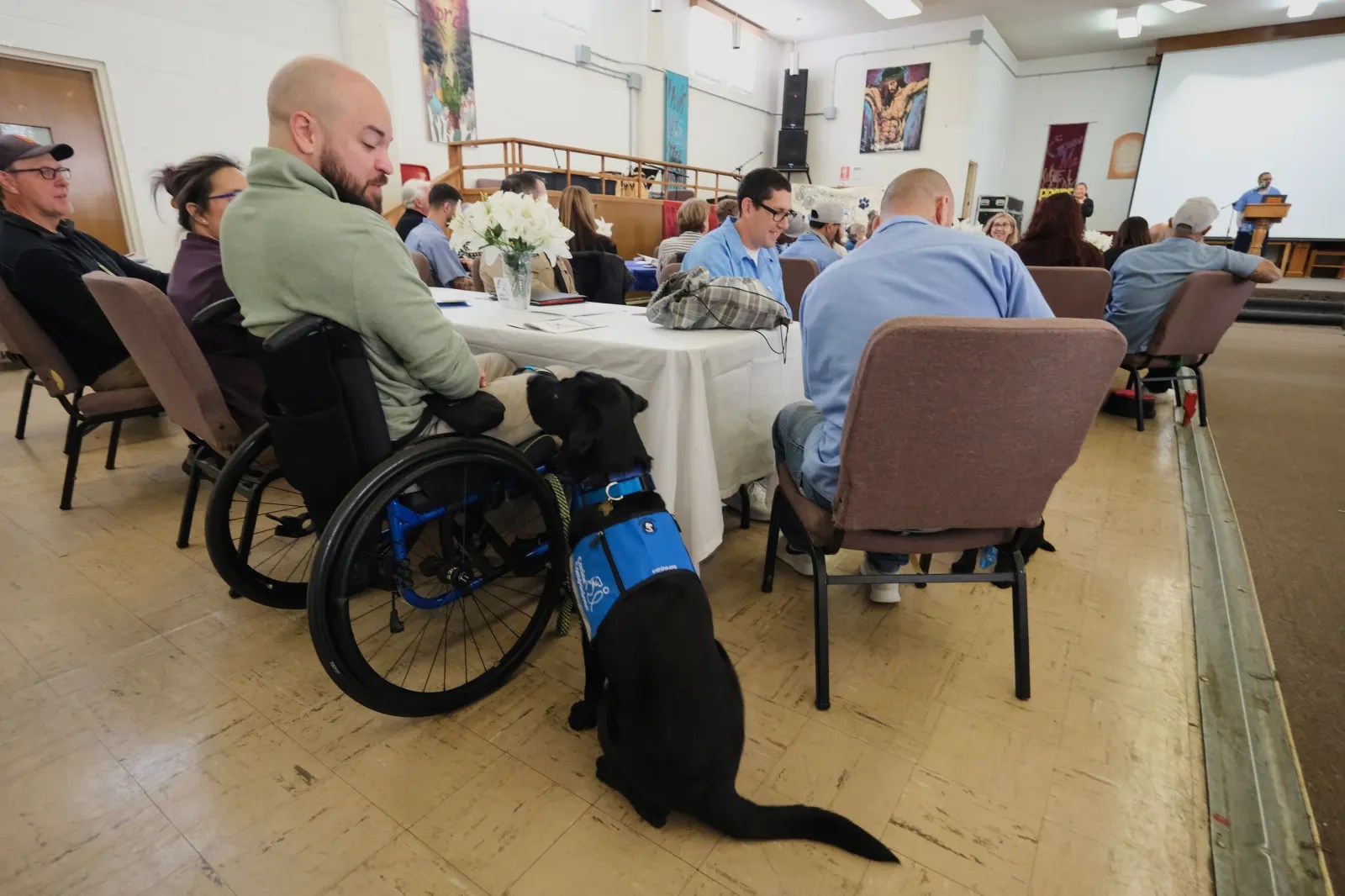
Handler Benjamin Carter looks at his service dog Artemis during a gathering at the San Quentin Rehabilitation Center in San Quentin, Calif., Friday, March 28, 2025. (AP Photo/Eric Risberg)
Like proud parents, Carter and Hansen shared notes on Artemis’ calm and loving personality and penchant for cuddles.
“Seeing him in action and actually serving somebody in the community, it’s just … I’m at a loss for words right now. It’s amazing!” said Hansen, who has been in prison for 15 years for bank robbery.
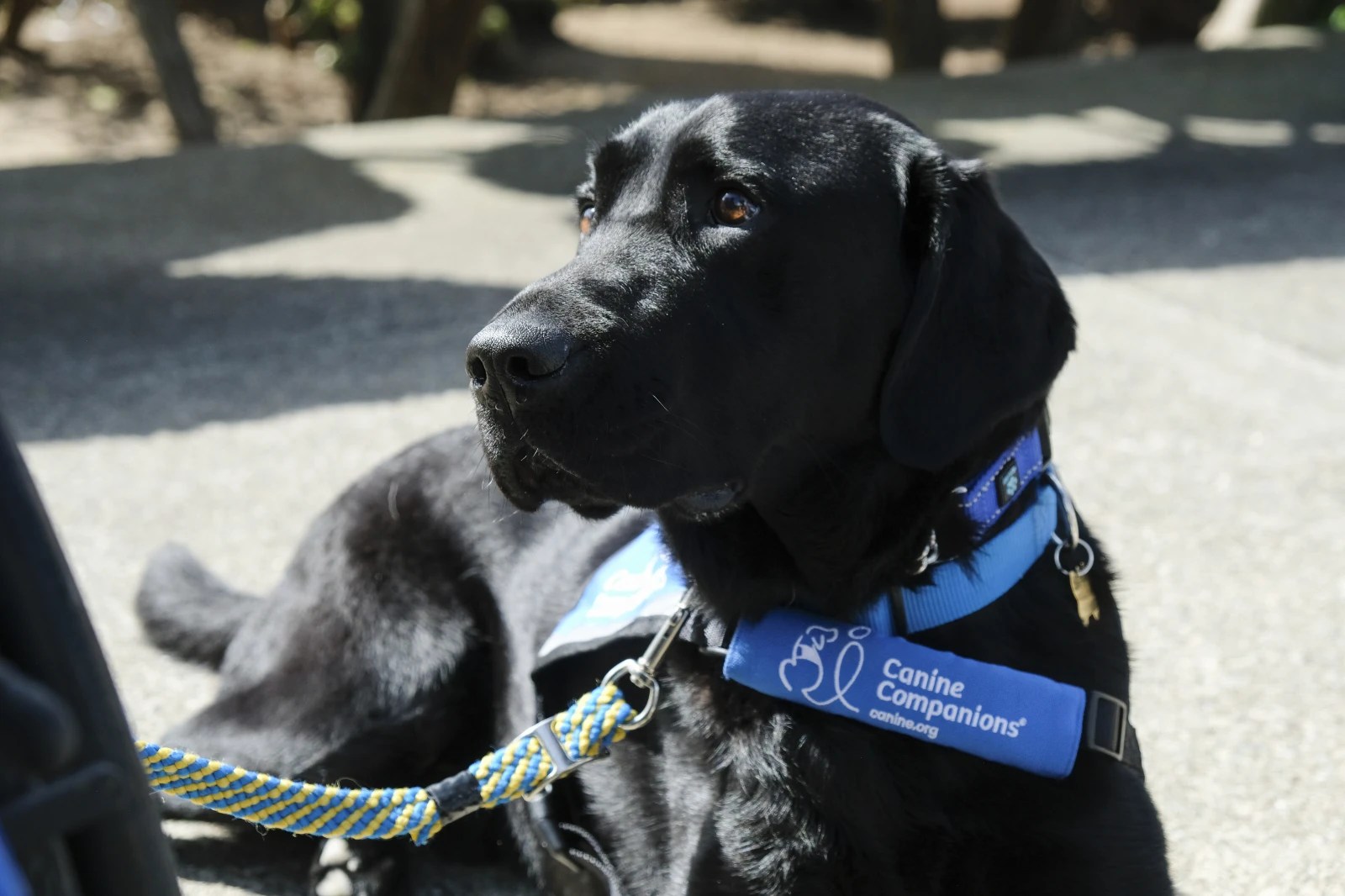
Artemis, a service dog, is seen by the wheelchair of handler Benjamin Carter at the San Quentin Rehabilitation Center in San Quentin, Calif., Friday, March 28, 2025. (AP Photo/Eric Risberg
Artemis, or Artie, pushes door plates, pulls doors open, fetches things around the house, and does many other tasks that would be hard for Carter alone.
First work, then cuddles
“He is responsive when he’s working. He is cuddly when he is off the clock. He’s an amazing companion. And all that structure, love, and trust was built from these guys here, so I’m just super grateful to them,” Carter said.
The puppies are placed with incarcerated trainers when they are between 2 and 4 months old and stay with them until they are about 16 to 17 months old. Every three months, the puppies are taken out for socialization experiences like interacting with children, riding in cars, or going to the grocery store.
Incarcerated men at the San Quentin Rehabilitation Center pet a service dog in training at the prison in San Quentin, Calif., Friday, March 28, 2025. (AP Photo/Eric Risberg)Jared Hansen, who is incarcerated at the San Quentin Rehabilitation Center, is greeted by Artemis, a service dog he helped train, in San Quentin, Calif., Friday, March 28, 2025. (AP Photo/Eric Risberg)
The incarcerated men teach the dogs about 20 skills, including fetching, sitting, and walking on a leash. After the dogs leave the prison, they train for several more months with professional trainers.
People incarcerated at San Quentin and who participate in the program have been convicted of crimes that include bank robberies, gun offenses, and murder. Only those in an “earned living unit,” where residents participate in an array of self-help programs, are allowed to apply for puppy training. Inmates with records that include any animal or child cruelty crimes are not allowed to participate, said James Dern, national director of puppy programs for Canine Companions.
The value of time
Dern said dogs trained in their prison programs have a 10% greater success rate at becoming service dogs than other candidates because of the amount of time and care that incarcerated puppy raisers put into their dogs.
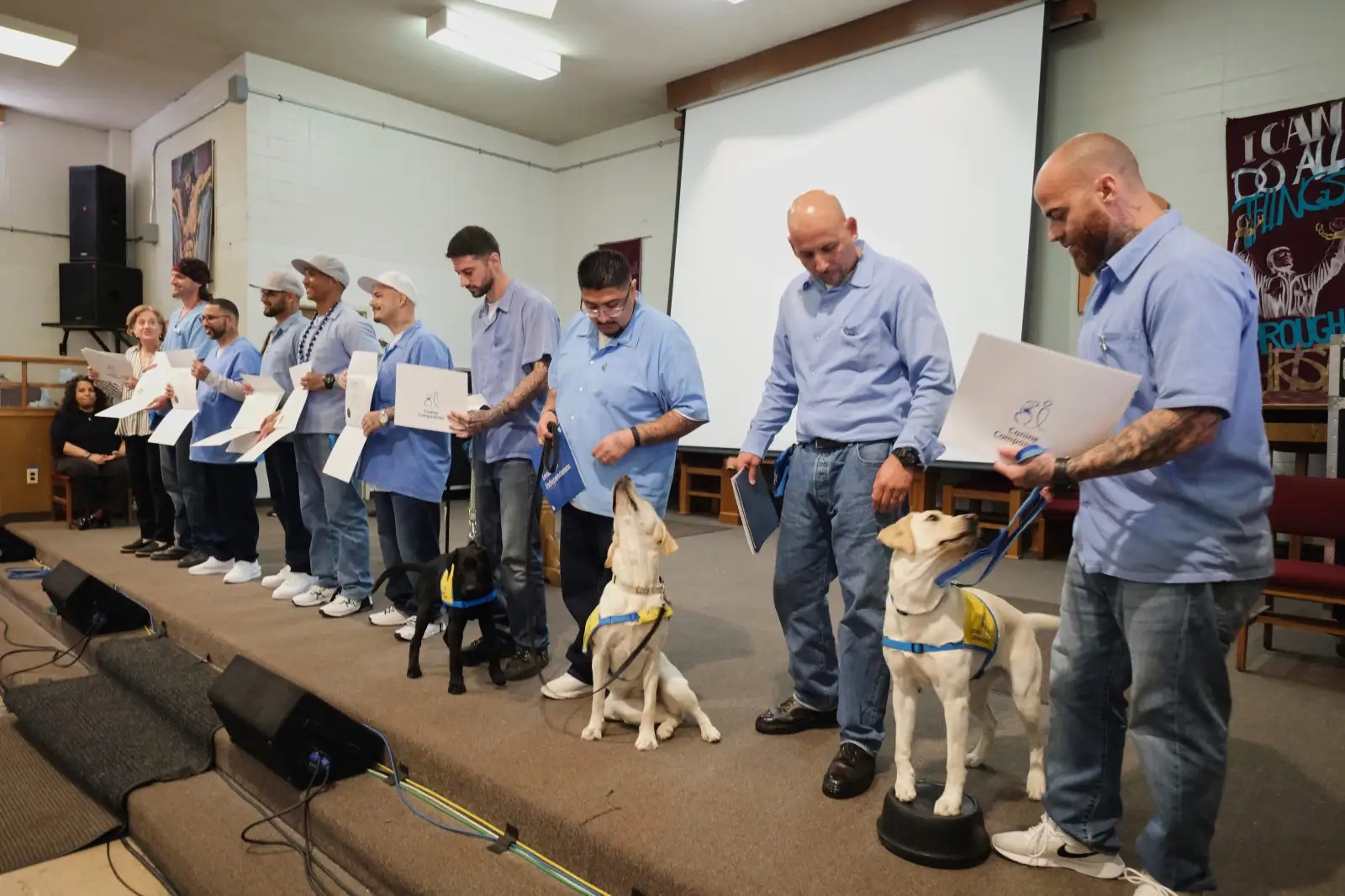
Jared Hansen, right, and other incarcerated men at the San Quentin Rehabilitation Center hold up their dog training certificates during a celebration in San Quentin, Calif., Friday, March 28, 2025. (AP Photo/Eric Risberg)
“Being given something to care about other than themselves and the opportunity to give back and to sort of start to make amends for the things they have done in their lives can be life-changing,” Dern said.
San Quentin was once home to the largest death row population in the United States. The puppy training program started the year it transformed into a lockup where less-dangerous prisoners receive education, training, and rehabilitation. Since then, another 11 correctional facilities have joined the nonprofit for a total of 24 prison institutions, Dern said.
Speaking to a crowd at the prison chapel gathered to celebrate the program, Benoit credited Canine Companions with bringing out the humanity, love, and caring in the incarcerated community. “Instead of keeping it to themselves within their small community of professional trainers or even volunteer puppy raisers, they shared this with us in prison. I think that’s huge,” he said.
The good news in this story is that people who have made grave mistakes can find a new path by helping others. Today’s JohnKu talks about second chances. I hope you have a delightful weekend.