Today, we are going to explore the neighborhood and check out what some consider trash. Is there treasure? You can decide. We are catered by Arlo Grey of Austin. Or entertainment is Mary Heather Hickman.
The desire for something different led to punching the Latte button instead of plain coffee. Had to stand back as the machine did its work. Much hissing and bubbling produced a tall glass of delightful milk foam and a layer of golden nectar. Someone called out my name, so I knew it was ready. While taking a big sip and noting the foam mustache, the Westminster chimes of the doorbell caused an instant eruption.
Twiggy and Tempeste were all about barking the intruder to St. Louis. Getting them settled was not easy. The question of what idiot would ring a doorbell when there is a sign to not do that is still unanswered.
Moving to the security system, the shutdown process begins.
The turret machine guns are set to stand by, the boiling oil cauldron tipping mechanism is turned off, and the automated arrow launching pods are unarmed. In addition, the Trebuchet, ballista, and falling rock device are switched to manual. The claymore mines are set to manual, the mote net rolled back, and the concertina wire retracted. The Iron gate is raised, and the bolts are thrown on the front door.
Standing there is a character who looks very much like Elmer Fudd. I ask what he wants, and he responds, “Have you seen a wabbit around here?”
“No, I have not seen a Wabbit.”
“If you do can you give me a call?”
“Might I ask what business you have with the Wabbit?”
“I want to shoot him. Here’s my card.”
“Okay Thanks. I’ll call if I see him.”
The guy turns around and heads off the porch. My mental note reads “No way Jose.” After dumping the card and touching the security activate switch the text tone causes me to check my phone. The text reads Your Friday prompt for Stream of Consciousness Saturday is “i before e.” Find a word that has an “i” before an “e” even if there’s a letter between them, and use it for your prompt word. Have fun!
credit – Guillaume Blondel, Archaeological Service of the City of Eu
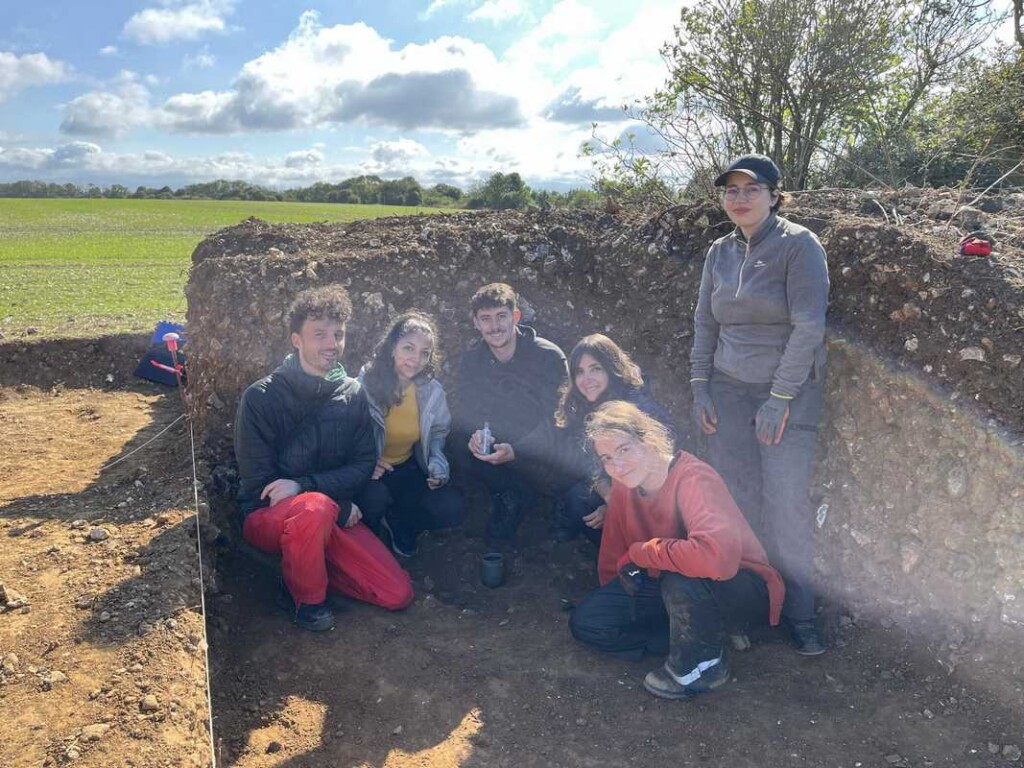
A team of student archaeologists in France was surprised while working on a site dating to Gaulic times.
The excavations, carried out under the direction of Guillaume Blondel, director of the municipal archaeological service of the city of Eu, delivered, among other things, a moving and very special testimony from the past.
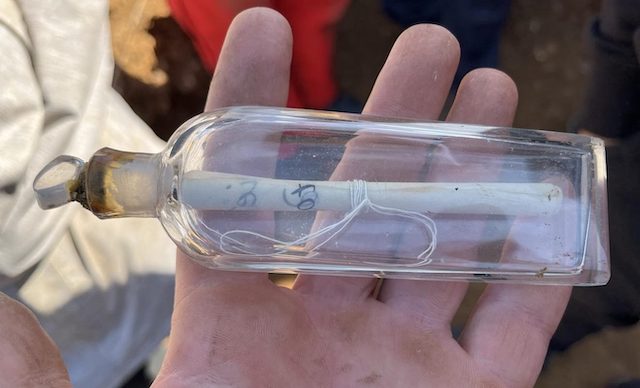
Located in a previously investigated section of the site, a message was discovered in a small glass bottle from the 19th century accompanied by two coins: a “time capsule” buried almost 200 years ago, a statement from the service read.
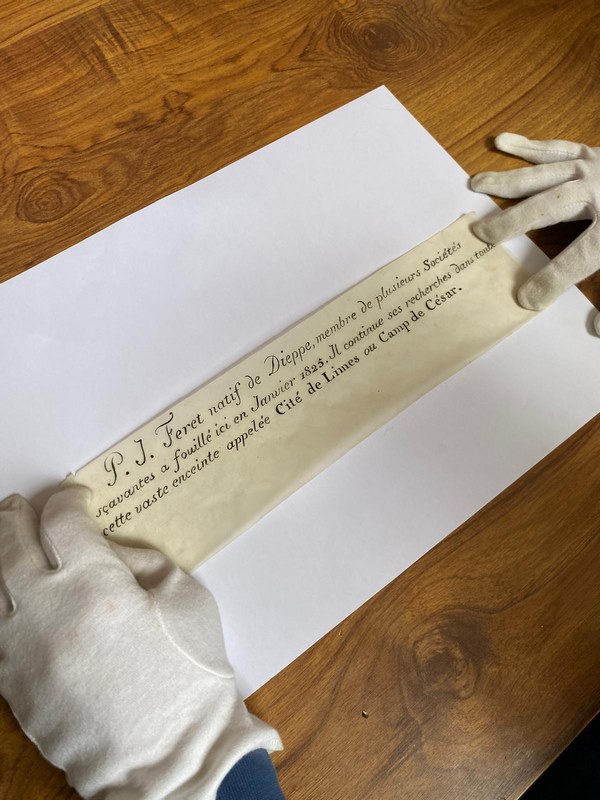
“P. J. Féret, a native of Dieppe and member of various intellectual societies, excavated here in January 1825. He continues his investigations in this vast area known as the Cité de Limes or Caesar’s Camp.”
The message in a bottle had been carefully placed in a ceramic pot dating to a much earlier century so that future archaeologists would be sure to find it.
“It was an absolutely magic moment,” Mr. Blondel told the BBC. “We knew there had been excavations here in the past, but to find this message from 200 years ago… it was a total surprise.”
credit – Guillaume Blondel, Archaeological Service of the City of Eu
“Sometimes you see these time capsules left behind by carpenters when they build houses. But it’s infrequent in archaeology. Most archaeologists prefer to think that there won’t be anyone coming after them because they’ve done all the work!”
Local archives indeed record P. J. Féret in the area as a historical excavator when the letter was dated.
credit – Guillaume Blondel, Archaeological Service of the City of Eu
The work was funded and carried out in partnership with the Regional Archaeology Service to preserve archaeological sites endangered by the coastline’s decline. Already a part of the ‘oppidum’ or fortified Gaulic camp, has fallen away with the crumbling of the coastal hillside on which it was perched.
The Gauls were a series of interconnected feudal (at best) and tribal (at worst) societies that shared societal, cultural, and warrior practices and who inhabited most of central and western Europe during the time of the Roman Republic.
Gaius Julius Caesar waged a campaign to pacify Gaul, hence the name “Caesar’s Camp,” which brought Spain, France, and Belgium under Roman control.
The good news in this story is that the past has been preserved to be studied today. Today’s JohnKu talks about history. I hope you have a wonderful weekend.
This post ran on July 9, 2018. Since we all still go to dentists, it may be useful.
* * *
Top Ten Things Not to Do When You Are in a Dentist’s Chair
The inspiration for this list was a routine visit to the dentist. Like all dentist offices, I could hear what was happening in several offices around me. I listened to some funny things and made up some of my own. I hope you enjoy this list
10 If you are in a dentist’s chair, do not try to answer the dentist’s questions while their hand is in your mouth. If you do, at best, your answer will be garbled and not understood. At worst, the dentist may come up missing a tool. (Yes, it is strange the dentist asks a question while you are incapable of speech, Elijah. Try to resist since that lost tool may be with you for a long time.)
9 If you are in a dentist’s chair, do not listen to Tiny the WWF champ whimper in the next room. If you do, at best, it may unnerve you. At worst, Tiny may catch sight of you as he leaves and will want to make sure you won’t gossip about his lack of fortitude. (That shadow passing over you as you go from the dentist’s office, Evan, is Tiny coming up from behind. Don’t think. Just drop and roll.)
8 If you are in the dentist’s chair, do not ask about the cost of a procedure while it is underway. If you do, at best, you won’t like the answer. At worst, the dentist may decide to give you a discount, provided you can endure the procedure with no painkillers. ( You have to wonder, Ezekiel, why he keeps asking, “Is it safe?” from the movie Marathon Man. Yes, that is you making all that noise.)
7 If you are in the dentist’s chair, do not try to read your chart when the Dentist leaves. If you do, at best, you won’t understand a thing. At worst, the hygienist will walk in just as you are leaning over backward with the chart in your hands. (How do you explain yourself, Edgar? You could have just asked to see your chart.)
6 If you are in the dentist’s chair, do not think about the Italian sub you had for lunch. If you do, at best, you won’t open your mouth. At worst, you will try to explain your faux pas, all while the hygienist continues to spray mouthwash each time you open your mouth. (You wish the “ew” sound were a result of a different source, huh, Elliott?)
5 If you are in the dentist’s chair, do not fool around with the controls. If you do, at best, you won’t get wet. At worst, you will cause possible complications from replacing the polishing tool function with a drilling tool function. (That hole in your front tooth is charming, Emmett. Maybe you can get a diamond to fit in there.)
4 If you are in the dentist’s chair, do not think the dentist will be right in to see you. If you do, at best, your waiting time will seem even longer. At worst, you fell asleep and drooled all over that lovely napkin under your chin. (How do you explain the wet spot to the hygienist, Edwin? Try your Quasimodo impersonation. “Here. Take whistle. That is the only thing I hear. Blow if in trouble.” They will love it.)
3 If you are in the dentist’s chair, do not remind yourself about that 32-ounce Big Gulp soda you finished on the way over here. If you do, at best, you will forgive yourself for not making a restroom stop. At worst, the dental staff will think you are a crack addict, given the amount of twitching and jumping you go through as you try to manage the specter of an accident. (Why is that little voice in your head still talking about Niagara Falls, Easton? Pretty self-defeating, I would say.)
2 If you are in the dentist’s chair, do not acknowledge the rumbling inside of you. If you do, at best, your explanation of the sour kraut and corned beef sandwich will fall on unsympathetic ears. At worst, you may give your body permission to vent off the building pressure. (Nothing pleases people more in a closed room, Edmund.)
1 If you are in the dentist’s chair, do not ask to hold a teddy bear before the procedure. If you do, at best, the staff will think you are joking. At worst, you will get the bear and a chart notation to watch for an emotional break in the future. (Ever wonder why everyone talks in a whisper when you visit the office, Ezequiel?)
The message on the coffee machine’s screen is very clear: No coffee until we are clean. Throwing hands up in the air, all peace seems lost until the second message flashes: It only takes two minutes; press start. Grabbing a piece of courage, pressing start saves the day. There is some noise, and then the magic message: All Clean.
The first sip brings the brain to life and reminds us to grab the clock. The time is set for September 20th, 1924, and the location is Washington, D.C. When the plunger is pulled, we find ourselves on the corner of Rhode Island Avenue N.W., M Street, and Connecticut Avenue N.W. in Washington, D.C. Here, the dedication of the Nuns of the Battlefield is a public artwork made in 1924 by Irish artist Jerome Connor.
The artwork honors the more than 600 nuns who served as nurses to both the Union and Confederate injured and ill troops during the US Civil War.
The lower right side of the relief is signed: JEROME CONNOR 1924
The lower left side of the relief is inscribed: BUREAU BROS. BRONZE FOUNDERS PHILA. ENN
On the granite above the relief is inscribed: THEY COMFORTED THE DYING, NURSED THE WOUNDED, CARRIED HOPE TO THE IMPRISONED, GAVE IN HIS NAME A DRINK OF WATER TO THE THIRSTY.
On the granite below the relief: TO THE MEMORY AND IN HONOR OF THE VARIOUS ORDERS OF SISTERS WHO GAVE THEIR SERVICES AS NURSES ON BATTLEFIELDS AND IN HOSPITALS DURING THE CIVIL WAR.
On the rear of the slab near the base is inscribed: ERECTED BY THE LADIES AUXILIARY TO THE ANCIENT ORDER OF HIBERNIANS OF AMERICA. A.D. 1924 BY AUTHORITY OF THE CONGRESS OF THE UNITED STATES
Just before the Temperance Union served lemonade, our alarm goes off, and we are in the comfort of the couch. A text has arrived from Linda Hill. It reads:
Your Friday prompt for Stream of Consciousness Saturday is “peace/piece.’” Use one, use them both (for bonus points), use them any way you’d like. Enjoy!
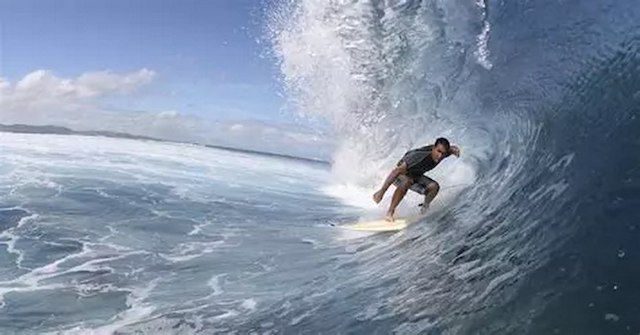
Nearly 90 million metric tons of planet-warming carbon have been found surrounding surf breaks worldwide, making these coastal locations essential climate allies and ideal locations for conservation efforts.
The news came from a groundbreaking study by conservationists examining forests, mangroves, and marshes around surf breaks—submerged features like rocks or reefs that create great surfing areas.
This is all the better for surfers themselves. Protecting these coastal ecosystems from development means more space and more waves for them.
Researchers analyzed more than 4,800 popular surf spots across 113 countries for the study. They found that immediately surrounding areas (within 0.6 miles or 1 kilometer of the waves) store over 88 million tons of irrecoverable carbon. That’s roughly equivalent to the annual emissions from 77 million gas-powered cars.
When the surrounding area is expanded to 3 kilometers or 1.8 miles, the amount of carbon stored in the ecosystem doubles to 191.7 million tons. According to the most up-to-date models, irrecoverable carbon refers to the carbon-rich lands humanity must protect to prevent the worst impacts of climate change.
“This research demonstrates the enormous role that protection of surf breaks and surrounding coastal areas can have in our global fight to reverse biodiversity loss and combat climate change,” said Scott Atkinson, a surfer, senior director of surf conservation at Conservation International, and an author of the study.
“Our study shows where we must now focus on legally protecting these areas. Surfers worldwide are fantastic allies for efforts like this—they love the ocean, know it is threatened, and are extremely motivated to protect it. They’ve been ‘on board,’ so to speak, helping to lead the establishment of all the Surf Protected Areas we’ve partnered to create.”
To date, Conservation International, which partners with surfers from the Save the Waves Coalition, has contributed to the establishment of 30 Surf-Protected Areas in Indonesia, Costa Rica, and Peru. These Areas are centered on surf breaks and seek to protect their larger surrounding ecosystems, including coastal forests, mangroves, beaches, seagrass, coral reefs, and the waves themselves.
Over half of these (23 Surf Protected Areas) have been established in Indonesia, which was used in the paper as a case study in creating an effective network of community-based protections. Collectively, the 23 locations form Indonesia’s initial Surf Protected Areas Network, covering more than 148,000 acres. This network can be expanded to hundreds of world-class surf sites across the incredibly biodiverse and carbon-rich country.
Atkinson also highlighted the positive impacts of the community-based Surf Protected Areas on Morotai Island in Indonesia, which is the focus of the paper’s case study.
“They protect precious marine and coastal ecosystems and strengthen community bonds and cultural heritage. Local people on Morotai have surfed on handmade wooden boards since at least World War II and have a strong surf culture,” he said.
“Additionally, local surf and conservation-related livelihoods are flourishing, with eco-friendly tourism and sustainable fishing practices becoming the norm. The community’s involvement in conservation efforts has fostered a sense of pride and ownership, showcasing the power of grassroots initiatives in achieving lasting environmental and social benefits.”
The good news in this story is that vital areas of conservation are being protected. Today’s JohnKu talks about the need for protection. I hope you have a wonderful weekend.