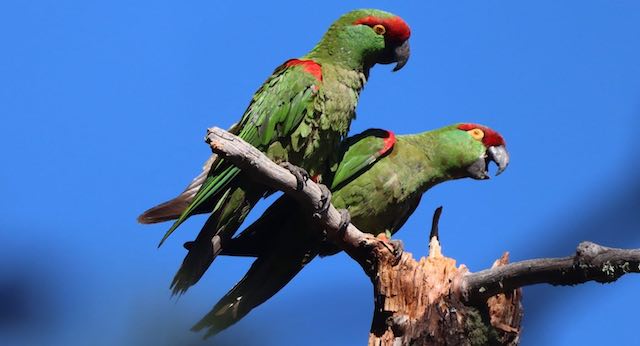
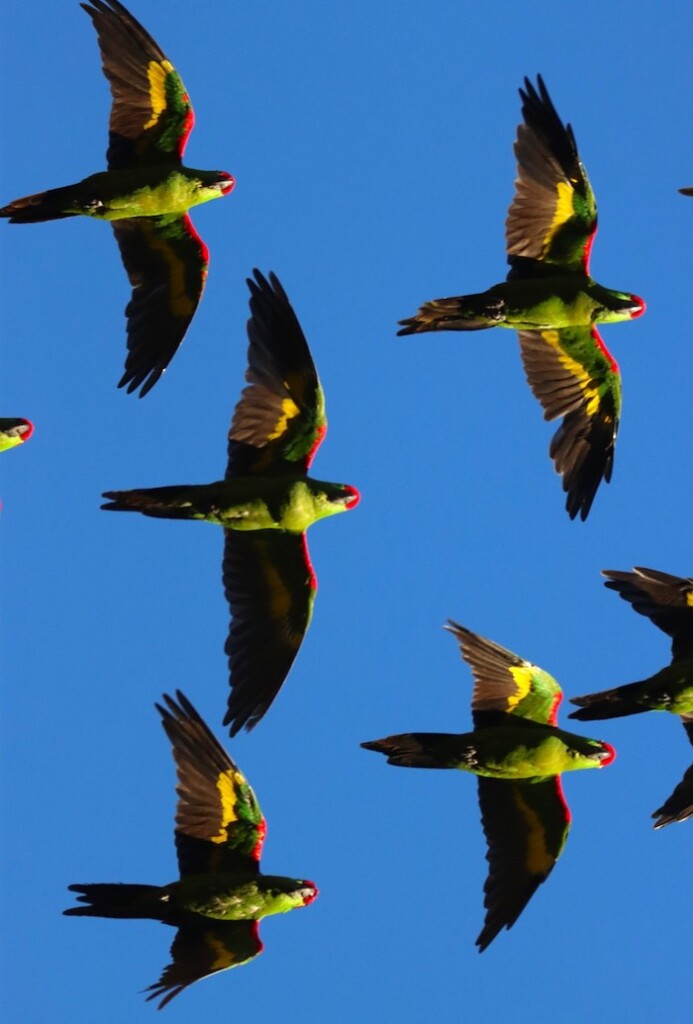
A public-private partnership in Mexico just announced that the population of thick-billed parrots is approximately 2,500 individuals—at least 10% higher than that recorded 12 years ago.
The number was determined in a recent population survey in a protected area in the state of Chihuahua, where this charismatic species once roamed north into the United States.
The thick-billed parrot is an emblematic species of the temperate forests of the Sierra Madre Occidental, once found in Arizona and New Mexico.
Since 1995, this species, listed in danger of extinction by the Mexican government, has been the subject of numerous studies and actions for protection and management, while the mountain forests on which it depends have been the focus of extensive reforestation.
These efforts, led by the National Commission of Protected Natural Areas (CONANP) and the civil organization Organización Vida Silvestre (OVIS), along with the participation of local communities and other organizations in the US and Mexico, are yielding encouraging results as demonstrated by the increase in population, a statement from OVIS details.
“This emerging success story reflects the importance of collaboration between society and government and a vision of healthy ecosystems and sustainable communities, which is in line with the policies and practices that CONANP will strengthen in the following years,” said the head of CONANP, Pedro Álvarez-Icaza.
Credit: Ernesto Enkerlin / OVIS
The census data suggests that the population of thick-billed parrots will continue to increase as the region’s communities consolidate sustainable forestry management practices.
Sergio Jiménez, OVIS’s executive director, thanked the various institutions’ support.
“This multi-institutional effort led by Ernesto Enkerlin Hoeflich, scientific director of OVIS, is bearing fruit after three decades, which gives us hope for other species at risk and points to the need for cooperation, persistence, and long-term planning to produce results and effective conservation.”
A significant effort was undertaken in the 1980s to restore populations of this parrot among the sky islands of Arizona. These dramatic, short, squat mountain chains amid the scorching lowlands were perceived as perfect havens for the reintroduction. Still, the problem was that predatory species like the American goshawk had already returned in large numbers to these hills, and their take of the parrots proved unsustainable.
In October 2020, it was announced that a higher elevation among the sky islands, including the Chiricahua mountains, would be sought to form the basis for a new reintroduction attempt.
If populations recover substantially enough in Mexico, the bird may recolonize its former haunts in the Southwestern US without the need for scientists’ intervention.
The good news in this story is that species on the verge of extinction can recover with concerted effort. Today’s JohnKu talks about efforts. I hope you have a wonderful weekend.
Today, I opened My GRL randomly to page 85 and pointed to the page with my eyes closed. The word closest to my finger was ‘paths,’ which is the prompt.
This list ran on October 16th, 2017. Since folks still get bored, it may come in handy.
* * *
This list was inspired by a daydreaming session during which I wondered what it would be like to be bored and then make some bad choices as a result. I hope you like it.
10 If you are bored, do not attend a city council meeting. If you do at best, you’ll get a needed nap. At worst, you will attempt to liven things up with an outrageous proposal. ( You didn’t think the idea of a five-year-old taking over the mayor’s job would gain traction, did you, Dylan? You make being the laughing stock look like a legitimate profession.)
9 If you are bored, do not go to the grocery store. If you do, at best, you will hope the paper goods section has been moved, but only to find it hasn’t. At worst, you will fill your cart and jump into the ten items or less line manned by Tiny, the WWF champ. Tiny was just told by the manager that he is too soft when demanding compliance with the ten-or-under rule. (You did hold your own for a while there, Drake.)
8 If you are bored, do not go to the park to watch a chess match. If you do, at best, one of the players will move a piece. At worst, you will be lucky to observe two well-matched players for what turns into a ten-hour match. (I’m unsure what you were expecting, Douglass, but this is not a contact sport.)
7 If you are bored, do not turn on reruns of the 90’s show “Cop Rock.” If you do, at best, you’ll fall into a deep sleep. At worst, about mid-episode, you will suddenly realize watching paint dry is better than this. ( Thinking that you like music and cop shows, you thought this would be a winner, right, Dean?)
6 If you are bored, do not take up a hobby that has been identified as most boring. If you do, at best, you’ll snap out of it. At worst, your family will set up an intervention to stop your traffic cone collection activities. (Just because the living room is filled with traffic cones, you didn’t see the hospitalization coming, did you, Dexter?)
5 If you are bored, do not take up a hobby like bungee jumping. If you do, at best, you’ll chicken out before the first jump. At worst, you’ll make a jump and then have to buy numerous copies of the video where you are screaming like a baby. (Oops. You missed the one that went viral on YouTube, Duke.)
4 If you are bored, do not go to Las Vegas for some excitement. If you do, at best, your first thousand-dollar loss will cure you. At worst, you put your life savings on the black spot at the roulette wheel just for kicks. (Retirement is now put off until you are eighty-two, Drew?) Editor’s note – Unfortunate alliteration.
3 If you are bored, do not plan to visit North Dakota. If you do, at best, you’ll go in the summer. At worst, you’ll be caught in the snow and can look forward to playing solitaire until May. (Hopefully, you’ll have a deck of fifty-two, Dalton.)
2 If you are bored, do not organize something. If you do, at best, it will be a half-hearted effort. At worst, you will get so wrapped up in the organization that you’ll take on signs of a classic OCD attack. (Just put that paper anywhere, Darren. You’ll never look at it again anyway.)
1 If you are bored, do not look up a list of what to do if you are bored. If you do, at best, the list may be extensive. At worst, you might do one of the items like “download the Bitmoji app. Make your personalized emoji, and then send all your friends fun cartoon texts.”* (Wonder where your friends went, Dane?)
*From 96 Things to Do When You’re Bored by Katie Sweeney. An excellent list of things to do.
Last Friday was movie night in Lakeway. By the miracle of a time freeze, we can still attend. The event is at the Activity Center in Lakeway. The movie is A Christmas Story. We are catered again by Craigos Pizza and DonutsNV. Our entertainment is Pistol Annies.
Menu
Pizza, Donuts, Hot Cholate, and Smores. (There will be a defibrillator available)
There’s the sign
Looks like the Activity Center is ready for us.
A box outside the Activity Center for Santa letters.
Reindeer at the Activity Center.
More atmosphere.
An outside tree.
Welcome.
The lamp and Ralphie in his new PJs.
Still, it’s time to write letters to Santa.
A festive tree in the Activity Center.
Santa says, “Give me Smores, or someone gets hurt.”
Beautiful Hibiscus plants.
Pick up your Smore kit,
Roast those marshmallows over an open fire.
Here’s the donuts.
And the pizza.
It is time to relax and enjoy the movie, food, and music. I hope you have a great week.
After putting the food for breakfast into Twiggy and Tempeste’s bowls, it is time for coffee. Thinking a change would be good, the coffee machine was ordered to brew a Latte instead of the standard straight 10-ounce cup. The button is pushed, and nothing. The machine stares back at me as if a big mistake is about to happen. The touchpad asks, “You sure?” Once more, the order is confirmed, and the sounds begin almost like the machine shrugs what could pass for shoulders. Steamed milk followed by a shot of espresso and then foam.
Grabbing the finished product and taking a sip turns the mind to the clock. Today, the clock is set for December 14, 1924. The location is Fairfield, Montana, and the duration is thirty minutes. The plunger is pulled, and we arrive in Fairfield in time to see a record being set.
The town of Fairfield, Montana, set a weather record for most significant drop of temperature in a 12-hour period, from 63 °F (17.2 °C) at noon to −21 °F (−29.4 °C) at midnight. It is now midnight, and my cheeks are starting to crack in the cold. Being caught in twenty-one degrees below zero temperature in PJs is not the most comfortable thing in the world. Just as my Lattee begins to freeze, the alarm goes off, and we are back on the warm, comfy couch.
Linda Hill sent a text. It reads, “Your Friday prompt for Stream of Consciousness Saturday is “food.” Use it any way you’d like. Have fun!
American scientists have proposed a new method for recruiting trillions of microscopic sea creatures and their insatiable appetites to fight climate change.
The technique harnesses the animals’ daily habits to accelerate the ocean’s natural cycle for removing carbon from the atmosphere, known as the biological pump, according to the paper in Nature Scientific Reports.
The study, published by researchers at Dartmouth College, reported that spraying clay dust on the ocean’s surface converts carbon into food the animals eat, digest, and send deep into the sea as carbon-filled feces.
They explain that the process would begin with spraying the clay dust at the end of algae blooms. These blooms can grow to cover hundreds of square miles and remove about 150 billion tons of carbon dioxide from the atmosphere each year, converting it into organic carbon particulates. But once the bloom dies, marine bacteria devour the particulates, releasing most of the captured carbon into the atmosphere.
The researchers found that the clay dust attaches to carbon particulates before re-entering the atmosphere. It redirects them into the marine food chain as tiny sticky pellets the ravenous zooplankton consume and later excrete at lower depths.
“Normally, only a small fraction of the carbon captured at the surface makes it into the deep ocean for long-term storage,” says Mukul Sharma, the study’s corresponding author and a professor of earth sciences. Sharma presented the findings on December 10th at the American Geophysical Union annual conference in Washington, D.C.
“The novelty of our method is using clay to make the biological pump more efficient—the zooplankton generate clay-laden poops that sink faster,” says Sharma, who received a Guggenheim Award in 2020 to pursue the project.
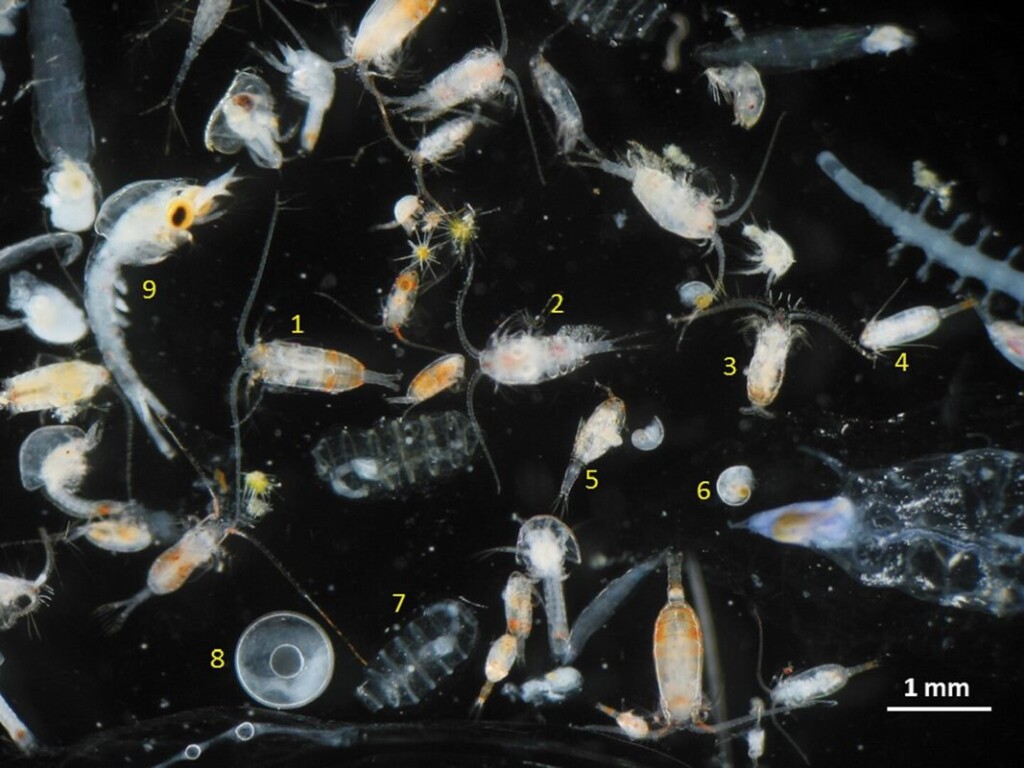
A mixed zooplankton sample including common species – Credit Adriana Zingone, Domenico D’Alelio, Maria Grazia Mazzocchi, Marina Montresor, Diana Sarno, LTER-MC team CC 4.0. BY-SA (John’s note – I don’t have the number key for the photo)
“This particulate material is what these little guys are designed to eat. Our experiments showed they cannot tell if it’s clay and phytoplankton or only phytoplankton—they just eat it,” he says. “And when they poop it out, they are hundreds of meters below the surface, and all that carbon is, too.”
The team conducted laboratory experiments on water collected from the Gulf of Maine during a 2023 algae bloom. They found that when clay attaches to the organic carbon released when a bloom dies, marine bacteria produce a kind of glue that causes the clay and organic carbon to form little balls called flocs.
The researchers report that the flocs become part of the daily smorgasbord of particulates that zooplankton gorge on. Once digested, the flocs embedded in the animals’ feces sink, potentially burying the carbon at depths where it can be stored for millennia. The uneaten clay-carbon balls also sink, increasing in size as more organic carbon, as well as dead and dying phytoplankton, stick to them on the way down.
In the team’s experiments, clay dust captured as much as 50% of the carbon released by dead phytoplankton before it could become airborne. They also found that adding clay increased the concentration of sticky organic particles—which would collect more carbon as they sink—by 10 times. At the same time, the populations of bacteria that instigate the release of carbon back into the atmosphere fell sharply in seawater treated with clay, the researchers report.
Sharma says that in the ocean, the flocs become an essential part of the biological pump called marine snow. Marine snow is the constant shower of corpses, minerals, and other organic matter that falls from the surface, bringing food and nutrients to the deeper ocean.
“We’re creating marine snow that can bury carbon at a much greater speed by specifically attaching to a mixture of clay minerals,” Sharma says.
Zooplankton accelerate that process with their voracious appetites and incredible daily sojourn, known as the diel vertical migration. Under cover of darkness, the animals—each measuring about three hundredths of an inch—rise hundreds, and even thousands, of feet from the deep in one immense motion to feed in the nutrient-rich water near the surface.
When the day breaks, the animals return to deeper water, depositing the flocs as feces. This expedited process, active transport, is another key aspect of the ocean’s biological pump that shaves days off when it takes carbon to reach lower depths by sinking.
Sharma plans to field-test the method by spraying clay on phytoplankton blooms off the coast of Southern California using a crop-dusting airplane. He hopes that sensors placed at various depths offshore will capture how different species of zooplankton consume the clay-carbon flocs so that the research team can better gauge the optimal timing and locations to deploy this method—and exactly how much carbon it’s confining to the deep.
“Finding the right oceanographic setting to do this work is significant. You cannot go around willy-nilly dumping clay everywhere,” Sharma told Dartmouth Press. “We need to understand the efficiency first at different depths to understand the best places to initiate this process before we put it to work. We are not there yet—we are at the beginning.”
The Good News in today’s story is that scientists continue to work to make our oceans healthier. Today’s JohnKu talks about the oceans. I hope you have a super weekend.
As you can see, the final book in the Eternal Road series is ready to be launched. The actual launch date is February 10, 2025. I am calling for volunteers who would like to host a visit anytime in February. The first through the tenth would be in the pre-publication period, and then after the tenth, the book will be available from Amazon in paperback and ebook formats.
If you would like to host a visit, please send me an email at johnhowell (dot)wave(at)gmail(dot)com. If you have a preferred date, please put it in the note. Otherwise, I will contact you back to confirm a date.
All material will be sent well before the date of the post.
Here is the blurb.
Sam and James are dragged into another strange assignment when a couple of souls on The Eternal Road drop off the radar. Archangel Micheal gives them specific orders to resolve the issue and get Billy Ray Chitwood, the national race car champion, and Dale Earnhardt, his guide, back on the task of finding Billy’s Eternal Home.
Finally, meeting up with Billy Ray and Dale, the foursome finds themselves in the future where World War III has devastated the country. The team discovers the cause of the start of the war and vows to mitigate that circumstance and save the world from devastation. They encounter their old nemesis, Lucifer, who has in mind trading preventing the war in exchange for Sam accepting his offer to be his queen.
Since Lucifer’s offer is a non-starter, Sam and James must overcome Lucifer’s interference and work to change the course of history, or else humankind is doomed.