
A team of student archaeologists in France was surprised while working on a site dating to Gaulic times.
The excavations, carried out under the direction of Guillaume Blondel, director of the municipal archaeological service of the city of Eu, delivered, among other things, a moving and very special testimony from the past.
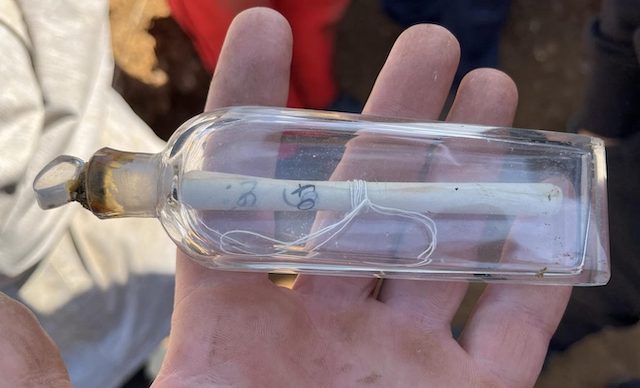
Located in a previously investigated section of the site, a message was discovered in a small glass bottle from the 19th century accompanied by two coins: a “time capsule” buried almost 200 years ago, a statement from the service read.
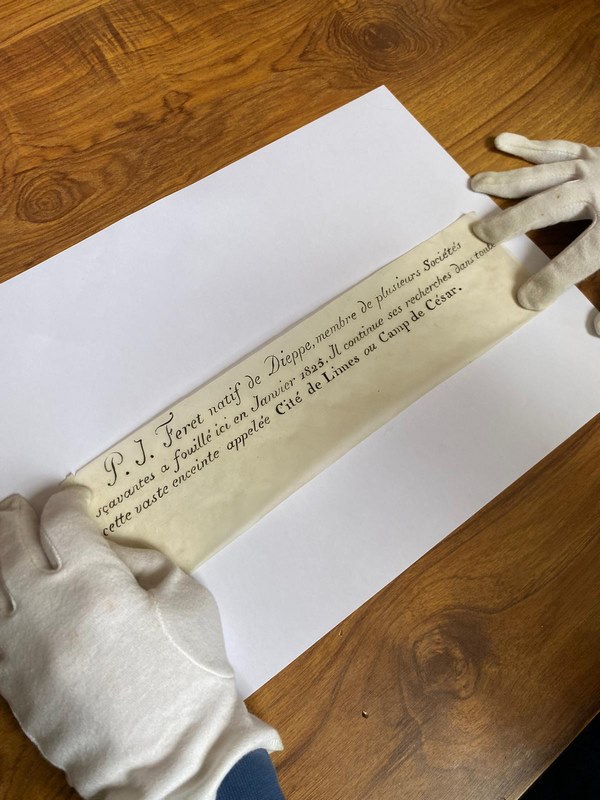
“P. J. Féret, a native of Dieppe and member of various intellectual societies, excavated here in January 1825. He continues his investigations in this vast area known as the Cité de Limes or Caesar’s Camp.”
The message in a bottle had been carefully placed in a ceramic pot dating to a much earlier century so that future archaeologists would be sure to find it.
“It was an absolutely magic moment,” Mr. Blondel told the BBC. “We knew there had been excavations here in the past, but to find this message from 200 years ago… it was a total surprise.”
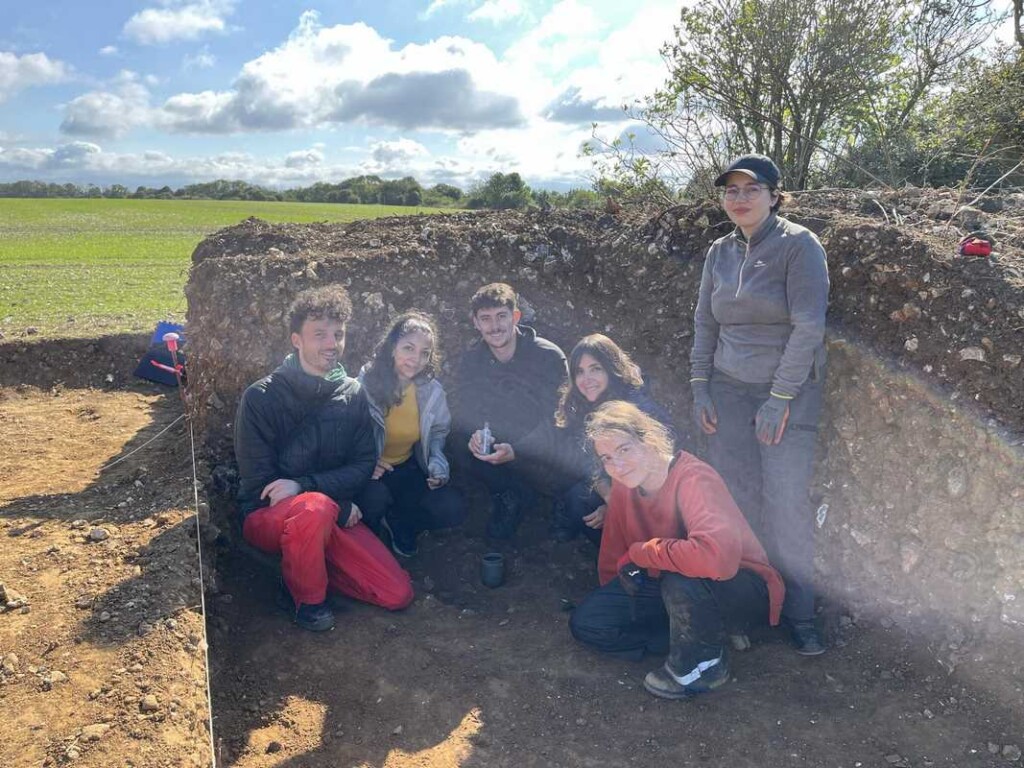
“Sometimes you see these time capsules left behind by carpenters when they build houses. But it’s infrequent in archaeology. Most archaeologists prefer to think that there won’t be anyone coming after them because they’ve done all the work!”
Local archives indeed record P. J. Féret in the area as a historical excavator when the letter was dated.
The work was funded and carried out in partnership with the Regional Archaeology Service to preserve archaeological sites endangered by the coastline’s decline. Already a part of the ‘oppidum’ or fortified Gaulic camp, has fallen away with the crumbling of the coastal hillside on which it was perched.
The Gauls were a series of interconnected feudal (at best) and tribal (at worst) societies that shared societal, cultural, and warrior practices and who inhabited most of central and western Europe during the time of the Roman Republic.
Gaius Julius Caesar waged a campaign to pacify Gaul, hence the name “Caesar’s Camp,” which brought Spain, France, and Belgium under Roman control.
The good news in this story is that the past has been preserved to be studied today. Today’s JohnKu talks about history. I hope you have a wonderful weekend.
History by John W. Howell © 2024
The past can teach us,
Many lessons about now . . .
If we want to learn.

So cool. Shows how long humans have been exploring the past too.
LikeLiked by 1 person
That is a good point, Charles.
LikeLike
Wonderful story. The poem also has a nice caution.
LikeLiked by 1 person
Thank you, Craig. 😊
LikeLiked by 1 person
I have a book, “Testimony of the Spade”, that almost changed my mind about my history research direction. It shows just how long man has looked back to find his history.
LikeLiked by 1 person
I looked the book up. It looks fascinating.
LikeLiked by 1 person
I did find it interesting.
LikeLiked by 1 person
😊
LikeLiked by 1 person
A message from one archeologist to future archeologists — this is really neat! Thanks for reporting on this news, John. 🌞
LikeLiked by 1 person
I thought the same, Dave. 😊
LikeLiked by 1 person
Chills of excitement… how flabbergasted must they have been. I wonder if they have stopped pinching themselves.
LikeLiked by 1 person
And given the handwriting it was a mind blower I’m sure.
LikeLiked by 1 person
That’s fascinating, that a time capsule was left by an archeologist that long ago. Yes, studying history can bring out lessons that can be applied to the present time, if one listens to the lessons.
LikeLiked by 1 person
Yes we have to listen. Thanks, Tim.
LikeLiked by 1 person
I read about this. Fascinating! I’m sure it gave a lot of energy to the students!
LikeLiked by 1 person
I’ll bet it did. I know it would me if I had been there.
LikeLiked by 1 person
I just read about this in our local newspaper. It’s so cool.
LikeLiked by 1 person
Terrific. I think it is cool too. 😁
LikeLiked by 1 person
What a cool find. That’s treasure in my book.
LikeLiked by 1 person
My book too, Deborah.
LikeLiked by 1 person
Wow that’s so cool and found intact. The past can teach us and that is key if we stay open to living., Great news, John.💕
LikeLiked by 1 person
We have to stay open for learning too. Thanks, Cindy. 😁
LikeLiked by 1 person
We sure do, John. You’re so welcome💗
LikeLiked by 1 person
😊
LikeLiked by 1 person
I enjoyed learning about this. What a thrill it must have been for them to find the time capsule.
Your JohnKu was enjoyable, too.
LikeLiked by 1 person
I can image the thrill after reading the note. Thanks, Kymber.
LikeLiked by 1 person
What an exciting find! Your JohnKu is spot-on. Hurray for new discoveries!
LikeLiked by 1 person
I agree on the new discoveries, Liz.
LikeLiked by 1 person
What a cool find, John:) Fun getting a message from the past.
LikeLiked by 1 person
It would have knocked my socks off.
LikeLiked by 1 person
What pretty handwriting on that note! Sad to say, handwriting is becoming a long-lost art (my nuns would be appalled and so am I!). What a find, too! There’s something awfully special about leaving a remnant behind us … and in somebody finding that!
LikeLiked by 1 person
I agree.on finding a remnant bring special. They don’t teach handwriting anymore so it sure is lost.
LikeLiked by 1 person
HI John, this is such an interesting post. A great find.
LikeLiked by 1 person
Thank you, Robbie. I thought it was amazing.
LikeLike
That is a pretty interesting discovery. On a related note, I just bought two comic books in Sweden featuring Gaulic warriors during the Julius Ceasars campaign in Gaul. The comic book series is named Asterix (Asterix and Obelix). Have you heard of this comic book series?
LikeLiked by 1 person
I have never heard of these comic books, Thomas. One thing I should also say is I don’t read comic books so I’m not the best person to ask.
LikeLiked by 1 person
I have to admit I still read comic books at my advanced age. However, that is because I read the French Belgian comic books (Bande-Dessiné), and those are great for both kids and adults. They are the most popular comic books in the world (Asterix alone sold 400 million copies) and Asterix has also been translated into more than a 100 languages including Swedish. You never know, you might like the Bande Dessiné style (Asterix, Tintin, Spirou, etc) of comics even if you don’t like Marvel stuff.
LikeLiked by 1 person
Who knows? I’ll have to check them out. I’ll let you know.
LikeLiked by 1 person
Some of them like the Asterix series are educational. Many people in Europe claim that they learned all the Roman, Gaulish and Celtic history they know from Asterix. Those people may not know a lot of history but I think Asterix may help spark an interest in history.
LikeLiked by 1 person
That would be good.
LikeLiked by 1 person
I always love your Friday posts, John, because they are so hopeful and show the best in humanity. Thank you for sharing — and adding your perfect JohnKu.
LikeLiked by 1 person
Thank you, Gwen. I’m so glad you liked the post and the JohnKu. 😁
LikeLiked by 1 person
I would have responded earlier, but Larry’s family is visiting, so it’s a busy time. Great post.
LikeLiked by 1 person
I can imagine the busy time for sure. Thanks
LikeLike
We supposed to learn from history so we don’t repeat our failures. How’s that going? Excellent story, John.
LikeLiked by 1 person
Yes, we are supposed to learn but you ask a good question. How’s that going? Thanks, Steve.
LikeLike
I’m kinda envious of this ancient news delivery system. Sure the good news didn’t get told for weeks and sometimes months, but hey, the same goes for the bad news!
LikeLiked by 1 person
Of course, bad news goes at light speed. This good news took 200 years. 😊
LikeLiked by 1 person
Sort of like AOL
LikeLiked by 1 person
Ha ha ha. Love that.
LikeLiked by 1 person
LOL
LikeLiked by 1 person
I love this story, John. I’ve always been drawn to buried messages!
LikeLiked by 1 person
Me too.
LikeLiked by 1 person
That is just incredible! What a find.
LikeLiked by 1 person
I know right? Was terrific. Thanks, Monika
LikeLiked by 1 person
A very neat report, John.
A message in a bottle, love it!
Not enough people enjoy history, so they don’t learn what. not to repeat. Many young have only a fuzzy at best knowledge of WWII.
Well, your JohnKu says it. Thank you!
🐖 🐂 🐖 🐂
LikeLiked by 1 person
Thank you, Resa. 🐖 🐂 🐖 🐂
LikeLiked by 1 person
🐖 🐂 🐖 🐂
LikeLike
🥇X🐖 🐂 🐖 🐂
LikeLiked by 1 person
🥇X 🥇X
LikeLike
We win. 🥇X 🥇X 🥇X
LikeLike
Wow!
LikeLiked by 1 person
Good word. 😁
LikeLiked by 1 person
Yes!
LikeLike
A wonderful story and poem, John. 🤗
LikeLiked by 1 person
Thank you, Lauren.
LikeLiked by 1 person
Oh, at least good news from the blue chicken country!🤔Thank you, dear John!🍤🍤🍤🍻
LikeLiked by 1 person
I thought you would find it welcome. 😁
LikeLiked by 1 person