
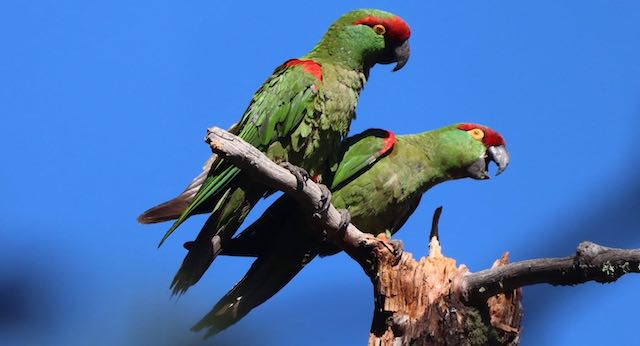
Thick-billed parrots – Credit: OVIS / Ernesto Enkerlin Hoeflich
Today’s Good News comes from the Good News Network.
Endangered Thick-billed Parrot That Once Roamed the US Is on the Way to Recovery
A public-private partnership in Mexico just announced that the population of thick-billed parrots is approximately 2,500 individuals—at least 10% higher than that recorded 12 years ago.
The number was determined in a recent population survey in a protected area in the state of Chihuahua, where this charismatic species once roamed north into the United States.
The thick-billed parrot is an emblematic species of the temperate forests of the Sierra Madre Occidental, once found in Arizona and New Mexico.
Since 1995, this species, listed in danger of extinction by the Mexican government, has been the subject of numerous studies and actions for protection and management, while the mountain forests on which it depends have been the focus of extensive reforestation.
These efforts, led by the National Commission of Protected Natural Areas (CONANP) and the civil organization Organización Vida Silvestre (OVIS), along with the participation of local communities and other organizations in the US and Mexico, are yielding encouraging results as demonstrated by the increase in population, a statement from OVIS details.
“This emerging success story reflects the importance of collaboration between society and government and a vision of healthy ecosystems and sustainable communities, which is in line with the policies and practices that CONANP will strengthen in the following years,” said the head of CONANP, Pedro Álvarez-Icaza.
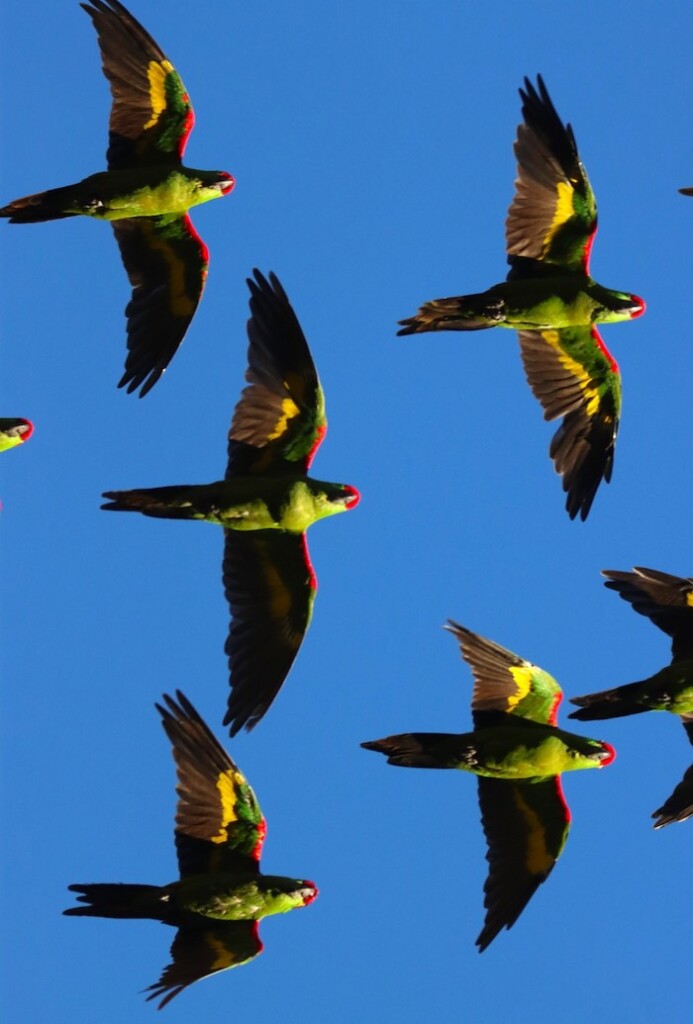
The census data suggests that the population of thick-billed parrots will continue to increase as the region’s communities consolidate sustainable forestry management practices.
Sergio Jiménez, OVIS’s executive director, thanked the various institutions’ support.
“This multi-institutional effort led by Ernesto Enkerlin Hoeflich, scientific director of OVIS, is bearing fruit after three decades, which gives us hope for other species at risk and points to the need for cooperation, persistence, and long-term planning to produce results and effective conservation.”
A significant effort was undertaken in the 1980s to restore populations of this parrot among the sky islands of Arizona. These dramatic, short, squat mountain chains amid the scorching lowlands were perceived as perfect havens for the reintroduction. Still, the problem was that predatory species like the American goshawk had already returned in large numbers to these hills, and their take of the parrots proved unsustainable.
In October 2020, it was announced that a higher elevation among the sky islands, including the Chiricahua mountains, would be sought to form the basis for a new reintroduction attempt.
If populations recover substantially enough in Mexico, the bird may recolonize its former haunts in the Southwestern US without the need for scientists’ intervention.
The good news in this story is that species on the verge of extinction can recover with concerted effort. Today’s JohnKu talks about efforts. I hope you have a wonderful weekend.
Recovery by John W. Howell © 2024
Even the hopeless,
Can benefit from our help. . .
The key is hard work.























 Fiction Favorites
Pretty. We have monk parakeets in one of our parks up here. No idea why. Can get we get some of these guys too?
LikeLiked by 1 person
Never know. If they cross the border we might wind up deporting them.
LikeLiked by 1 person
😁
LikeLike
The parakeets here in Austin are as a result of pets getting away. There is a large colony of them in the downtown area.
LikeLike
Rumor has it that these escaped a cargo ship container in the 60’s or 70’s.
LikeLiked by 1 person
That is an excellent rumor
LikeLike
I really enjoy hearing these success stories. At least someone is trying something.
LikeLiked by 1 person
I agree. Maybe little actions will end up becoming big actions.
LikeLiked by 1 person
It’s about time this world decided to save each species.
LikeLiked by 1 person
Well said, GP. Thanks.
LikeLiked by 1 person
Wonderful to see the good that can be accomplished when people work together!
LikeLiked by 1 person
Working together is key.
LikeLiked by 1 person
Yes!
LikeLiked by 1 person
😊
LikeLiked by 1 person
Your JohnKu says it all!
LikeLiked by 1 person
Thank you, Liz.
LikeLiked by 1 person
You’re welcome, John.
LikeLiked by 1 person
How beautiful!
LikeLiked by 1 person
😁
LikeLiked by 1 person
I hope they continue to thrive and grow in population so they can thrive here in the States again.
LikeLiked by 1 person
I do too. They are so pretty
LikeLike
That is wonderful news Indeed there is always HOPE when we work together to preserve Nature and our environment…
Thank you for sharing John xx
LikeLiked by 1 person
I agree on the hope, Sue.
LikeLiked by 1 person
Glad to read this.
LikeLiked by 1 person
I was glad to find the story.
LikeLike
Thanks for sharing this, John. It’s wonderful to see humans working to save species. Those birds are really beautiful.
LikeLiked by 1 person
Yes they are, Tim. Thank you.
LikeLiked by 1 person
Good news, indeed — I really like that photo of them in flight!
LikeLiked by 1 person
I thought that was a great photo too. Thank you, Debbie.
LikeLiked by 1 person
They’re stunning. I do hope this works. Thank you for sharing this news, John.
LikeLiked by 1 person
I hope it works as well Esther.
LikeLiked by 1 person
It is always good news when species gain in population. Thank you for the heartwarming news, John.
LikeLiked by 1 person
My pleasure, Dale.
LikeLiked by 1 person
💞
LikeLiked by 1 person
😊
LikeLiked by 1 person
This is such a cool story. I hope the population continues to grow. I would love to see these beautiful birds.
LikeLiked by 1 person
I would to. Thanks, Noelle.
LikeLiked by 1 person
The strengthening of a bird population is great news! Thank you for sharing, John. 🦜
LikeLiked by 1 person
I agree. They are so beautiful too.
LikeLiked by 1 person
Wonderful news, John. I hope they repopulate in Arizona, as I’d love to see them fly. Miracles abound, don’t they? With dedication and ingenuity, our world could be transformed. Thank you for sharing this great news — and your JohnKu. 😊
LikeLiked by 1 person
We should hope for a renewal. Thanks, Gwen.
LikeLike
Whenever I read a story that a species is on the path to recovery, my heart just swells with joy. This is good news that I hope continues to make forward progress. Thanks so much for sharing. We need stories like this to nourish our souls!
LikeLiked by 1 person
We do need nourishment of our souls, Monika.
LikeLiked by 1 person
I love that “if at first you don’t succeed…” attitude, John. It’s paying off. I hope the US continues to protect endangered species. 🙂 That photo of the flying parrots is beautiful!
LikeLiked by 1 person
I agree, Diana. Gotta keep punching.
LikeLiked by 1 person
That’s cool. These are such beautiful birds.
LikeLiked by 1 person
They are
LikeLiked by 1 person
Great to hear that more of these birds are flying about. And they’re beautifully colorful.
LikeLiked by 1 person
I agree, Dave. They are beautiful and I would like to see them flying around my yard.
LikeLiked by 1 person
That is a tremendously impressive turnaround. And yes, it speaks to all the good that can come of the collective efforts of community and government. Here’s to it.
LikeLiked by 1 person
Yes. Cheers to those guys.
LikeLiked by 1 person
You know it.
LikeLiked by 1 person
A profound JohnKu…NOTHING COMES EASY. Well done, John!
LikeLiked by 1 person
Thankyou, Steve.
LikeLike
My dad was a wildlife biologist involved on the recovery team of two endangered animals (One was a bird and another was a mammal.) As you said, it does take a concerted effort.
LikeLiked by 1 person
Great work, Pete. Thanks for sharing.
LikeLiked by 1 person
It is sad that the thick-billed parrots are endangered but great that they are recovering thanks to the efforts of wonderful people and organizations.
LikeLiked by 1 person
Well said, Thomas. 😁
LikeLiked by 1 person
Hooray! What beautiful birds.
LikeLiked by 1 person
Yes they are.
LikeLiked by 1 person