Today’s good news story comes from the Good News Network.
Teens Developed App That Identifies Mouth Cancer–Making Early Diagnosis Easy and Winning $50k for Their School
GNN has reported on multiple occasions how artificial intelligence is being leveraged to detect signs of cancer.
Now, a team of high schoolers is using AI to help their community combat one of the deadliest forms: oral cancer.
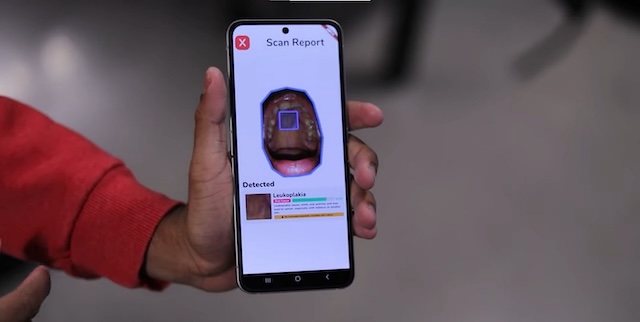
The Oral Scan app detects signs of oral cancer using a photo taken on a smartphone with an 82% success rate. If the AI finds evidence of a tumor, it can diagnose the stage with an even better 87% success rate.
Not bad for a bunch of teenagers, and even though 82% is below what most medical ethicists believe should be the threshold for outsourcing tumor identification to a machine, it’s far better than the rate of 0%, which is what many in the team’s home state of Arkansas will experience.
52,000 Americans are diagnosed with oral cancer every year, and more than 12,000 die as a result, according to their research. Early detection of oral cancers can boost survival rates by 40%, but such cancers are detected early in only 30% of cases.
In dental deserts, these numbers are even worse. In Arkansas, for example, 90% of the population didn’t visit a dentist last year, and according to one dental surgeon the team spoke with, whole counties in Arkansas don’t even have a dentist to visit.
“We learned that current diagnosis methods are expensive, intrusive, and often inaccurate, making early detection rare,” said Veera Unnam, one of the team members, from Bentonville West High School.
Their response is Oral Scan, a free app that costs just 50 cents for each diagnosis and delivers a response in just 15 seconds.
The team designed the app to be usable in all countries on both Apple and Android IOS and ensured it. was easy and intuitive to use, showing their commitment not only to Arkansas but the world at large.
Recently, Unnam and his two colleagues entered Oral Scan into the 15th annual Samsung Solve for Tomorrow competition, empowering public school students (grades 6-12) to drive positive change in their communities by applying STEM know-how to address real-world, pressing issues.
Each finalist school receives $50,000 in Samsung technology and supplies and will compete at the live Solve for Tomorrow Pitch Event in Washington, DC, on April 28th. Three National Winners will each earn $100,000 in prizes, and one will be named the Community Choice Winner.
Celebrating the 15th year of Solve For Tomorrow, Samsung has awarded more than $27 million in resources to nearly 4,000 public schools across the US to date, and the Oral Scan team will be hoping they’re among the recent winners. However, before the winner’s announcement, Oral Scan is already getting national news headlines, and the team has been invited to speak at medical conferences to present their invention.
You can watch the student’s presentation here.
The good news about this story is that a team of students took the initiative to find a way for the unserved to check for oral cancer. Today’s JohnKu talks about youth and the future. I hape you have a wonderful weekend.
Genius by John W. Howell © 2025
Inspired young people,
Working together achieve . . .
Results called genius.


With all their brilliance, you’d think the money would go to help pay to further their education.
LikeLiked by 3 people
That’s so cool.
LikeLiked by 1 person
I agree.
LikeLike
This is a relief of hearing about a good use of AI — after reading many messages that come down to: AI Is Horrible! But Companies Like It Because It’s Cheaper Than Humans!
LikeLiked by 1 person
Much cheaper than humans and you don’t have to worry about offending AI.
LikeLiked by 1 person
To me, it’s amazing that teens developed that. Wonderful! Thanks for sharing this information, John.
LikeLiked by 1 person
A pleasure, Tim. Thank you.
LikeLiked by 1 person
I think this app is outstanding, especially since poor dental health and the use of tobacco by teens can lead to cancer. Kudos and thanks to those teens and I suspect they have bright futures.
LikeLiked by 1 person
I suspect they do as well, Noelle. Thanks
LikeLiked by 1 person
What a great idea! Glad to see young minds doing so much good 🙂
LikeLiked by 1 person
Me too, Denise. Thanks
LikeLiked by 1 person
Extraordinary! Who would have thought — but thank goodness, some young, curious minds did! What a great share, John. Thank you. 🌞
LikeLiked by 1 person
I agree, Gwen. Who woulda thought. Glad they did. 😀
LikeLiked by 1 person
That’s such a great achievement. I always look forward to your good news stories on a Friday.
LikeLiked by 1 person
I am so happy to hear that, Esther. I enjoy them, too.
LikeLiked by 1 person
I want these kids to run the country, please.
LikeLiked by 1 person
Ha ha ha. Might be a good idea. Thanks, Liz.
LikeLiked by 1 person
You’re welcome, John.
LikeLiked by 1 person
😊
LikeLiked by 1 person
I think these kids are brilliant! There’s no telling what else they might accomplish.
LikeLiked by 1 person
I agree, Kymber. Looks like a bright future.
LikeLiked by 1 person
That’s so great. I havn’t fully understand yet how AI works. Here it seems they used a lot of prior taken oral photos to train the AI. Thanks for the information, John! Best wishes, MIchael
LikeLiked by 1 person
You feed AI information, and it extrapolates meaning. So a bunch of photos or oral cancer loaded into a program will produce predictive and diagnostic abilities of the software. Thanks, Michael.
LikeLiked by 1 person
That sounds great. In my next life i will try it. Lol Best wishes, Michael
LikeLiked by 1 person
Go for it. 😀
LikeLike
This sounds really amazing, John. I was surprised to read about the lack of dental treatment in Arkansas though. I though everyone in the USA had access to dental care.
LikeLiked by 1 person
There are areas so remote that it is not profitable for a dentist to set up practice. Also, the cultural norms in these remote places are not conducive to good oral hygiene.
LikeLike
Very neat share, John. 😁
LikeLiked by 1 person
Thank you, Pat
LikeLiked by 1 person
What a great story, once again Boss.
I guess it’s true that the kids really are alright.
LikeLiked by 1 person
I think the kids are alright.
LikeLiked by 1 person
Indeed
LikeLiked by 1 person
Wonderful story, John! I get the best feeling when I observe young people contributing things that will improve our lives. While a 82% accuracy rate may be below what the medical community would like, it’s a good start. Perhaps with further development, the app will continue to improve.
LikeLiked by 1 person
I agree, Pete. I love to see kids excel too. Thanks
LikeLiked by 1 person
Wow, what an amazing story! Finally a story where AI isn’t some attempt to scam or mislead peeps. Hard to believe the Arkansas dental world is in such dire straits but think this story is such good news…for the school and the kids who created the app. Bravo!
LikeLiked by 1 person
I agree, Monika. The sad thing about some poverty-stricken places is that not enough people are knowledgeable about dental health to make it profitable for a dentist to open a practice.
LikeLiked by 1 person
Exactly. When you don’t know what to do (or have the resources to do it if you do), health outcomes are bound to suffer.
LikeLiked by 1 person
A sad state for sure.
LikeLiked by 1 person
That is amazing and it is good news. However, I can add that detecting cancer using AI is not new. An engineering friend of mine was doing that in 1992. It was using image processing on white blood cells from a blood test and then applying AI / a one layer neural network to the image. A one layer neural network is pretty primitive compared to today’s AI but it worked.
LikeLiked by 1 person
Sounds like a breakthrough, Thomas. Thanks for sharing.
LikeLiked by 1 person
This is excellent news. What a great discovery by these kids.
LikeLiked by 1 person
It is very exciting, Deborah. Thanks.
LikeLiked by 1 person
Now that is a smartphone! Smart teenagers, too. Your sharing of these stories, especially those highlighting brilliant young minds, reinforces my belief that we are in good hands. 🤞🏻 Thanks John!
LikeLiked by 1 person
I think we are in good hands, Michele. 😀
LikeLiked by 1 person
There is some talent and compassion out there, that’s for sure. That includes you! Thank you. 😊
LikeLiked by 1 person
Oh my. You caught me with that compliment. Big blush here. Thank you.
LikeLiked by 1 person
It is a wonderful genius of the young, as the story reveals and your JohnKu confirms.
I’d like to add that this is a terrific application of AI. I have seen a few other great uses, but mostly I see applications that are used for propaganda, mind culling, artists’ rip offs, music rip offs and other heart breaking big brother stuff.
OX OX OX
LikeLiked by 1 person
I have seen all those uses of AI, too, Resa. Not a fan. In this instance some good came out.
OX OX OX OX.
LikeLiked by 1 person
YES!
We win! 🏆🏆
LikeLiked by 1 person
😊X
LikeLiked by 1 person
Your JohnKu is perfect. Hats off to our genius youth.
LikeLiked by 1 person
I agree, Jennie.
LikeLiked by 1 person
🙂
LikeLiked by 1 person
😊
LikeLiked by 1 person
😊
LikeLiked by 1 person
That is amazing John. The younger gen will save the world! 🙂
LikeLiked by 1 person
I think so too. 😀
LikeLiked by 1 person