
Today’s good news story comes from Fox News and was sent to me by good friend Tom Okragly. Thanks, Tom.
Wisconsin officials recently announced the discovery of a trove of ancient canoes in an underwater “parking lot” of sorts — including one that predates the Pyramids of Giza.
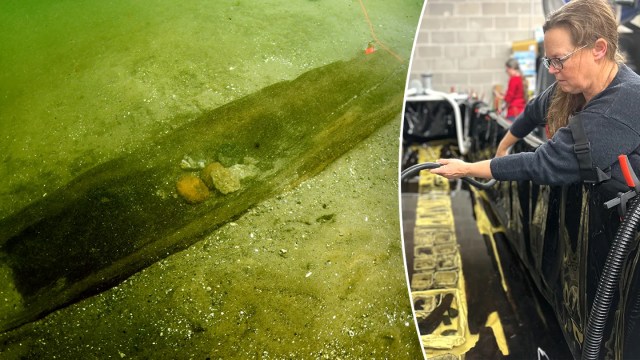
The Wisconsin Historical Society is studying the unusually large cache of canoes after identifying 14 vessels preserved beneath Lake Mendota. (Tamara Thomsen, Wisconsin Historical Society; Wisconsin Historical Society)
The Wisconsin Historical Society (WHS) announced this month that its experts have identified 14 canoes in Madison’s Lake Mendota so far, six of which were found this spring. The WHS worked with the First Nations of Wisconsin during the research process, a release noted.
The WHS also recovered a 1,200-year-old dugout canoe in 2021 and retrieved another 3,000-year-old one in 2022.
All in all, the oldest canoe is 5,200 years old, while the most recent one dates back to the 1300s A.D. The vessels were used to catch fish, to make travel more efficient, and to facilitate trade, the WHS said.
“The landscape around Madison lakes looked very different before European settlers arrived in the area and conducted terraforming to suit modern transportation, with large bluffs that made traveling over the land difficult in some areas,” the statement noted.

The canoes survived because they remained buried in deep water for millennia, according to a maritime archaeologist. (Wisconsin Historical Society; Dean Witter, Wisconsin Historical Society)
“Canoe travel may have been more efficient for certain routes for the communities who lived in the area spanning thousands of years before Wisconsin became a state,” the statement also said.
WHS maritime archaeologist Tamara Thomsen told Fox News Digital the canoes were preserved by being buried under Lake Mendota for thousands of years.
“The canoes have all been found eroding from a bank underwater, in about 25 feet of water,” said Thomsen. “They survived because they remained buried for so many millennia.”
There are no current plans to retrieve the 14 canoes that remain underwater, Thomsen added. The two that have been retrieved, however, are slated to be included in a museum display at the Wisconsin History Center in 2027.
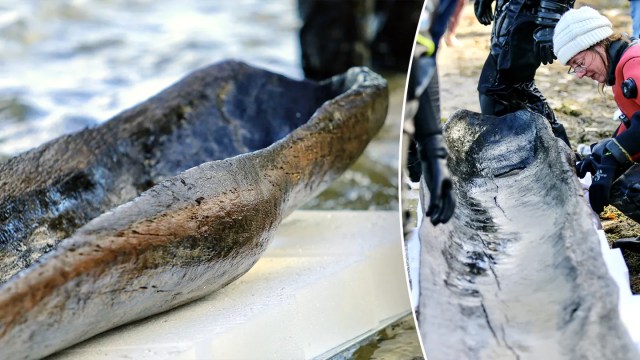
The canoes’ construction reflects early forms of bioengineering long before the modern term existed, said experts. (Wisconsin Historical Society)
“The oldest Lake Mendota canoe identified to date was likely crafted sometime around 3000 B.C., before the Great Pyramid of Giza was built in Egypt, and around the time of the invention of writing in Sumer,” she added.
“Constructed of red oak, it is now the oldest dugout canoe recorded from the Great Lakes region and the third oldest in eastern North America.”
The cache is rare in the Midwest, as such discoveries are more common in the Southeast.
The WHS also said the canoes were made of either red or white oak — curious choices, as they tend to be water-absorbent.
Thomsen speculated that the builders may have intentionally selected trees that were damaged, or may have damaged them on purpose to impact their growth cycle.
“We think of bioengineering as a modern practice, but the samples we have suggest this may have been taking place long before the term was coined in the mid-20th century,” she said.
“Archaeology is kind of like putting together pieces of a puzzle, and the more pieces you can find, the better you can start to form a picture of what was going on and why during a period of history,” Thomsen added.
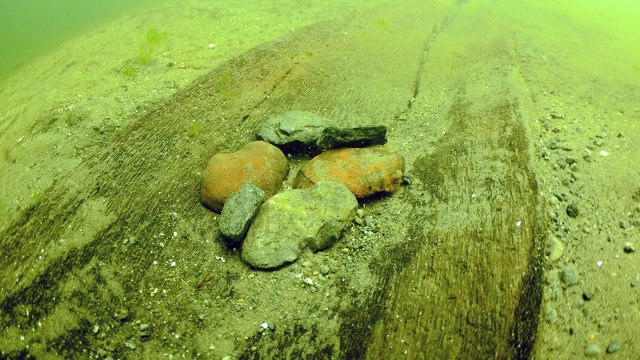
“This is the only cache of canoes that has so far been discovered in Wisconsin,” said maritime archaeologist Tamara Thomsen. (Tamara Thomsen, Wisconsin Historical Society)
Bill Quackenbush, a tribal historic preservation officer for the Ho-Chunk Nation, said the project “gives us a meaningful opportunity to gain a deeper perspective on our heritage and our ancestors.”
He added, “It is important that we document and share these stories, so that our youth feel that connection to our past.”
“Protecting and preserving this knowledge ensures that the next generation understands where we come from and why these stories matter. That is why we share them and continue this work.”
The good news in this story is that ancient artifacts are being preserved and studied for any new learning. Today’s JohnKu talks about history. I hope you have a lovely weekend.
Our Story by John W. Howell © 2025
Those who came before,
Left their stories to be read . . .
We must preserve them.























 Fiction Favorites
Fascinating, John. We tend to underestimate our forebearers.
LikeLiked by 3 people
I think so too. Thanks, Chris.
LikeLiked by 2 people
Such a fascinating story. People back then and people right here… not so authentically different .
LikeLiked by 2 people
Yet very similar. Thank you, Annette.
LikeLiked by 1 person
What interesting pieces of a puzzle these are. The ‘what’s’ and the ‘why’s’ are fascinating.
LikeLiked by 2 people
Yes, they are. Thanks, Lois.
LikeLiked by 1 person
I know we’ve barely explored the ocean, but it looks like we should be investigating our lakes as well. Lots of stuff hidden in those waters.
LikeLiked by 2 people
Especially the deep ones.
LikeLike
How fascinating!
LikeLiked by 1 person
I thought so, too. Thanks, Joy
LikeLike
What very interesting information, John! Thanks for sharing! I hope you are enjoying wonderful festive days in the midst of your beloved ones. Best wishes, Michael
LikeLiked by 1 person
Thank you, Michael. 😊
LikeLiked by 1 person
You`re very welcome, John! xx Michael
LikeLiked by 1 person
😊
LikeLike
The girls were adorable yesterday in their elf outfits.
LikeLiked by 1 person
Thank you, Lois
LikeLiked by 1 person
What an amazing find. I hope it helps uncover more to the story of the ancients that once lived there.
I agree with ^ the girls were adorable in their costumes yesterday. Have a lovely week-end!
LikeLiked by 1 person
Thank you, Deborah. The miracle of AI
LikeLiked by 1 person
😉
LikeLiked by 1 person
😊
LikeLike
This is fascinating, John
LikeLiked by 1 person
I thought so too, Robbie. 😊
LikeLiked by 1 person
It’s really something that those fascinatingly shaped canoes were found. They sure deserve a place in the museum.
LikeLiked by 1 person
They do. Thanks, Tim.
LikeLiked by 1 person
That is really cool!
LikeLike
Thank you, Kymber. 😊
LikeLiked by 1 person
A new archeological discovery is always good news!
LikeLiked by 1 person
It is, Liz. 😊
LikeLiked by 1 person
The John-ku is marvelous. I enjoyed this article. Hugs.
LikeLiked by 1 person
Thank you, Teagan.
LikeLiked by 1 person
That was certainly an interesting discovery.
LikeLiked by 1 person
I agree. Thanks, Thomas.
LikeLiked by 1 person
What an amazing find and yes, we must preserve those stories, in all the ways they reveal themselves.
LikeLiked by 1 person
Thanks, Michele.
LikeLiked by 1 person
😊
LikeLiked by 1 person
What an incredible find!! It is without question that these items be preserved. Thanks for the good news, John. In an era of war, incivility and self-absorption, these posts always warm my heart.
LikeLiked by 1 person
I’m so glad, Monika. I find them conforting as well.
LikeLiked by 1 person
Tremendous find! It made me think of the generation upon generation that went before us in North America and how much we still need to learn about them.
LikeLiked by 1 person
I agree Noelle. Thank you.
LikeLiked by 1 person
That’s so wild! What an exciting discovery! Woo! I love ancient stuff! Thanks for this, John. 🙂
LikeLiked by 1 person
I love it too. Thank you, Ilsa.
LikeLiked by 1 person
Fascinating, thanks John!
To me the JohnKu is right on. I adore history and believe we have a lot to learn from all aspects of it: societal, political, creational, agricultural and more.
OX 🐂
LikeLiked by 1 person
I agree with you, Resa. 😊X 🐂
LikeLiked by 1 person
👍X 🌟X
LikeLiked by 1 person
🏆X
LikeLiked by 1 person
Fascinating, and your JohnKu is perfect.
LikeLiked by 1 person
Thank you, Jennie. 😊
LikeLiked by 1 person
You’re welcome!
LikeLiked by 1 person
😊
LikeLiked by 1 person
Wondefrul discovery,dear John! Thank you!
LikeLiked by 1 person
All for you, Dear Maria.
LikeLike
It’s hard to believe anything that old would still be recognizable but hey, it’s true that stuff made in the past was made to last.
Hey! I rhymed!
I didn’t try that . . .
LikeLiked by 1 person
A natural poet. Good one.
LikeLiked by 1 person
🙂
LikeLiked by 1 person