Today’s good news story is from the Good News Network.
Full Recovery for Coral Reef Within 4 Years–The Speed of Restoration They Saw was ‘Incredible’
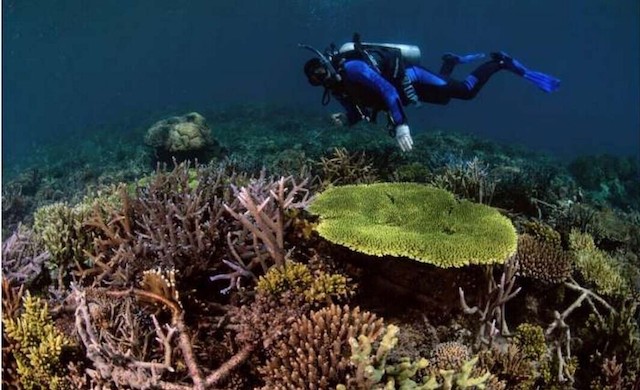
In a truly monumental discovery, scientists studying coral restoration in Indonesia found that artificially restored coral reefs can regrow as fast as naturally occurring reefs just 4 years after the initial transplantation.
With many reefs around the world believed to be threatened by stronger storms and acidic seas, the finding shows that as long as corals can survive in the water, humans can quickly rebuild reefs that are damaged.
The study was conducted at the Mars Coral Reef Restoration Program in South Sulawesi, Indonesia, one of the largest restoration projects in the world, and included an international team of marine biologists. The site was turned from a colorful reef to rubble 30 to 40 years ago from dynamite fishing.
At the project site, “reef stars” are first affixed to the seafloor. These small, recycled metal scaffolds provide a foundation for the coral larvae to glom onto and begin building their hard bodies.
“Corals constantly add calcium carbonate to the reef framework while some fishes and sea urchins erode it away, so calculating the overall carbonate budget basically tells you if the reef as a whole is growing or shrinking,” says Ines Lange of the University of Exeter, UK.
“Positive reef growth is important to keep up with sea-level rise, protect coastlines from storms and erosion, and provide habitat for reef animals.”
Four years after coral transplantation onto the metal reef stars, net carbonate budgets have tripled and are indistinguishable from healthy control sites. The only drawback is that because branching coral is preferred for reef restoration, the overall species diversity is lower in restored reefs than in natural ones.
“The speed of recovery that we saw was incredible,” said Lange. “We did not expect a full recovery of reef framework production after only four years.”
The carbonate budget method of calculating reef restoration has never been used before, and the team believes it offers a simple, surefire way to assess whether a reef is growing, static, or in decline.
Tim Lamont, a study co-author at the Lancaster University Environment Center, UK, said that while a longer-term assessment of restored reefs is needed to fully understand its capability, the success at Mars shows that if humanity can stabilize the climate, we have the tools to undo some of the damage that climate change has wrought on coral reefs.
The good news in Today’s story is that even fully destroyed coral reefs can be regrown. Today’s JohnKu talks about humankind’s responsibility to repair damage caused by human behavior. I hope you all have a wonderful weekend.
Step Up by John W. Howell © 2024
Humans devastate,
Fixing the devastation . . .
Is human duty.