Today’s good news story comes from the Good News Network. Here it is in its entirety.
Aviation Startup ZeroAvia Flies Largest-Ever Hydrogen Electric Aircraft
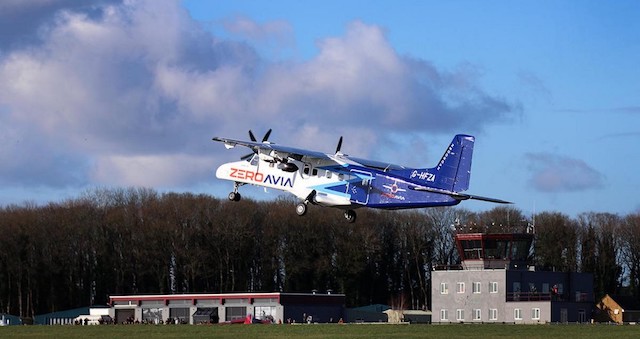
An aviation start-up just set a new world-first for the largest hydrogen-powered aircraft flight in history—a 19-seat aircraft called the Dornier 228.
Designed by ZeroAvia, the start-up is developing hydrogen-powered engines for regional flights and has taken off over the last 12 months.
This most recent flight was a 10-minute affair from the Cotswolds Airport in Gloucestershire, England, but was only the most recent manifestation of their success.
ZeroAvia counts American and United airlines as their investors, and by 2025, the firm has 1,500 pre-orders of their hydrogen-electric powertrains to fulfill. In addition, the prototype powertrains have received approval from the UK and US civil aviation authorities.
“This is a major moment, not just for ZeroAvia, but for the aviation industry as a whole, as it shows that true zero-emission commercial flight is only a few years away,” ZeroAvia founder and CEO Val Miftakhov said in a statement Thursday.
The flight comes after news in August that the company signed a memorandum of understanding with American Airlines for 100 of the powertrains being developed for 90-seat aircraft.
“Having support from [one of the] world’s largest airline is a strong indication of the progress we’re making on the development of hydrogen-electric, zero-emission flight,” added ZeroAvia Founder and CEO Val Miftakhov. “We are focused on delivering sustainable travel and are delighted that American, a visionary leader in the industry, sees ZeroAvia as a part of the future of aviation.”
Hydrogen as a fuel source is currently one of two more sustainable alternatives to powering aviation. Accounting for 2.8% of all global emissions, passenger aircraft need high-octane, energy-dense fuel sources because of the weight limitations that batteries can’t account for.
The ZA2000-RJ powertrain from ZeroAvia is predicted to have a 500-mile range on a full tank, which United Airlines said would restore the economic viability of smaller regional flights.
“A lot of small cities have lost service because of the cost, and we think that these technologies will allow United to bring back more frequent service and service to airports that don’t have any service today,” Michael Leskinen, president of United Airlines Ventures, told CBS.
For reference, 500-mile jumps could service distances such as Pittsburgh to Chicago, Amarillo to Austin, or Fort Myers to Savannah. In Europe, the benefits compound because of the size of the continent. ZeroAvia could easily service Milan to Naples, Munich to Hamburg, or Newcastle to Exeter.
The good news here is zero emissions are possible for air travel. Today’s JohnKu talks about innovation. I hope you have a wonderful weekend.
Discovery by John W. Howell © 2023
Like we always have,
Is not an excuse anymore . . .
Innovation rules.