
Today’s good news story comes from the Good News Network.
Hyper Efficient Solar-Powered Desalination System Requires No Extra Batteries to Purify Groundwater
Envisioned as a way to provide water to communities whose groundwater is too brackish to drink, the device’s real trick is adjusting its desalination activity in response to the amount of solar power it produces.
Multiple times every second, the central control module takes readings of the strength of the sunlight and pumps correspondingly more or less water through the electrodialysis membrane stack. This innovation allows the whole package to skip the necessity for battery storage for times when the panels are producing more energy than the system is using.
No batteries means much lower costs and shipping weight, making it ideal for rural communities in arid parts of the Global South or southern United States with ample yearly sunshine and brackish groundwater.
Electrodialysis is one of two methods for desalinating water, with the other being reverse osmosis. Both have drawbacks at both the micro and macro scale, and in the case of electrodialysis, it requires electricity, which is typically produced by fossil fuels. Renewables have replaced them before, but challenges persist.
“The majority of the population actually lives far enough from the coast that seawater desalination could never reach them. They consequently rely heavily on groundwater, especially in remote, low-income regions,” says Jonathan Bessette, MIT PhD student in mechanical engineering and co-author on the project.
“[U]nfortunately, this groundwater is becoming more and more saline due to climate change. This technology could bring sustainable, affordable clean water to under-reached places around the world.”
For Bessette and the team behind the invention, their biggest challenge was establishing feedback mechanisms in the system that were sharp enough to detect minute changes in sunlight, for example, if a whisp of cloud passes by.
Over months of testing and improvements, their “flow command-current control” module gradually reached the point at which 94% of the solar power generated by the panels was utilized immediately to pump water through the desalination system without any lag and any transfer of power to a battery.
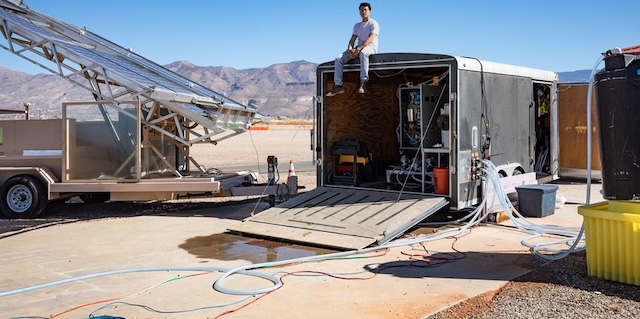
During a 6-month field trial at the Brackish Groundwater National Desalination Research Facility in Alamogordo, New Mexico, the system produced 5,000 liters of water per day despite large swings in weather and available sunlight.
“Conventional desalination technologies require steady power and need battery storage to smooth out a variable power source like solar,” explains Amos Winter, a decorated professor of mechanical engineering at MIT. “Being able to make drinking water with renewables, without requiring battery storage, is a massive grand challenge. And we’ve done it.”
Amos and Bessette are now looking to form a company to develop the technology into a product to help water-stressed communities worldwide.
The good news about this story is that fresh water can be made without using fossil fuels. Today’s JohnKu talks about chipping away at innovation. I hope you have a wonderful weekend.
Perseverance by John W. Howell © 2025
Big problems exist,
Continued working on them . . .
produces results.