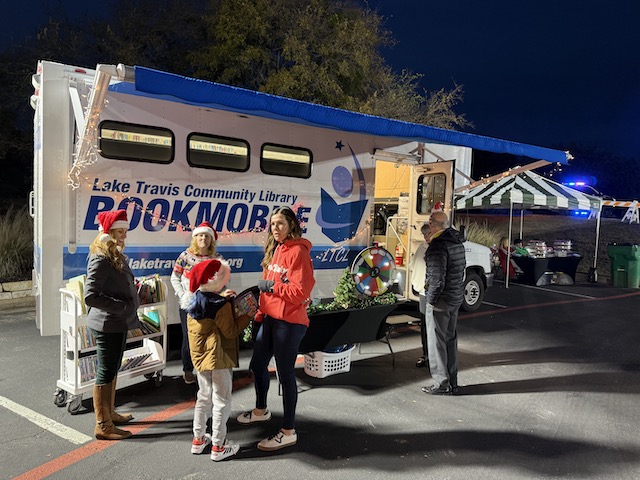
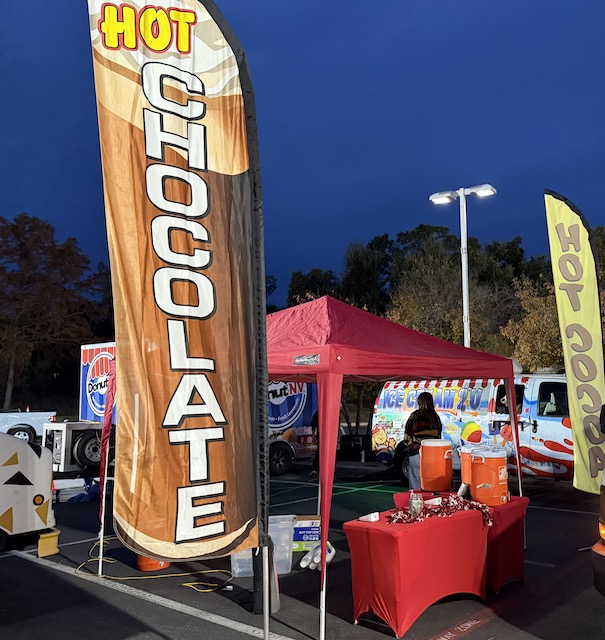
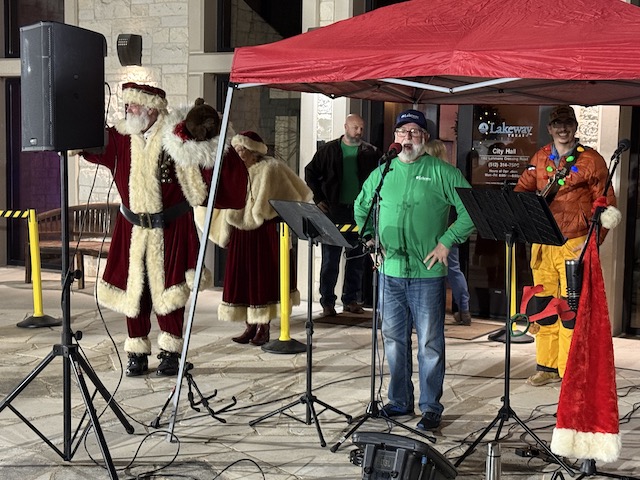
Last Friday was movie night in Lakeway. By the miracle of a time freeze, we can still attend. The event is at the Activity Center in Lakeway. The movie is A Christmas Story. We are catered again by Craigos Pizza and DonutsNV. Our entertainment is Pistol Annies.
Menu
Pizza, Donuts, Hot Cholate, and Smores. (There will be a defibrillator available)
There’s the sign
Looks like the Activity Center is ready for us.
A box outside the Activity Center for Santa letters.
Reindeer at the Activity Center.
More atmosphere.
An outside tree.
Welcome.
The lamp and Ralphie in his new PJs.
Still, it’s time to write letters to Santa.
A festive tree in the Activity Center.
Santa says, “Give me Smores, or someone gets hurt.”
Beautiful Hibiscus plants.
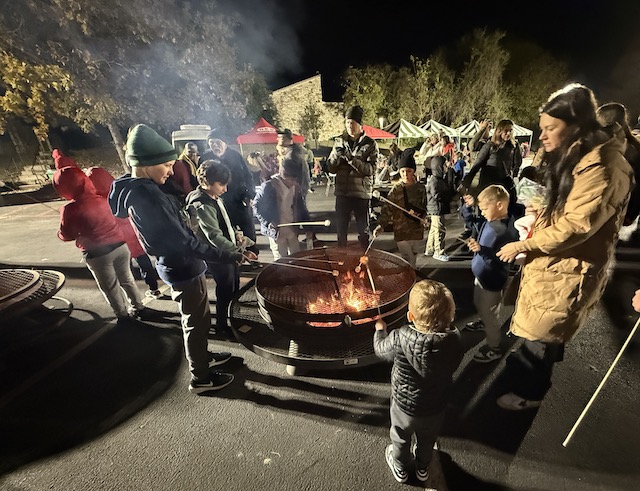
Pick up your Smore kit,
Roast those marshmallows over an open fire.
Here’s the donuts.
And the pizza.
It is time to relax and enjoy the movie, food, and music. I hope you have a great week.
After putting the food for breakfast into Twiggy and Tempeste’s bowls, it is time for coffee. Thinking a change would be good, the coffee machine was ordered to brew a Latte instead of the standard straight 10-ounce cup. The button is pushed, and nothing. The machine stares back at me as if a big mistake is about to happen. The touchpad asks, “You sure?” Once more, the order is confirmed, and the sounds begin almost like the machine shrugs what could pass for shoulders. Steamed milk followed by a shot of espresso and then foam.
Grabbing the finished product and taking a sip turns the mind to the clock. Today, the clock is set for December 14, 1924. The location is Fairfield, Montana, and the duration is thirty minutes. The plunger is pulled, and we arrive in Fairfield in time to see a record being set.
The town of Fairfield, Montana, set a weather record for most significant drop of temperature in a 12-hour period, from 63 °F (17.2 °C) at noon to −21 °F (−29.4 °C) at midnight. It is now midnight, and my cheeks are starting to crack in the cold. Being caught in twenty-one degrees below zero temperature in PJs is not the most comfortable thing in the world. Just as my Lattee begins to freeze, the alarm goes off, and we are back on the warm, comfy couch.
Linda Hill sent a text. It reads, “Your Friday prompt for Stream of Consciousness Saturday is “food.” Use it any way you’d like. Have fun!
American scientists have proposed a new method for recruiting trillions of microscopic sea creatures and their insatiable appetites to fight climate change.
The technique harnesses the animals’ daily habits to accelerate the ocean’s natural cycle for removing carbon from the atmosphere, known as the biological pump, according to the paper in Nature Scientific Reports.
The study, published by researchers at Dartmouth College, reported that spraying clay dust on the ocean’s surface converts carbon into food the animals eat, digest, and send deep into the sea as carbon-filled feces.
They explain that the process would begin with spraying the clay dust at the end of algae blooms. These blooms can grow to cover hundreds of square miles and remove about 150 billion tons of carbon dioxide from the atmosphere each year, converting it into organic carbon particulates. But once the bloom dies, marine bacteria devour the particulates, releasing most of the captured carbon into the atmosphere.
The researchers found that the clay dust attaches to carbon particulates before re-entering the atmosphere. It redirects them into the marine food chain as tiny sticky pellets the ravenous zooplankton consume and later excrete at lower depths.
“Normally, only a small fraction of the carbon captured at the surface makes it into the deep ocean for long-term storage,” says Mukul Sharma, the study’s corresponding author and a professor of earth sciences. Sharma presented the findings on December 10th at the American Geophysical Union annual conference in Washington, D.C.
“The novelty of our method is using clay to make the biological pump more efficient—the zooplankton generate clay-laden poops that sink faster,” says Sharma, who received a Guggenheim Award in 2020 to pursue the project.
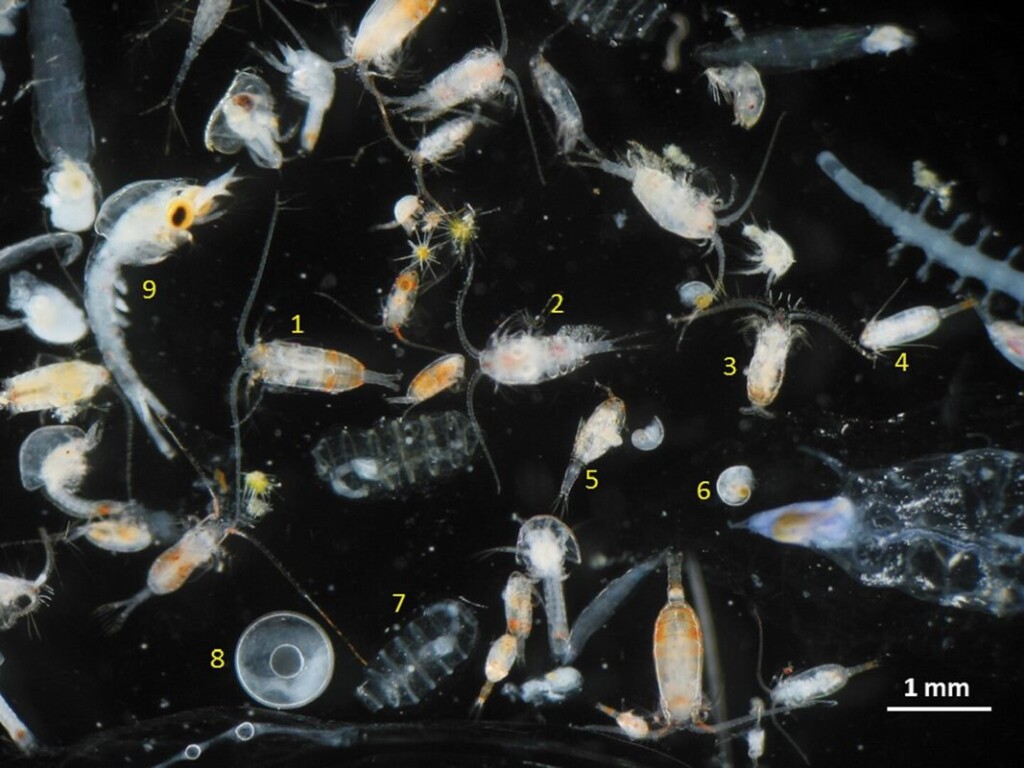
A mixed zooplankton sample including common species – Credit Adriana Zingone, Domenico D’Alelio, Maria Grazia Mazzocchi, Marina Montresor, Diana Sarno, LTER-MC team CC 4.0. BY-SA (John’s note – I don’t have the number key for the photo)
“This particulate material is what these little guys are designed to eat. Our experiments showed they cannot tell if it’s clay and phytoplankton or only phytoplankton—they just eat it,” he says. “And when they poop it out, they are hundreds of meters below the surface, and all that carbon is, too.”
The team conducted laboratory experiments on water collected from the Gulf of Maine during a 2023 algae bloom. They found that when clay attaches to the organic carbon released when a bloom dies, marine bacteria produce a kind of glue that causes the clay and organic carbon to form little balls called flocs.
The researchers report that the flocs become part of the daily smorgasbord of particulates that zooplankton gorge on. Once digested, the flocs embedded in the animals’ feces sink, potentially burying the carbon at depths where it can be stored for millennia. The uneaten clay-carbon balls also sink, increasing in size as more organic carbon, as well as dead and dying phytoplankton, stick to them on the way down.
In the team’s experiments, clay dust captured as much as 50% of the carbon released by dead phytoplankton before it could become airborne. They also found that adding clay increased the concentration of sticky organic particles—which would collect more carbon as they sink—by 10 times. At the same time, the populations of bacteria that instigate the release of carbon back into the atmosphere fell sharply in seawater treated with clay, the researchers report.
Sharma says that in the ocean, the flocs become an essential part of the biological pump called marine snow. Marine snow is the constant shower of corpses, minerals, and other organic matter that falls from the surface, bringing food and nutrients to the deeper ocean.
“We’re creating marine snow that can bury carbon at a much greater speed by specifically attaching to a mixture of clay minerals,” Sharma says.
Zooplankton accelerate that process with their voracious appetites and incredible daily sojourn, known as the diel vertical migration. Under cover of darkness, the animals—each measuring about three hundredths of an inch—rise hundreds, and even thousands, of feet from the deep in one immense motion to feed in the nutrient-rich water near the surface.
When the day breaks, the animals return to deeper water, depositing the flocs as feces. This expedited process, active transport, is another key aspect of the ocean’s biological pump that shaves days off when it takes carbon to reach lower depths by sinking.
Sharma plans to field-test the method by spraying clay on phytoplankton blooms off the coast of Southern California using a crop-dusting airplane. He hopes that sensors placed at various depths offshore will capture how different species of zooplankton consume the clay-carbon flocs so that the research team can better gauge the optimal timing and locations to deploy this method—and exactly how much carbon it’s confining to the deep.
“Finding the right oceanographic setting to do this work is significant. You cannot go around willy-nilly dumping clay everywhere,” Sharma told Dartmouth Press. “We need to understand the efficiency first at different depths to understand the best places to initiate this process before we put it to work. We are not there yet—we are at the beginning.”
The Good News in today’s story is that scientists continue to work to make our oceans healthier. Today’s JohnKu talks about the oceans. I hope you have a super weekend.
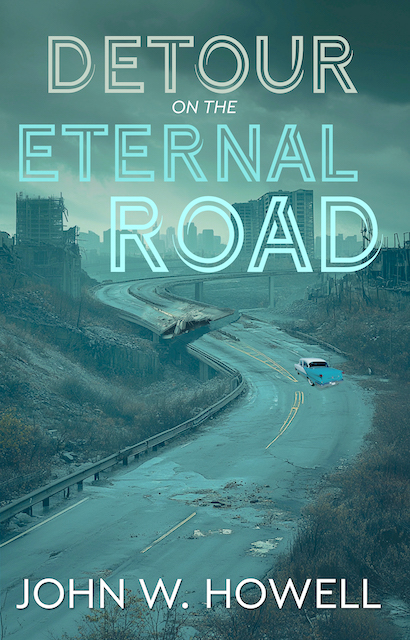
As you can see, the final book in the Eternal Road series is ready to be launched. The actual launch date is February 10, 2025. I am calling for volunteers who would like to host a visit anytime in February. The first through the tenth would be in the pre-publication period, and then after the tenth, the book will be available from Amazon in paperback and ebook formats.
If you would like to host a visit, please send me an email at johnhowell (dot)wave(at)gmail(dot)com. If you have a preferred date, please put it in the note. Otherwise, I will contact you back to confirm a date.
All material will be sent well before the date of the post.
Here is the blurb.
Sam and James are dragged into another strange assignment when a couple of souls on The Eternal Road drop off the radar. Archangel Micheal gives them specific orders to resolve the issue and get Billy Ray Chitwood, the national race car champion, and Dale Earnhardt, his guide, back on the task of finding Billy’s Eternal Home.
Finally, meeting up with Billy Ray and Dale, the foursome finds themselves in the future where World War III has devastated the country. The team discovers the cause of the start of the war and vows to mitigate that circumstance and save the world from devastation. They encounter their old nemesis, Lucifer, who has in mind trading preventing the war in exchange for Sam accepting his offer to be his queen.
Since Lucifer’s offer is a non-starter, Sam and James must overcome Lucifer’s interference and work to change the course of history, or else humankind is doomed.
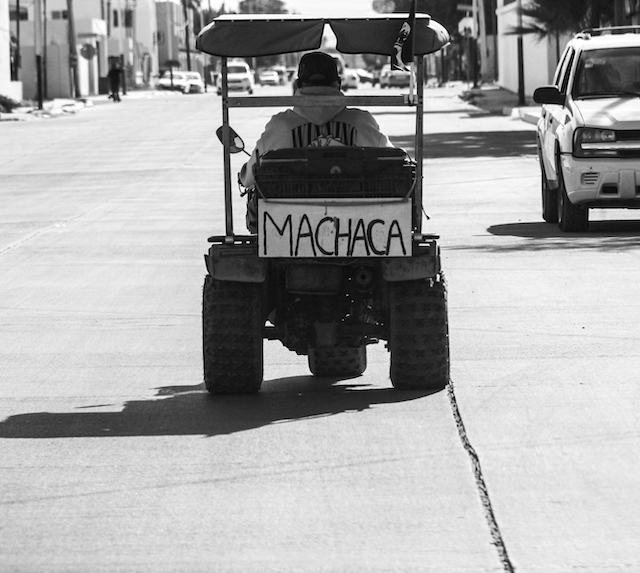
On Sunday, I was reading Michele Lee’s post, which contained some photos from her trip to Peñesco, Mexico. I couldn’t help but be taken by the image below. So, here is one of Michele’s photos instead of a finger-point prompt. You should visit her blog. It is special. Thank you so much, Michele.
Photo by Michele Lee
“Excuse me, sir. Do you know how fast you were going?”
“Yes, I was doing five miles an hour in a 30-mile an hour zone.”
“That is exactly right.”
“So, what’s the problem?”
“Do you know how dangerous driving 25 miles an hour below the speed limit is?”
“No, I don’t.”
“You could be hit from behind.”
“Oh, I don’t think so.”
“What makes you say that?”
“I am a student of psychology, that’s why.”
“What does being a student have to do with getting killed by someone who doesn’t realize you are going so slow?”
“It has everything to do with it.”
“Okay, explain.”
“If you tell people to do something, the human tendency is to resist and mostly do the opposite. It’s human psychology.”
“I’m still having trouble seeing how this fits the situation.”
“Look at the sign on the back of my cart.”
“Yeah, okay.”
“It says machaca, which is Spanish for crush.”
“Still don’t get it.”
“When someone coming up behind me reads the sign, his psychology will make him do anything but hit me.”
“So you are saying that instead of crushing you, the person will do anything but.”
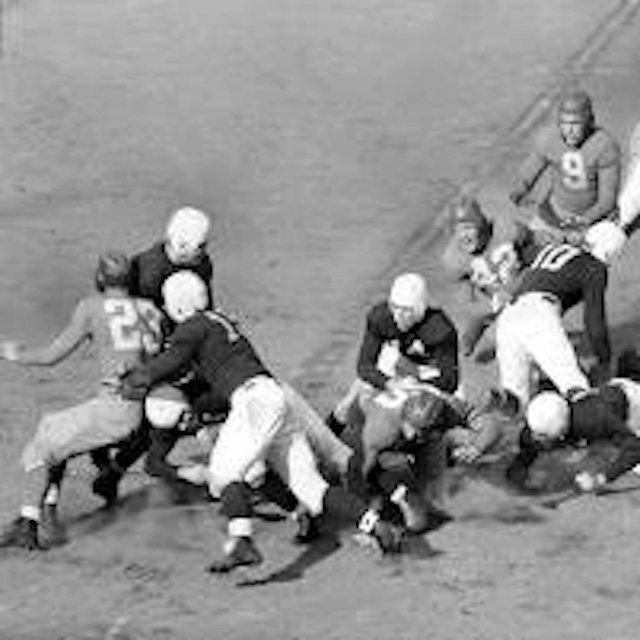
This post was first run on November 11, 2018. From a historical perspective, I thought you would enjoy it since we are all now surrounded by Sunday American Football
Top Ten Things Not to Do at the First Sunday Football Game at Philadelphia in 1933
10 At the first Sunday football game in Philadelphia, do not sit next to your parish priest unless you have been to church. If you do, at best, you can take confession right there. At worst, you will be invited to a special service titled Miscreants of the Week. ( Of all the seats in the stadium, you had to pick this one, Farzad.)
9 At the first Sunday football game in Philadelphia, do not forget to tip Tiny, the WWF Champ and now stadium vendor, for your hot dog. If you do, at best, that mustard stain on your back will come out. At worst, Tiny, who believes tips are a showing of love, will think you hate him. (The time to vacate your seat is now, Fedele. That large tray of hot dogs will not rest well when Tiny lets it go in your direction.)
8 At the first Sunday football game in Philadelphia, do not try to eat a Philly Cheesesteak sandwich and cheer for your team at the same time. If you do, At best, the guy in front of you is wearing a raincoat. At worst, your expelled cheesesteak bite goes down the collar of the police chief in the row in front of you. (I don’t think you can explain this as an accident, Felicien. Good luck on your first night in jail)
7 At the first Sunday football game in Philadelphia, do not cause yourself to be over-celebrating on your carry-in hooch just because the blue laws in Pennsylvania allowed Sunday sports. If you do, at best, you’ll find someone to take you home. At worst, you will need an ironclad excuse for spending the night in the bleachers. (Gotta wonder why none of the cleaning crew found you, huh, Fenris.)
6 At the first Sunday football game in Philadelphia, do not sit in the Chicago section wearing your Eagles jersey. If you do, at best, the fans around you think you have a mental condition. At worst, as the game progresses, someone may get the idea to remove you by crowd-surfing you over the lip of the Baker Bowl stadium. (It is a long fall from the top to the parking lot, Ferke. Flapping your arms may help a little.)
5 At the first Sunday football game in Philadelphia, do not think you don’t have to pay off your bet because the score was tied at 3 and 3. If you do, at best, the bookie considers your bet too small to collect. At worst, your bookie is the kind who believes any no-pay is a matter of honor. ( Those cement overshoes are styling, Fidal. They might prove to hamper treading water, though.)
4 At the first Sunday football game in Philadelphia, do not blow your large and loud horn to cheer on your team. If you do, at best, you’ll be sitting alone. At worst, your fellow participants will tire of losing their hats, hair, and hearing and will stuff your horn where the sun don’t shine. (I know I’m surprised as well, Finnbar. I think that high-decibel honk is terrific. It might be better on a MAC truck, though.)
3 At the first Sunday football game in Philadelphia, do not ask your neighbor to share their popcorn. If you do, at best, the corn will be gone. At worst, your neighbor has just been diagnosed with the flu and is happy to share. (Don’t worry, Fionn. In the 30s, the flu only took maybe half of those diagnosed. Oh, look, a guy in a black hoodie carrying a scythe. I don’t see any hay that needs cutting, do you?)
2 At the first Sunday football game in Philadelphia, do not run out and attempt to ring the Liberty Bell to count the first field goal points. If you do, at best, the Liberty Bell Center in Independence National Historic Park will be closed on Sunday. At worst, your attempt at goodwill has been seen as a terrorist act. (You’ve earned yourself a nice cozy room in Guantanamo, Firmann. I have no idea why it is so dark there.)
1 At the first Sunday football game in Philadelphia, do not dispute how the Eagles got their name. If you do, at best, there was no money on the fact that they got their name from the Blue Eagle, which was a symbol of economic recovery during the Franklin Roosevelt administration. At worst, you need to walk home since you put your car up to back your bet that the Eagles were named after the great American Bald Eagle. (You could have been right, too, Flanagan. You might try putting your thumb out. Maybe some hapless fool will give you a lift.)
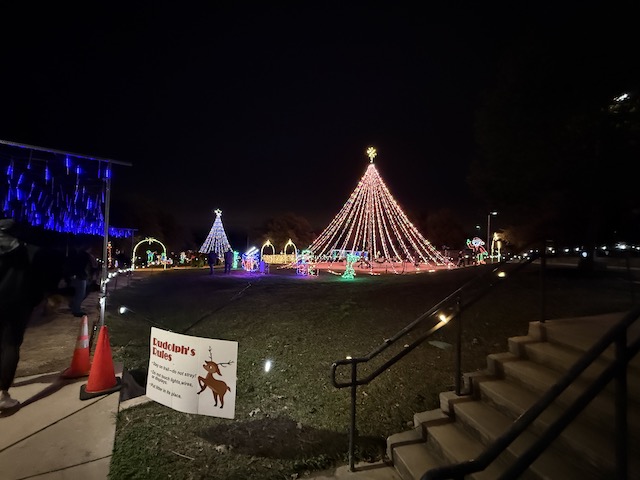
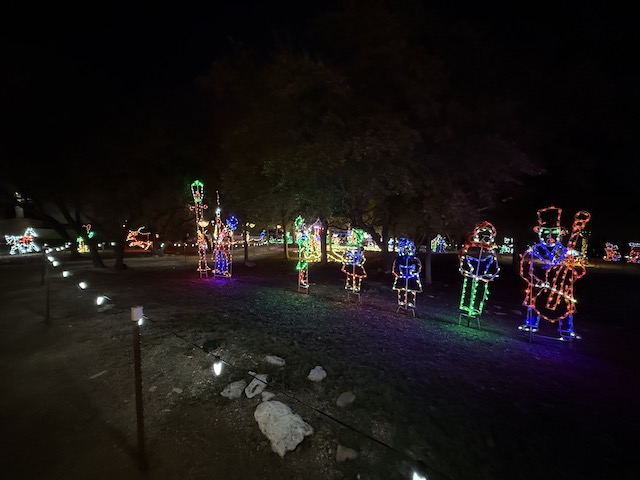
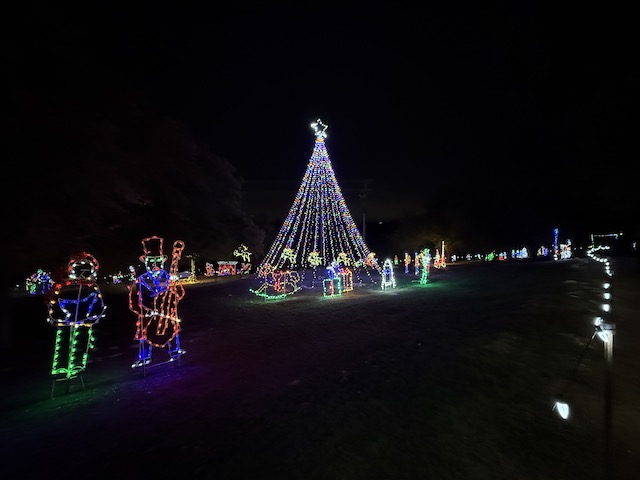
We are visiting the Lights On event in Lakeway. Each year, the city sets up a holiday light display, and Friday night was the grand opening. We are going to eat off the food trucks. Our entertainment is Jimmy Buffet.
Menu
Pizza, Bar B Q, donuts, Smores, hot chocolate
So jump on the bus.
Santabus from Waterford Unified School District, photographed by Suzanne Bauer, director of transportation.
There’s the sign, so we know we are here.
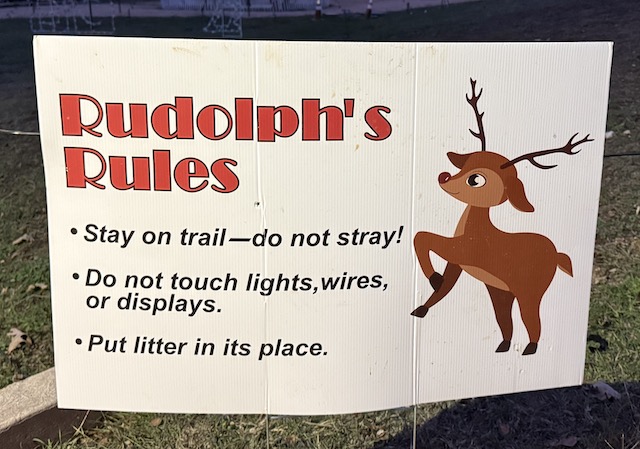
There have to be rules.
Great sign.
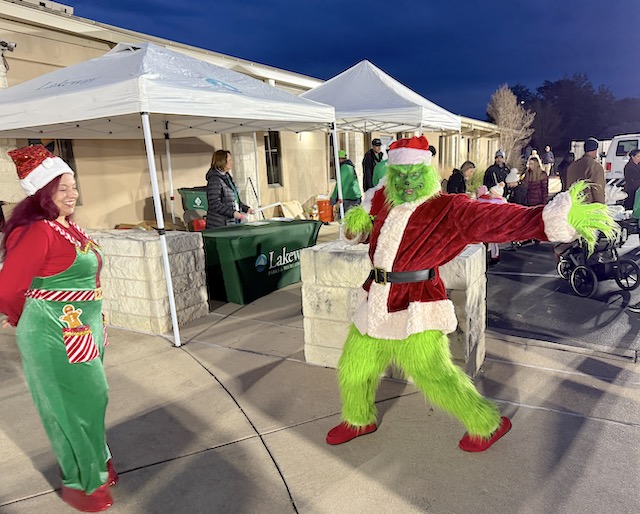
Of course, the Grinch is here.
Decorate cookies.
Ride the bucking reindeer.
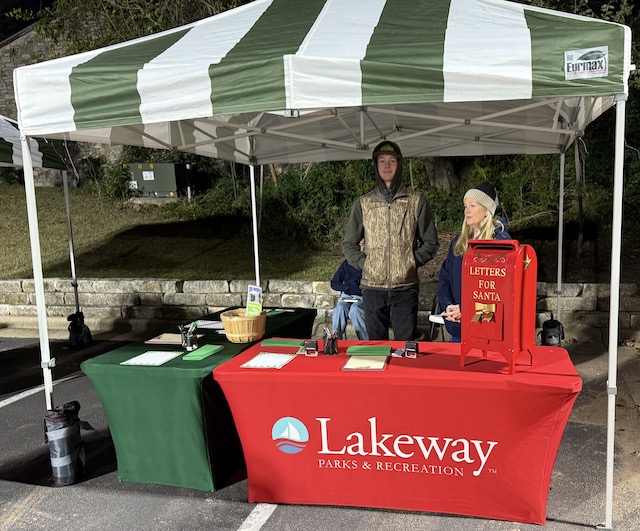
Write a letter to Santa.
Visit the Bookmobile.
There is a band.
Mini donut cakes
Craigo’s pizza.
Hot chocolate.
BBQ
Marshmallows for smores.
Mayor Kilgore and Santa are ready to light the display.
The lights are on.
Trails of lights.
Beautiful lights.
The center of the big tree looking up
Time now for some food and music. I hope you have a great week.
Stop me if you have heard this one. The Coffee machine stands ready for the order. One could almost hear the click of heels as the coffee was promptly delivered. One sip and the clock came to mind.
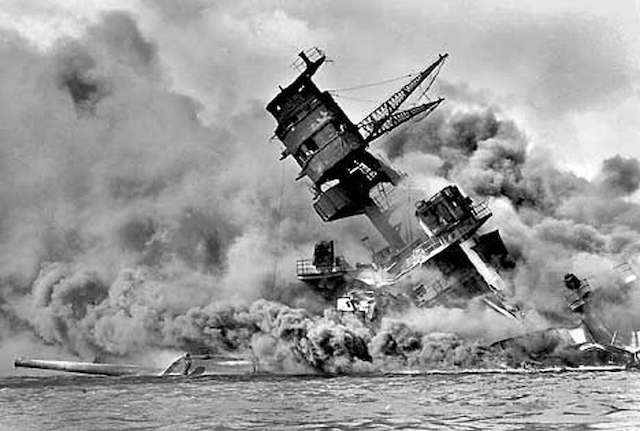
The setting is 1941, and the location is Pearl Harbor, Oahu, Hawaii. The time is 7:55, and the duration is 110 minutes. The plunger is pulled, and we find ourselves on the deck of the battleship USS West Virgina. It is a beautiful Sunday morning, and in the distance, we can see what looks like a whole squadron of airplanes returning to Hickam Field on the island.
These are not American planes returning but 353 Aircraft – 40 torpedo planes, 103 level bombers, 131 dive-bombers, and 79 fighters of the Imperial Japanese Navy with the intent of sinking the American fleet at Pearl Harbor.
These Japanese aircraft were launched from the Japanese fleet north of Hawaii, which consisted of 67 Ships: 6 heavy aircraft carriers, 2 heavy cruisers, 35 submarines, 2 light cruisers, nine oilers, 2 battleships, and 11 destroyers.
In about one hour and fifteen minutes, Japanese planes destroyed or damaged 19 US warships and 300 aircraft and killed over 2,400 US servicemen.
As the West Virginia settles to the bottom of the shallow harbor, the alarm goes off, and we find ourselves back on the couch.
There is a text from Linda Hill. It reads: Your Friday prompt for Stream of Consciousness Saturday is “Stop me if you’ve heard this one.” Write whatever comes to mind when you think of the prompt. Enjoy!
Today marks the 83rd anniversary of the attack and a day that should be remembered. We are not going to the pub today but will be thinking of those who lost their lives.
It’s new news, old news, and news that can never be repeated too often: spending time in nature reduces emotional distress among troubled 10-—to 12-year-olds.
The Canadian researchers behind the new study say their findings suggest that an inexpensive school-based, nature-born program may help the most vulnerable youngsters.
Canadian researchers discovered that spending two hours a week of class time in a natural environment can reduce emotional distress among child participants who had the most significant mental health problems before the program began.
The research, published in the journal JAMA Network Open, follows the recent publication of a UNICEF report pointing to the importance of green space for children’s development.
The Canadian team looked at the effects of spending time in nature on the behavior and mental health symptoms of more than 500 schoolchildren across Quebec in the spring of 2023.
“The idea for the project came up during the pandemic when people were worried about the health risks of children spending so much time inside the school each day,” said study senior author Professor Marie-Claude Geoffroy of McGill University.
They found that at the end of three months, teachers noted that the most significant changes in behavior occurred in children with the most important problems at the outset. These included anxiety and depression, aggressivity and impulsivity, and social issues relating to interaction with their peers.
Interviews with the teachers following the program also suggested that children were calmer, relaxed, and attentive in class after spending time in nature.
“This suggests that nature-based programs may offer targeted benefits for children with higher levels of mental health vulnerabilities and potentially act as an equalizer of mental health among school-age children,” co-author Professor Sylvana Côté from the University of Montreal added.
The research builds on earlier observational studies but is the first to use a randomized controlled trial—the gold standard of medical research—to provide concrete information about the benefits to children of spending time in nature.
All the schools involved in the study were within a mile of a park or green space, and half of the children stayed in school while a similar number took part in the nature-based intervention.
“My kids and I spend lots of time in parks, so I’ve seen the benefits of spending time in nature, both for myself and them,” added Professor Geoffrey. “So, I thought maybe we can have a free and accessible intervention where school children can spend time in nature, and we can measure the effects this has on their mood and behavior.”
During the two hours they spent in the park each week, teachers were asked to offer regular classes in math, languages, or science.
They were also asked to incorporate a 10—to 15-minute activity to promote mental health, using examples drawn from a teachers’ kit designed by the research team.
The activities included drawing a tree, writing haikus, and mindful walking.
Study first author Tianna Loose, a post-doctoral fellow at the University of Montreal, added that the intervention was low-cost, well-received, and posed no risks, making it a promising strategy for schools.
The good news here is something we all could have guessed, but it is now a matter of science. Today’s JohnKu talks about intuition. I hope you have a glorious weekend.