Guest Post – Liz Gauffreau – #newbook – Simple Pleasures: Haiku from the Place Just Right!

I am so happy to have Liz Gauffreau here on Fiction Favorites. Liz is a very creative writer and poet. She is here to talk about her new book, which is comprised of haikus. I will admit I’m no stranger to haikus, though; Liz makes my efforts pale in comparison.

Thank you, John, for hosting me on Day #2 of my blog tour for Simple Pleasures: Haiku from the Place Just Right! Haiku seems to have become part of Western popular culture, so when I was putting this blog tour together, I was curious as to whether it had inspired any music.

Sure enough, I found a silly, albeit very catchy, haiku song on YouTube. (I’ll spare your readers, “I Wrote Haikus about Cannibalism in Your Yearbook.” It’s just a bunch of young men screaming unintelligibly over eardrum-piercing heavy metal guitar. Not Zen at all.)

https://www.youtube.com/watch?v=QvmdEGR93mE

Haiku has even entered the stand-up comedy sphere!

https://www.youtube.com/watch?v=pwnqUmmJ-zE

I’m sure I could find a scholarly work of literary criticism to explain the cultural phenomenon of poking fun at haiku, but I’d rather just write haiku for my own purposes of expression.

Author Biography

Elizabeth Gauffreau writes fiction and poetry with a strong connection to family and place. Her work has been widely published in literary magazines, as well as several themed anthologies. Her short story “Henrietta’s Saving Grace” was awarded the 2022 Ben Nyberg Prize for fiction by Choeofpleirn Press.

She has published a novel, Telling Sonny, and a collection of photopoetry, Grief Songs: Poems of Love & Remembrance. She is currently working on a novel, The Weight of Snow and Regret, based on the closing of the last poor farm in Vermont in 1968.

Liz’s professional background is in nontraditional higher education, including academic advising, classroom and online teaching, curriculum development, and program administration. She received the Granite State College Distinguished Faculty Award for Excellence in Teaching in 2018. Liz lives in Nottingham, New Hampshire, with her husband. Find her online at https://lizgauffreau.com

Purchase links:

Book2Read Purchase Link: https://books2read.com/SimplePleasures

Print & Fixed EPUB for tablets and Kindle Fire

BookFunnel PDF Purchase Link: https://buy.bookfunnel.com/gef1ili6qd

For any device.

Blog Tour Host Links: https://lizgauffreau.com/simple-pleasures-blog-tour-links/
Friday JohnKu – AKA – TGIF – Fri-Yay/Good News

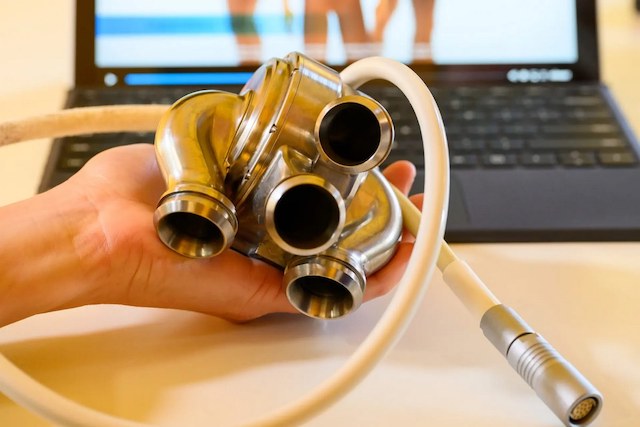
The Total Artificial Heart, made of titanium – credit BiVACOR

Today’s good news comes from the Goodnews Network

Titanium Maglev Heart Implanted Successfully in a Patient for First Time May Help Others Waiting for a Transplant

In a highly-anticipated world-first, the Texas Heart Institute has successfully implanted an artificial titanium heart that uses the same technology as bullet trains to pump blood mechanically throughout the body.

Called the Total Artificial Heart (TAH), the feat is seen as a major step in keeping people alive for longer and longer periods while they wait for heart transplants.

Texas Heart partnered with the medical tech company BiVACOR to create the TAH. It’s a titanium-constructed biventricular rotary blood pump with a single moving part that utilizes a magnetically levitated rotor that pumps the blood and replaces both ventricles of a failing heart.

The benefit of using magnetic levitation is that none of the moving parts ever scrape or slide against each other, reducing friction and dramatically increasing the longevity of the device. But what’s really cool is the TAH can pump blood at a rate of 12 liters per minute, enough to allow an adult male to engage in exercise.

The first-in-human clinical study, overseen closely by the FDA, aims to evaluate the safety and performance of the BiVACOR TAH as a bridge-to-transplant solution for patients with severe bi or univentricular heart failure. Following this first implantation completed at Baylor St. Luke’s Medical Center in the Texas Medical Center, four additional patients are to be enrolled in the study.

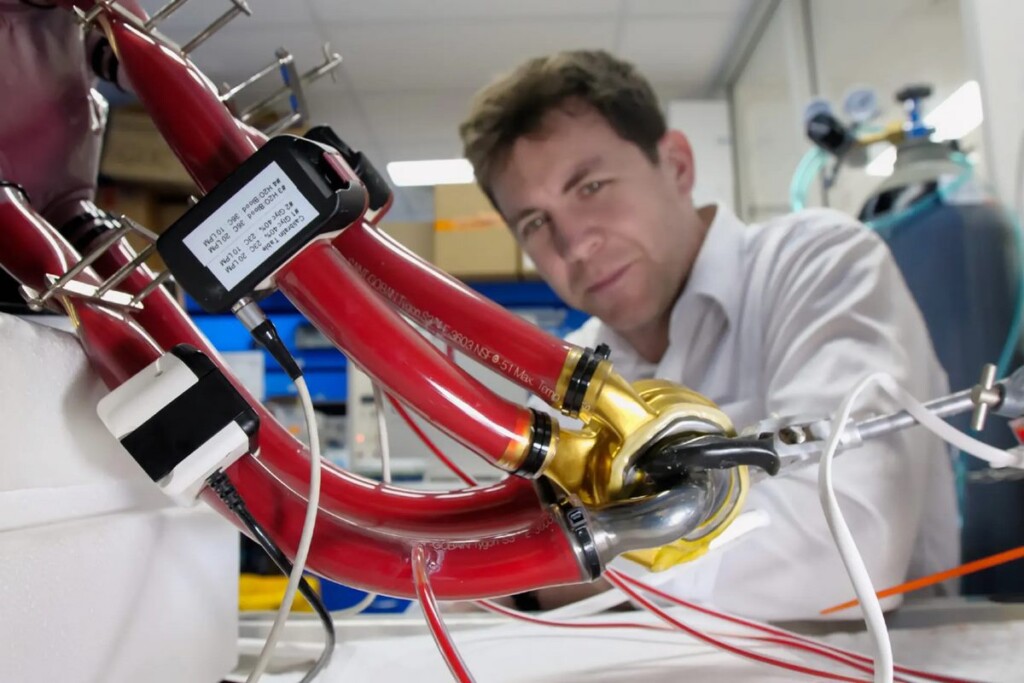
BiVACOR founder and CTO Daniel Timms tests the artificial heart – credit BiVACOR.

“The Texas Heart Institute is enthused about the groundbreaking first implantation of BiVACOR’s TAH. With heart failure remaining a leading cause of mortality globally, the BiVACOR TAH offers a beacon of hope for countless patients awaiting a heart transplant,” said Dr. Joseph Rogers, President and Chief Executive Officer of The Texas Heart Institute and National Principal Investigator on the research.

“We are proud to be at the forefront of this medical breakthrough, working alongside the dedicated teams at BiVACOR, Baylor College of Medicine, and Baylor St. Luke’s Medical Center to transform the future of heart failure therapy for this vulnerable population.”

Heart failure is a global epidemic affecting at least 26 million people worldwide, 6.2 million adults in the US, and is increasing in prevalence. Heart transplantations are reserved for those with severe heart failure and are limited to fewer than 6,000 procedures per year globally. Consequently, the US National Institutes of Health estimated that up to 100,000 patients could immediately benefit from mechanical alternatives.

The successful implantation of BiVACOR’s TAH highlights the potential of innovative technologies to address critical challenges in cardiac care, such as long transplantation waitlists.

“This achievement would not have been possible without the courage of our first patient and their family, the dedication of our team, and our expert collaborators at The Texas Heart Institute,” said Daniel Timms, founder and CTO of BiVACOR.

WATCH the story below… 

The Good News in this report is that more and more people can be saved. Today’s JohnKu talks about dedication. I hope you have a fabulous weekend.

Unorthodox by John W. Howell © 2024

Sometimes answers found,

By thinking outside the box . . .

Show dedication.

Friday JohnKu – AKA – TGIF – Fri-Yay/Good News

http://www.returnmycup.com


Today, good news comes from the Good News Network.

City Experiments with Reusable Cups at Starbucks, Taco Bell, and 30 Other Restaurants–with Return Bins all over town

By Andy Corbley –

A consortium of small firms is creating a renewable revolution within the boundaries of a small city in Northern California. The city will be the testbed for a use-and-return concept for fast food drinks.

Around 50 billion disposable drink cups are used every year in the US, but in the city of Petaluma, we will see if Americans have the discipline to reduce this footprint.

The city has around 60,000 people and will participate in the Reuseable Cup Project. The aim is to furnish 30 local restaurants, from Starbucks to Taco Bell, with identical, durable plastic drink cups. Customers and diners can use these cups and then either leave them on the table or deposit them in a network of dropoff bins around the city.

NextGen Consortium, led by the Center for the Circular Economy at Closed Loop Partners investment firm, asked the city government for help identifying partner restaurants. A firm called Muuse will provide professional cleaning and distribution services to redeliver the cleaned cups back to the locations.

“What they’ve told us they like about Petaluma is that there’s already a spirit of sustainability in Petaluma and [an] interest in trying to reduce the amount of waste that we’re creating collectively as a city,” Patrick Carter, assistant of the city manager who oversees the program, said in a phone call with FOX Business.

“They liked the combination of kind of a denser downtown, more businesses together that are serving these drinks, these beverages, but with a smaller population.”

Located between Santa Rosa and San Francisco, Petaluma’s residents will not be charged a penny more for their drinks and are only asked to drop them off in one of the networks of bins when they are finished. A map showing the locations of the bins can be found on the project website.

Along with reducing cup waste, it should also reduce the number of throwaway hot drink sleeves since the cups themselves are more durable and less conductive to heat.

A three-month trial starting on August 5 and running into November will provide NextGen with the data it needs to understand whether such a program can be used in larger cities.

The good news in this article is that the government, community, and individuals are all working together to eliminate waste. Today’s JohnKu talks about cooperation. I hope you have a wonderful weekend.

Together by John W. Howell © 2024

Projects done alone,

Require increased energy . . .

Better to have help.

Friday JohnKu – AKA – TGIF – Fri-Yay/Good News


photo released by Shaurya Jain (right)

Today’s good news comes from the Good News Network.

These 2 Northern Virginia High School Students Just Got a $15,000 Grant to Use AI to Prevent Deer from Running into Cars

Every Virginian over 30 you could hope to meet will know someone who has collided with a deer in their car: the state is in the top ten nationwide for deer-related crashes.

These two high school seniors have just received a large grant to pursue their research into a device that detects cars and deer via artificially intelligent cameras and helps both avoid collisions.

Shaurya Jain and Anmol Karan from Thomas Jefferson High School in Fairfax County received $15,000 after presenting their prototype.

The money came from the Animal Welfare Institute as a part of the Christine Stevens Wildlife Award, leaving the two young men feeling “honored.”

“Not everyone would trust a bunch of high schoolers with this kind of money,” Jain told WTOP.

Positioned on the side of the road, if the device detects cars and deer in the vicinity, it emits high-frequency pulses and animal sounds to deter the deer from attempting to cross at that moment. If positioned in places with high deer traffic, the boys hope it will stop them from impacting traffic, especially at night when visibility is low and deer are most active.

In 2022, 6,100 traffic collisions, or 15% of the total number in the state, involved deer, an incident ratio that left 500 people injured.

Mr. Jain says he was inspired by his religion, Jainism—which holds all animals to be sacred and carriers of souls, while Karan was moved to action by the news that his uncle had collided with a deer in his car at night in Loudon County and was severely injured.

“Seeing him caused me to just feel that there probably is some type of method that we can use to keep on these roads to prevent such accidents from happening,” said Karan.

The Virginia Transportation Research Council applauded the students’ idea and wrote letters of encouragement to them. They are still collecting data on deer injuries and hope to start roadside testing soon.

The good news in this article is that two young men felt strong enough about a problem to do something about it. Today’s JohnKu continues the theme of embracing people who are called to action. I hope you have a terrific weekend.

Action by John W. Howell © 2024

A problem exists,

Some would simply ignore it . . .

Others take action.

Friday JohnKu – AKA – TGIF – Fri-Yay/Good News

The bell frogs in their sauna – credit, Anthony Waddle

Today’s good news comes from the Good News Network

In humans, sauna use is so beneficial that some medical researchers are attempting to add it to the standard of care for those at high risk of heart disease.

Well, researchers in Australia have found that this same leisure activity can save certain species of frogs from the ongoing fungal pandemic called chytrid.

GNN has already reported on chytrid and ways to combat it. Documented as having infected 500 species of frog or more, it’s a massive threat to the amphibiome.

Anthony Waddle at Macquarie University in Australia built a series of “frog saunas” to see if they could help golden bell frogs and green bell frogs native to Australia recover from chytrid. The fungal pathogen thrives in cooler tropical temperatures and is unviable above 84°F (29°C).

Consisting of unshaded black brick structures with narrow holes inside an artificial greenhouse habitat with water and plants, the frogs quickly made themselves at home inside the saunas.

Four healthy frogs were used as controls for a study group of eight frogs, half of which were infected with chytrid. Some habitats were shaded, and others were left uncovered to test a range of temperatures. Infected frogs who frequented the unshaded structure, where temperatures could climb as high as 97 to 100°F, had milder infections, but access to any sauna helped the frogs fight off the disease.

Once they recovered via the saunas, the bell frogs were 23 times less likely to die from a repeat infection with chytrid.

Bell frogs “used to live in people’s toilets and letterboxes and everywhere before chytrid,” Waddle told Science News. “Setting up these habitats where they still persist might give them enough of a boost that you could see a population increase.”

Building these simple structures in a garden could help frogs survive chytrid outbreaks and help the local population develop resistance.

Not all frog species enjoy roasting, however, so saunas are limited to warm-weather species. Another solution needs to be found for those who enjoy cooler temperatures.

The good news in today’s story is that folks are working on eliminating a threat affecting a whole animal species.  Today’s JohnKu talks about those folks. I hope you have a terrific weekend.

Heroes by John W. Howell.© 2024

It’s hard to define,

What actions are heroic . . .

The frogs could tell you.


Friday JohnKu – AKA – TGIF – Fri-Yay/Good News

The Nippon Foundation – released

Today’s good news story comes from the Good News Network.

Pioneering Zero-Emissions Hydrogen Fuel-Cell-Powered Ship Successfully Tested in Japan

A consortium of Japanese firms has successfully demonstrated the first-ever zero-emissions ship above 20 gross tons.

Sailing 30 kilometers between the Port of Kokura and the Shirashima Offshore Wind Farm, the HANARIA was powered entirely by hydrogen fuel cells.

An island nation, 10.25 million tons of carbon emissions from Japan’s transportation sector came from coastal shipping and transport. In 2015, former Prime Minister Yoshihide Suga outlined carbon neutrality by 2050 as a major component of Japan’s development strategy, in line with the Paris Climate Agreement, and significant steps must be taken to achieve that.

The Nippon Foundation, a research and development fund dedicated to passing the riches of the sea intact to future generations, worked in tandem with manufacturers and shipping operators to develop a suite of hydrogen-powered, zero-emission vessels for use in shipping and coastal transport.

Hydrogen is manufactured by using an electrical current to split water molecules into hydrogen and oxygen. The pure hydrogen can then be used as a substitute for heavy engine fuels like diesel and kerosene in a fuel-cell vehicle. If the hydrogen is manufactured with green energy, it’s known as ‘green hydrogen.’

A passenger ship, HANARIA spans 108 feet (33 meters), weighs 248 gross tons, and is equipped with a hydrogen fuel system. She is expected to transport personnel to the offshore wind farm and conduct site tours.

During the demonstration, she registered zero CO2 emissions using hydrogen fuel from her departure to her arrival and return.

A zero-emissions research or yachting ship to be tested in 2026 – The Nippon Foundation, released.

“The realization of a hydrogen society requires not only technological development but also city and social design, and we look forward to moving ahead with all parties involved,” said the project’s chief leader, Yoshihiko Hamamura, who also holds a post at the Toyota Motor Corporation’s Hydrogen Factory which supplied the hydrogen tanks for HANARIA.

The Nippon Foundation has been carrying out the Zero Emission Ships Project since January 2022. The project plans to test two other vessels by the end of fiscal year 2026, including a yacht and a hydrogen-powered tanker.

The executive director of the Nippon Foundation, Mitsuyuki Unno, said that they hope to help Japan lead the world to zero-emissions shipping.

The good news in this story is that real advancements are being made with hydrogen-fueled vehicles. Today’s JohnKu talks about technology advances. I hope you have a great weekend.

Technology by John W. Howell © 2024

Every day, there’s more,

Great minds working to advance . . .

Stewardship of Earth.


Friday – JohnKu – AKA- TGIF – Fri-Yay/Good News


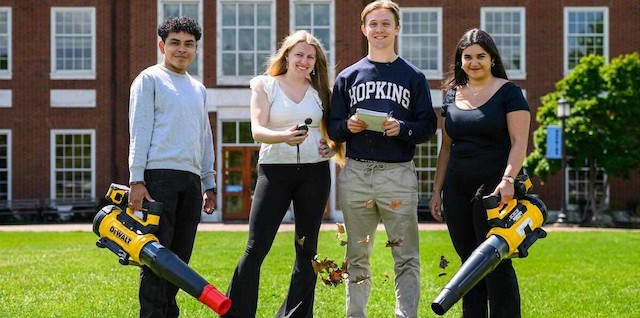
Michael Chacon, Madison Morrison, Andrew Palacio, and Leen Alfaoury – credit WILL KIRK JOHNS HOPKINS UNIVERSITY

Today’s good news comes from the Good News Network.

Students Invent Leaf Blower Silencer Attachment–Corporation Expects to Be Selling Them Soon

Engineering students at Johns Hopkins have created a silencer module for the campus leaf blowers, reducing the devices’ overall noise pollution by 37%. At the same time, they succeeded in almost completely eliminating the high-pitched whining that annoyed them the most.

The design is patent-pending, and Stanley Black & Decker, who sponsored the students, expects to sell them in two years.

It’s not uncommon for leaf blowers to be banned by homeowners associations or following apartment tenant protests—their endless, up-and-down caterwauling of various frequencies is the delight of no one, and worse, landscapers often use them in the early morning to avoid the heat of the day.

“The sound that comes out of this leaf blower is very complicated, and it contains a lot of different frequencies,” said team member Andrew Palacio. “A lot of different notes on a piano would be a good analogy.”

The Johns Hopkins campus currently uses battery-powered leaf blowers, which are already quieter than gasoline-powered ones. Since last September, Palacio and his team members Michael Chacon, Leen Alfaoury, and Madison Morrison have examined the devices in depth—how many sounds are there and what is causing them.

Overall, they have workshopped more than 40 versions of leaf blower silencers. Many of them worked but diminished the power of the air coming out. They eventually came up with an easy-to-secure suppressor that functions much like the ones fitted to firearms.

“Our product takes in a full blow of air and separates it,” Alfaoury told Johns Hopkins. “Some of that air comes out as it is, and part comes out shifted. The combination of these two air sections makes the blower less noisy.”

“It ultimately dampens the sound as it leaves, but it keeps all that force, which is the beauty of it,” adds Chacon.

It’s one thing to come up with trumps in a class project, but this invention isn’t designed to win them any science fairs, but rather for going on Home Depot or Lowe’s shelves.

“It’s not just some cool theoretical thing that will sit on a shelf and never be heard from again—this is ready to be mass manufactured,” said Nate Greene, senior product manager at Stanley Black & Decker, who graduated from Johns Hopkins in 2017 with an engineering degree. “This is a scarce and dramatic level of success.”

WATCH the story below from JH University Press…

The good news in this story is that a problem that is not Earth-shattering has been solved through hard work. Although leaf blower noise is a first world annoyance it is good to see it has been overcome. Today’s JohnKu talks about solving problems.

Solutions by John W. Howell © 2014

Its not world hunger,

But a problem worth solving . . .

Shows genius at work.

Friday JohnKu – AKA – TGIF – Fri-Yay/Good News

A rendering of the solar project – credit City of Valencia

Today’s good news comes from the Good News Network

Three Valencia Cemeteries to Play Host to Largest Urban Solar Farm in Spain

Another European city has taken up the idea of utilizing the space over its cemeteries for generating solar power, a project it calls Requiem in Power, or RIP.

In the heart of Valencia, three cemeteries, Grau, Campanar, and Benimàmet, will be outfitted with 7,000 panels to create the largest urban solar farm in Spain.

GNN reported in March that a town on the River Loire in France had initiated a community-led project to raise solar panel canopies to stop excess rainwater from flooding the sea-level town cemetery.

The town, Saint-Joachim, had to raise the money for the project through voluntary taxation and seek permission from residents, which wasn’t a problem for former Valencia city climate councilor Alejandro Ramon, who explained that the city owns the cemetery land and can do as it likes.

But to ensure they weren’t walking over anyone’s graves, they sought permission from the Catholic Diocese, which supported the idea.

“We suffer droughts and extreme heat. It’s necessary to speed up the transition, but sometimes in cities, it’s difficult to find large free spaces to install renewable energy,” Ramon told Adele Peters at Fast Company. “After consulting with technicians, they told me that the roofs of the niches were perfectly suitable for installing solar panels.”

The niches that Ramon refers to are those above the mausoleums.

As Ramon said, in an effort to speed up the transition, Europeans are coming up with increasingly inventive ways to install solar panels, including inside the terracotta roof tiles typical of a historic Italian or Greek roof or on over 100,000 balconies and terraces in Germany.

One benefit of a solar farm right in the heart of the city, as those above the cemeteries will provide, is that wattage isn’t lost through the transfer of power from the countryside into the city on long power lines.

Far less additional transfer infrastructure needs to be built, and residents can be inspired knowing that their ancestors are still contributing years after their deaths.

The good news in this story is communities are continuing to find new ways to generate power. Today’s JohnKu talks about innovation. I hope you have a wonderful weekend.

New by John W. Howell © 2024

The old ways make room,

For the new methods needed . . .

To sustain our life.


Friday JohnKu- AKA TGIF – Fri-Yay/Good News

credit – Rewilding Europe, Nelleke de Weerd, released.

Today’s good news is from the Good News Network.

Portugal Welcomes First Wild Bison in 10,000 Years–a Keystone Herd for Rewilding a Quarter-Million Acres

The Rewilding Europe organization is thrilled to announce the arrival of a small herd of bison in a large valley in Portugal.

Believed to be the key to preventing catastrophic wildfires, invasive species spread, and promoting endemic biodiversity, it’s the first time bison have been present in Portugal since the last Glacial Maximum.

From Poland to Romania to the UK, European wood bison are now firmly recognized as one of the best tools for returning what little wilderness Europe has left to as wild a state as possible.

Once upon a time, all of Europe was covered in forests or scrubland, through which the European bison and the steppe bison roamed. Today, nations across the Old World are trying to reintroduce these large grazers into wild areas to help improve native ecosystems.

In Portugal, a country smaller than Pennsylvania, the gradual abandonment of the Greater Côa Valley has presented an unprecedented opportunity for rewilding.

The government has already set aside a quarter million acres of land for conservation, boasting an exciting mix of natural and semi-natural habitats of scrub, Mediterranean dry forests, and steep gorges.

The Iberian wolf is present on the land in the form of a small pack, and the area acts as a refuge for roe and red deer, wild boar, eagles, and an ancient cattle breed that’s left to roam wild as its ancestor, the mighty auroch, once did across Europe.

European Bison keystone species – ARK Rewilding Netherlands

The arriving European bison will be managed in cooperation with the Rewilding Portugal team, who received the individuals from the forests of northern Poland, where over 4,000 bison roam wild.

“We are viewing this translocation as a pilot,” explains Rewilding Portugal team leader Pedro Prata. “The bison will be closely monitored to see how they acclimatize to the local landscape and climate. This is the first time the Rewilding Portugal team has managed bison, so it’s also a learning process for us. Members of the team will receive training in bison management.”

It won’t just be new for the team but also for Portugal. The remains of the European bison have never been discovered in the country or on the whole of the Iberian Peninsula.

Scientific evidence has to look back 10,000 years to find a bison in Portugal—the steppe bison—a predecessor of the modern European bison. However, studies of translocated bison in Spain have shown they are at home in the hot, dry climate.

Through their grazing, foraging, trampling, and fertilizing, bison help to maintain biodiversity-rich mosaic landscapes of forest, scrub, and grassland, as well as numerous micro-habitats, which host a wide range of plant and animal species.

Studies in Europe and North America have highlighted this with regard to the related American bison. These same interactions can boost the capture of atmospheric carbon in both vegetation and the soil.

This report is good news since the rewilding of any area is a step closer to the naturalization of the planet. Today’s JohnKu talks about replenishment. I hope you have a super weekend.

Replace by John W. Howell © 2024

Emptying resource,

Is a dangerous action . . .

Replace what you take.


Friday JohnKu – AKA – TGIF – Fri-Yay/Good News

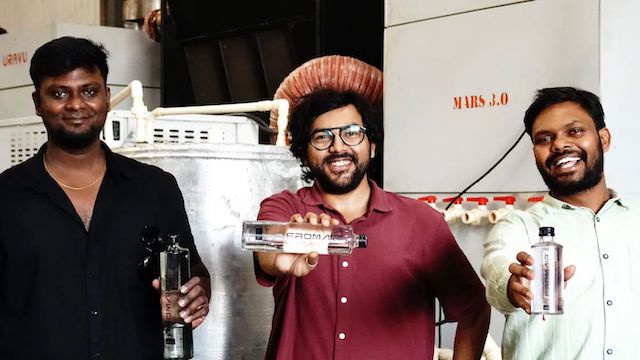
Credit – Uravu Labs, released.

Indian Engineers Tackle Water Shortages with Star Wars Tech in Kerala

By Andy Corbley –

When a severe water shortage hit the Indian city of Kozhikode in the state of Kerala, a group of engineers turned to science fiction to keep the taps running.

Like everyone else in the city, engineering student Swapnil Shrivastav received a ration of two buckets of water a day collected from India’s arsenal of small water towers.

It was a ‘watershed’ moment for Shrivastav, who, according to the BBC, had won a student competition four years earlier on the subject of tackling water scarcity, and armed with a hypothetical template from the original Star Wars films, Shrivastav and two partners set to work harvesting water from the humid air.

“One element of inspiration was from Star Wars, where there’s an air-to-water device. I thought, why don’t we give it a try? It was more of a curiosity project,” he told the BBC.

According to ‘Wookiepedia’ a ‘moisture vaporator’ is a device used on moisture farms to capture water from a dry planet’s atmosphere, like Tatooine, where protagonist Luke Skywalker grew up.

This fictional device functions according to Star Wars lore by coaxing moisture from the air through refrigerated condensers, which generate low-energy ionization fields. Captured water is then pumped or gravity-directed into a storage cistern that adjusts its pH levels. Vaporators can collect 1.5 liters of water per day.

Moisture vaporators on the largely abandoned Star Wars film set of Mos Espa, in Tunisia – credit © Andrew Corbley

If science fiction authors could devise the particulars of such a device, Shrivastav must have felt he had a good chance of succeeding. In 2019, he and colleagues Govinda Balaji and Venkatesh Raja founded Uravu Labs, a Bangalore-based startup.

Their initial offering is a machine that converts air to water using a liquid desiccant. The desiccant absorbs moisture from the air, and sunlight or renewable energy heats it to around 100°F. The captured moisture is released into a chamber, where it’s condensed into drinking water.

The whole process takes 12 hours but can produce a staggering 2,000 liters, or about 500 gallons of drinking-quality water per day. Uravu has since had to adjust course due to the cost of manufacturing and running the machines—it’s just too high for civic use with current materials technology.

“We had to shift to commercial consumption applications as they were ready to pay us, and it’s a sustainability driver for them,” Shrivastav explained. This pivot has so far been enough to keep the start-up afloat, and they produce water for 40 different hospitality clients.

Looking ahead, Shrivastav, Raja, and Balaji are planning to investigate whether the desiccant can be made more efficient. Can it work at a lower temperature to reduce running costs, or is there another material that might prove more cost-effective?

They’re also looking at running their device attached to data centers in a pilot project that would see them utilize the waste heat coming off the centers to heat the desiccant.

The good news in this article is that smart people are exploring ideas that seem more fiction than reality to solve real problems. Today’s JohnKu talks about the potential of the human brain. I hope you have a wonderful weekend.

Ingenuity by John W. Howell © 2024

An idea born,

From a sci-fi writer’s brain. . .

Is now feasible.