Today, we are going to the movies. The Lakeway Parks and Recreation Movie Night was on Friday. Through the mircle of toime travel we can go today. We are catered by Moonshine Grill of Austin. Our entertainment is Shakeria.
Menu
THE ORIGINAL MOONSHINE – ” CORN DOG” SHRIMP® honey mustard, blueberry swirl
MAMA’S PIMENTO CHEESE – garden crudités, hot pretzel sticks
STREET CORN QUESO – queso fresco, pico de gallo, bacon, tortilla chips
CATHEAD BISCUITS -honey butter, house preserves
FRIED GREEN TOMATOES – jumbo lump crabmeat, avocado, tomato, green goddess dressing
FULLMOONPLATTER – two eggs any style, bacon, home fries, toast
STEAK&EGGS.- charcoal bistro filet, two eggs any style, grit cake, salsa verde, toast
The coffee machine is ready for me. A finger on the touchscreen is enough to draw a steaming 8-oz cup of soothin’ syrup. The first sip served to quell the shipyard riveting hammer noise in my head from the lack of caffeine. The second (as we know) is accompanied by the cacaphony of Twiggy and Tempest and their St. Louis-bound barking volume and the Westminster chime of the doorbell.
A sweet treat tossed into the soundproof room, and the slamming of the door brings the peace train back into the station. A look at the security monitor identifies the idiot who can’t read. It is none other than the wolf from the story of ” The Little Red Riding Hood. He is holding a clipboard, an envelope, and a handwritten sign. The sign reads “Open the door, or I’ll huff, and I’ll puff and blow your house down. ” My thought is fat chance, but with a sign, the security shutdown process is begun.
The B-2 bomber squadron and the F-35 escort must be called off. One call does it. The tank corps and gunboats are told to stand by. The Apache helicopters are rerouted. The electric shock fence is turned off. The drawbridge over the quicksand is lowered. The robot attack dogs returned to their charging station. The laser-guided machine guns on the roof are set to caution. The nest filled with rattlesnakes put away. The bucket filled with 1000 marbles is locked down. The tear gas canisters shut off. The electrified welcome mat set to off. The fall-away sidewalk into the pit filled with spikes is locked. The hornet’s nest closed. The water cannons are set to safety. Bear traps are set to off. Peregrine Falcons perched on the roof above front door fed. The vat of boiling oil set to warm. The front door is opened.
The wolf looks pleased and hands over the clipboard and envelope. The board is returned with a signature and a fiver clipped to the top. The wolf curls his lip, so a good word has to be shared before slamming the door. The words given to the wolf were by Victor Hugo: “Even the darkest night will end, and the sun will rise.”
The envelope is from Linda Hill with a message inside. It reads: Your Friday prompt for Stream of Consciousness Saturday is “draw.” Use it as a noun, use it as a verb, use it any way you’d like. Have fun!
Today’s Good News story comes from the India Times and was sent to me by Noelle Granger . Thank you, Noelle
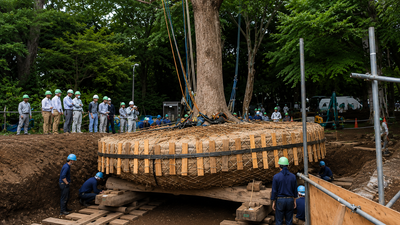
Japan does not cut down centuries-old trees for development. Instead, experts spend months preparing their roots and relocating them
When roads, railways, or new buildings are planned, centuries-old trees are often among the first casualties of development. In Japan, however, some of the country’s most valuable trees are given a second chance. Rather than cutting them down, arborists and horticultural experts sometimes relocate them using a painstaking process that can take months or even more than a year. Before a tree is moved, specialists carefully prepare its root system to improve its chances of surviving in a new location. The technique, known as nemawashi, combines centuries of horticultural knowledge with modern engineering and reflects Japan’s long-standing respect for nature and cultural heritage. Its continued use highlights a conservation philosophy that values preserving living history, proving that development and environmental stewardship can sometimes exist side by side. The remarkable practice has attracted global attention as a model for balancing infrastructure expansion with the protection of irreplaceable natural landmarks. As cities worldwide grapple with rapid urbanization, Japan’s approach demonstrates that thoughtful planning can preserve both cultural identity and ecologically significant trees for future generations
Why Japan relocates some centuries-old trees instead of cutting them down
Not every tree standing in the path of development is relocated. The practice is generally reserved for trees with exceptional historical, cultural, or ecological value. Many of these trees are found in temple grounds, shrines, traditional gardens, parks, or historic neighborhoods, where they have stood for generations and are considered part of local heritage, often holding deep spiritual, emotional, and community significance for nearby residents and visitors alike. In some cases, moving a mature tree also helps preserve biodiversity and the character of a landscape while allowing infrastructure projects to continue. Because the process is expensive and technically demanding, authorities carefully evaluate whether relocation is practical before deciding against removal.
The months-long preparation hidden beneath the ground
The most remarkable part of the relocation process happens long before cranes arrive. Months before transplantation, specialists begin carefully pruning the tree’s roots. Instead of uprooting the entire root system at once, they gradually trim selected roots around the tree. This encourages the growth of new, fine feeder roots closer to the trunk. These feeder roots are essential because they absorb most of the water and nutrients needed for survival. By allowing them to develop before relocation, experts significantly reduce transplant shock and improve the tree’s chances of adapting to its new environment. Depending on the size and species, this preparation may take anywhere from six months to over a year.
What is nemawashi, and why does it matter?
The root-preparation process is known in Japan as nemawashi, a term that literally means “going around the roots.”Originally a horticultural practice, nemawashi has become a widely used term in Japanese business and politics, referring to quietly laying the groundwork before introducing major changes. The metaphor comes directly from tree transplantation: careful preparation before taking decisive action leads to better outcomes. In gardening, the principle remains the same. Preparing the roots first greatly increases the likelihood that a mature tree will survive the move.
How Japan moves giant trees
Once the root system is ready, the relocation begins. Workers excavate around the tree to preserve as much of the prepared root ball as possible. The roots are wrapped in protective materials such as burlap, while the trunk and branches may also be secured to prevent damage during transport. Depending on the tree’s size, cranes, hydraulic lifting equipment, or specially designed transport vehicles are used to move it to its new location. There, it is replanted in a carefully prepared pit, supported by stabilizing structures, and monitored closely through regular watering and maintenance until it establishes new growth.
Does every relocated tree survive?
Even with months of preparation, relocating a mature tree is never guaranteed to succeed. Larger trees experience significant stress because part of their root system is inevitably lost during transplantation. Success depends on factors including the species, age, health of the tree, timing of the move, and the quality of aftercare. For this reason, Japanese arborists reserve the technique for trees whose cultural, historical, or environmental value justifies the considerable cost and effort involved.
A lesson in balancing development and conservation
Japan’s approach demonstrates that urban development and environmental conservation do not always have to be opposing goals. Although relocating centuries-old trees requires careful planning, specialized expertise, and significant investment, it allows some of the country’s most treasured natural landmarks to survive for future generations. Rather than viewing ancient trees as obstacles, the practice treats them as living heritage worthy of preservation, even as cities continue to grow. A horticultural practice so precise and patient that it became a metaphor for introducing change carefully in business and politics is carrying more meaning than most agricultural techniques do. Nemawashi works on trees because you cannot rush root development, and it works as a concept in organizations for exactly the same reason: the preparation is the work, not a delay before the work begins.
The good news in this story is that people care for ancient trees when they have to be moved. Today’s JohnKu talks about caring for nature. I hope you have a terrific weekend.
Today I randomly opened Detour on the Eternal Road to page 97. With eyes closed, I pointed to the page. The word closest to my finger is “Bearings.” This is our prompt today.
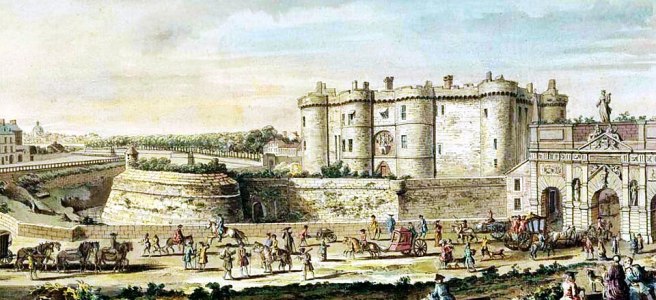
Since July marks the anniversary of the storming of the Bastille in 1789, I thought it would be a good idea to lay out some things not to do if you can go there and join in the fun. As you know, the Bastille was a prison that the government of the time used to incarcerate and torture political prisoners. The day is called “Bastille Day” in English (la Fête Nationale in French) and is widely recognized as the beginning of the French Revolution. If you are going, take this list. Who knows, it might just save your head. This post first ran on July 15th 2019
Top Ten Things Not to Do While Storming the Bastille in 1789
10 If you are storming the Bastille, do not continue to carry your Vive Le Roi banner. If you do, at best, someone will take it from you. At worst, you will be associated with royalty and may become a guest of the third estate at the next guillotine party. (Why on Earth didn’t you know this was a demonstration against Louis XVI, Ike. Too many vin rouges, eh?)
9 If you are storming the Bastille, do not get in front of Tiny, the WWF champ. If you do, at best, you’ll fall down, and Tiny will run over you. At worst, Tiny just left the rally where the beer was free and is anxious to grab the royal flag. (The sad thing is, Tiny is focused on getting through the locked door and is now using you like a battering ram. It should be over in a few minutes, Iggy one way or another.)
8 If you are storming the Bastille, do not count on trading stories with the Marquis de Sade, a prisoner there. If you do, at best, you’ll accept that he left ten days before. At worst, you’ll try to organize a group to storm the insane asylum where he was transferred. (You have to admit, not many want to help you, Ilias. Maybe that should give you a clue.)
7 If you are storming the Bastille, do not insist on a foie gras lunch. If you do, at best, you’ll be ignored. At worst, the average person has no idea what a foie gras is and will think you a royalist. (Now we are back to the original invitation to the head loss party after the storming is done, Inigo. I would think you could learn something in all this.)
6 If you are storming the Bastille, do not get caught with your “Go Camera recording the whole thing. If you do, at best, you can tell them it’s a new kind of bomb, and they’ll believe you. At worst, your explanation will fall on deaf ears. (So now you are in line for the dunking chair, which is designed to get the truth out of witches. Just tell them you are a witch, Isaak. Maybe they’ll go easy on you.)
5 If you are storming the Bastille, do not say to the mob that red, white, and blue are not your colors. If you do, at best you’ll get a sympathetic colorist. At worst, you would be confessing to a bloodthirsty peasant your disdain for the tri-color, the symbol of the revolution. (Yes, his eyes are red, Isah. No, I don’t think he has allergies. I believe he is mad at you. Yeah, running may not be the answer.)
4 If you are storming the Bastille, do not stop for a café au lait and croissant. If you do, at best, you won’t be late for the storming. At worst, you’ll arrive after the storming is over and be accused of dereliction of duty. (I’ll bet you can guess what the punishment is for dereliction of duty, Iman. You got it. The big falling blade and close haircut.)
3 If you are storming the Bastille, do not try to yell “Liberté, égalité, fraternité” in French. If you do, at best, the noise will be too loud, and no one will hear you. At worst, you will be heard, and your American accent will give you away. (You wonder why everyone is so angry, Iain? They want their revolution to be theirs without interference from Americans. If you continue to try to help, you will. only to be despised later)
2 If you are storming the Bastille, do not suggest that it would make a beautiful condo after the storming. If you do, at best, folks will think you are shell-shocked. At worst, Maximilien Robespierre will overhear your idea. (You may wonder why ole Max gave you a card with the number one printed on it, Idi. You have been honored to be the first to give up your head for the revolution. There’s the guillotine line right over there. You just march right to the front. It’s your right.)
1 If you are storming the Bastille, do not throw away that stale baguette. If you do, at best, you will still have a sword. At worst, that baguette would have made an excellent weapon, and now you are defenseless. (Everyone knows that a day-old baguette can be used to drive nails, Ignace. Think of what a beautiful club it would have made.)
Today, we are visiting Lake Travis in Lakeway. Since the heavy rain last week, the lake is completely full. I thought it would be fun to take a look at the lake at its lowest point and then see how it looks today at its highest. We are catered by ATX Cocina Restaurant in Austin. Our entertainment is David Bowie.
Today’s good news story comes from YouTube and was sent to me by Maria Olimpieva. Thanks Maria.
Beloved teacher says goodbye after 50 years at St. Margaret School in Narbirth Pennsylvania
For fifty years, Dolores Lopresti greeted generations of second graders at St. Margaret’s School with a smile, a lesson, and a heart full of love. Standing before students, parents, and former classmates on the day of her retirement, she admitted a surprising truth: during her first year of teaching, she cried every day and nearly quit. Fresh out of college, she felt overwhelmed. But with the encouragement of fellow teachers, she discovered her calling—and never looked back.
Mrs. Lopresti believed learning should be joyful. Whether she was dressing up as the unforgettable “Mrs. Pepperoni” to teach math or preparing children for their First Communion, she filled every lesson with laughter, patience, and kindness. To her, the students were never just pupils; they were family.
All the children wore Miss Lopresti buttons
Over the decades, she taught not only children, but eventually their children as well. Former students returned to thank her for changing their lives, inspiring careers, and giving them confidence when they needed it most. Her influence reached far beyond the classroom.
Flowers for the teacher
Although retirement marked the end of her full-time teaching career, Mrs. Lopresti knew her mission would continue. “Every day is a new day,” she reminded everyone. “Don’t give up. Be kind. Be loving. It’s not how you start—it’s how you finish. And once I’m your teacher, I’m always your teacher.”
Just a few who came to say farewell.
The good news in this story is when one loves what they do they can have a positive impact on all those they meet.
Today’s JohnKu talks about how other see us. I hope you have a lovely weekend
Today, I opened Eternal Road – The final stop randomly to page 167. With eyes closed, I pointed to the page. The word closest to my finger is “horses.” That is our prompt today.