
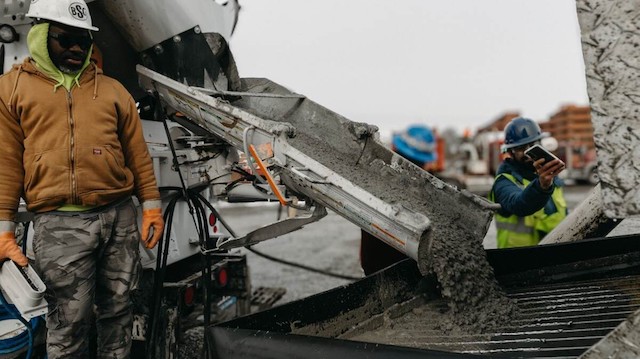
Photo courtesy of Sublime Systems
Today’s good news comes from the Good News Network.
Premiere of Innovative Low-Carbon Cement: Will ‘Be in That Building for Decades to Come’
Two firms in Boston have just laid the foundations of a large building using a zero-carbon cement mixture made in the USA. This represents one of the first real-world real-world adoptions of this technology.
Many companies are testing or subsidizing low- or zero-carbonrbon cement and concrete to reduce their carbon footprint, but few are yet using it liberally to build real structures.
Manufactured by Sublime Systems, which was just named to Fast Company Magazine’s Most Innovative Companies in Sustainability for 2024, the firm uses an electrochemical process to create the cement for ready-mix products.
At the heart of traditional Portland and other kinds of cement is its heating in a kiln, wherein calcium carbonate reacts with silica-bearing minerals to form a mixture of calcium silicates. Over a billion tonnes of cement are made annually, and cement kilns are the heart of this production process. According to The Economist, they heat the mixture to over 1,300°C and produce around 5% of all made-made carbon emissions worldwide.
By eliminating the kiln altogether, Sublime Systems has removed most emissions from the process.
Best of all, it’s currently being used in the Greater Boston Area. Boston Sand & Gravel is supplying Turner Construction Co. with ready-mix cement containing Sublime Systems’ product to form the mud mat of a large building.
“It’s going to be in that building for decades to come,” Sublime Systems’ CEO, Leah Ellis, told Engineering News Record.
“It really was the culmination of a lot of effort to see it not just being done for testing’s sake, but actually, replacing cement that would otherwise have been the carbon-intensive variety.”
Along with reducing the carbon emissions budget of that new building, the construction has validated that several critical targets of Sublime Systems’ product have been met: the product was transported to the site in a ready-mix concrete truck like normal, maintained malleability during transit, was poured out of the concrete truck and into a hose, and the hose was able to deliver it to the setting where it stuck and hardened—all exactly like traditional cement.
“In the grand scheme of things, it was, really, very boring for construction,” David Robb, a Turner estimator and the preconstruction manager on the Boston-area project, told ENR. “But a huge step in terms of our embodied carbon reduction goals that we’re striving toward in the future here at Turner.”
Government money, as well as private investment, has been pouring into Sublime Systems’ which seems poised to lead a great revolution in cement by building its first full-scale, dedicated manufacturing facility in Holyoke, Mass.
The good news in this article is that 5% of worldwide carbon emissions have the potential tto be reduced to zero without sacrificing the quality of construction projects. Today’s JohnKu talks about obscure carbon footprints. I hope you have a lovely weekend.
Concrete by John W.Howell © 2024
Who would have thought that,
The concrete process would yield . . .
Large carbon savings























 Fiction Favorites
Every little bit helps. Maybe one day we’ll get ahead of the problems we caused Earth to face.
LikeLiked by 5 people
We have to hope so, GP. Not sure I’ll see it but the hope is there.
LikeLiked by 1 person
It would be interesting to know the economics of this. I expect it to be more expensive, because most changes are. This is usually temporary as interest and usage increases.
LikeLiked by 2 people
Economies of scale do come into play. Given the heavy govt subsidy the current phase probably isn’t costing the end user any more than the old process.
LikeLiked by 1 person
Good point.
LikeLiked by 1 person
Another awesome article. Love the advancement.
LikeLiked by 1 person
Thanks, Charles. I do too.
LikeLike
“Who would have thought that?” – great question. Sometimes, the answers are right in front of us. This is great news, John. Thanks for sharing.
LikeLiked by 1 person
I thought it was great too. I never would have thought that cement production would represent 5% of worldwide carbon emissions. Thanks, Gwen.
LikeLiked by 1 person
Very interesting… There is certainly much to be excited about with this news!!
LikeLiked by 1 person
There is. Thank you, Annette.
LikeLiked by 1 person
I hope it continues to prove itself.
LikeLiked by 1 person
Sounds like there is a good chance.
LikeLiked by 1 person
In the words of Artie Johnson, “Very interesting.” Habits are hard to break, so it will be interesting to see if the concept spreads. Good find, John.
LikeLiked by 1 person
Given the heavy government subsidy the scale up will have to produce more efficiencies to make it sustainable. Let’s hope that can happen.
LikeLike
Anything that helps reduce carbon emissions is a good thing. Like GP said, every little bit helps. Have a great weekend, John!
LikeLiked by 1 person
You as well, Teri.
LikeLiked by 1 person
That’s great, John. It’s good to see every improvement in carbon emissions.
LikeLiked by 1 person
I agree, Tim. A super story
LikeLiked by 1 person
This article gives us hope. I’m so glad you posted it. I really liked your JohnKu, too.
LikeLiked by 1 person
Thank you, Kymber.I glad you enjoyed it.
LikeLiked by 1 person
That is amazing, John. It’s wonderful to see companies taking this to heart and trying to find alternatives.
The USA, while still no. 2 in emissions, has reduced by 11% from 2010 to 2022 (As we sit here, in Canada, no. 11, producing a mere 1.89% of the world’s emissions; and our s.o.b. Prime Minister has decided we should pay an extra carbon tax on everything.)
LikeLiked by 1 person
Sounds like a true liberal.
LikeLiked by 1 person
That he is…
LikeLiked by 1 person
😁
LikeLiked by 1 person
Great post, John 🙂 I never would have thought about cement as a solution.
LikeLiked by 1 person
I know right? Thanks, Denise.
LikeLiked by 1 person
I saw this news – and I think it’s great. Human ingenuity!
LikeLiked by 1 person
Me too, Noelle. Thanks 😊
LikeLiked by 1 person
This looks like a very encouraging development!
LikeLiked by 1 person
Thank you, Liz. I so agree with you 😊
LikeLiked by 1 person
You’re welcome, John.
LikeLiked by 1 person
😁
LikeLiked by 1 person
It’s encouraging to hear news like this and to know there are people and companies who care enough to pursue good options.
Nice share, John!
LikeLiked by 1 person
Thank you, Mae. I agree with you. 😁
LikeLiked by 1 person
I live in the Boston area, and I have not heard about this brilliant concept and innovation. I hope they publicize it more. Thanks for doing so, with us bloggers.
LikeLiked by 1 person
Thank you, Pamela😊
LikeLiked by 1 person
I hope it holds up for years and years and if so catches on.
LikeLiked by 1 person
Me too, Deborah
LikeLike
These are the stories that need to reach everyone. I’m sad that the local press here in the Boston area didn’t make a big fuss over this. Thank goodness for the Good News Network reporting, and for John Howell’s reporting.
LikeLiked by 1 person
Yeah too bad.
LikeLiked by 1 person
Yes.
LikeLiked by 1 person
What a spectacular development in reducing our carbon footprint. Thanks for sharing.
LikeLiked by 1 person
It is quite remarkable. Thank you, Monika.
LikeLiked by 1 person
This is encouraging!
LikeLiked by 1 person
Yes it is,
LikeLike
Thanks for sharing this good thinking story!
LikeLiked by 1 person
That is a good way to put it. A good thinking story.
LikeLike
Well now, that’s some solid news.
More steps taken….. slowly.
Good news, John. I’m thinking yourfab JohnKu has a ) carbon footprint!
𝕺👣 𝕺👣 𝕺👣 𝕺👣
LikeLiked by 1 person
I’ve reduced my JohnKu carbon footprint to zero. 0X 0X 0X 0X
LikeLiked by 1 person
LOL!!! Zero! Ex!
💋
LikeLike
UCH 0 not )
𝕺 = Fraktur Capital O
LikeLiked by 1 person
Humm This one has me stumped
LikeLiked by 1 person
It’s a capital O from some weird script in my emojis.
LikeLiked by 1 person
Oh.
LikeLike
Hahahah !
LikeLiked by 1 person
😊X
LikeLiked by 1 person
I surely hope this great idea spreads far and wide. 🙂
LikeLiked by 1 person
I do too, Debby. Thank you.
LikeLiked by 1 person
🙂
LikeLiked by 1 person
There are two kinds of people. Those who do not believe it’s possible and those who make it so.
LikeLiked by 1 person
So true Pilgrim. Thanks 😊
LikeLiked by 1 person