
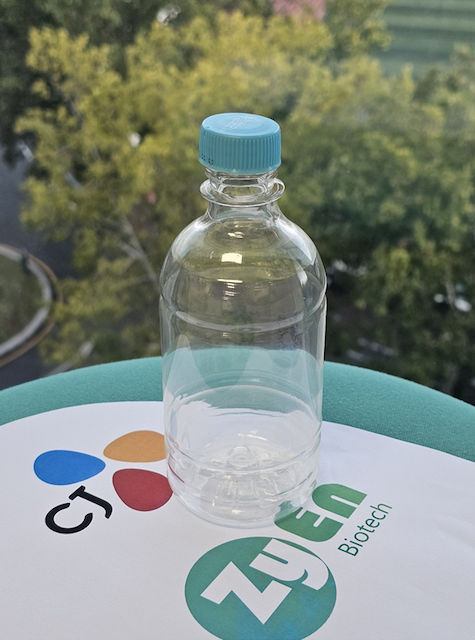
출처 : Businesskorea(https://www.businesskorea.co.kr)
Today’s Good News story comes from the Business Korea periodical and was brought to my attention by Noelle Granger.
Groundbreaking Bio-catalyst Developed for Efficient PET Plastic Decomposition
by Michael Herh – January 2025
The Ministry of Science and ICT (Information and Communication Technologies) has announced a groundbreaking development in the field of plastic recycling. A joint research team, led by Prof. Kim Kyung-jin of the Department of Biotechnology at Kyungpook National University and CJ CheilJedang, has developed a bio-catalyst with the world’s highest performance for decomposing PET (polyethylene terephthalate) plastic under industrial conditions. The research results, announced on Jan. 3, were published in the prestigious international journal “Science” on the same day.
PET plastic is a ubiquitous material found in everyday items such as PET bottles, clothing, seat belts, disposable cups, and car mats. Traditionally, PET plastic is recycled through mechanical processes that involve label removal, crushing, washing, and reprocessing. However, this method often results in a decline in the quality of the recycled material, leading to its eventual incineration or disposal in landfills. Chemical catalysts, which induce chemical reactions to break down plastics, have been considered an alternative, but they come with their own set of limitations, including raw material contamination and waste generation.
To address these issues, the research team developed a high-performance bio-catalyst named “KUBU-M12.” Unlike chemical catalysts, bio-catalysts decompose plastics through biological reactions akin to the natural decay of wood. This process results in less waste and raw material contamination, thereby maintaining the quality of the recycled material. KUBU-M12 has demonstrated remarkable efficiency, capable of decomposing 1 kilogram (kg) of PET by 45% in just 1 hour, over 90% in 8 hours, and almost completely in 12 hours with only 0.58 grams (g) of the catalyst. The research team emphasized that this is the highest performance recorded among bio-catalysts for plastic decomposition globally.
Prof. Kim highlighted the importance of this development, stating, “This is a groundbreaking technology that enables permanent recycling of even contaminated plastics that cannot be recycled.” He further added, “Innovations applying bio-catalysts will occur in various chemical industries.”
The development of KUBU-M12 is expected to revolutionize the recycling of difficult-to-recycle waste plastic, contributing to various chemical industry innovations and addressing critical environmental issues such as carbon neutrality and climate change. The eco-friendly nature of this technology aligns with global efforts to reduce plastic waste and improve recycling efficiency, ultimately mitigating the environmental impact of plastic pollution.
The achievement of world-class performance in eco-friendliness and the ability to decompose waste plastic in just 12 hours using a small amount of bio-catalyst marks a significant milestone in the field of biotechnology and materials science. The publication of these findings in “Science” underscores the importance and credibility of the research, highlighting the potential for widespread application and impact.
The good news in this story is the issue of plastic pollution is being addressed in many countries. Today’s JohnKu talks about technology. I hope you have a super weekend.
Plastic by John W. Howell © 2025
Great when invented,
Its waste is found everywhere . . .
Need solutions now.

Great article, John. Your JohnKu sums it up perfectly. Remember the line from ‘The Graduate’ movie when the young protagonist was given career advice, ‘plastic’? Finally, here’s a very interesting article about compostable plastic, https://window.wwu.edu/plastics-problem.
LikeLike
I got half way through the article an then a pop up window (subscribe) made reading more impossible. I got enough of the article to know that the Korean effort goes one step further in breaking down the plastic for reuse. Thanks, Steve. Hopefully it will all come together and we will finally get plastic under control.
LikeLike
Interesting advancement. I wonder about the economics of it. That’s why some of this doesn’t become widespread.
LikeLiked by 1 person
No sure. Obviously that would be a consideration. Thanks, Craig.
LikeLiked by 1 person
We always seem to have so much garbage. Do you think they could use the recycled plastic to help build up low-lying cities like New Orleans to hold back the rising oceans?
LikeLiked by 2 people
It you think of Singapore being build on landfill it would seem to be possible. Great idea, GP. (Someone should consider it.)
LikeLiked by 1 person
Sounds cool. Wonder if this can be used on plastics that don’t normally get recycled.
LikeLiked by 1 person
Not sure about that.
LikeLike
Good news, John! I hope this new invention will only recycle used and discarded plastic. Not what is currently used, imagine sitting in your new car and all the plastic parts disappear during your ride. Best wishes, Michael
LikeLiked by 1 person
Ha ha ha. Yes only discarded.
LikeLike
Great to hear about this discovery. I hope it becomes widespread as a tool to use.
LikeLiked by 1 person
I do too, Dave. Thanks
LikeLiked by 1 person
I am thrilled to read about this. It has long since been a curiosity of mine that we can create what we believe to be advances etc. but appeared to have no way of handling the results when the creations have surpassed their “single use” lives. (did that make sense)
LikeLiked by 1 person
That made a great deal of sense. For an example someone invented a great herbicide but the side effects are cancer,
LikeLike
That’s great, John. Thanks for the information. I’m a strong believer in recycling, and think it’s great that South Korea came up with an advancement in breaking down polyethylene terephthalate plastic.
LikeLiked by 1 person
If we put our minds to it, we can solve almost anything.
LikeLiked by 1 person
I agree, Pam. With enough work, most problems should be solvable.
LikeLiked by 1 person
Thanks, John,. When I read this, I thought, sooner or later someone would solve the plastic problem. I hope it becomes economically feasible and widespread.
LikeLiked by 1 person
Me too. Thanks again for sending the article.
LikeLike
You’re most welcome!
LikeLiked by 1 person
😁
LikeLike
Another bit of news I hadn’t yet heard — thanks for passing it along, John. I stand in amazement at how much good can be accomplished when folks put their minds to it!
LikeLiked by 1 person
I agree. It does take focus. Thanks, Debbie
LikeLiked by 1 person
What an exciting development! I hope it can be adopted on a wide scale.
LikeLiked by 1 person
I do too, Liz.
LikeLiked by 1 person
It’s great to read about advancements like this. It’s so important for the planet’s future.
LikeLiked by 1 person
I agree, Esther. Thank you.
LikeLiked by 1 person
I hope you have a super weekend as well, John. The plastics everywhere are very alarming. This is a great article, definitely something to be more aware of.
LikeLiked by 1 person
I would hope this process could be economically feasible.
LikeLike
We definitely need another alternative to plastics and this is encouraging. Thank you for sharing!
LikeLiked by 1 person
My pleasure, Jan
LikeLiked by 1 person
This is a step in the right direction.
LikeLiked by 1 person
Yes it is. Thanks, Deborah.
LikeLike
Anything to help with all the plastic. Have a great weekend, John!
LikeLike
That was technical, John, but the gist of it is clear, and what great news for the planet and it’s life, including us. Thanks for sharing the great news. I hope the US takes advantage of it!
LikeLiked by 1 person
I hope this country can take advantage of the technological breakthrough too, Diana
LikeLiked by 1 person
This would be a game changer. We have to continue to think creatively to solve these massive problems.
LikeLiked by 1 person
I agree, Pete. Wishing you a super weekend.
LikeLiked by 1 person
Now if we can access this technology at a viable price tag AND get buy in from leaders who are averse to change, maybe we can really affect some change! Not holding my breath but hey, it’s always possible.
LikeLiked by 1 person
I hope we can get this stuff to work too, Pilgrim.
LikeLiked by 1 person
Where there’s a will . . .
LikeLiked by 1 person
Yes indeed.
LikeLiked by 1 person
Plastic pollution is certainly something that needs to be addressed. A newly developed bio-catalyst with the world’s highest performance for decomposing PET plastic is indeed good news.
LikeLiked by 1 person
Yes it is and hopefully the process is scaleable and will be used universally. Thanks, Thomas
LikeLiked by 1 person
Wonderful news! Thank you, John, for sharing this new development. Very hopeful for all of us!
LikeLiked by 1 person
I think so too, Gwen. 😁
LikeLiked by 1 person
Yay! Any time there is good news for the environment is a good day.
LikeLiked by 1 person
I agree with you, Monika.
LikeLiked by 1 person
Bombastic plastic does need to be put in its place, and as the JohnKu says – now!
Crazy how addictive plastic is, or is it the convenience that is addictive?
OX OX
LikeLiked by 1 person
So true, OX OX
LikeLiked by 1 person
OX OX OX
LikeLiked by 1 person
😊X
LikeLiked by 1 person
Wonderful.
LikeLiked by 1 person
😊
LikeLiked by 1 person