Today’s good news story comes from the Good News Network.
No AC Needed in India’s Heat: Inside Gujarat’s Eco-Friendly ‘Cool House’
Western India is home to one of the hottest deserts on Earth, and the residents of the western states of Rajasthan and Gujarat have traditionally used architecture to keep cool.
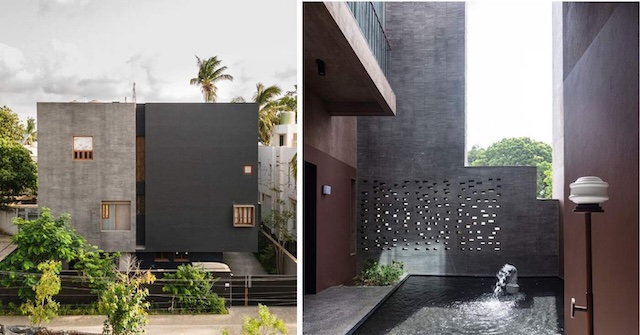
Utilizing principles of thermodynamics, one house in the city of Bharuch, where temperatures can hover at 110°F for days during the summer, stays cool all day and all summer without ever needing the air conditioning switched on.
In fact, the building’s interior is a breezy, green, “introverted space” that passively cools the air inside by a whopping 18°F, all using simple science.
“We used the direction of the winds, design, and cooling materials to lower the heat of the house,” Samira Rathod, the principal architect of the ‘Cool House’ and founder of Samira Rathod Design Atelier (SRDA), told The Better India, reporting on the story.
“The plot had three buildings around it and a road on one side. The only view that the house would have was the neighbor’s building. An introverted house was a good choice in that sense. It is basically one where the house opens up when you go inside it. It would look like a rather closed structure from the outside,” she explains.
Indeed, it might even be called depressing, as its front door is hidden between two giant, 18-inch-thick facades of gray and black. But inside, a design reminiscent of a railroad track sees the rooms divided on either side of a giant split in the house, built to align with the current of the wind off the ocean.
Bharuch is situated on the Indian Ocean, and despite the scorching temperatures, a breeze is present throughout much of the city at various times during the day. The narrow slit in the house leverages the Venturi effect, which states that the narrower the space an element must pass through, the faster and colder it becomes.
The principle can be seen in human breath, which emerges hot through an open mouth but cool through pursed lips. The same effect can be seen in rivers, where narrow channels cause the water to speed up and form rapids, while wide, flat lands cause the water to slow down.
The wind from the sea enters the split and hits an interior courtyard where a pool of water cools it down further. Entering the 10,500 square foot home interior, a second courtyard aids in circling it around each room, where the family lives with three generations.
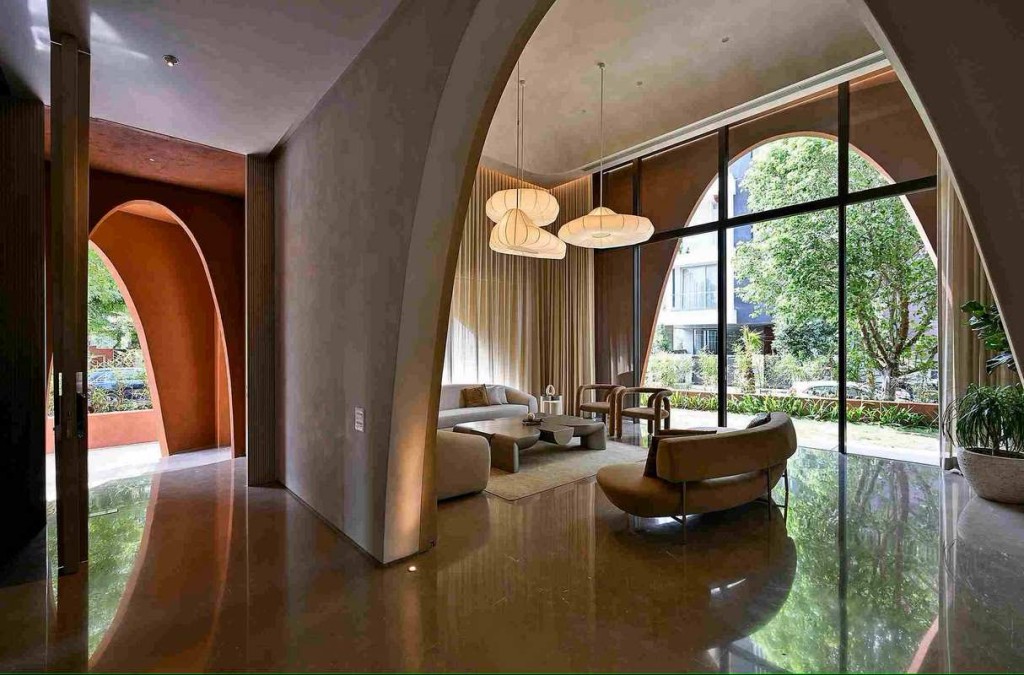
“The house looks inwards and we have created courtyards with trees so it feels like you are looking outside rather than inside,” said Rathod.
GNN has previously reported on Indian architecture in this part of the country. Natural designs like envelopes, air channels, and even “wind towers” could, and probably should, become standard designs in parts of the world where temperatures are predicted to rise, such as the southwest United States or Southern Europe.
In Rajasthan’s city of Bhilwara, a “House of Arches” ensures that no part of the building is exposed to the sun thanks to a building envelope that provides shade and air circulation.
The science lies in the separation of the envelope from the house itself. Even as the sun’s rays heat the envelope, wind and moisture evaporation can penetrate the space between the house and the envelope to reduce the radiant heat that enters the living areas.
The good news in this story is that it is possible to engineer structures with features that can reduce the need for electricity for cooling. Today’s JohnKu talks about new thinking. I hope you have a lovely weekend.
Progress by John W. Howell © 2025
Demand reduction,
May be the solution at hand . . .
To solve climate change.


we don’t have to suffer in hot houses, if they build them better. Brilliant news, John…
LikeLiked by 3 people
I agree. At least if they built them better, it would take less energy to cool them off.
LikeLiked by 1 person
This may not work for every house, but it’s a big piece of the puzzle.
LikeLiked by 2 people
I agree.
LikeLiked by 1 person
Such simple ideas, but it took an engineer to put it together. Outstanding!!
LikeLiked by 2 people
It is outstanding, GP. Thank you.
LikeLiked by 2 people
Very cool. More houses that utilize thermodynamics should be made.
LikeLiked by 2 people
I agree. I wonder if there is a cost difference?
LikeLiked by 1 person
Probably be more expensive here than current homes.
LikeLiked by 2 people
I’m guessing you are right.
LikeLiked by 1 person
Dear John
A cool idea, indeed 👍
Wishing you a happy weekend
The Fab Four of Cley
🙂 🙂 🙂 🙂
LikeLiked by 1 person
Thank you, F4oC. I wish you a lovely weekend as well.
LikeLiked by 1 person
People in Texas were utilizing a similar design decades ago in the so-called ‘shotgun houses.’ Between those central splits and the shade provided by the wrap-around galleries of larger homes, Texas heat and humidity could be dealt with. Those folks may not have known the phrase “Venturi effect,” but they sure enough used it to their benefit.
LikeLiked by 1 person
With the advent of A/C, I believe the heat control building methods fell by the wayside.
LikeLiked by 2 people
I didn’t even know something like this was possible – how amazing. Have a great weekend, John!
LikeLiked by 2 people
Thank you, Teri. You as well. 😀
LikeLiked by 2 people
Love this! The ingenuity of people is often not recognized. Thank you for featuring this today, John. It hit home in a special way. Growing up in the desert, in the pre-air conditioning days, my mom would hang wet towels by a cooler or windows. It seemed to help in the worst of the heat.
LikeLiked by 2 people
We lived in the city, and those August nights were killers. Thanks for sharing, Gwen.
LikeLiked by 1 person
I’d like to tour that house. I learned something new today, the Venturi effect. It’s a cool concept.
LikeLiked by 2 people
Ha ha ha. Love that, Deborah.
LikeLiked by 1 person
😊
LikeLiked by 1 person
This project goes to show that when there’s a will, there’s a way. (And engineering know-how, of course.)
LikeLiked by 1 person
Yes, engineering does help. 😀
LikeLiked by 1 person
😁
LikeLiked by 1 person
😊
LikeLiked by 1 person
Using structure to keep the building cool is intelligent, John. Thanks for bringing that to our attention.
LikeLiked by 1 person
Thank you, Tim. I thought it was a great concept. 😀
LikeLiked by 1 person
😊
LikeLiked by 1 person
This is such a great example of how necessity spawns invention. A wonderful story, John! Thanks for sharing.
LikeLiked by 1 person
I agree with you, Jan. This is an excellent adaptation to a hot condition. 😊
LikeLiked by 1 person
I found this so interesting! And it could work in our Southwest! When we were grad students and living in a hot apartment during the summer dog days, we had a huge window fan in one room., We wet a large towel and draped it in front of the fan to cool the place down. Worked well.
LikeLiked by 1 person
I’ve done that as well in the pre-A/C days
LikeLiked by 1 person
That is such a beautiful room … and to think how its design capitalizes on coolness and comfort! I don’t guess that part of the world suffers through tornadoes and hurricanes, right? I mean, where would you go for a “safe room”??
LikeLiked by 1 person
Underground is the only place I can think of.
LikeLiked by 1 person
That’s a great idea. People are so inventive. Thank you for sharing the story, John.
LikeLiked by 1 person
I agree on the inventiveness.
LikeLiked by 1 person
10000 square feet? Did I read that correctly?
LikeLike
10,500 to be exact.😀
LikeLiked by 1 person
Man, that’s big…
LikeLiked by 1 person
Yup.
LikeLiked by 1 person
Genuis! And replaceable genius at that!
LikeLiked by 1 person
Yes, genius for sure.
LikeLiked by 1 person
oops, I just realized I meant to write replicable there…
LikeLiked by 1 person
That is what I read.
LikeLiked by 1 person
Gorgeous and practical houses. We need to rethink the way we build houses.
LikeLiked by 1 person
I agree, Jo. 😊
LikeLike
Very impressive,John.
LikeLiked by 1 person
Thank you, Pat.
LikeLiked by 1 person
🤓
LikeLike
Not only have they found ways to beat the heat, but the architecture is pleasing to the eye too.
LikeLiked by 1 person
I thought the same thing, Pete.
LikeLiked by 1 person
That was an interesting article. I guess partially Venturi/Bernouilli principle.
LikeLiked by 1 person
Yes, indeed.
LikeLiked by 1 person
That is amazing.
LikeLiked by 1 person
It is. Thanks, Craig.
LikeLiked by 1 person
A brilliant solution! Reminds me of a house that I saw recently on an architectural TV show. The house is called Sharma Springs, and it’s made almost entirely out of bamboo. It’s stunning: https://ibuku.com/project/sharma-spring-ibuku/
LikeLiked by 1 person
Thanks for the share, Dave. It is stunning. I love the openness.
LikeLiked by 1 person
I totally love this! I don’t understand why US builders don’t do more in terms of efficiency. Our society is accustomed to plugging into the grid for heat/cooling option before anything else.
LikeLiked by 1 person
I think that’s it. The availability of A/C has made really cool construction way too expensive.
LikeLiked by 1 person
I love this idea, John, and the home looks beautiful.
I wonder how a design technology like this, but in its own way for a different purpose, could help in a climate like where I live?
Icy cold in the winter, and wildly hot & humid in the summer, require a lot of energy to heat and cool.
Perhaps a combination of ideas, like this + solar panels + ability to adjust practical design features = success?
Just throwing things out there!
Thanks for the fab JohnKu!
LikeLiked by 1 person
I think if anyone could figure it out, it would be you. I do wish we could build homes that were less energy-dependent. OX OX
LikeLiked by 1 person
Agree!
OX OX
LikeLiked by 1 person
OX OX OX
LikeLiked by 1 person
OX OX OX OX
LikeLiked by 1 person
OX OX OX OX O🥦
LikeLiked by 1 person
🏆🥦🥦🏆
LikeLiked by 1 person
YAY 😊X
LikeLiked by 1 person
Brilliant! More people need to learn to do this!
I don’t think I could handle living in that climate.
LikeLike
I agree with you. We get temps of 106, and I want to die or throw up.
LikeLike
Eww. Yikes, John!
LikeLiked by 1 person
Yes indeed.
LikeLiked by 1 person
😦
LikeLiked by 1 person
We have over 30 days of +100 degrees temps
LikeLiked by 1 person
This is Phoenix?
LikeLiked by 1 person
Seems like it at times, but is still Austin
LikeLike
Ah, okay. Another city for me to avoid then. 🙂
LikeLiked by 1 person
Great spring, fall, and winter, though.
LikeLiked by 1 person
Good to know! I will plan any future visits accordingly!
LikeLike
Brilliant!
LikeLiked by 1 person
I agree. 😀
LikeLiked by 1 person
What an absolutely brilliant idea. The solutions are definitely out there.
LikeLiked by 1 person
They are. Let’s hope folks take advantage
LikeLiked by 1 person
For sure.
LikeLiked by 1 person
😊
LikeLiked by 1 person
An amazing idea. 🙂
LikeLiked by 1 person
It is. 😀
LikeLiked by 1 person