
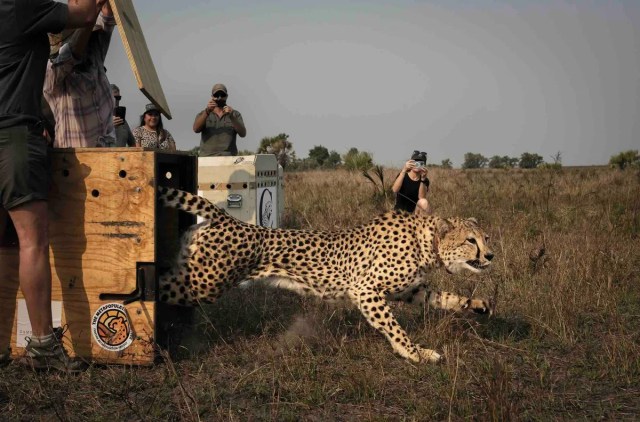
In the Zambezi Delta, the first cheetah releases were made in 2021. Credit: Jim Tan
Today’s good news story comes from the BBC Wildlife Magazine. I want to thank Noelle Granger for sending it to me.
“It’s a kind of Tinder for big cats.” Cheetahs were dying out in Africa, so conservationists tried something new
By Graeme Green
The cheetah is back – thanks to a smart release project that now sees populations flourishing in South Africa and beyond
When four sub-adult cheetahs arrived at Kuzuko Private Game Reserve, South Africa, in 2023, there were high hopes that the female among them would breed. There was just one snag: it turned out that all four were, in fact, male.
A gender mix-up was the least of the quartet’s concerns, as their mother had been killed at Karongwe Private Game Reserve.
“To increase their chances of survival, they came to live in our boma facilities,” explains Jim Tan, CEO of Kuzuko, referring to the traditional fenced animal enclosure.
“We looked after them into adulthood. Two went off to Lolelunga Private Reserve, Zambia, in 2024; the other two were set to go to Mozambique, but were jumped by lions – sadly, one was killed.”
Kuzuko is one of more than 70 reserves across South Africa currently involved in the metapopulation management of cheetahs. It’s a modern, more holistic approach to cheetah conservation that has taken shape over the past 15 years and has been a remarkable success story.
As the fastest land animal on the planet – the cheetah can accelerate to 110kph in just three seconds when hunting – this is one of Africa’s most iconic species. It is a beautiful feline, instantly recognisable by its lean appearance, delicate ‘teardrop’ facial markings, and long legs built for running.
Conserving cheetahs
Once widespread across Africa and Asia, the cheetah is now largely confined to southern Africa, with a tiny remnant population of Asiatic cheetahs surviving in Iran. Globally, just 6,500 to 7,100 individuals remain in the wild.
Listed as Vulnerable by the IUCN since 1986, the species has suffered a dramatic decline over the past century and today roams less than 10 per cent of its historic range. For decades, efforts have been underway to restore South Africa’s cheetah populations, but the initial focus was on growth across all populations.
“This is not what the metapopulation approach is about,” says Sam Ferreira, large mammal ecologist at South African National Parks.
A metapopulation is a network of small, separate populations that, together, act as one larger population. In the wild, cheetahs would naturally disperse and connect these groups, sharing genes and boosting resilience.
But with fences and other human infrastructure now blocking that movement, conservationists have stepped in, mimicking those processes using translocations. It’s a kind of Tinder for big cats.
Fencing became an increasingly common feature of South Africa’s landscape after the country’s political transformation in 1994, when wildlife tourism surged and private reserves multiplied.
While these barriers helped to reduce human-wildlife conflict and poaching, they also impeded the natural movement of cheetahs, which depend on vast, open spaces. A growing human population has also impacted the landscape.
“Protected areas have become more fragmented,” says Olivia Sievert, cheetah range expansion co-ordinator for the Endangered Wildlife Trust (EWT).
“As a result, you don’t have the natural dispersal that allows gene flow between populations, so there’s more inbreeding. This impacts cheetah health, including reproductive health. Litters can be smaller, and the animals can be more susceptible to disease. It becomes dangerous.”
“Metapopulation management is also about source-sink dynamics,” adds Sievert.
“If you have a population that’s acting as a ‘sink’ for a species, because of disease or predation, the natural metapopulation dynamics of dispersal allow a ‘source’ that has good breeding to rescue it. Fences and other human impacts mean you lose these dynamics. That’s why we do this work.”

The Cheetah Metapopulation Project
In 2011, the EWT launched the Cheetah Metapopulation Project (CMP), driven by conservationist Vincent van der Merwe. Today, two other organisations in South Africa are successfully working on cheetah metapopulation management and range expansion: Ashia Cheetah Conservation, founded in 2016, and The Metapopulation Initiative (TMI), founded in 2022 by van der Merwe, after he left EWT.
“Cheetahs play a big role,” says Sievert. “When we introduce them to a new area, the number of scavenging birds increases, especially vultures. Cheetahs leave a lot of food in the landscape, thereby promoting the scavenging community, which is critical for controlling disease. It all has a knock-on effect.”
The cheetah is also a charismatic species, attracting tourists. As well as coordinating translocations from one location and population to another, both within and outside South Africa, metapopulation management involves extensive monitoring of population dynamics and the maintenance of a national studbook and DNA database.
“The biggest challenge is habitat and finding suitable homes for surplus cheetahs,” says Kulani Nyakane, cheetah metapopulation manager for TMI.
“In South Africa, we’ve done well, and we’re running out of space. We want to ensure we relocate the cheetahs to an ecosystem, such as in Zambia.”
It’s not only wild cheetahs that are moved. Zoo-born and captive-bred animals are also translocated, increasing genetic diversity within the wider metapopulation.
The Aspinall Foundation helped to send Edie (a female born at the Wild Cat Conservation Centre in Sydney, Australia) and Nairo (a male born at Howletts Wild Animal Park in Kent, UK) to live wild in South Africa.
Nairo, now based in Mount Camdeboo Reserve, has sired more than 15 descendants, dispersing his genes into the wider metapopulation.
Kuzuko has supported metapopulation projects over the years with the EWT and other organisations. “For captive-born cheetahs, we are a halfway house,” Tan explains.
“We’ve got small, medium, and large bomas, so we can monitor them at every stage. They might not adapt immediately, so we intervene if necessary. If they’re struggling to hunt, we can see if they need assistance. If they’ve never been exposed to a lion, we can see their reaction.”
Since 2010, 32 cheetahs have moved from Kuzuko to other locations, including 10 born on the reserve. Seven captive-born females and nine males have been ‘wilded’ at Kuzuko since 2018, and all the females have gone on to breed.
“Without this metapopulation management work, we could lose a very special species,” says Tan. Translocating any animal is fraught with risk. With cheetahs, it’s possible they won’t adapt to their new environment, struggling to navigate unfamiliar vegetation, find water, and avoid predators.
“We’re operating in tourist areas that are often overstocked with lions and leopards, which hurts cheetahs, because lions prey on cheetahs,” adds Nyakane. The move itself is stressful. “Cheetahs are sensitive,” says Nyakane.
“If you capture them, their stress levels can result in mortality. Being shot with a dart gun is stressful, and they’re not used to being handled by humans or put in crates. If they get too cold or too hot, they could die.”

A success story?
Despite the challenges, the initiative has seen great success. In 2011, when EWT’s metapopulation work first began in South Africa, an estimated 217 cheetahs lived across the 41 CMP reserves.
By the end of 2023, there were 455 known cheetahs, including 264 breeding adults, across 67 reserves. And numbers continue to increase.
“Cheetahs are now doing very well in South Africa,” says Sam Ferreira. “We can produce cheetahs to support other parts of Africa if we need to.”
The success now extends beyond South Africa’s borders. In 2017, the EWT led the first international reintroduction under the CMP initiative (now the Cheetah Range Expansion Project), sending four cheetahs to Malawi’s Liwonde National Park, where the species had been absent for nearly two decades.
This led to reintroductions in Malawi’s Majete Wildlife Reserve, Zambia’s Bangweulu Wetlands, Mozambique’s Maputo National Park, Kariengani Game Reserve, and Zambezi Delta.
Between the three main cheetah organisations, hundreds of translocations have now been successfully completed, including to eight locations outside South Africa where the animals were previously extinct. TMI also worked on Project Cheetah, the high-profile reintroduction of the species to India.
Last year, a new national Biodiversity Strategy and Action Plan came into effect in South Africa, which included cheetah management. The Cheetah Advisory Group, coordinated by Sievert, is hoping to make the metapopulation effort more cohesive.
“We need a coordinated effort and information-sharing,” Sievert says. “New organisations are coming in and learning the same lessons we learned 10 years ago. Why have that gap? Why not work together and make sure we’re all moving forward for cheetahs?”
EWT plans to work with partners in Zambia and Mozambique on cheetah relocations, restoring cheetahs to larger ecosystems to allow for more self-sustaining populations.
Ashia is currently focusing on the Free-Roaming Cheetah Census, a three-year project to study wild cheetahs that live outside protected areas in South Africa. For TMI, it’s currently a transition period after Vincent van der Merwe took his own life in March 2025.
“Vincent dedicated his life to cheetah conservation,” says Nyakane. “He was always looking at ways things could be improved. He had some failures, but many successes for cheetahs in South Africa fall under his name.”
Van der Merwe worked on TMI’s Project Cheetah, which in 2022 translocated 20 cats from South Africa and Namibia to Kuno National Park in India.
It was the first large carnivore translocation between continents. It marked the cheetah’s first presence in India in more than 70 years (India had previously been home to Asiatic, not African, cheetahs).
The project has been criticised for its fatalities, and for the cost – a reported £9.98 million over five years.
“With Project Cheetah, losses were expected, though you try to ensure the animals survive,” says Nyakane. “It was a new ecosystem for them, and they needed to adapt. But rather than focus on losses, we should focus on recovery. Of the 20 individuals introduced to India, eight died, but the population has now increased to 29.”
Two males from Kuno were translocated to a second location in India – Gandhi Sagar Wildlife Sanctuary – to boost numbers there, and were joined by a female in September 2025. Eight cheetahs from Botswana are due to be transported to India.
TMI is working in an advisory role to protect the Critically Endangered Asiatic cheetah in Iran, where fewer than 20 individuals are thought to remain in the wild.
Van der Merwe had started collaborating in an independent capacity with the government of Saudi Arabia on its cheetah reintroduction programme, which saw the birth of four cubs in 2024.
The successful cheetah metapopulation strategy could be applied to other species. Similar work is underway with South Africa’s lions; EWT has launched the Wild Dog Range Expansion Project, and there’s potential for giraffes, elephants, rhinos, buffalo, and hyenas.
“We’re open in terms of how we can apply this strategy,” says Nyakane. “When you see a species back and breeding in its rightful ecosystem, it’s the happiest you can feel. We need to restore what we’ve lost.”























This is so fascinating, John. It’s good to know how these projects are going. Such stunning and powerful animals.
LikeLiked by 1 person
They certainly are, Esther. You are right, it is good to know these projects are underway. 😊 Thanks.
LikeLiked by 1 person
Happy to see progress.
LikeLiked by 1 person
Me, too.
LikeLike
Such incredible work these folks are doing. We were lucky enough to see a group of three cheetahs while on safari in Botswana last year. They are graceful, magical creatures….💕
LikeLiked by 1 person
Wow. That had to have been a trip of a lifetime. 😁
LikeLike
Great inspiring event, dear John! It reminds us that we, unreasonable humans, can do good things.🦐🦐🦐🍻😎
LikeLiked by 1 person
Well, except for the blue chicken folks. Thanks, Maria. 😁
LikeLiked by 1 person
The cheetahs are such glorious cats, I couldn’t resist sending you this story, John!
LikeLiked by 1 person
I agree, and thanks again for sending.
LikeLiked by 1 person
Oh my goodness, these cats are extraordinary. Thank you for sharing this story with us.
LikeLiked by 1 person
It was a pleasure, Laura. 😁
LikeLiked by 1 person
Brilliant!😂😂😂😂😂 So true!
LikeLiked by 1 person
Thank you, Maria. 🍰 🥂
LikeLiked by 1 person
Such beautiful animals!
LikeLiked by 2 people
Yes, they are. Thanks, Joy.
LikeLiked by 1 person
Amazing animals.
LikeLiked by 1 person
They are. Thanks, Don.
LikeLiked by 1 person
I had no idea about cheetahs–other than the fact that they are beautiful creatures. Thanks for this, John.
LikeLiked by 1 person
I learned about them, too.
LikeLiked by 1 person
I am in awe of the people who work on these types of cases. We come in and ruin their habitat and expect them to adapt. A wonderful endeavour to correct the wrongs.
LikeLiked by 1 person
I agree so much. Thanks, Dale.
LikeLiked by 1 person
Thank YOU!
LikeLiked by 1 person
😊
LikeLiked by 1 person
It’s good that the cheetahs are making a comeback, and such great things are being done to help them. I suppose the lions attacked them because they didn’t want some of their food being eaten by cheetahs.
LikeLiked by 1 person
I think you may be right. Thanks, Tim
LikeLiked by 1 person
😊
LikeLike
Who knew there was so much material to be in learned about cheetahs?
LikeLiked by 1 person
I agree, who knew?
LikeLike
This feel-good story makes me think of Robbie Cheadle and her passion for endangered animals. This is hopeful and yes, patience is the word. Thanks, John.
LikeLiked by 1 person
I agree, Jan. Hopeful for sure.
LikeLiked by 1 person
Just splendid, John. Thanks for sharing. Hugs.
LikeLiked by 1 person
It is a good story to share. Thanks, Teagan. 🤗
LikeLiked by 1 person
This is a great news story! From what I know, cheetahs are the low cat on the pole in the hierarchy of big cats so anything that can help them re-establish numbers seems like a great idea. They are definitely iconic in the African plains. Thanks for this week’s good news story, John!
LikeLiked by 1 person
So glad you enjoyed the story, Monika. Thanks for letting me know.
LikeLiked by 1 person
I am happy for the big kitties AND for the rest of the world population of all creatures. We are all part of a greater whole! ❤
LikeLike
I found the metapopulation management concept fascinating!
LikeLiked by 1 person
I did, too.
LikeLiked by 1 person
A long way to go, but it’s a good start.
LikeLiked by 1 person
I agree. Thanks, Pete.
LikeLiked by 1 person
The Cheetah Metapopulation Project sounds like a very interesting project. Cheetahs are certainly amazing animals and I knew they were threatened. It is easy to forget how much fences, walls and roads can disrupt ecosystems and animal habitats.
LikeLiked by 1 person
It is. I’m glad they are working on improving the situation.
LikeLike
Yes me too
LikeLiked by 1 person
😊
LikeLiked by 1 person
I’m so glad they never quit. Yes, patience and conservation.
LikeLiked by 1 person
Two good combos. 😊
LikeLiked by 1 person
Very much so. 🙂
LikeLiked by 1 person
😊
LikeLiked by 1 person
Hey, whatever the big cats need to stay here right? Be it Tinder or whatever else, so long as it guarantees this planet more of their majesty, I say absolutely.
Thanks for a great tail. I mean tale.
Both
LikeLiked by 1 person
Thanks, Pilgrim
LikeLiked by 1 person
This is a wonderful program. I remember hearing some of these processes applied to bison and bighorns long ago. The local populations suffer from dwindling gene resources, but moving a few individuals helps.
LikeLiked by 1 person
Yes, it does help. Thanks, Craig
LikeLiked by 1 person
Hi John, it is really good to see this story here. Thank you for sharing.
LikeLiked by 1 person
Thanks for reading, Robbie. 😁
LikeLike
💝
LikeLiked by 1 person
Poor things.
At least they are making some kind of come back. That is heartening, good news for sure.
Like your JohnKu says patience is needed.
OMG! I hope the Iranian cheetahs survive. Man giveth. Man taketh away.
O🐆 O🐆 O🐆 O🐆
LikeLiked by 1 person
I hope the cheetahs are okay as well. Thanks, Resa. 🤗X.
LikeLike