
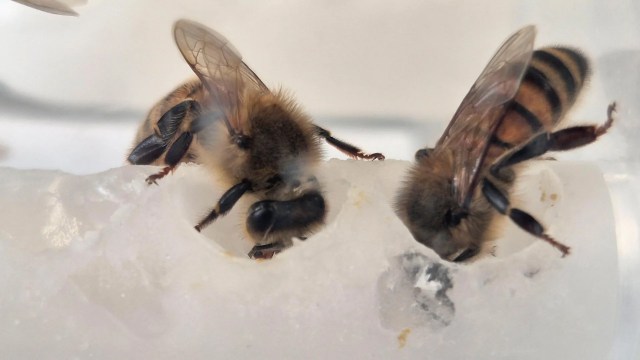
Worker bees feeding in the lab, Oxford Bee Lab. Credit: Caroline Wood
Today’s good news comes from Science Daily. Thanks to Noelle Granger for sending it in
Scientists uncovered the nutrients bees were missing — Colonies surged 15-fold
A lab-made diet supercharged bee colonies and could help save our food supply.
Date: March 27, 2026
- Source: University of Oxford
A team of researchers led by the University of Oxford has developed a breakthrough food supplement that could help reverse the alarming decline of honeybees.
Working with Royal Botanic Gardens Kew, the University of Greenwich, and the Technical University of Denmark, the scientists engineered a diet that mimics the key nutrients bees normally get from pollen.
When tested, colonies fed this supplement produced up to 15 times more young. The findings were published in the journal Nature.
Bees Are Starving for the Right Nutrients
Honeybees rely on pollen as their main food source. It contains essential lipids called sterols that are critical for growth and development.
But climate change and intensive farming have reduced the variety of flowers bees depend on. As a result, bees are increasingly missing key nutrients.
Beekeepers often use artificial pollen substitutes made from protein flour, sugars, and oils. These provide calories but lack the sterols bees need, leaving colonies nutritionally deficient.
A Lab-Made Solution Using Engineered Yeast
To fill this gap, researchers engineered the yeast Yarrowia lipolytica to produce a precise mix of six essential sterols.
They added this yeast to bee diets and tested it over three months in controlled glasshouse experiments. The enclosed setup ensured bees ate only the experimental feed.
Colonies Grew Faster and Stayed Healthier
The results were dramatic. Colonies receiving the enriched diet produced up to 15 times more larvae that reached the pupal stage compared with those on standard diets.
They also continued raising brood throughout the entire study period. Colonies without sterols stopped producing brood after about 90 days.
Even more striking, the nutrient profile of larvae matched that of bees feeding naturally, suggesting the supplement closely replicates real pollen nutrition.
Scientists Say This Could Be a Game Changer
Senior author Professor Geraldine Wright (Department of Biology, University of Oxford), said: “Our study demonstrates how we can harness synthetic biology to solve real-world ecological challenges. Most of the pollen sterols used by bees are not available naturally in quantities that could be harvested on a commercial scale, making it otherwise impossible to create a nutritionally complete feed that is a substitute for pollen.”
Lead author Dr. Elynor Moore (Department of Biology, University of Oxford at the time of the study, now Delft University of Technology) added: “For bees, the difference between the sterol-enriched diet and conventional bee feeds would be comparable to the difference for humans between eating balanced, nutritionally complete meals and eating meals missing essential nutrients like essential fatty acids. Using precision fermentation, we are now able to provide bees with a tailor-made feed that is nutritionally complete at the molecular level.”
Cracking the Code of Bee Nutrition
To figure out what bees actually need, researchers analyzed tissues from pupae and adult bees. This required extremely delicate lab work, including dissecting individual nurse bees.
They identified six key sterols that dominate bee biology: 24-methylenecholesterol, campesterol, isofucosterol, β-sitosterol, cholesterol, and desmosterol.
CRISPR and Yeast Make It Scalable
Using CRISPR-Cas9 gene editing, the team programmed Yarrowia lipolytica to produce these sterols efficiently.
This yeast was chosen because it naturally produces lipids, is safe for food use, and can be scaled up for industrial production. The final supplement is made by growing the yeast in bioreactors and drying it into a powder.
Why This Matters for Food and Farming
Honeybees help produce more than 70% of major global crops. But their populations are under severe pressure from poor nutrition, climate change, parasites, disease, and pesticides.
In the U.S., annual colony losses have ranged from 40 to 50% in recent years and could reach as high as 60 to 70% in 2025.
This new supplement could strengthen bee health without increasing competition for limited wildflowers. It may even evolve into a complete nutritional feed.
Helping Wild Bees Too
Co-author Professor Phil Stevenson (RBG Kew and Natural Resources Institute, University of Greenwich) added: “Honey bees are critically important pollinators for the production of crops such as almonds, apples, and cherries, and so are present in some crop locations in very large numbers, which can put pressure on limited wildflowers. Our engineered supplement could therefore benefit wild bee species by reducing competition for limited pollen supplies.”
A Potential Breakthrough for Beekeepers
Danielle Downey (Executive Director of honeybee research nonprofit Project Apis m., not affiliated with the study) said: “We rely on honey bees to pollinate one in three bites of our food, yet bees face many stressors. Good nutrition is one way to improve their resilience to these threats, and in landscapes with dwindling natural forage for bees, a more complete diet supplement could be a game-changer. This breakthrough discovery of key phytonutrients that, when included in feed supplements, allow sustained honey bee brood rearing has immense potential to improve outcomes for colony survival, and in turn the beekeeping businesses we rely on for our food production.”
What Happens Next
Larger field trials are still needed to confirm long-term benefits. If successful, the supplement could reach farmers within two years.
The same technology could also be adapted to support other pollinators or farmed insects, opening new paths for sustainable agriculture.
The good news in this story is that science is helping nature. Today’s JohnKu talks about science. I hope you have a super weekend.
Discoveries by John W. Howell © 2026
Some discoveries,
Are a human one-way street . . .
Others are for all.



















 Fiction Favorites
So wonderful to read about something that actually works… yay for the bees! 🐝🐝
LikeLiked by 1 person
I agree, Jaye. 😁
LikeLike
I couldn’t BEE happier to know this!
LikeLiked by 2 people
Just think how happy the Bees are, too.
LikeLiked by 1 person
Well, I’ll bee, science to the rescue, again.
LikeLiked by 2 people
Ha ha ha. Good one, Steve. 😁
LikeLiked by 1 person
I’m passing this one on to a couple of beekeepers I know.
LikeLiked by 2 people
What a great idea, Linda. 😀
LikeLike
Hurrah!
LikeLiked by 1 person
😀
LikeLike
Wonderful news, John. Thank you for sharing this with us. It’s a rarity to see a bee these days, and I grew up with them swarming and nesting outside our kitchen window. 😊
LikeLiked by 1 person
I’m glad someone is doing something about the decline. Thanks, Gwen.
LikeLike
It’s good to learn this, John. The decrease in the population of honeybees has been going on for decades and they’re needed.
LikeLike
Nice that science figure out what Bees were missing. Good news indeed.
LikeLike
What a wonderful idea. I am only a bit concerned that we could get bees only alive with patented food supplements. Best wishes, Michael
LikeLiked by 1 person
At least they will be alive. Thanks, Michael.
LikeLike
Awesome. If they can also cure that mold or whatever that decimates hives then bees are golden.
LikeLiked by 1 person
Would be good, Charles. Thank you.
LikeLike
Makes me wonder how the beekeepers were not aware of the missing nutrient. Researchers to the rescue. Definitely good news. Thanks, John.
LikeLiked by 1 person
Probably just did what they always did and didn’t give it any thought. Thanks, Lois.
LikeLiked by 1 person
What a wonderful story, John. Bees are a large part of our ecological system and have been threatened. Thank you for sharing!
LikeLiked by 1 person
Always like to find these kinds of stories. Thank you, Jan.
LikeLiked by 1 person
After we’ve lost so many bees to that virus, this made me jump for joy!
LikeLiked by 1 person
I’m right there with you, Noelle.
LikeLiked by 1 person
How high?
LikeLiked by 1 person
Bees and other pollinators face such an uphill battle to survive these days. We hope this fortified food can make a difference to help swell their numbers. 🤞🏼
LikeLiked by 1 person
I hope so, too, Monika.
LikeLiked by 1 person
Bees are so important; it’s great to hear news like this. Thanks, John.
LikeLiked by 1 person
I agree, Esther. We need our bees.
LikeLike
Most interesting and uplifting thing I’ve read in a long time.
LikeLiked by 1 person
So glad you enjoyed it, Craig.
LikeLike
Very good news. I don’t see many honey bees here, just bumble bees. We do have a large colony of bee hives about six miles away though. Thanks for sharing this, John 🙂
LikeLiked by 1 person
Glad you liked it, Denise 😊
LikeLike
I know scientists have been sounding the alarm for the decline of bees. Oxford’s scientific breakthrough is very good news indeed.
LikeLiked by 1 person
Let’s hope it gets widespread use. 😊
LikeLike
Such amazing creatures. Hugs.
LikeLiked by 1 person
I agree, Teagan. Thanks for 🤗
LikeLike