
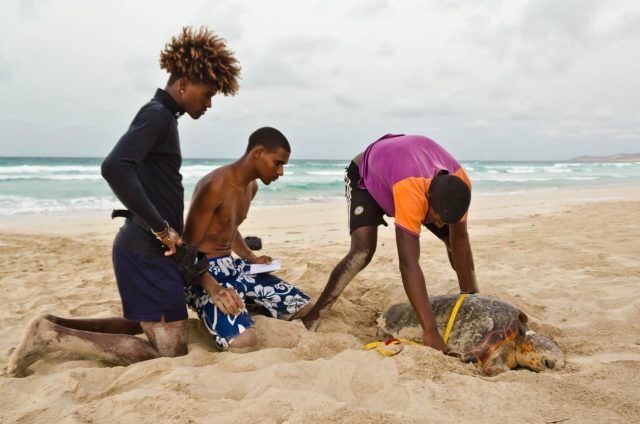
A ranger measuring a turtle’s shell and collecting data at the Canto camp. Image courtesy of The Turtle Foundation.
Today’s good news story comes from Mongabay.com and was sent to me by my correspondent Noelle Granger. Thank you, Noelle.
Former poachers guard Cabo Verde’s endangered sea turtles
by
Former sea turtle hunters in Cabo Verde, off the coast of West Africa, have shifted to loggerhead turtle conservation work along the archipelago nation’s main nesting beaches. The change was propelled by 2018 legislation that criminalized killing threatened turtle species, Sonam Lama Hyolmo reported for Mongabay.
Rangers, around a dozen of whom used to poach or hunt turtles, now patrol key beaches where turtles lay their eggs, walking several kilometers each night during the nesting season, which runs from June to October. Turtle meat has historically been consumed in Cabo Verde and many other regions, creating a conflict between conservation needs and local customs. However, awareness campaigns and employment opportunities are helping to bridge that gap.
“I had turtle meat for personal consumption and never realized I could make a living out of conserving them,” Roni Nelson Batista Ramos, a ranger and camp coordinator at the Turtle Foundation, told Mongabay. “But now, I guard them against the poachers, and it’s motivating to see how these efforts have driven positive impacts for their conservation.”
Ramos and others monitor around 31 kilometers (19 miles) of coastline, patrolling the beaches on foot, and using drones and dogs for added assistance.
Roughly two-thirds of loggerhead turtle nesting activity in Cabo Verde happens on the eastern island of Boa Vista, which has seen a dramatic decline in illegal turtle hunting, according to the Turtle Foundation. In 2007, 1,253 female loggerheads were illegally caught on the island; by 2024, there were just 20. Over the same period, loggerhead turtle nests on Boa Vista increased more than sevenfold.
Cabo Verde’s loggerhead turtle population is the largest in the eastern Atlantic Ocean and the third largest in the world, after Oman and southeast Florida.
Another four of the world’s seven sea turtle species roam the waters of the Cabo Verde archipelago: the green turtle (Chelonia mydas), the leatherback turtle (Dermochelys coriacea), the Olive Ridley turtle (Lepidochelys olivacea), and the critically endangered hawksbill turtle (Eretmochelys imbricata).
Bycatch in fishing is another significant threat to sea turtles in the region. In 2024, the Sustainable Fisheries Partnership Agreement (SFPA) renewed a five-year allowance for 56 fishing vessels from Spain, Portugal, and France to fish in Cabo Verdean waters.
Read the full story here. Warning: some photos are disturbing
The good news in this story is that those who hunt turtles are now protecting them, benefiting both. Today’s John Ku talks about reversing trends. I hope you have a beautiful weekend.
Turning a New Leaf © 2026 by John W. Howell
Once there were hunters,
Who saw their game disappear . . .
They turned to help save.























Talk about turning the tables to more positive outcomes! Great get Boss.
LikeLiked by 1 person
I agree, pilgrim. Good news indeed.
LikeLiked by 1 person
What a heartwarming story, John. Thank you for sharing it. Your JohnKu captures the dynamic beautifully. 😊
LikeLiked by 1 person
Thank you, Gwen. Ex-poachers on the job are pretty effective, I’ll bet.
LikeLiked by 1 person
Well done my man
LikeLiked by 1 person
😊
LikeLiked by 1 person
That`s a great change to the better, John! Thanks for sharing these great news. Enjoy a wonderful weekend! xx Michael
LikeLike
Thank you, Michael. Have a super weekend as well.
LikeLike
Love the former felons becoming good members of society. Wonder if former felons would do as well here?
LikeLiked by 1 person
They were poachers, but I get the political entendre
LikeLike
No flies on you, John.
LikeLike
Indeed.
LikeLiked by 1 person
I can tell you that I had my first bowl of turtle soup about 40 years ago at a little place North of Detroit. Simply called The Turtle Soup Inn. Absolutely fabulous. But I’m all for conservation of turtles. They are very neat animals. Good work in Cabo.
LikeLike
Yeah this slipped through the cracks. I’ve never had turtle soup so I will take your word for it. There now get out of the bedroom.
LikeLike
Thanks, tell Jim too 👍
Did you ever hear of that place North of Detroit ?
LikeLike
Thanks, tell Jim too 👍
Did you ever hear of that place North of Detroit ?
LikeLiked by 1 person
No, I did not hear of it.
LikeLike
An awesome story of protection and redemption.
LikeLike
So true.
LikeLike
John, thanks for sharing this wonderful story of commitment, and compassion. My heart is lighter for reading it. Turtles are special creatures that are easy to like and have an appeal for their safety and well-being.🐳
LikeLiked by 1 person
Such a nice comment, Jim. Thank you. 😊
LikeLike
From bad to good…hooray!
LikeLiked by 1 person
Yup. Hooray is right.
LikeLiked by 1 person
😀
LikeLike
It’s funny… decades ago, my husband and I were at a wild game feast in Ontario with several other couples. One of the items on the menu was snapping turtle. I did not care for it. I am happy to know the turtles are being protected and how cool is it that they are being safe guarded by those who once saw them as dollar signs.
LikeLiked by 1 person
I don’t even like the sound of eating a snapping turtle. Thanks for sharing, Annette.
LikeLiked by 1 person
This is great to see, John. I like how these former poachers have switched careers 🙂
LikeLiked by 1 person
I thought it was an unusual story for sure. Thanks, Barbara.
LikeLiked by 1 person
Another wonderful good news story John… and the old saying ‘set a thief to catch a thief’ has worked in other conservation projects such as in Africa… It is clear the rangers are dedicated and proud in what they are achieving and that has to be the best feeling in the world. hugsx
LikeLiked by 1 person
This was a genius thought by someone. To catch a thief indeed. Thanks, Sally
LikeLiked by 1 person
Thanks for posting this, John. I thought it was a great story.
LikeLiked by 1 person
I did, too. Thanks for sending it. 😀
LikeLiked by 1 person
Thanks for this encouraging story, John. Poaching of turtles is a huge problem in Africa. South Africa has conservation programmes which include paying money to Mozambique to try and prevent people from killing the turtles for food.
LikeLiked by 1 person
I’m glad things are being done to save the turtles. Thanks, Robbie.
LikeLiked by 1 person
I like your good news stories. Thank you so much for sharing.
LikeLiked by 1 person
My pleasure Kymber. Good to see you. 😀
LikeLiked by 1 person
Thank you! Good to see you, too. 🌺
LikeLiked by 1 person
😀
LikeLiked by 1 person
How wonderful to have a change of face, so to speak, such as this! I am always torn when I hear of what poachers do to beautiful beasties like this.
Wonderful JohnKu, too.
Have a marvellous Friday, John!
LikeLiked by 1 person
I wish there were a hunting season for poachers. That’s how I feel. Thanks, Dale. 😀
LikeLiked by 1 person
I am with you on that, John!
LikeLiked by 1 person
😊
LikeLiked by 1 person
Reformed poachers – love they’re protecting the turtles now. Have a great weekend, John!
LikeLiked by 1 person
Thank you, Teri. You as well.
LikeLike
I think it’s great that they now see things differently and protect them.
LikeLiked by 1 person
I do too. It is like rehabilitation.
LikeLiked by 1 person
Every good story needs a plot twist.
LikeLiked by 1 person
Yes, it does, and this is a good twist. Thanks, Pete
LikeLiked by 1 person
It’s good that the sea turtle hunters changed what they’re doing, John, and so nice that you posted the good news.
LikeLike
Fabulous news. Shows what education can do and compassion. When we visit Kauai we love the way they protect the monk seals and as soon as one comes up on the beach as well as the Honu turtles they put cones around them to keep people away.
LikeLiked by 1 person
I haven’t been to Kauai since the 90s. Loved it there.
LikeLiked by 1 person
Isn’t that wonderful, that the hunters become the conservators!
LikeLiked by 1 person
It is l Liz. It’s like who better to catch poachers than a poacher.
LikeLiked by 1 person
Exactly. Just like the hackers who go into cybersecurity.
LikeLiked by 1 person
Good one.
LikeLiked by 1 person
Thanks!
LikeLiked by 1 person
😊
LikeLiked by 1 person
A great turn around of what looked like a really sad story. It is great that the poachers are now protectors. It shows that people can change.
LikeLiked by 1 person
Given a way to feed their families, they certainly can change.
LikeLiked by 1 person
Yes I guess that is an important point
LikeLike
It would be hard to love this story anymore. Love that the poachers are now the protectors. Thanks for another feel good story, John.
LikeLiked by 1 person
Always a pleasure, Monika. I like these stories, too.
LikeLiked by 1 person
That is a positive change in behavior! I can’t imagine ever hunting or harming a beautiful sea turtle. They are incredible to see and swim with. Thank you for sharing this encouraging story and a happy weekend to you. 🐢
LikeLike
Thank you for the weekend wish. I hope yours is peaceful, Michele.
LikeLiked by 1 person
Thank you! 😊
LikeLike
The JohnKu says it all.
We don’t normally stop to see what harm we are doing, until it affects us. Then we try to make it better.
I’m happy to hear about this shift in attitude, and reality.
Turtle meat —YUK!
𝕆𝖃 🐢🐢 𝕆𝖃
LikeLiked by 1 person
Sometimes we should try to prevent disasters, but you are right. It is usually response rather than prevention. 😊X
LikeLiked by 1 person
Well, I suppose we don’t always answer the phone until it rings. 🐂 🐂
LikeLiked by 1 person
Good analogy. 😀X
LikeLiked by 1 person
Thanks! OX
LikeLiked by 1 person
😊X
LikeLiked by 1 person
Well, I guess if the money is better to guard them than kill them. Not exactly altruism, but I’m glad it’s working!
LikeLiked by 1 person
Me, too.
LikeLiked by 1 person