
The Nature Conservancy. BirdReturns: Creating Dynamic Habitat for Migratory Birds. The Nature Conservancy California
Today’s good news comes from @Massimo on X. Thanks to Noelle Granger for sending it to me.
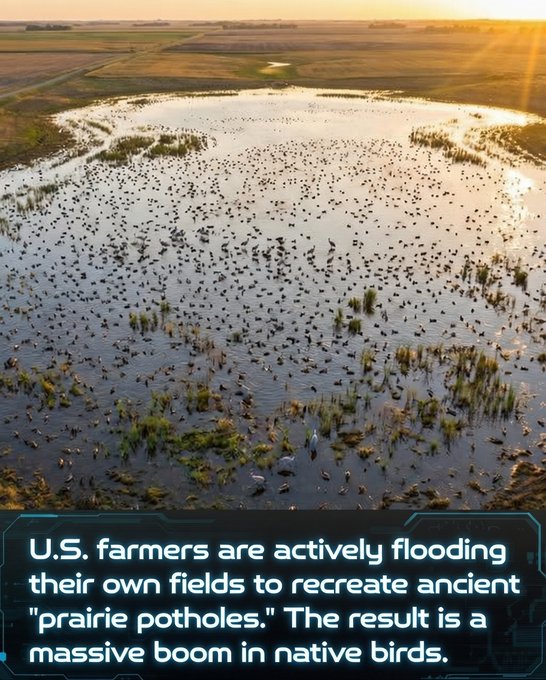
U.S. farmers are intentionally flooding their fields to revive ancient “prairie potholes,” creating temporary “pop-up” wetlands that deliver a huge boost to migratory birds while improving soil health.
In regions like California’s Central Valley and the Mississippi Delta, innovative programs—most notably BirdReturns (launched by The Nature Conservancy in 2014)—pay farmers to strategically flood low-lying or post-harvest fields at precise times during bird migrations. These short-term wetlands mimic the natural prairie potholes and seasonal marshes that once dotted the landscape but were largely drained for agriculture.
By timing floods to align with peak migration periods (e.g., spring and fall for shorebirds, waterfowl, and sandhill cranes), farmers provide essential stopover habitat: shallow water, mudflats, and abundant food for millions of birds traveling along flyways like the Pacific Flyway. The approach has transformed tens of thousands of acres of working farmland into critical refueling stations, with studies showing dramatic increases in bird use and numbers—sometimes 3.5 times higher in these managed pop-up wetlands compared to standard fields.
Farmers also gain practical benefits. Seasonal flooding enhances soil structure, boosts nutrient cycling (as bird activity and water help break down residues), recharges groundwater, reduces erosion, and supports long-term land productivity—often without hurting crop yields in subsequent seasons.
The good news in today’s story is an active program to help birds during their migrations while helping the soil as well. Today’s JohnKu talks about assisting nature. I hope you have a lovely weekend.
A Hand by John W. Howell ©2026
Times present themselves,
To extend a helping hand. . .
Do not miss the chance.






















What a brilliant project John and thank you to Noelle too for passing along… hugsx
LikeLiked by 2 people
Go Birds. Good for the Farmers and the Birds.
LikeLiked by 1 person
Go birds indeed. 😊
LikeLike
Great news, John! A win for the farmers and the birds.
Happy fri-Yayyy! ❣️
LikeLiked by 1 person
Happy Fri-Yay, Cindy. Thank you. 😊
LikeLike
winning all the way around
LikeLiked by 1 person
I agree. A wonderful project.
LikeLiked by 1 person
Real good news, John! It’s so good that BirdReturns figured out the best timing for farmers’ job of flooding their soil to be good for birds in migration and pay them to do it at that time.
LikeLiked by 1 person
I agree, Tim. It is a terrific project. 😊
LikeLiked by 1 person
I can expect good news here every week – as a bonus, I also learn about things I’ve never heard of. Thanks, John!
LikeLiked by 1 person
Me too, Teri. I learn and am uplifted as well. Thanks. 😊
LikeLiked by 1 person
Do not miss the chance. Absolutely! Never miss a chance to do something good. This is wonderful, John.
LikeLiked by 1 person
Thank you, Lois. Too many do. 😊
LikeLiked by 1 person
Good news! I’m wondering whether this is similar to the recovery of oxbows in rivers. I guess one of us should check on that, huh.
LikeLiked by 1 person
I looked it up. Here’s a brief description of oxbow revcovery, “Oxbow recovery involves excavating accumulated sediment down to the historic riverbed level to restore natural depth, reconnecting the oxbow to the main channel, and planting native vegetation on the banks. This process creates crucial flood storage, purifies water by removing nitrates, and provides vital wildlife habitat.” It seems the big difference is that there is no excavating or planting with the field flooding, and it is a temporary condition.
LikeLiked by 1 person
I knew that humans had tried straightening them out, then discovered they were actually very useful the way they were!
LikeLiked by 1 person
Yup.
LikeLiked by 1 person
That’s fascinating – I wouldn’t have thought it would do that. What great news. Thanks, John.
LikeLiked by 1 person
I thought so too, Esther. Thanks.
LikeLiked by 1 person
This is so heartening, John. Thank you for bringing it to our attention. We need hopeful news! 😊
LikeLiked by 1 person
I agree, Gwen. I found this very satisfying. Wishing you a super weekend.
LikeLiked by 1 person
John, nice to be reading your good news here again, and also nice to know some of us can still figure out how to make lemonade from lemons. This is such a no-brainer, and what a win-win for humans and wildlife alike…which in this day and age is one of the very best things to work for and towards.
LikeLiked by 1 person
Yes, it is, Bruce. It is good to see you again. Where have you been? (If you don’t mind me asking.)
LikeLiked by 1 person
John, I took time off WP to implement a couple of lifestyle/health modifications, and also get a handful of time-consuming home projects done which had been put off from last year. Also, just wanted to “recharge” those blogging batteries a little bit. Nice to be back!
LikeLiked by 1 person
Hope all came out okay. 😊
LikeLiked by 1 person
I’ve enjoyed the benefits o f birding many of those flooded rice fields in Central California. It’s a win win for birders, farmers, and the birds! I hope more farmers across the country do it.
LikeLiked by 1 person
Flooded rice fields and birds are a great synergy. Thanks, Deborah
LikeLiked by 1 person
It seems like humans are finally learning to work with nature instead of against it. A great post.
LikeLiked by 1 person
I think so, Robbie.
LikeLiked by 1 person
Cool. With all the benefits, I’m surprised this hasn’t been going on longer.
LikeLiked by 1 person
Me too.
LikeLike
I love stories like these, John. There’s so much good happening in the world, and it’s worth seeking out. Great share!
LikeLiked by 1 person
One has to look, though. Thanks, Diana.
LikeLiked by 1 person
Yes. That’s the key. Wonderful that you do, John, and we all get to benefit.
LikeLiked by 1 person
😄
LikeLiked by 1 person
This concept is new to me. Bravo to the farmers!
LikeLiked by 1 person
I agree, Liz.
LikeLike
One for the birds!
LikeLike
It is Noelle.
LikeLike
I absolutely love this, John! It reminds me of the wildlife refuge in Monte Vista where they created wetlands as birds travel toward Canada every spring. When I lived there I thought the wetlands were natural, little did I know they have an extensive irrigation system for designed for crucial feeding, resting, and breeding habitat for over 200 bird species. So cool. Thanks for sharing another feel good story that positively impacts nature and the environment.
LikeLiked by 1 person
So good to raise up memories, Monika. Thanks for sharing
LikeLiked by 1 person
Those are great and creative projects that I’ve never heard of before. Great way to protect birds and good news.
LikeLiked by 1 person
This is so interesting. Good news!
LikeLiked by 1 person
😊
LikeLiked by 1 person
That is good news!
LikeLiked by 1 person
Thank you, Dawn
LikeLike
Totally new to me and so intriguing!
LikeLiked by 1 person
New to me as well. Thanks, Becky.
LikeLiked by 1 person
Yay!
I like this idea. For once the saying “That’s for the birds” means something great and wonderful!
O🕊️ O🦅
LikeLiked by 1 person
I thought it was a great idea.
and hope more do the same. 💧X
LikeLiked by 1 person
🌟X
LikeLike
💡X
LikeLike
… and compliments on the JohnKu!
LikeLike
🐂 🐂
LikeLike
A win/win for the farmers and the birds. 😊
LikeLiked by 1 person
Yes, a double win. Thanks, Debby.
LikeLiked by 1 person
😊
LikeLiked by 1 person
This is cool. I’m happy for the birds–and bird watchers! I’m surprised this article didn’t list one of the benefits to farmers being all that fertilizer from bird droppings. I experienced that first-hand when we moved the chickens, and so many, many tomato plants grew in their former coop area.
LikeLiked by 1 person
I hope someone who knows about droppings reads this and can give us more info. Thanks, Ilsa
LikeLiked by 1 person
Haha. What a think to hope for. 😛
LikeLiked by 1 person
Well, you raised the idea.
LikeLiked by 1 person