
Today’s good news story comes from the Good News Network.
Maine Counts Over 20 Million River Herring During Annual Run, the Highest in Decades
A beloved local fish staple that was illegal to harvest as recently as 2012 has seen an incredible recovery in Maine’s rivers following the removal of several large dams.
Particularly on the Penobscot River, the removal of 2 dams has resulted in the “premier success story of our time,” for Maine’s alewife fish, which had been declining in population since the 18th century because of damming.
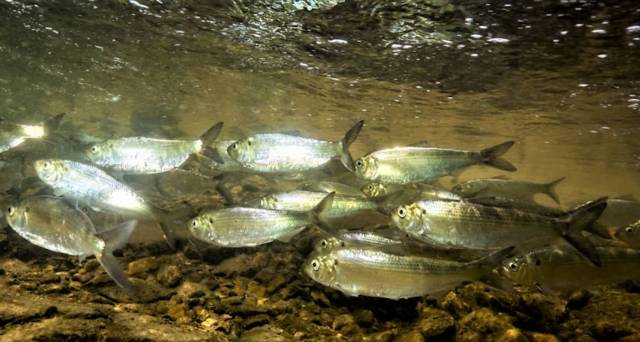
At its best, the alewife run is like a force of nature. From bank to bank, a babbling brook that’s quiet for most of the year will become a torrent of silver as the fish migrate upriver to spawn just as salmon do.
Colonial settlers, Native Americans, fishermen, and every predator in the woods needed only to reach their hands in and pull out breakfast lunch and dinner. But as the rivers were dammed, the migrations slowed, and even as early as 1840 there were catastrophic collapses in fish stocks.
Commercial offshore harvesting also decimated the fish, causing towns whose rivers weren’t dammed to lost their alewife runs as well. By 1994, annual inland catches had fallen from 3 million pounds average to just 150,000 pounds of fish.
As the country found new ways to power itself, an effort to undam the rivers began in 1999 and finished in 2016—four years after a moratorium was declared on the fishing of alewives offshore.
In 2025, these efforts culminated in 20 million alewives running up Maine’s rivers.
“We’ve gone from losing the fish completely in a lot of river systems due to damming and pollution, and now we have some of the largest populations in the globe,” Rustin Taylor, the executive director of the Alewife Harvesters of Maine, told Sydney Cromwell from Inside Climate News.
More officially known as a river herring, this non-game fish was dubbed an alewife due to its fat silver belly—a reference to female tavernkeepers of yore. Taylor described them in an ecological sense, acting as a great “nutrient conveyor belt,” bringing the nutrients of the cold ocean up into the land inside their guts.
Fed upon by most carnivores and omnivores in the forest and the rivers, the nutrients from the ocean are recycled through other animals and into the soil through those animals’ droppings.
In fact, Cromwell shares, the native Passamaquoddy tribe’s name for the species, siqonomeq, translates to “the fish that feeds all.”
Across Maine, alewife festivals routinely celebrate the return of the herring from the ocean, but for many decades, they were mostly somber affairs, as the torrents of silver from yesteryear became trickles due to overfishing in the Atlantic. Some locals would actively help their fish get past smaller dams by scooping them up in buckets and dumping them out on the other side.
Along with the removal of those dams, the construction of fish channels has helped them to get around the dams that remain.
“Some of those dam removals have led to incredible restorations of alewife migrations much faster than anticipated,” Taylor said, who called two dam removals on the Penobscot, where Atlantic salmon also run, “probably one of the premier success stories of our time.”
The good news about today’s story is that, with a little work, man-made impediments to species health can be removed, and the species will return. Today’s JohnKu talks about helping nature. I hope you have a lovely weekend.
Nature by John W. Howell © 2026
All that is required,
Is to give nature a break . . .
She will cure herself.























That is brilliant news John… so many times massive projects are undertaken without taking into account the cost to the ecology or living of those inhabiting the areas…. Glad that this has now been rectified for the alewives…hugs
LikeLiked by 2 people
I thought it was a good story, too. Thanks, Sally. 😊
LikeLiked by 1 person
A fascinating story. Maine’s good decisions resulted in a very positive outcome.
LikeLiked by 1 person
This was a good decision, Neil. Thank you.
LikeLike
I never knew dams had this kind of effect, but of course it makes sense. Glad they’ve been eliminated. Have a great weekend, John!
LikeLiked by 1 person
Thank you, Teri. Have a great one as well.
LikeLiked by 1 person
Big debates about dams out here. Our species is salmon, big ones. I also like the cheap electricity, so there is that.
LikeLiked by 1 person
Seems there could be both with fish ladders.
LikeLiked by 1 person
It’s good that the dams were gotten rid of to have the alewives recover and had such good results, John.
LikeLiked by 1 person
I agree, Tim. Took some work, but seems to have paid off. 😊
LikeLiked by 1 person
I love seeing stories like this. It’s good to be reminded that nature can bounce back when we give it room. This was a great pick for Good News Friday.
LikeLiked by 1 person
I agree, Kymber. Thank you.
LikeLiked by 1 person
All that is required,
Is to give nature a break . . .
She will cure herself
Your words are so true, John. It just shows how good nature is at healing herself. Great news story.
LikeLiked by 1 person
That is so true, so many times, Esther.
LikeLiked by 1 person
The locals would help by scooping and dumping…that is some kind of wonderful. They knew the fish needed help. Definitely good news, John.
LikeLiked by 1 person
They no longer have to do that now that the dams have been cleared. Thanks, Lois
LikeLiked by 1 person
Love this article. Plymouth has had an alewife run every year up Town Brook since the days of the Pilgrims, something I found in my research.
LikeLiked by 1 person
I guess the Plymouth alewives had a clear run with no dams
LikeLiked by 1 person
I recall they had some barriers to jump over when I saw the run many years ago, but I don’t think they are there now.
LikeLiked by 1 person
😊 Excellent.
LikeLike
That run would be awesome to see in person.
LikeLiked by 1 person
It would. 😊
LikeLike
Great news, John:) I know its the same issue with the salmon but given a chance nature does seem to recover.
LikeLiked by 1 person
I think salmon ladders have helped.
LikeLiked by 1 person
That is a wonderful success story! Kudos to those reponsible!
LikeLiked by 1 person
Thank you, Stephie. I agree with you.
LikeLiked by 1 person
That is great news. Russian trawlers were (illegally) emptying out the northern Baltic Sea (Bay of Botnia) of herring. I am from there and it was almost impossible to fish for herring. I don’t know if it has gotten better since then. I should ask my brother.
LikeLiked by 1 person
Knowing the Russians, it probably hasn’t gotten any better.
LikeLiked by 1 person
Great story, John. And a better JohnKu. Those dams, a good example of man’s interference with nature.
LikeLiked by 1 person
They are, and I’m glad they took them down.
LikeLiked by 1 person
Finally, Maine does something right. Boy, they seem way too far left. Must be something in the water…besides the fish
LikeLiked by 1 person
Maybe it’s fermented fish. Who knows?
LikeLiked by 1 person
Good find, John. One of my brothers is the vice president of the North American Butterfly Association. They do counts each year, and they’re numbers continue to dwindle. The theory is that global warning and other environmental factors may be responsible.
LikeLiked by 1 person
I don’t doubt that. Too bad too.
LikeLiked by 1 person
This awesome! I love me some herring. Not to eat, just because I can love them.
LikeLiked by 1 person
Ha ha ha. I get that.
LikeLiked by 1 person
Great good news! Coincidentally, my husband and I spent the entire day in Maine today. I love the idea of “the fish that feeds all.”
LikeLiked by 1 person
That is a good idea. Thanks, Liz.
LikeLiked by 1 person
When I would get in a “David” mood as a kid, my parents would send me to my room and tell me not to come out until I was fit for polite society again.
LikeLike
Nature will find a way, John. We just have to get out of the way!
LikeLiked by 1 person
Get out of the way is a good way to put it, Bruce. Thanks.
LikeLiked by 1 person
Your JohnKu is perfect. May I add, ‘Don’t mess with Mother Nature?’
LikeLiked by 1 person
Good add. 😄
LikeLike
Let’s hear it for fish fries throughout Maine!
LikeLiked by 1 person
Ha ha ha. Thanks, Monika. 😊
LikeLiked by 1 person
Hi John, this is a great success story. Thanks for the upliftment with a positive story.
LikeLiked by 1 person
I’m so glad you liked it, Robbie. Thanks for letting me know. 😄
LikeLike
💖
LikeLiked by 1 person
😊
LikeLike
Ahh, as the JohnKu says, nature will balance if we allow her to.
Well, she will still rebalance even if we don’t allow her to. It’s just that in those cases, she may have to use drastic measures.
Always great to read you Friyay good news.
OX OX
LikeLike
Thank you, Resa. I love finding good news. OX OX
LikeLiked by 1 person
OX OX
LikeLiked by 1 person
😊X
LikeLiked by 1 person
A great outcome for Maine. 🙂
LikeLiked by 1 person
Yes, it is. Thanks, Debby.
LikeLiked by 1 person
Such good news!
LikeLiked by 1 person
It is, Dawn. Thank you.
LikeLike