
Today’s good news story comes from the Times of India and was sent in by field reporter Noelle Granger.
Thanks to Noelle.
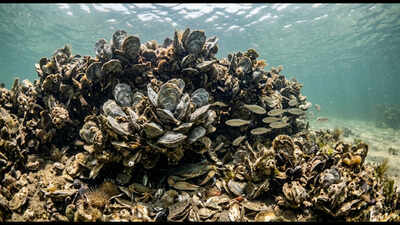
Florida returned half a million oyster shells to the Gulf of Mexico. The discarded shells became new reef habitat for marine life
Florida returned half a million oyster shells to the Gulf of Mexico. The discarded shells became new reef habitat for marine life.
TOI World Desk / TIMESOFINDIA.COM /
Oyster reefs also protect coastlines by helping reduce the force of waves during storms.
What looked like waste has turned into an important tool for restoring marine life along Florida’s coast. Between 2007 and 2024, Florida placed more than 500,000 tonnes of recycled oyster and clam shells into the Gulf of Mexico as part of a long-term effort to restore damaged marine habitats. According to a report by Upworthy, the shells did not come from the sea directly, but were collected from seafood restaurants, where they were discarded after meals, and from seafood processing plants. Instead of sending them to a landfill, they were returned to the water in areas where oyster reefs had declined over the years. At first, many people questioned the idea, even calling it dumping waste into the sea. Even researchers saw little visible change in the early stages of the project and were unsure whether the effort would succeed.
Although there was no immediate change on the surface, important processes had already started. As the shells were placed in the water, bacteria settled on them and formed a thin layer called biofilm. This is one of the first building blocks of a marine ecosystem, creating conditions that allow other organisms to attach, settle, and grow. The shells slowly broke down, releasing calcium into the water. This created small areas with a different water chemistry called microzones.
These tiny changes create suitable conditions for several underwater organisms that depend on such environments to survive. The shells also solved another major problem. Healthy oyster reefs need hard surfaces where young oysters can attach and grow. As many reefs had disappeared, much of the seabed had become soft and sandy, making it difficult for new oysters to establish themselves. The recycled shells acted as that missing foundation, and young oysters settled on them, gradually forming new reefs over time.
Shells were collected from seafood restaurants, where they had been discarded after meals,
Impact on water quality
Oyster population growth also brought additional benefits. While feeding, they filter large volumes of water, removing particles and helping reduce harmful algal blooms. Cleaner water also supports the growth of other plants and animals that depend on coastal ecosystems. Over time, these changes spread through the food chain, and fish and larger marine animals find more suitable habitats. According to the project, populations of fish, turtles, and dolphins recovered to levels not seen for more than 25 years. The gradual rebuilding of the seabed eventually became visible as marine life returned to areas that had earlier struggled to support it.
Importance of reefs
Healthy marine ecosystems support commercial fishing, which generates income for coastal communities. When fish populations decline, fishermen’s earnings are impacted, and seafood prices increase. Cleaner coastal waters support tourism, a major source of income for communities in Florida. Oyster reefs also help protect coastlines by reducing wave energy during storms. They act as natural barriers that can limit erosion and protect nearby shores. Oyster populations have declined over the years because of overharvesting. Human-caused environmental disasters, including the Deepwater Horizon oil spill, have also damaged marine habitats, making it harder for oyster reefs to recover. The results from Florida have drawn attention from coastal engineers and marine biologists, and similar shell recycling programs have already been introduced in several US states, including Alabama, Texas, Louisiana, California, Mississippi, and the Carolinas.
The good news here is recycled shells are giving birth to new life and improved environment. Today’s JohnKu talks about recycling. I hope you have a wonderful weekend
New Life by John W. Howell © 2026
The oysters are dead,
Instead of throwing them out . . .
They support new life.























Now that’s what I call recycling!
LikeLiked by 2 people
Yes indeed. 😄
LikeLike
This is absolutely amazing news John and Noelle…It just goes to show that whilst results might not be immediate with dedicated consistency over a period of time you can recover decades of loss… very happy to share this news..hugs
LikeLiked by 3 people
Thank you, Sally. 😄
LikeLiked by 1 person
[…] Friday JohnKu – AKA- TGIF – Fri-Yay/ Good News […]
LikeLiked by 1 person
Thank you for sharing the post today, Sally.
LikeLike
It made the news nhere too, John.
LikeLiked by 1 person
😄
LikeLike
John, when we met in NO for meetings our “bait eaters” would consume close to this number of 🦪O’s on the half shell🦪…TomO could suck those things down like a vacuum…❗️l couldn’t watch🤢🐳
LikeLiked by 1 person
Ha ha ha. Well, now they are put to good use.
LikeLike
You can dress Tom up, but you can’t take him out🐳
LikeLiked by 1 person
He can be taken out with a nice cup of coffee.
LikeLike
Yeah at a drive-thru joint…
LikeLiked by 1 person
😄
LikeLike
No sea food restaurants and processing plants are not the normal route for sea shells to get back in the ocean. However it is where they belong for all the reasons listed. And no overthinking is not a superpower.
LikeLiked by 2 people
I agree. Gotta wonder why it hasn’t been done before.
LikeLike
How extraordinary, hopeful, and exciting! Thank you for sharing this development, John (and Noelle). There’s so much we humans can do to “support life”. 😊
LikeLiked by 2 people
I agree, Gwen, and we had better wake up and begin looking for different ways to do that. Thanks, and I hope you have a super weekend.
LikeLiked by 1 person
what a great piece of news
LikeLiked by 1 person
It is for sure.
LikeLike
Nice story John. I really like the concept and the ingenuity they had to come up with this. That Tuna guy is kind of irritating. But probably true. Felix’s and Acme were two good spots as I remember. Try the book by Mark Kurlansky“The big oyster”. Great history of oysters. And his best book is just called “cod”. Check them out.
LikeLiked by 1 person
DK wants you to think he knows somen’bout dat oster bidness…he don’t no nuttin’
LikeLiked by 1 person
Is that the Oster blender bidness you are talkin’ about?
LikeLike
Not very nice to Big🐳…you know l struggled with spellen when I’d beed in skool. I’m hurt, heading to the bottom now🐋
LikeLiked by 1 person
Watch out for the giant squid down there. 🦑
LikeLike
Thanks for the recommendations, Tom. 😄
LikeLike
They really are good reads. Not too long and very informative.
LikeLiked by 1 person
😊
LikeLike
How fascinating!
LikeLiked by 2 people
I agree, Joy.
LikeLiked by 1 person
Another amazing story about the power of recycling! Thanks to Noelle for this and thank you, John, for sharing.
LikeLiked by 2 people
Thanks for the lovely comment, Jan. 😊
LikeLiked by 1 person
Many thanks to both John and Noelle. This is something that really gladdens the heart – just when everything seems to be disintegrating, people come up with something that really works. 😊👏
LikeLiked by 2 people
I agree, Trish. We need to see more of this kind of conservation. Thanks for the comment. 😊
LikeLike
😊
LikeLiked by 1 person
At a time when reefs are disappearing, this is a brilliant move!
LikeLiked by 1 person
I think so too, Noelle. Thanks again for the article.
LikeLiked by 1 person
This is so innovating. Love it, John!
LikeLiked by 1 person
Thank you, Monika. I love it, too. 😄
LikeLiked by 1 person
That’s what I call using the benefits of recycling! 😊
LikeLiked by 1 person
It is. Thank you, Debby. 😊
LikeLiked by 1 person
😊
LikeLiked by 1 person
Nice. They should do that everywhere reefs are dying.
LikeLiked by 1 person
Very true. I agree.
LikeLike
It’s good that they are so knowledgeable and being helpful to the environment, John. I’m glad you posted it.
LikeLiked by 1 person
Thank you, Tim. I’m glad Noelle sent it to me. 😊
LikeLiked by 1 person
😊
LikeLike
And the fix was easy and inexpensive! All it took was a little ingenuity!
LikeLiked by 1 person
That is the beauty of it all.
LikeLiked by 1 person
Exactly!
LikeLiked by 1 person
😊
LikeLiked by 1 person
That’s amazing and wonderful.
LikeLiked by 1 person
It is. Thanks, Deborah.
LikeLike
It is most heart-warming to read GOOD NEWS, and this is not only good but reminds me that good doesn’t have to mean complicated, just GOOD!
LikeLike
Just good is the best. Thanks, Annette.
LikeLiked by 1 person
500,000 tonnes of oyster shells. I can’t believe people ate that many oysters. I couldn’t even eat one ton. Anyway, it is a great idea and good news.
LikeLike
How great to reuse something that would have once been tossed away without a second thought. I’ve noticed that Noelle has contributed to many of your Good News posts lately.
LikeLiked by 1 person
She has sent a bunch of them. I’m very thankful
LikeLiked by 1 person
What a cool story. Ive seen them used as concrete blinder, but this is really cool
LikeLiked by 1 person
I like the part where new ones develope
LikeLiked by 1 person
Now I don’t feel so bad about using blinder instead of binder. Develope sounds like it should roam with the buffalo, but closer to the edge of town.
LikeLiked by 1 person
Damn e anyway.
LikeLiked by 1 person
What a great story. Who knew those oyster shells from restaurants could do so much good. It was a long process, and it worked. I love your JohnKu.
LikeLiked by 1 person
Thank you, Jennie. A great story. 😊
LikeLiked by 1 person
You’re welcome, John.
LikeLiked by 1 person
Thanks to you and Noelle for sharing this interesting news. A great idea saving nature. I had made something similar with egg shells, which i offered to slugs in our garden. Finely ground, they accepted it gratefully, and stayed away from the lettuce. Best wishes, Michael
LikeLiked by 1 person
You are so kind, Michael. I would use diatomaceous earth, which would kill them with 1,000 tiny cuts.
LikeLike
This wonderful article reinforces something many already know. Give & take. Or, in this case take and give. It’s all cyclical.
Thanks for the encouraging article and fab JohnKu!
🦪X 🦪X 🦪X
LikeLiked by 1 person
Thank you, Resa. I was glad to know new oysters grew on the old. Nice circle of life. 😄X
LikeLiked by 1 person
Yes. I agree! OX
LikeLiked by 1 person
Wow, reuse recycle and new life on a grand scale. Great news, John.
LikeLiked by 1 person
I agree, Rebecca.
LikeLiked by 1 person