
Today’s good news story comes from the India Times and was sent by Noelle Granger. Thanks Noelle
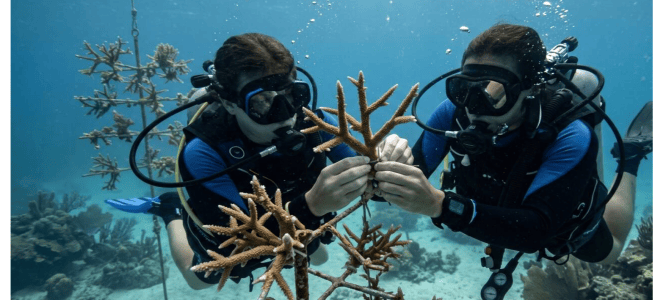
Around 2000, a Florida tropical-fish collector hung rescued coral fragments from underwater “trees”; the small nursery grew into a reef-restoration network
Both the deterioration of the Florida Keys reef and the response to it took time. Staghorn and elkhorn corals grew so numerous throughout the Florida Reef Tract for decades that divers reported swimming through underwater thickets. These corals were dying back because of disease, bleaching, and storm damage, and in some places their populations had dropped by almost 90%. It took more than good intentions to mend that kind of loss.
The breakthrough grew from a father-daughter 4-H project that built on Nedimyer’s years of experience working with marine life and aquaculture. A family project among the reef fish. Ken Nedimyer is a tropical fish collector and aquaculture operator based in the Florida Keys. He’s been diving those reefs since he was a kid and has witnessed them change for the worse over the years. Around 2000, when his daughter had a 4-H Youth Development project, Nedimyer used his marine-life experience to help her experiment with coral propagation. Together, they began growing staghorn coral fragments that had broken from nearby reefs. They began propagating staghorn coral fragments, keeping pieces that had broken from nearby reefs alive rather than leaving them to die on the seafloor.
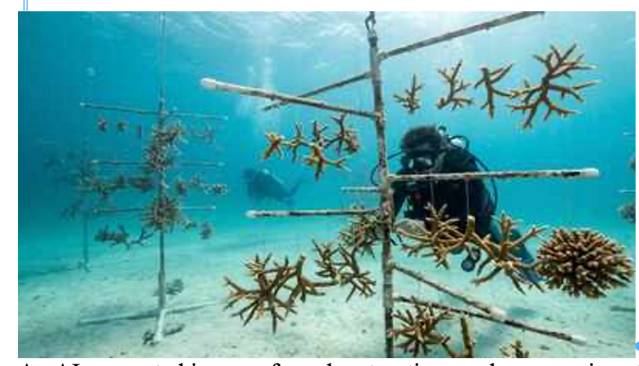
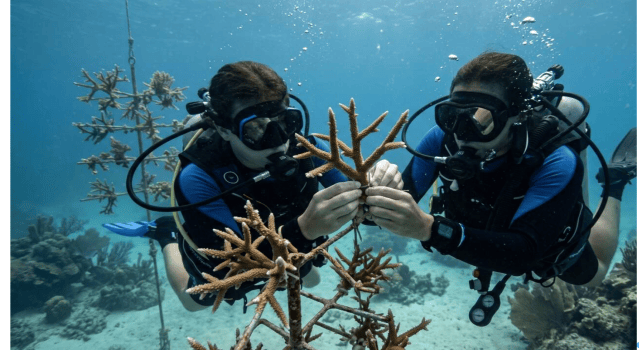
The small experiment went well enough that Nedimyer donated the propagated staghorn to the Florida Keys National Marine Sanctuary for restoration use, and a grant from The Nature Conservancy soon followed, allowing him to expand what had started out as a backyard hobby into something closer to a proper coral nursery. That early achievement posed a specific question. If a few saved bits could grow this nicely by chance, how many more could grow on purpose, and how quickly? Building coral tree nurseries that outgrow the ocean floor. In 2007, Nedimyer founded the Coral Restoration Foundation in Key Largo, where his team developed offshore nurseries that suspended coral fragments from structures known as coral trees rather than growing them directly on the seafloor.
Branching corals developed in this fashion and grew far faster than those left on the reef. Corals reportedly grew from a finger-sized fragment to a basketball-sized colony in six to nine months. At that point, divers would cut parts free and reattach them to neighboring deteriorated reef sites. That speed changed the economics of reef coral regrowth. Rather than waiting years for a few colonies to recover on their own, restoration teams could grow corals in offshore nurseries and then outplant them onto degraded reefs once they were large enough.
A study tracking Coral Restoration Foundation outplanting projects between 2007 and 2015 recorded survivorship and growth across 2,419 coral colonies placed on reefs throughout the sanctuary. It found that survivorship among the longest-monitored cohorts ranged from as low as 4 percent to as high as 89 percent, depending on the site and conditions. That range mattered because it gave restoration groups in the Caribbean and Pacific real-world evidence to build on instead of guesswork about which reef sites and outplanting techniques worked best.
From one nursery to a global reef restoration movement. The strategy became better known as the work expanded. In 2012, CNN named Nedimyer a CNN Hero for his coral-restoration efforts. By 2022, the Coral Restoration Foundation had planted more than 200,000 corals, according to NPR, and restored colonies at sites such as Carysfort Reef had begun reproducing naturally. That reproduction offered evidence that nursery-grown corals could become part of functioning reef communities rather than remaining isolated restoration plots. The Coral Restoration Foundation also publishes further detail on that ongoing restoration work.
This approach matters beyond replacing individual coral colonies. Staghorn and elkhorn corals create branching habitat that provides shelter and nursery space for fish and other reef animals, so restoring living coral can also help rebuild parts of the wider reef community. Nursery systems also give restoration teams a controlled place to grow genetically diverse colonies before placing them back onto damaged reefs, where survival can vary sharply with local conditions. That makes coral restoration as much a process of testing as planting: teams can compare sites, monitor which colonies persist, and adapt their methods over time. In the Florida Keys, the coral trees therefore became more than a way to grow fragments faster. They became a practical bridge between small-scale coral propagation and large-scale reef restoration.
Later, Nedimyer helped manage Reef Renewal International, an institution that has since spread the coral tree model far beyond Florida, supporting nurseries in Bonaire, Curaçao, Saint Vincent, the Cayman Islands, Hawaii, French Polynesia, and Australia. What started as a few pieces of coral hanging from his dock in the Florida Keys is now a routine technique at reef-restoration sites in three oceans, the result of a project launched because a teenager needed something to turn in for school.
The good news is that one person created a process that will save thousands of corals. Today’s JohnKu talks about individual effort. I hope you have a wonderful weekend.
Just One by John W. Howell ©2026
To accomplish much,
Takes just one with a passion . . .
The rest will follow.

heroes, indeed
LikeLiked by 1 person
For sure.
LikeLiked by 1 person
Amazing. He deserves a medal. More than one medal, in fact.
LikeLiked by 1 person
I agree. Thanks, Neil.
LikeLiked by 1 person
Best possible news, John.
LikeLiked by 1 person
😊
LikeLiked by 1 person
It really is amazing how such progress can be made. Thanks for the good news story.
LikeLiked by 1 person
I agree. Thanks, Esther.
LikeLiked by 1 person
This is SO neat – simple and effective~
LikeLiked by 1 person
Yup. Thanks, Noelle.
LikeLiked by 1 person
Another great reef revival story.
LikeLiked by 1 person
Yup. 😊
LikeLike
What makes this good news story even better is that it started as a father-daughter project!
LikeLiked by 1 person
I know, right?
LikeLiked by 1 person
This shows anyone can make a difference. So inspirational!
LikeLiked by 1 person
Thanks, Denise. I couldn’t have said it better. 😊
LikeLike
To me the father and daughter are wonderful. Their method of reviving the reefs is intelligent, and the results are great.
LikeLiked by 1 person
I agree, Tim. Thanks. 😄
LikeLiked by 1 person
😊
LikeLiked by 1 person
😊
LikeLiked by 1 person
Such a cool project.
LikeLiked by 1 person
It is. Thanks, Craig
LikeLiked by 1 person
I love that this started as a father-daughter 4H project! Amazing results!! Thanks for sharing, John and Noelle!
LikeLiked by 1 person
I like that part, too, Jan
LikeLiked by 1 person
Another encouraging conservation story to kick off the weekend. Thanks for sharing, John 🙏
LikeLiked by 1 person
A pleasure, Robbie. Thank you.
LikeLike
From a 4-H project to this! That’s very impressive stuff.
LikeLiked by 1 person
It is. Thanks, Pilgrim
LikeLiked by 1 person
Great stuff, as per.
LikeLiked by 1 person
😊
LikeLiked by 1 person
Another great example of how one person’s dedication to their singular mission eventually hits in a big way, and winds up being a big hit for all of us who want our Earth’s environment to survive and thrive.
LikeLiked by 1 person
Well said, Bruce. Thanks.
LikeLiked by 1 person
That’s a great project. I wish them much success!
LikeLiked by 1 person
Thanks
LikeLike
What an encouraging good news story. I hope the coral reefs can continue to grow. Thanks for sharing another amazing story about nature.
LikeLiked by 1 person
These stories all add up to a good feeling. Thanks, Monika.
LikeLiked by 1 person
Corals and coral reefs are under a great distress. They support a quarter of all ocean species and are largely threatened by us. They survived the dinosaur extinction but may not survive us. Corals are 540 to 485 million year old species. That’s why organizations like Coral Restoration Foundation are so important. It is a great post.
LikeLiked by 1 person
Thank you for the additional information, Thomas. I agree that protecting these reefs is important.
LikeLiked by 1 person
Another brilliant conservation project John and Noelle… and amazing how one man’s efforts can be magnified and built on..hugsx
LikeLiked by 1 person
All it takes is one light to start a movement. Thanks, Sally. 😊
LikeLiked by 1 person
What a great idea that became an even greater project. Love your JohnKu.
LikeLiked by 1 person
😊
LikeLiked by 1 person
Inspiring father-daughter story. Thank you for sharing, John.
LikeLiked by 1 person
A pleasure, Michele. Glad you liked it.
LikeLiked by 1 person
Lovely story and cool JohnKu.
It is interesting to me that many important projects/discoveries have come from school projects.
The young are idealistic and open and unafraid … and passionate. I’m more and more impressed with young people every day.
The future is theirs.
O🪸 O🪸
LikeLike
The future is theirs. Your observation is a good one. 😊X
LikeLiked by 1 person
An amazing project John, thanks for sharing. 😊
LikeLiked by 1 person
It is Debby. Thanks.
LikeLiked by 1 person
People destroy. People reconstruct. There is no other choice for the planet. Thank you, dear John!
LikeLiked by 1 person
The reconstruct part is the better choice. Thanks, Maria.
LikeLiked by 1 person