
Today’s good news comes from the Good News Network.
Coconut Oil Could Make Great Sustainable Jet Fuel, Pioneering Experiments Demonstrate
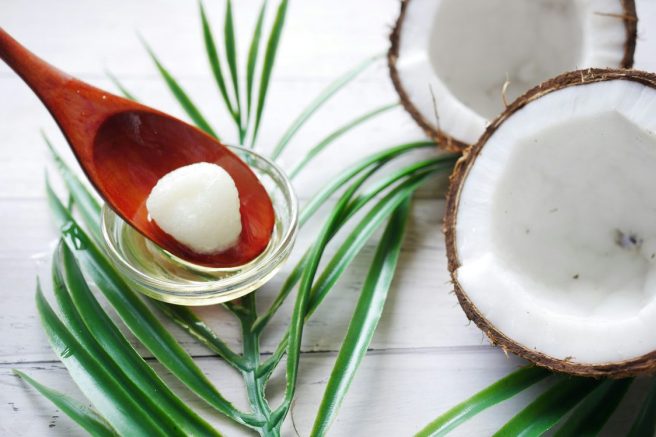
Chemists in Japan recently ran extensive experiments to see whether they could create sustainable aviation fuel from coconut oil, and they not only succeeded, but also outperformed existing biofuels across several metrics.
Compared with the high pressures and intense heating required to synthesize sustainable aviation fuel from existing biofuel feedstocks, the chemists’ co-solvent method produced an aviation-compatible fuel at room temperature and pressure, with lower heat input.
This minimized the fuel’s carbon footprint even before the researchers cut it with kerosene, poured it into a micro jet engine, and set it on fire to see what would happen.
The ultimate tests—how the mixture performed in the engine—showed “thermal efficiency… comparable to that of pure kerosene.” One drawback in pure performance metrics was slightly higher fuel consumption because coconut oil ignites at a lower temperature.
In terms of the emissions profile, the largest observed improvements over kerosene were reduced unburned hydrocarbon emissions. Called UHCs in the industry, or sometimes VOCs (volatile organic compounds) they include substances like butane, and result from incomplete fuel combustion and fuel vaporization.
Their formation depends heavily on the aircraft’s state. When the aircraft is taxiing or idling and engine temperatures are lower, it releases UHCs in much greater proportions, but these emissions were reduced by 5-40% depending on the amount of coconut fuel added, with larger amounts of biofuel resulting in greater reductions in UHC emissions.
CO2 and nitric oxide levels remained consistent with kerosene regardless of the blending ratios, which ranged from 10% biofuel-90% kerosene to a 50-50 blend.
The coconut biofuel really proved compelling in its production process: the co-solvent method. Here, they used coconut fruit discarded during commercial oil extraction, combined it with 10% acetone and an alcohol (either methanol or ethanol), and processed it first at room temperature, then at temperatures below boiling.
The process also produces glycerin and biodiesel as byproducts, while the acetone and alcohol reagents can be recovered and reused.
The team from Osaka Metropolitan University described their work as the first-ever experiments to create biofuels from coconuts and test them in a jet engine. They believe more research is needed before they can commercialize the process, mainly because they observed increased carbon monoxide emissions when the biofuel was blended with jet fuel, which could harm ground crews.
The good news is that this could be an acceptable, sustainable alternative to jet fuel that may reduce unburned fuel contaminants. Today’s JohnKu talks about perseverance. I hope you have a terrific weekend.
Success by John W. Howell © 2026
A common substance,
Repurposed for the better . . .
Shows perseverance.

This is remarkable. And I would imagine that airports, as well as airplane manufacturers would do well to grow their OWN coconuts to pull off the massive amounts required fuel an all-consuming industry!
LikeLiked by 2 people
I think that is a great idea. This stuff comes from already harvested coconuts, but to build to scale, there would have to be a bigger supply.
LikeLiked by 2 people
Put the lime in the coconut but not if it’s designated for jet fuel.
LikeLiked by 3 people
Drink ’em all up. 😊
LikeLiked by 1 person
😋
LikeLiked by 1 person
Call me in the morning.
LikeLiked by 1 person
My only worry is that coconut oil is responsible for a lot of deforestation and biodiversity loss. Hope they make farms.
LikeLiked by 2 people
Good point.
LikeLike
This is really interesting and promising. I am assuming they can synthesize coconut oil, otherwise it might not be cost effective to raise all those coconuts!
LikeLiked by 1 person
Not sure how it will work. I think we have to stand by.
LikeLike
That’s be a LOT of coconuts!
LikeLiked by 1 person
Sounds like it. 😄
LikeLike
Sounds promising. I wonder if the same thing could be done for heating fuel.
LikeLiked by 1 person
I have to believe it could.
LikeLiked by 1 person
I think the problem of scaling up is probably going to keep this pie-in-the-sky (aka coconut cream dream).
LikeLiked by 1 person
I suspect you are right. Eilene.
LikeLiked by 1 person
This seems like it could be helpful, John. I hope you have a terrific weekend too.
LikeLiked by 1 person
Thank you, Tim. 😊
LikeLiked by 1 person
You’re welcome, John. 😊
LikeLiked by 1 person
😊
LikeLiked by 1 person
What an amazing possibility! Thank you, John, for sharing this good news. There’s not a lot of it these days and messages of light/hope are cherished.
LikeLiked by 1 person
I agree, Gwen. We can use all the good news we can find. Thank you. 😊
LikeLike
Sounds interesting. I hope it works on a large scale.
LikeLiked by 1 person
Yeah, I have my doubts, but who’s to say? Thanks, Deborah.
LikeLike
Interesting findings and now I’m wondering if I should be cooking with potential jet fuel.
“set it on fire to see what would happen” Must be the scientific approach.
LikeLiked by 1 person
Ha ha ha. Great approach. Thanks, Michele,
LikeLiked by 1 person
Wow! I can’t help but wonder if this could be developed on a large scale and how cost effective it is. Our fuel in California just went “down” to $6.50 for regular unleaded.
LikeLiked by 1 person
California has the highest fuel prices in the country, largely due to its high taxes. I hope you guys get relief soon.
LikeLiked by 1 person
I love the idea of biofuel. Thanks for sharing another good news story that may just help; out our planet, John.
LikeLiked by 1 person
I keep looking for these stories. Thanks, Monika.
LikeLiked by 1 person
You do a great job curating them.
LikeLiked by 1 person
😄
LikeLiked by 1 person
It’s fun to imagine that exhaust fumes might smell like suntan lotion. 🙂
Thanks for this positivity, John. Hugs.
LikeLiked by 1 person
That is something I hadn’t thought of, Teagan. Good one. Hugs
LikeLiked by 1 person
That is impressive. You can cut carbon emissions and pollution from the grid with solar, wind, nuclear, hydro, geothermal, etc., the options are there. You can cut carbon emissions and pollution from land and sea transportation using electrical vehicles and ships (or sail boats) but airtraffic, that is a tough one. So it is great to find out that we are making progress here too.
LikeLiked by 1 person
I agree. The details need refinement, but it is worth further study. Thanks, Thomas.
LikeLiked by 1 person
Yes I certainly agree
LikeLiked by 1 person
😀
LikeLiked by 1 person
I always have coconut oil in the pantry because it’s so versatile. But here’s one I didn’t see coming. Great stuff Boss.
LikeLiked by 1 person
Thanks, Pilgrim. 😄
LikeLiked by 1 person
Interesting. So you could almost eat or drink your jet fuel. 🙂
LikeLiked by 1 person
Could be a choice in First Class. 😀
LikeLiked by 1 person
Wow! WOW!
LikeLiked by 1 person
I agree, Jennie.
LikeLiked by 1 person
😀
LikeLiked by 1 person
😀
LikeLiked by 1 person
Really interesting efforts here.
LikeLiked by 1 person
Thank you, Craig.
LikeLiked by 1 person
Wow! I’d heard the stuff was good for brain function, which is why I put some in my coffee every morning, but jet fuel too?? I thought olive was a super-powered oil, curing all that ails you. Look out, olive oil. Coconut is coming for you!
LikeLiked by 1 person
Pretty amazing stuff for sure.
LikeLiked by 1 person
They better start planting numerous palm trees because they’ll need a lot of coconuts. 😊
LikeLiked by 1 person
I’ve got a lovely bunch of coconuts. There they are a- standing in a row.
LikeLike
Let’s hope, dear John! Thank you for thus encouraging news.🍻🍻🍻🍤
LikeLiked by 1 person
Always hope, Maria. 😊
LikeLiked by 1 person