Today’s good news story comes from the Good News Network.
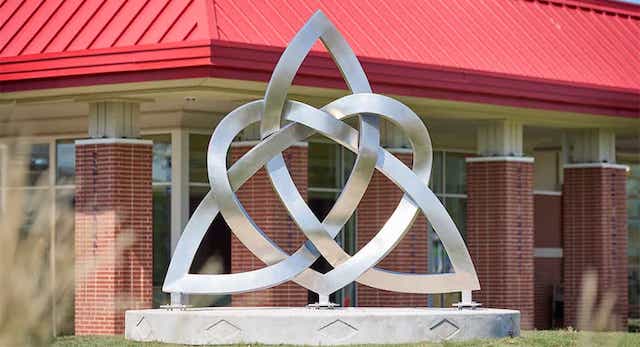
In the Choctaw Nation’s territory in Oklahoma, tribal leaders have erected a knotted statue to honor a 170-year-old cross-continental connection.
The “Eternal Heart” sculpture, combining a heart with a Celtic trinity shape, was designed to honor the eternal bond forged between the Choctaw Nation and the most unlikely of people: the Irish.
In 1847, when Ireland was experiencing years of starvation due to potato blight, the North American Choctaw tribe joined a compassionate campaign in the U.S. to help these strangers a whole ocean away from them.
Despite their own suffering, having been forced to relocate hundreds of miles from their native land, the tribe pooled their pennies and raised $170 (almost $5,000 in today’s currency) through a relief fund to send to Midleton in County Cork.
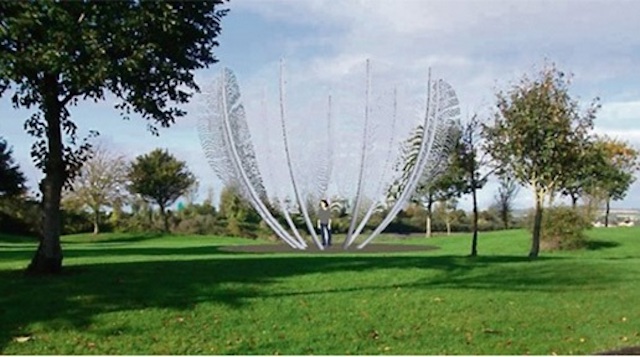
Nine years ago, a soaring silver monument to honor these donations was unveiled in Cork, and Choctaw leaders were invited to the grand unveiling.
“The bond between our nations has strengthened over the years,” Chief Batton said. “We are blessed to have the opportunity to share our cultures, and meet the generous people who have continued to honor a gift from the heart.”
In 2020, during the COVID-19 pandemic, the Navajo and Hopi nations were experiencing high rates of infection, and the Irish saw their moment to demonstrate that they remembered the kindness shown to them by America’s native peoples. Irish donors raised $2.7 million for water and supplies through a GoFundMe, with many leaving messages of remembrance and hope.
“Ours is a debt that can never be repaid, but please consider this a small token of love and solidarity from your Irish brothers and sisters. Praying for the strength, well-being, and prosperity of your community always,” said Caroline Kelly, adding a Gaelic message of unity. “Ar scáth a chéile a mhaireann na daoine.”
“When the Choctaw people had nothing, they gave Ireland all they could at a time when we needed it most. I know it’s not much, but I hope this helps our friends in their time of need,” added Ciaran Mc Brearty.
One of the truly wild parts of this historical story is that the people of 19th century Ireland who ultimately benefitted from the Choctaw donations didn’t learn about the aid money’s origin until decades after the famine had ended.
One can only imagine their surprise when the Midleton residents found out that it came not from Catholics or countrymen but from a group of ‘Indians,’ the conceptualizations of whom the Irish would have only possessed via written accounts of colonial explorers, and the high drama contained in early Wild West, Cowboys and Indians-like material distributed by publishers in America.
In 1995, then-Irish President Mary Robinson visited the Choctaw Nation to express gratitude and rekindle the friendship between the two nations. During the visit, President Robinson was appointed “Honorary Chief of the Choctaw Nation.” This historic visit began a renewed commitment to honor the bond forged by the Choctaws’ selfless act.
“It is a great honor to have a hand in exemplifying the Choctaw-Irish connection through my art,” said Choctaw sculptor Samuel Stitt. “The Choctaw culture of giving and caring for others is passed down to each generation. The ‘Eternal Heart’ is an artistic interpretation of how the Irish people and Choctaw Nation will forever be connected by that human characteristic of compassion—one people for another.”
The unveiling of the “Eternal Heart” sculpture reminds us of the power of compassion and solidarity and stands as a testament to the enduring friendship between the Choctaw Nation and the people of Ireland.
The good news in this report is helping others form a bond that could last a lifetime. Today’s JohnKu talks about helping others. I hope you have a wonderful week.
A Hand by John W. Howell © 2024
A simple gesture,
Of kindness to one in need . . .
Brings both together.
















 The essence of the gods slowly makes its way into my cup. Being old school, there is no reason to move or engage in mental activity without that first sip of Columbia’s second-most favorite export. The cup is full, and the first sip is consumed. Thoughts turn to the alarm clock. It is set for August 31, 1924, and the location is Coberg in Bavaria. The duration is for an hour. The puller plunger finds us in the town of Coburg.