Today’s story comes from the Good News Network. Here it is without editing.
World’s Largest Container Line is Rerouting its Fleet to Avoid Collisions with Endangered Blue Whales
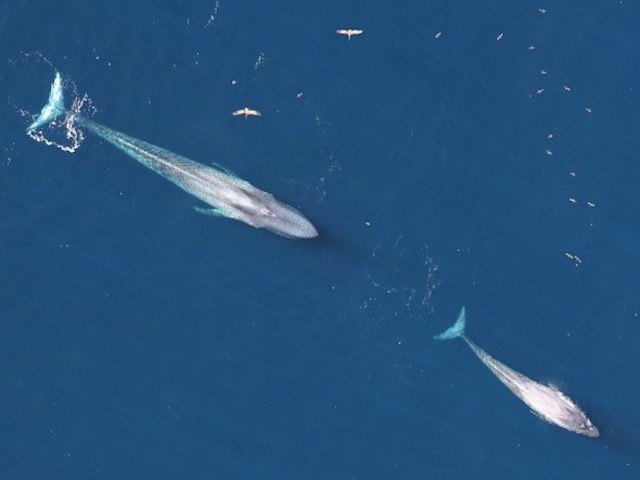
Mediterranean Shipping Company (MSC) has taken a major step to help protect blue whales and other cetaceans living and feeding in the waters off the coast of Sri Lanka by altering shipping lanes to avoid their habitat.
A global leader in container shipping and logistics, MSC began in mid-2022 to voluntarily reroute its vessels passing by Sri Lanka on a new course that is approximately 15 nautical miles to the south, in line with the advice of scientists and other key actors in the maritime sector.
The decision was based on research surveys completed by the International Fund for Animal Welfare (IFAW), with the World Trade Institute (WTI), Biosphere Foundation, University of Ruhuna (Sri Lanka), and supported by the World Wildlife Fund (WWF).
Westbound ship traffic is now limited to a latitude between 05 30N and 05 35N, and eastbound traffic is limited to a latitude between 05 24N and 05 29N in order to avoid designated cetacean habitats.
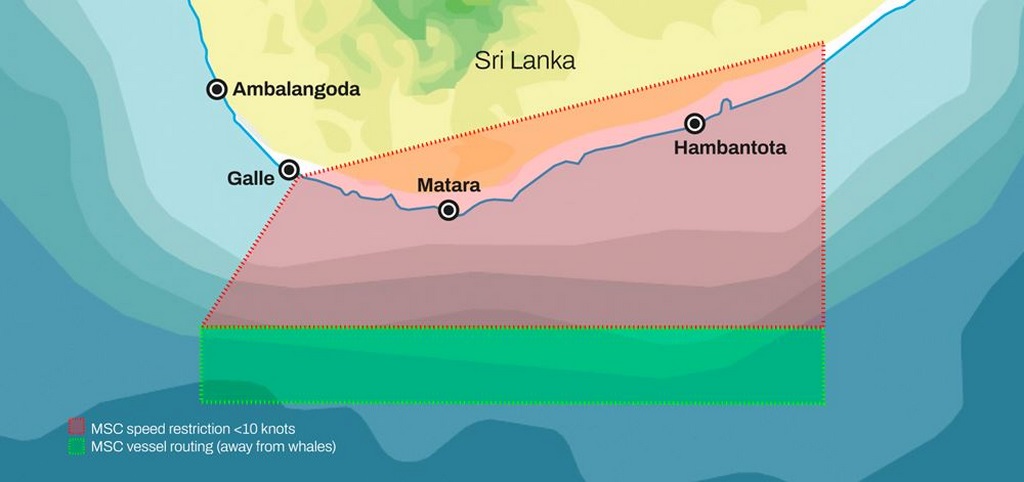
Sri Lanka lies in the Indian Ocean, between Asia and Europe, and the port of Colombo is a major transshipment hub for global trade.
The area off its southern coast is one of the busiest shipping lanes in the world and is also inhabited by large populations of whales, meaning that these animals may be at risk of colliding with ships.
Simulations have shown that moving the official shipping lane 15 nautical miles to the south could reduce the strike risk to blue whales by a whopping 95%. However, despite years of advocacy by scientists, the shipping industry, and NGOs, the boundaries of the official shipping line have not been reassigned to reduce the risk of ship strikes on cetaceans.
MSC is now taking measures to protect marine wildlife seriously, from adapting shipping service networks to keep away from designated whale breeding and feeding grounds to reducing vessel speed and rerouting ships to avoid reported marine wildlife populations.
“We believe that the commercial shipping sector has an important role to play in protecting cetaceans, specifically in helping to reduce the risk of ship collisions with whales,” said Stefania Lallai, Vice President – Sustainability at MSC.
“MSC is proud to rank at or near the top of whale safety shipping rankings. However, we are not at all complacent. We believe that raising awareness of these issues and encouraging collaboration between industry, scientific bodies, civil society, and governments is essential as we strive collectively to do more to minimize the risk of ship strikes.”
In Sri Lanka specifically, the liner shipping industry led by the World Shipping Council, of which MSC is a member, has advocated creating a new official marine traffic scheme that is fully separated from the blue whale feeding area.
It is hoped that this will soon become a reality, so all large-scale commercial marine traffic moves to the more southerly zone that MSC ships are now guided to follow. In the meantime, MSC urges all other ship operators to consider choosing a more southerly route past Sri Lanka to significantly reduce the possibility of whale strikes.
The good news here is that big business is beginning to take some stewardship of the planet. Today’s JohnKu talks about sharing the planet. I hope you have a terrific weekend.
Neighbors by John W. Howell © 2022
We often take care,
Of our neighbors when in need . . .
Why not animals?
Today I’m at Story Empire talking about lousy story endings. Here’s the LINK if you want to visit