Acres of Toxic Chemicals and Rusting Cars Becomes National Park After Amazing Transformation
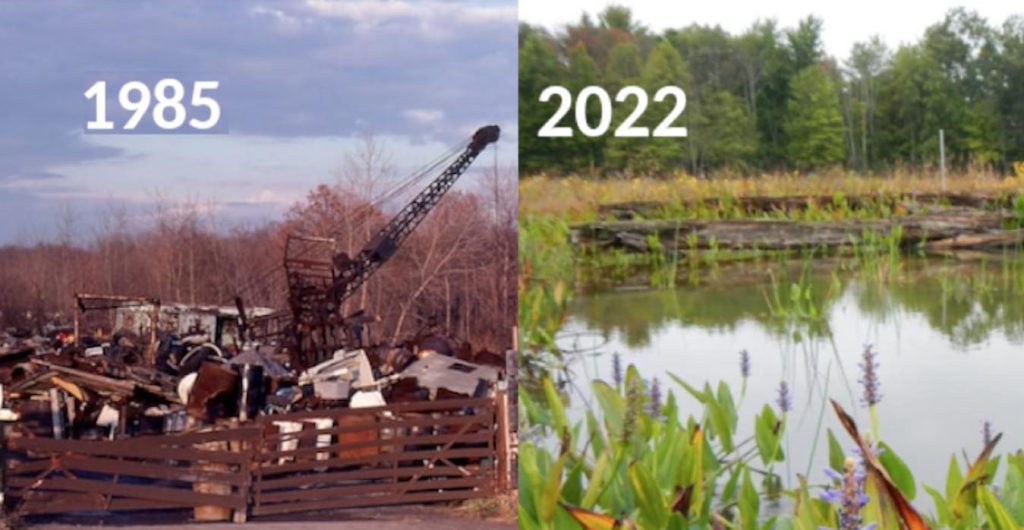
When President Gerald Ford signed a bill creating the Cuyahoga National Recreation Area in Ohio in 1974, the site’s boundaries deliberately included a well-known local garbage dump, assuming it could be easily cleaned.
When the National Park Service (NPS) discovered a nearly-unmanageable chemical wasteland where even the water and soil were flammable, a decades-long cleanup effort converted it, at the polluters’ expense no less, into a vibrant marsh ecosystem with some of the highest biodiversity in the region.
“This was a toxic wasteland only a few decades ago. To find this diversity of species there today is remarkable,” said Ecologist for Cuyahoga Valley National Park, Chris Davis.
The story begins when the Krejci (krech-ee) family opened up a dump along a river between Akron and Cleveland in 1940. Before municipal waste management, people were responsible for their own waste disposal, and Krejci innocently offered them an out-of-the-way place to do it.
As the years went by, the 200-acre site, with 50 acres meant for landfilling, began accepting heavier and heavier waste until many of the Rust Belt’s biggest manufacturers began relying on Krejci for disposal of their most harmful chemicals.
Getting stuck with the bill
As the years passed, the Cuyahoga area became a National Recreation Area and eventually a national park—the only one in the Rust Belt states. However, visitors began getting sick, and when NPS members finally got wind of the severity of the situation at the dump, a 25-year cleanup process began.
NPS needed a lot of cash to lead the cleanup, so they nominated Shawn Mulligan, a former Assistant Attorney General for Colorado, as an attorney representing the NPS. Mulligan would pursue companies like Chevron, Ford, Federal Metal Co., and Chrysler for almost $50 million in damages to pay for the cleanup.
The case dragged on, and few of the EPA legal staff believed it would yield a positive result for them. Eventually, as the NPS reported in a 2016 magazine issue, Ford quietly took the NPS legal team aside and decided on a solution: let the Motor City mechanics pay for and organize the whole cleanup.
The cleanup begins
With offices and resources close at hand, Ford hired contractors to begin excavating the contaminated soils. Still, every inch further dug revealed more sludge—and even more dangerous carcinogens like polychlorinated biphenyls or polyaromatic hydrocarbons.
The rusted cars and barrels, the tires, and all the other waste and discarded machinery were cleared out from 2002 to 2012, along with 400,000 tons of contaminated dirt—equivalent to 20 feet of topsoil.
Once no more barrels were found sticking out of the ground, and soil samples were clear of containments, the ground was contoured to match the surrounding ecosystem, and several wetlands were built up on the 50-acre dumping site.
Krejci dump today
Today, indigenous plants have been restored, and natural wetlands and all the plant and animal species they support are thriving.
Park visitors who experience the full-summer landscape find themselves soaking up the vista of native wildflowers and grasses as they watch turtles sun themselves on floating logs and listen to the birds sing.
Ford has been involved the whole way, paying its debt to society to a tune of $29 million and ensuring that the grasses and vegetation grow undisturbed and that soil erosion is prevented.
“[The Krejci site] is now as clean as any natural area in the park,” Dickerson says. That’s something remarkable, considering what it was in 1985.”
“You can categorize wetlands, and these are right up there with a three and a four (the top rating for wetlands). They can sustain high levels of benthic communities and critters, and turtles. They can sustain life here. It’s a vibrant resource for them.”
The Good news here is when like-minded people tackle a problem, there can be a positive solution. Today’s JohnKu discusses dedication. I hope you have a wonderful weekend.
The Impossible by John W. Howell. © 2022
Something worth doing,
Seems impossible at times. . .
Grit saves the day.