
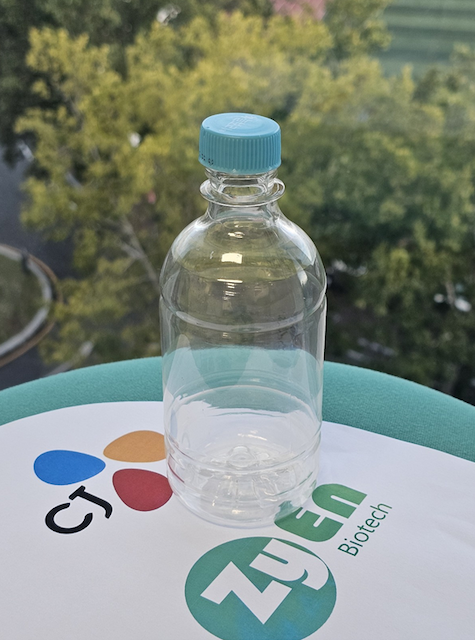
출처 : Businesskorea(https://www.businesskorea.co.kr)
Today’s Good News story comes from the Business Korea periodical and was brought to my attention by Noelle Granger.
Groundbreaking Bio-catalyst Developed for Efficient PET Plastic Decomposition
by Michael Herh – January 2025
The Ministry of Science and ICT (Information and Communication Technologies) has announced a groundbreaking development in the field of plastic recycling. A joint research team, led by Prof. Kim Kyung-jin of the Department of Biotechnology at Kyungpook National University and CJ CheilJedang, has developed a bio-catalyst with the world’s highest performance for decomposing PET (polyethylene terephthalate) plastic under industrial conditions. The research results, announced on Jan. 3, were published in the prestigious international journal “Science” on the same day.
PET plastic is a ubiquitous material found in everyday items such as PET bottles, clothing, seat belts, disposable cups, and car mats. Traditionally, PET plastic is recycled through mechanical processes that involve label removal, crushing, washing, and reprocessing. However, this method often results in a decline in the quality of the recycled material, leading to its eventual incineration or disposal in landfills. Chemical catalysts, which induce chemical reactions to break down plastics, have been considered an alternative, but they come with their own set of limitations, including raw material contamination and waste generation.
To address these issues, the research team developed a high-performance bio-catalyst named “KUBU-M12.” Unlike chemical catalysts, bio-catalysts decompose plastics through biological reactions akin to the natural decay of wood. This process results in less waste and raw material contamination, thereby maintaining the quality of the recycled material. KUBU-M12 has demonstrated remarkable efficiency, capable of decomposing 1 kilogram (kg) of PET by 45% in just 1 hour, over 90% in 8 hours, and almost completely in 12 hours with only 0.58 grams (g) of the catalyst. The research team emphasized that this is the highest performance recorded among bio-catalysts for plastic decomposition globally.
Prof. Kim highlighted the importance of this development, stating, “This is a groundbreaking technology that enables permanent recycling of even contaminated plastics that cannot be recycled.” He further added, “Innovations applying bio-catalysts will occur in various chemical industries.”
The development of KUBU-M12 is expected to revolutionize the recycling of difficult-to-recycle waste plastic, contributing to various chemical industry innovations and addressing critical environmental issues such as carbon neutrality and climate change. The eco-friendly nature of this technology aligns with global efforts to reduce plastic waste and improve recycling efficiency, ultimately mitigating the environmental impact of plastic pollution.
The achievement of world-class performance in eco-friendliness and the ability to decompose waste plastic in just 12 hours using a small amount of bio-catalyst marks a significant milestone in the field of biotechnology and materials science. The publication of these findings in “Science” underscores the importance and credibility of the research, highlighting the potential for widespread application and impact.
The good news in this story is the issue of plastic pollution is being addressed in many countries. Today’s JohnKu talks about technology. I hope you have a super weekend.
Plastic by John W. Howell © 2025
Great when invented,
Its waste is found everywhere . . .
Need solutions now.