
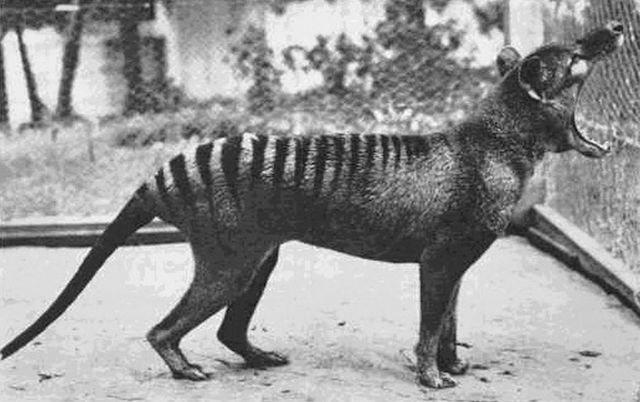
A thylacine in a zoo
Today’s Good News story comes from the Good News Network. Here is in its entirety.
Tasmanian Tiger RNA Recovered from Preserved Specimen in Groundbreaking World First
A team of Scandinavian researchers has recovered messenger and micro RNA from a Tasmanian tiger specimen kept in a museum collection.
It’s the first-ever collection of RNA from an extinct creature in history, an achievement long sought after in the study of extinct species and for other applications.
The Tasmanian tiger, or thylacine, was truly unique for an apex predator. This large predatory marsupial was king among Tasmanian forests, which remain largely intact since its extinction 130 years ago.
For this reason, the potential resurrection of the thylacine has received a lot of attention, as it would immediately solve many problems facing the balance of the Tasmanian ecosystem without the complexities of trying to replace the apex predator role with a non-native animal.
The thylacine evolved on Tasmania, and putting it back would be by far the easiest solution, provided the incredibly difficult task of somehow recreating the thylacine through paleogenomics could be accomplished. Colossal Biosciences in Texas is currently working to produce viable thylacine-like embryos using already sequenced DNA to raise in surrogates over the next few years.
Now, though, a Swedish-Norwegian team has isolated the transcriptome of the skin and skeletal muscle tissues from a 130-year-old desiccated Tasmanian tiger specimen preserved at room temperature in the Swedish Museum of Natural History in Stockholm.
The functional difference between DNA and RNA is that DNA stores genetic information that only RNA can read. RNA reads and carries out the instructions for protein coding contained within DNA.
The researchers were able to isolate useable RNA from a thylacine that carried instructions for skin and skeletal muscle coding, which might be key to any resurrection.
“This is the first time that we have had a glimpse into the existence of thylacine-specific regulatory genes, such as microRNAs, that got extinct more than one century ago,” says Marc R. Friedländer, Associate Professor at the Wenner-Gren Institute at Stockholm University.
The authors point out that museum collections around the world contain vast collections of endangered and extinct species, and their technique for recovering the thylacine RNA holds promise for the study and or protection of all these creatures.
They write that the RNA from the thylacine looks a lot like that of existing marsupials.
“Resurrecting the Tasmanian tiger or the woolly mammoth is not a trivial task and will require a deep knowledge of both the genome and transcriptome regulation of such renowned species, something that only now is starting to be revealed,” says Emilio Mármol, the lead author of a study recently published in the Genome Research journal.
The idea of resurrecting a species has nothing to do with cloning and has so far centered around the idea of altering the genetic expression of the animal’s closest living relative in utero. In the case of the wooly mammoth, it would be the elephant, and in the case of the thylacine, perhaps the fat-tailed dunnart or Tasmanian devil.
The good news in this article is that possibly extinct animals can be resurrected using what is learned in this case. Today’s JohnKu talks about reversing extinction. I hope you have a super weekend.
Resurrection by John W. Howell © 2023
What used to be lost,
Through science has a slim chance . . .
Of resurrection.























 Fiction Favorites
Can’t help but think that just because we can, we shouldn’t, John, after all, every time humans have done something to the environment, (introducing species such as rabbits for food or something to control another species, etc), we mess it up and make things worse 🤔
LikeLiked by 2 people
That thought crossed my mind as well, Chris.
LikeLiked by 3 people
He made a good point. I vote for caution but to proceed.
LikeLiked by 2 people
I can see both sides of it, so I’m on the fence, although it is a fascinating scientific development.
LikeLiked by 1 person
It is. Of course, the Atom bomb was fascinating too. 😳
LikeLiked by 1 person
Good point!
LikeLiked by 1 person
😁
LikeLiked by 1 person
Good point, Chris. The Producer just slapped me across the head with a “This is not good news.” Maybe it is good to discuss news. My reason for selecting the story was seeing science going in a direction to help a situation. You are right, maybe it is not a good idea. Thanks
LikeLiked by 2 people
Nature finds a way to live and change, it doesn’t need us to do its bidding. And I don’t think we should.
LikeLiked by 3 people
You have a good point, Pilgrim. At the minimum we should be careful.
LikeLiked by 3 people
Most definitely.
LikeLiked by 1 person
😊
LikeLiked by 1 person
Despite the other 2 comments, I think this is the perfect solution for the Tasmanian forest problems.
LikeLiked by 2 people
I think at least it is an alternative. I would vote for caution. Like you, when I saw the story I thought of the solution side as good news. Thanks, GP
LikeLiked by 2 people
Whoa, that’s incredible. I have Jurassic Park red lights flashing in my mind, but the science aspect of this is amazing.
LikeLiked by 3 people
I agree wit you Vera. Caution is the word but it does sound amazing.
LikeLiked by 2 people
I’m not entirely convinced this is good news. The law of unintended consequences too often applies.
LikeLiked by 4 people
You and The Producer agree. I think a step forward in science if done correctly is good news. Unintended Consequences is always a risk for sure. Thanks, Linda.
LikeLiked by 3 people
Well, I am gob smacked!
LikeLiked by 2 people
A fair reaction to the news. Thanks, Annette.
LikeLiked by 2 people
I think it is good news. Science needs to explore and learn new things. Research here, could lead to healing genetic disorders or any number of things beyond the first thought.
LikeLiked by 3 people
I do agree with others on an exercise of caution but I share your basic optimism. Thanks, Craig.
LikeLiked by 2 people
I’ve seen articles show up from time to time on this. Always saying they’re still trying. Very cool that we may be able to reintroduce a species we wiped out.
LikeLiked by 2 people
That is the good news part here, Charles. Thanks.
LikeLiked by 1 person
On the one hand, I’m smiling at the thought of ever seeing a live Tasmanian tiger, which would be exciting. On the other hand, I can’t help but wonder if we are going into an area where doing something like this might cause more problems than it solves. I can’t decide how I feel for sure, but I’m leaning a bit toward what Chris said above. “Just because we CAN doesn’t always mean we SHOULD.” It’s an amazing discovery, though, and who knows what other very positive uses could come from this accomplishment?
Thanks for sharing, John! It’s certainly food for thought. 😀 ❤
LikeLiked by 3 people
I agree on the food for thought, Marcia. JUst shows when a good news subject comes up sometimes there are other considerations. It is good to talk about these although my intent isn’t to create a controversy on what is good news. Let’s hope the science is careful in their progress. Thanks, Marcia.
LikeLiked by 1 person
I’m getting Jurassic Park vibes. LOL
LikeLiked by 2 people
I can see that, Darcy. Thanks.
LikeLiked by 1 person
😎 I used to follow your blog a while back, while I was going by a different name. Found you again yesterday by accident.
LikeLiked by 1 person
I hope you continue. I knew you had been here before because your comment did not go into moderation mode. 😁
LikeLiked by 1 person
Oh…. sweet! I will. I realized I like blogging too much to quit again, as well as the people I get to meet.
LikeLiked by 1 person
Yeah, Me too.
LikeLiked by 1 person
This is interesting, John. Thanks for sharing this research. Happy Friday!
LikeLike
I had the same reaction as Priscilla – first thing I thought of was Jurassic Park. Have a great weekend, John!
LikeLike
This good news has me happy and freaking out simultaneously! Great John Q. Have a wonderful weekend, John 💕🙂
LikeLiked by 3 people
I can understand how you feel, Harmony. Have a great weekend too. 🤗
LikeLiked by 1 person
In Jurassic Park they used frog DNA to fill in the ‘gaps.’ As I recall fictionally this almost worked out perfect. I imagine here they will go with something much safer like tiger, cave bear, or saber tooth tiger DNA to fill in the gaps. On a serious note the rate at which we introducing foreign species around the world continues. And they are of the smaller varieties. Things like fire ants and Asian giant hornets. Oh and Burmese pythons in Florida. All good things to keep life interesting. Science is a good thing. Humans messing with ecosystems is how we teach Artificial Intelligence to say WTF. Said with deep profound sincerity. Then again the theme parks and the movies will be great for the economy. If you excuse me I will just pour three fingers and try to calm down. Happy Friday John ! And a jolly good try…
LikeLiked by 1 person
Thank you, John. Love where you took this. 😁
LikeLiked by 1 person
I’m a tad torn on this one, to be honest. If it would benefit Tasmania (problem with overpopulation of some critter?) that is one thing. Species have a normal life (existence?) cycle, methinks. It’s very interesting, though! Could you imagine? My goodness.
Happy Friday, John.
LikeLiked by 1 person
Twiggy could take it. 😀
And I love the picture of “the producer” slapping you across the head. Give her a hug from me. Ha Ha Ha.
Bring back Dino, Fred and Wilma.
LikeLiked by 2 people
Haha!
LikeLiked by 1 person
😁
LikeLiked by 1 person
Thank you, Dale. My goodness indeed. 😁
LikeLiked by 1 person
😊
LikeLike
Break through or break neck? Like many of the comments, I see how this could go two ways and only time will tell. Let’s hope the outcome proves positive.
LikeLiked by 1 person
Yeah, I hope it is positive, Grant. Thanks for the comment. 😁
LikeLiked by 1 person
I love the thought of resurrecting extinct species, but as we are all too well aware, the best of intentions can go awry. I guess I’ll take the sit-back-and-see seat. Thanks for this information, John. What do you think?
LikeLiked by 1 person
I like the idea of bringing back a lost species. Wait and see is a good posture on this one. Thanks, Noelle.
LikeLiked by 1 person
Twiggy could take it. 😀
And I love the picture of “the producer” slapping you across the head. Give her a hug from me. Ha Ha Ha.
Bring back Dino, Fred and Wilma.
LikeLiked by 1 person
Thanks, Tom. 😁
LikeLike
Although this may be a good thing for them and keep thinking about Jurassic Park.
LikeLiked by 1 person
I know. A scary thought.
LikeLike
Fascinating! I love it when history is proven. Thanks for sharing, John!
LikeLiked by 1 person
Thank you, Jan.
LikeLike
I wonder where this will go. We’ll see.
LikeLiked by 1 person
Let’s hope no where that folks don’t want it to go. Thanks, Tim
LikeLiked by 1 person
I’m waiting for the part where they discuss what could possibly go wrong.
LikeLiked by 1 person
That will be after the funding is secure. (“Yeah, there could be a mutation that could eat New York.”) 😁
LikeLiked by 1 person
A thylacine looks scary. It is a good thing you have Twiggy to protect you in case one gets loose. Science is amazing. Good story…I think. TGIF to you, John.
LikeLiked by 1 person
Thank you, Jo. I hope you have a super weekend.
LikeLike
This reminds me of the positivity that occurred when wolves were reintroduced to Yellowstone.
LikeLiked by 1 person
Good point, Jennie. That worked.
LikeLiked by 1 person
Yes it did work, in many more ways than Yellowstone expected or realized. Best to you, John.
LikeLiked by 1 person
😊
LikeLiked by 1 person
Slim and none, and slim just left town on the back of a Sabre tooth tiger 🤓
LikeLiked by 1 person
😁
LikeLike
The JohnKu speaks true.
Fascinating news, as much as good news, dear John.
Where science leads, some will follow.
🐂🐂🐂🐂
(Fortunately we don’t have to resurrect the OX!)
LikeLiked by 1 person
Yes the OX will not go extinct. 🐂🐂🐂🐂
LikeLike
Whew! 🐂🐂🐂🐂
LikeLiked by 1 person
🐂🐂🐂🐂🐂🐂🐂🐂 Can’t leave them in the dark.
LikeLiked by 1 person
True!
💡🐂🔦🐂🕯🐂
LikeLiked by 1 person
⏰🐂🏮🐂🪩🐂
LikeLiked by 1 person
Oh, I like the disco OX!
Better than Disco Duck!
🪩𝖃🪩𝖃🪩𝖃🪩𝖃
LikeLike
Disco OX is the best. 🪩X🪩X🪩X🪩X
LikeLiked by 1 person
Can’t beat it!
🪩X🪩X🪩X🪩X
LikeLiked by 1 person
Yay
LikeLiked by 1 person
Should we do it? That’s the question, dear John! Thank you a lot! The scientists must be happy.🙂
LikeLiked by 1 person
Always the question, Maria.
LikeLiked by 1 person