

Today’s Good News story comes from the Good News Network
Trillions of Microscopic Sea Plankton Recruited to Solve the Carbon Problem
American scientists have proposed a new method for recruiting trillions of microscopic sea creatures and their insatiable appetites to fight climate change.
The technique harnesses the animals’ daily habits to accelerate the ocean’s natural cycle for removing carbon from the atmosphere, known as the biological pump, according to the paper in Nature Scientific Reports.
The study, published by researchers at Dartmouth College, reported that spraying clay dust on the ocean’s surface converts carbon into food the animals eat, digest, and send deep into the sea as carbon-filled feces.
They explain that the process would begin with spraying the clay dust at the end of algae blooms. These blooms can grow to cover hundreds of square miles and remove about 150 billion tons of carbon dioxide from the atmosphere each year, converting it into organic carbon particulates. But once the bloom dies, marine bacteria devour the particulates, releasing most of the captured carbon into the atmosphere.
The researchers found that the clay dust attaches to carbon particulates before re-entering the atmosphere. It redirects them into the marine food chain as tiny sticky pellets the ravenous zooplankton consume and later excrete at lower depths.
“Normally, only a small fraction of the carbon captured at the surface makes it into the deep ocean for long-term storage,” says Mukul Sharma, the study’s corresponding author and a professor of earth sciences. Sharma presented the findings on December 10th at the American Geophysical Union annual conference in Washington, D.C.
“The novelty of our method is using clay to make the biological pump more efficient—the zooplankton generate clay-laden poops that sink faster,” says Sharma, who received a Guggenheim Award in 2020 to pursue the project.
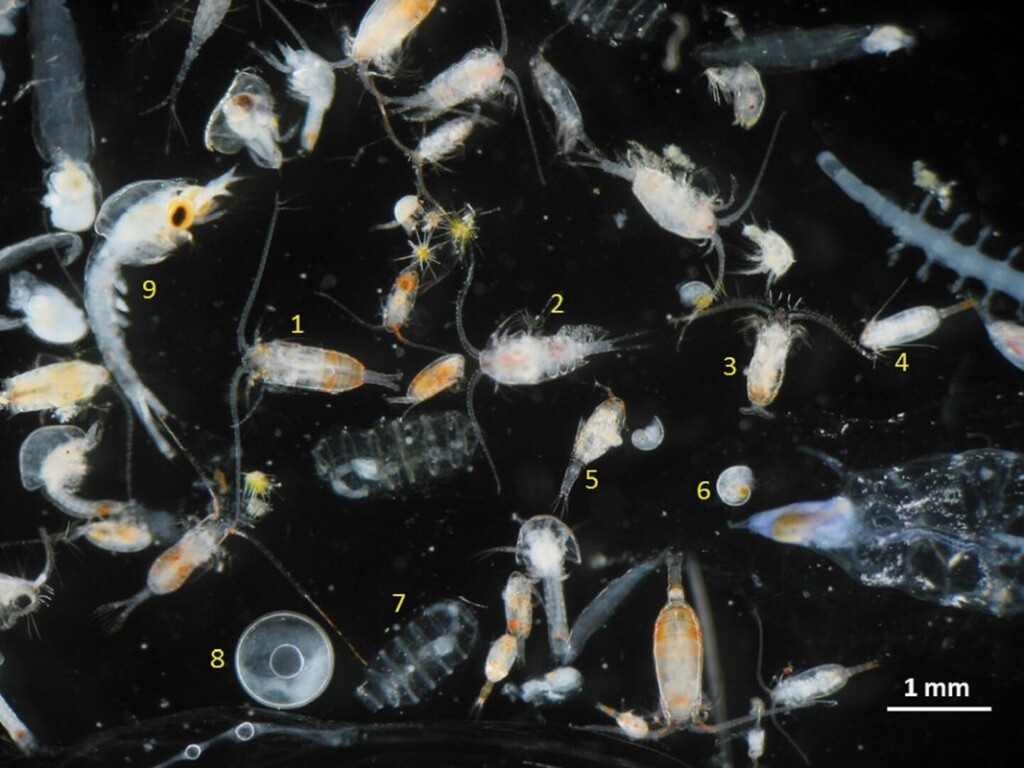
“This particulate material is what these little guys are designed to eat. Our experiments showed they cannot tell if it’s clay and phytoplankton or only phytoplankton—they just eat it,” he says. “And when they poop it out, they are hundreds of meters below the surface, and all that carbon is, too.”
The team conducted laboratory experiments on water collected from the Gulf of Maine during a 2023 algae bloom. They found that when clay attaches to the organic carbon released when a bloom dies, marine bacteria produce a kind of glue that causes the clay and organic carbon to form little balls called flocs.
The researchers report that the flocs become part of the daily smorgasbord of particulates that zooplankton gorge on. Once digested, the flocs embedded in the animals’ feces sink, potentially burying the carbon at depths where it can be stored for millennia. The uneaten clay-carbon balls also sink, increasing in size as more organic carbon, as well as dead and dying phytoplankton, stick to them on the way down.
In the team’s experiments, clay dust captured as much as 50% of the carbon released by dead phytoplankton before it could become airborne. They also found that adding clay increased the concentration of sticky organic particles—which would collect more carbon as they sink—by 10 times. At the same time, the populations of bacteria that instigate the release of carbon back into the atmosphere fell sharply in seawater treated with clay, the researchers report.
Sharma says that in the ocean, the flocs become an essential part of the biological pump called marine snow. Marine snow is the constant shower of corpses, minerals, and other organic matter that falls from the surface, bringing food and nutrients to the deeper ocean.
“We’re creating marine snow that can bury carbon at a much greater speed by specifically attaching to a mixture of clay minerals,” Sharma says.
Zooplankton accelerate that process with their voracious appetites and incredible daily sojourn, known as the diel vertical migration. Under cover of darkness, the animals—each measuring about three hundredths of an inch—rise hundreds, and even thousands, of feet from the deep in one immense motion to feed in the nutrient-rich water near the surface.
When the day breaks, the animals return to deeper water, depositing the flocs as feces. This expedited process, active transport, is another key aspect of the ocean’s biological pump that shaves days off when it takes carbon to reach lower depths by sinking.
Sharma plans to field-test the method by spraying clay on phytoplankton blooms off the coast of Southern California using a crop-dusting airplane. He hopes that sensors placed at various depths offshore will capture how different species of zooplankton consume the clay-carbon flocs so that the research team can better gauge the optimal timing and locations to deploy this method—and exactly how much carbon it’s confining to the deep.
“Finding the right oceanographic setting to do this work is significant. You cannot go around willy-nilly dumping clay everywhere,” Sharma told Dartmouth Press. “We need to understand the efficiency first at different depths to understand the best places to initiate this process before we put it to work. We are not there yet—we are at the beginning.”
The Good News in today’s story is that scientists continue to work to make our oceans healthier. Today’s JohnKu talks about the oceans. I hope you have a super weekend.
Oceans by John W. Howell © 2024
They cover the Earth,
And have been abused for years . . .
Reversal takes work.

What great news, John. I love the inherent nature of the goodness and the brilliance of connecting these forces for greater good of our environment! 💓
LikeLiked by 1 person
I do too, Cindy. Thank you.
LikeLike
How very interesting, John.
LikeLiked by 1 person
I agree, Robbie. Thanks.
LikeLike
Very interesting. Will a second plane spray micro bran to help the little darlings move the clay through?
LikeLiked by 1 person
LOL. This is a good suggestion. 😂
LikeLiked by 1 person
Sounds great for our atmosphere.
I wonder if some strange creature will develop from eating all the carbon in the ‘snow’.
LikeLiked by 1 person
I could see the plankton from hell ravishing the East Coast. 😁
LikeLiked by 2 people
haha, that’s what I was picturing!
LikeLiked by 1 person
Yes.
LikeLiked by 1 person
Sounds promising!
LikeLiked by 1 person
It does. I hope it gets further developed.
LikeLiked by 1 person
This is so interesting and informative to me, John. It’s good they came up with this technique to break up CO2.
LikeLiked by 1 person
These two look like they are in High School. Amazing. Thanks, Tim.
LikeLiked by 1 person
They sure do look young, John.
LikeLiked by 1 person
They sure do.
LikeLiked by 1 person
Recruiting makes me imagine a mini-HR department running interviews.
LikeLiked by 1 person
Ha ha ha. Don’t call us . We’ll call you. Thanks, Charles.
LikeLike
This sounds wonderful. I’m all for healthier oceans.
LikeLiked by 1 person
Me too, Teri. We depend on the oceans.
LikeLiked by 1 person
The last line of your JohnKu speaks volumes. Indeed, lots of years and lots of work. But hopefully projects like this one will improve the conditions of the oceans.
LikeLiked by 1 person
I agree, Dave. Thanks for the additional info.
LikeLiked by 1 person
It’s interesting.
LikeLiked by 1 person
😊
LikeLike
Such a clever idea that really works! I am so impressed. I also read in an article yesterday that a group is working on pumping sea water from below the Arctic ice to the surface where it thickens the ice by inches very quickly and because the ice gets thicker, more ice forms on the bottom the ice field because its colder. So far they’ve managed 40,00 square feet of ice to thicken, but plan to expand their efforts.
LikeLiked by 1 person
That sounds like a great answer to the melting polar cap.
LikeLike
Another inventive idea!
LikeLiked by 1 person
Yes.
LikeLike
How very cool — thanks for reprinting this, John. Who’d have thought??
LikeLiked by 1 person
My pleasure Debbie. I hope they make something of it.
LikeLiked by 1 person
I love your haiku, John. It’s true. Reversal takes work and patience! Great story. Happy Friday!
LikeLiked by 1 person
Thank you so much
LikeLike
How fascinating. It’s great to read about what they’re able to do to try and help the environment.
LikeLiked by 1 person
I think anything we can do is great. Thanks, Esther.
LikeLiked by 1 person
More great news, John 🙂 I’m hoping it works out well for us and the ocean.
LikeLiked by 1 person
I do too, Denise.
LikeLiked by 1 person
Very hopeful, John. Thank you for sharing the brilliance of these creative thinkers. Have a great weekend! 🌞
LikeLiked by 1 person
Thank you, Gwen. These kids are brilliant.
LikeLiked by 1 person
An exciting beginning! A great discovery that sounds promising, and fascinating. Thank you for sharing, John and thank goodness for brilliant minds! 🌍🌎🌏
LikeLiked by 1 person
I love this story, Michele. Thanks for the comment.
LikeLiked by 1 person
You’re welcome. It is a great one! Thank you.
LikeLiked by 1 person
😁
LikeLiked by 1 person
Simply brilliant!
LikeLiked by 1 person
so true.
LikeLiked by 1 person
When you think about the countless hours and the painstaking research that goes into changing something for the better, you gain an ever deeper appreciation for these scientists.
LikeLiked by 1 person
I so agree. These kids are genius’s
LikeLiked by 1 person
They are.
LikeLike
It was very interesting reading. I hope it works out.
LikeLiked by 1 person
I do too. Thanks, Thomas
LikeLiked by 1 person
Brilliant people out there, aren’t there? Now to tackle the erupting volcanos and cow farts. I know they can solve those too!
LikeLiked by 1 person
Just solving China would be a big step forward.
LikeLiked by 1 person
You do ask a lot.
LikeLiked by 1 person
I know. Toss in India as well. Talk about impossible.
LikeLiked by 1 person
I hope this works and doesn’t just switch carbon from earth into the oceans and pollute it. But it does sound fascinating and somewhat promising. 🤞🏼
LikeLiked by 1 person
Appearantly the sea plankton creatures gobble the stuff up
LikeLiked by 1 person
Your JohnKu says it.
And it will take more years to undo, than it took to do.
I’m glad some people are doing the good work.
🐟𝔁 🐟𝔁 🐟𝔁 🐟𝔁
LikeLiked by 2 people
Me too. I love these stories. 🐟X🐟X🐟X🐟X
LikeLike
Wouldn’t it be poetic is plankton poop saved our planet? Lol. Science is just amazing. Thanks for sharing the good news, John. What interesting research. 🙂
LikeLiked by 1 person
It would be ironic. Thanks, Diana.
LikeLiked by 1 person
Perfect summation with your haiku John. Sounds very promising. 🙂
LikeLiked by 1 person
Yes it does. Thank you, Debby. 😁
LikeLiked by 1 person
Brilliant minds. Hooray!
LikeLiked by 1 person
It is true.
LikeLiked by 1 person
Yes!
LikeLike