Today’s good news story comes from Twisted Sifter and was sent to me by Noelle Granger.
A New Japanese Invention Called Transparent Paperboard Could Mean Single Use Plastic Waste Will Be A Thing Of The Past
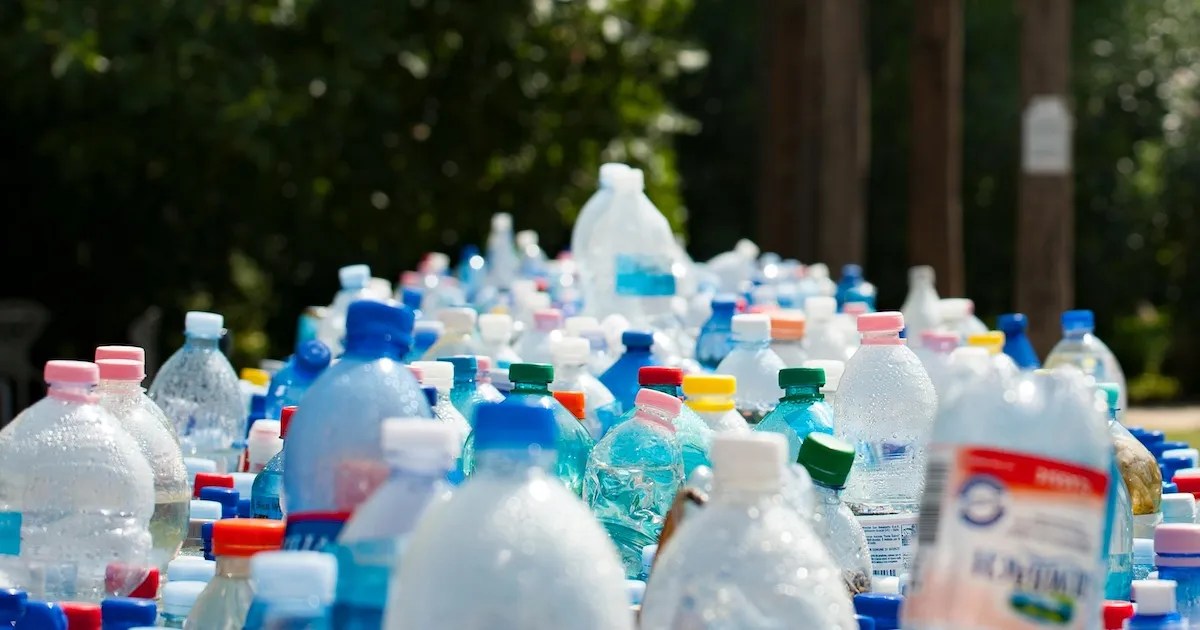
Anyone who has had their heart broken by images of dolphins or sea turtles struggling or even dying because they got tangled up in plastic waste will know exactly why single-use plastics are hated.
Not only are these materials wasteful, they are also highly polluting and difficult to dispose of. If it ever does break down, it can take hundreds or even thousands of years, after which time microplastics still remain.
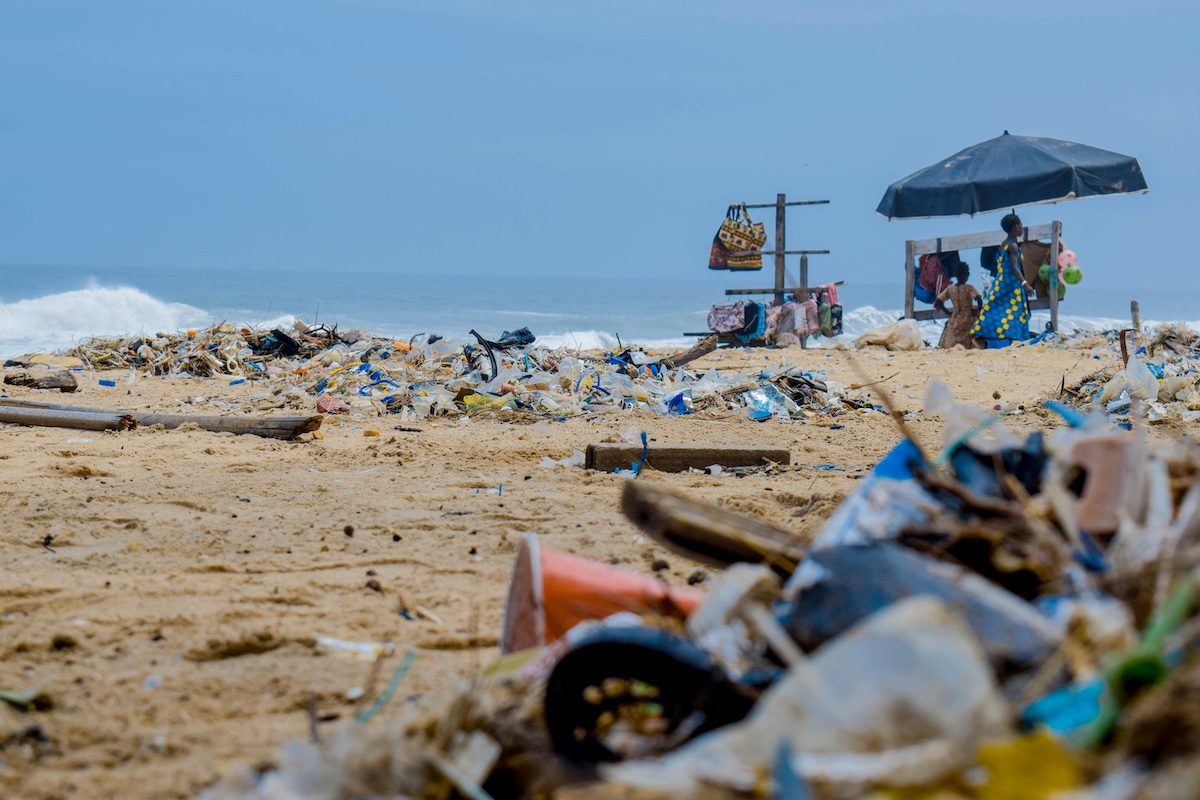
And what’s worse is the sheer volume of plastic that isn’t properly disposed of, meaning that it often drifts out in our waterways and ends up in our oceans.
It’s no wonder that 99% of the Great Pacific Garbage Patch is comprised of plastic.
Plenty of plastic alternatives have been rolled out, and that’s definitely a good thing.
From paper and cardboard packaging replacing the plastic that has proliferated our stores for decades, to refill stores selling loose items with the ability to fill your own containers, it’s great to see manufacturers and retailers doing their bit to help our planet and its valuable, vulnerable ecosystems.
But there are still some situations in which plastic is needed, for example where liquids are involved. And thus, researchers in Japan have been working on creating viable biodegradable alternatives to plastic in order to fill this gap in the market.
And according to their paper, which has been recently published in the journal Science Advances, they’ve had a breakthrough.
Isobe et al/Science Advances
When it came to the creation of their replacement plastic product, the team were driven by the acknowledgement that even with the best intentions, some waste items are still likely to end up in our oceans. As such, they explain in their paper, they created a material suitable for this:
“To mitigate marine pollution from single-use plastics, it is crucial to transition to next-generation commodity materials that are derived from biomass and are recyclable and marine biodegradable even at abyssal depths in case of the accidental release to the ocean.”
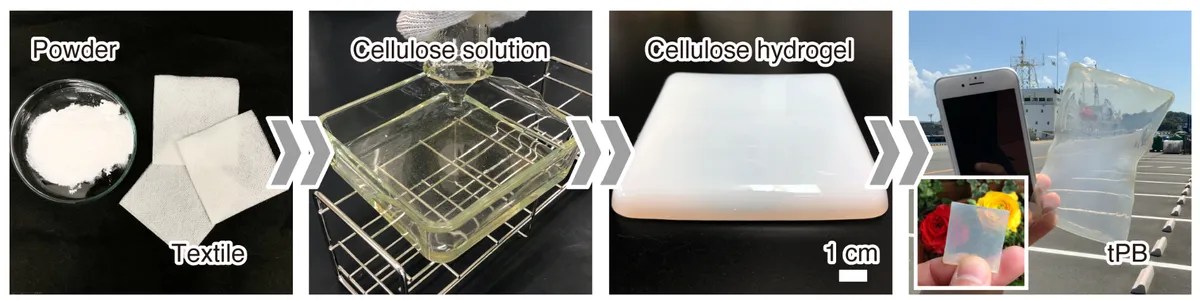
Thus the product that they have created – known as transparent paperboard (tPB) – has been proven to fully disintegrate even in the most challenging of aquatic conditions in under a year.
But if this is the case, would it still be effective in holding liquids? Well, as the researchers explain, the transparent paperboard (which, like paper, is made of cellulose from plants) is capable of carrying boiling water for hours without leaking:
“The tPB is made entirely of pristine cellulose and compositionally identical to paper. A cup-shaped tPB can hold just-boiled water without an internal film coating because of its high wet tensile properties and anisotropic thermal properties.”
And with a thin coating, this transparent material can hold all kinds of liquids for even longer.
Isobe et al/Science Advances
The real cherry on top of their sustainable product is the fact that the product not only breaks down into harmless molecules in water, but that it is fully recyclable too:
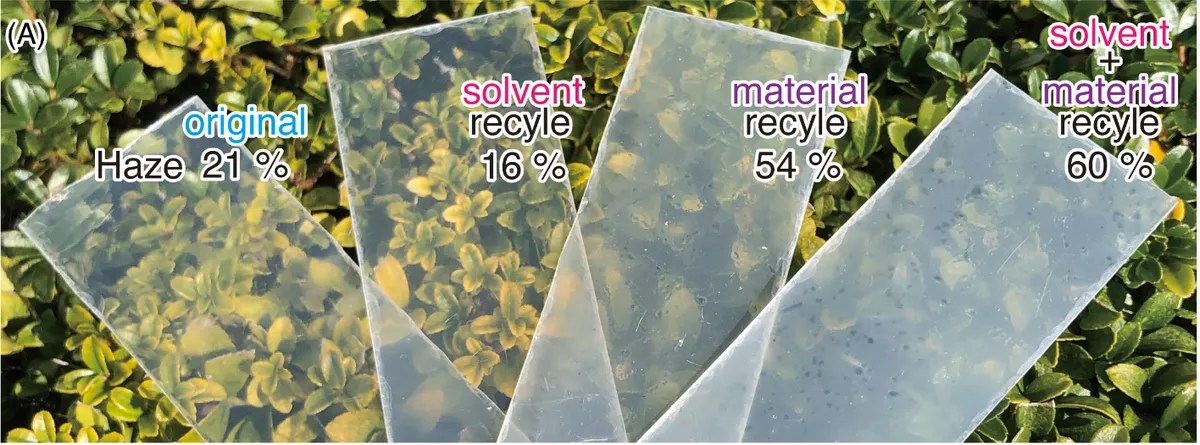
“The spent tPB is material recyclable in a closed system, where all chemicals and water are also recyclable. Furthermore, the marine biodegradability of tPB across shallow to abyssal depths is confirmed by on-site degradation tests and metagenomic analyses. Hence, tPB is expected to serve as a key fully circular commodity material in sustainable societies of the future.”
There is one small downside to the recycling of tPB, and that is that the recycled material is a little less transparent that its predecessor.
But in a world in which our climate and all of our most vital ecosystems are at risk, is fully clear packaging really a priority?
Thanks to the hard work of this team, for whom further testing is underway, we might be a whole lot closer to being free from single-use plastics forever.
The good news in this story is that there is more work being done to eliminate single use plastics. Today’s John Ku looks forward to the day when single use plastics are a thing of the past. I hope you have a beautiful weekend.
Single Use by John W. Howell ©2025
Imagine the sea,
With no plastic any where . . .
Healthy is the norm.


This is excellent news, John, let’s hope they’re used commercially soon, along with other alternatives to plastic 👍
LikeLiked by 1 person
I agree, Chris. The sooner the better. Thanks for the comment. 😀
LikeLiked by 1 person
It’s a start. Now – can we talk other companies to switch over to this product?
LikeLiked by 1 person
That will be the hard part. Thanks, GP.
LikeLiked by 1 person
A very encouraging development!
LikeLiked by 1 person
Yes ,it is. Thanks, Liz.
LikeLiked by 1 person
You’re welcome, John.
LikeLiked by 1 person
😊
LikeLiked by 1 person
This is awesome. Maybe they can line paper cups with it so they can still get their logos on there, or write “John” on your fancy coffee.
LikeLiked by 1 person
I wonder if it melts in the heat?
LikeLiked by 1 person
Don’t know.
LikeLiked by 1 person
I think it was a rhetorical question.
LikeLike
This is great, since the people who toss garbage into the water can’t be stopped.
LikeLiked by 1 person
Whole cities toss garbage into the water too.
LikeLiked by 1 person
Wow! They should all be spanked.
LikeLiked by 1 person
Yes, they should. In a recent report, Ocean Conservancy claims that China, Indonesia, the Philippines, Thailand, and Vietnam are spewing out as much as 60 percent of the plastic waste that enters the world’s seas.
LikeLiked by 1 person
Love this idea! Clear packaging isn’t a priority for me.
LikeLiked by 1 person
It would be hard to give a gift in clear packaging.
LikeLike
I like that several of your Good News stories involve scientists working on alternatives to plastics. The material in today’s post sounds quite promising 🌞
LikeLiked by 1 person
Having lived on the Gulf and witnessed the horrors of plastics, I believe this is an issue that needs to be solved.
LikeLiked by 1 person
This gave me a real aha! moment. I hope it comes to fruition in my life time!
LikeLiked by 1 person
Me too. I would love to see single-use plastics go away.
LikeLiked by 1 person
This is wonderful news,. Thanks for sharing, John. This is great news! 💕
LikeLiked by 1 person
Yes, it is. I hope they hurry up and get it into production.
LikeLiked by 1 person
Most definitely! 👍
LikeLiked by 1 person
😊
LikeLike
Sounds great. Hope it catches on.
LikeLiked by 1 person
I do too.
LikeLike
You bring us hope again, John, that one day single use plastic will be a thing of the past.
LikeLiked by 1 person
Yes, I hope I see it. Thanks, Esther.
LikeLiked by 1 person
What an incredible development! Very hopeful. Thank you for this post, John. Like you, I “imagine the sea, with no plastic anywhere…” and dream of a healthy world. 🌞
LikeLiked by 1 person
I hope I can see it happen. Of course, if I don’t, I won’t be too upset either since it will not be a problem to me then. (Well, unless I come back as a crab.)
LikeLiked by 1 person
😄
LikeLiked by 1 person
😊
LikeLike
Outstanding — thanks for passing this good news along, John!
LikeLiked by 1 person
Always happy to do that, Debbie. 😊
LikeLiked by 1 person
Oh, I love that image of “…the sea/With no plastic any where…” This good news will help!
LikeLiked by 1 person
I love that image as well.
LikeLike
I am smiling!
LikeLiked by 1 person
Yes, indeed.
LikeLiked by 1 person
May it be so. To research and sustainability and caring for our environment and the WORLD.
LikeLiked by 1 person
I agree, Pamela. Let it be so.
LikeLiked by 1 person
Oh, yes! Just imagine!! This is so hopeful, John. Thank you for sharing!
LikeLiked by 1 person
I think it is hopeful, too. Thanks, Jan.
LikeLiked by 1 person
Wonderful share, John.
LikeLiked by 1 person
Thanks, Pat.
LikeLike
You’ve been finding a lot of great information on protecting the environment and reducing waste, John. This is another good one.
LikeLiked by 1 person
Thank you, Pete. These stories are important since they have real solutions to big issues.
LikeLiked by 1 person
Hooray! Just what we need 🙂 Thanks for sharing this, John.
LikeLiked by 1 person
My pleasure, Denise.
LikeLiked by 1 person
Exciting! Hope this makes it to the market soon.
LikeLiked by 1 person
I do too. At least while I’m still around. 😀
LikeLiked by 1 person
I second that! 😄 🤞🏻
LikeLiked by 1 person
Thank you. 😊
LikeLiked by 1 person
😊
LikeLike
👍👍
The Fab Four of Cley
🙂 🙂 🙂 🙂
LikeLiked by 1 person
I agree. Wishing you a lovely weekend, F4oC
LikeLiked by 1 person
Technology can’t begin to replace single use plastic quick enough. Glad to see there some who are thinking out of the box, John!
LikeLiked by 1 person
I agree, Monika. I hope they hurry.
LikeLiked by 1 person
What a great idea!
LikeLiked by 1 person
It is. 😀
LikeLiked by 1 person
I’m imagining!
It’s another step in the right direction. Yay!
The changes can’t come fast enough. We’ve already done enough damage that it will last … in terms of micro plastics, forever.
I used to buy this Chinese candy – White Rabbit
They were like a white caramel. They came wrapped in rice paper. You could just eat the paper if you didn’t want to unwrap it. Sometimes I’d let the paper melt on my tongue on its own.
I’ve often wondered why edible wrappings weren’t used for many products.
♳X ♴X
LikeLiked by 1 person
A good idea on edible wrappings. Sadly, you would have to wrap the wrap to keep it clean. I hope they can commercialize the clear plastic quickly. 🌎X
LikeLiked by 1 person
Or, depending what the food was, sell a bunch in a recyclable box.
Me too! The planet can’t wait.
🌏X 🌎X 🌍X
LikeLiked by 1 person
I agree. ⚡️X
LikeLike
This really is very exciting news, John. Thanks for sharing it here.
LikeLiked by 1 person
I agree, Robbie. Thanks
LikeLike
My pleasure
LikeLiked by 1 person
😊
LikeLike
These are great tidings for the ocean, and yes, that’s a pun. But it’s also the truth.
LikeLiked by 1 person
Love the pun. 😊
LikeLiked by 1 person
I didn’t want to make waves, but yes, loved your story. As per.
LikeLiked by 1 person
😀
LikeLiked by 1 person
A well needed invention. I hope it takes off globally. 🙂
LikeLike
I do too.
LikeLike
Sounds like a dream product but what does it break down into, I wonder, and are there any PFAS or polyvinyl alcohol used in the processing. Thanks for sharing this, John.
LikeLiked by 1 person
Good questions, Pam that will require some hunting for the answers since I have no idea.
LikeLiked by 1 person
🙏
LikeLiked by 1 person
😊
LikeLiked by 1 person
Thanks for the share.
LikeLike