
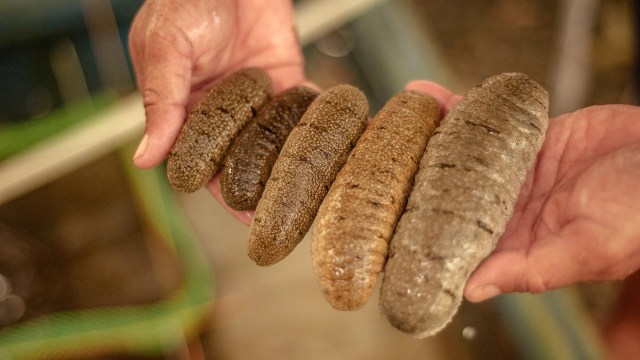
Photo by Maria Louella Tinio
Today’s good news comes from the BBC and was sent to me by Noelle Granger. The following is a condensed version of the article. You can see the full article HERE.
‘We’ve raised thousands’: The pickle-shaped ‘janitors’ cleaning Filipino reefs
Sea cucumbers, or ‘janitors of the sea’, scour and clean the seafloor, allowing other animals to thrive. In the Philippines, a group of women stand guard to help them multiply.
Aweng Caasi, a 61-year-old widow, often sits for hours in a wooden hut towering over waist-deep waters in Bolinao, a small town some 300km (190 miles) north of the Philippines’ capital of Manila.
The hut serves as a guard post for fisherfolk protecting a sea ranch filled with sea cucumbers. These unique-looking bulbous brownish-green animals have taken them years to raise.
Caasi’s late husband, Ka Artem, was the leader of the fisherfolk group in the village of Barangay Victory in Bolinao that worked with scientists to build the ranch almost two decades ago. They hoped to replenish the supplies of these pickle-like creatures, which once swarmed these waters. Today, Caasi carries on this legacy.
When Caasi was still in her teens, the Philippines was the top producer of wild sea cucumbers – between 1985 and 1993, it exported some 3,000 to 4,000 tonnes. But overexploitation and overfishing led to a sharp decline in stocks. In the 1980s, fisherfolk in Bolinao and its neighbouring island town, Anda, were collecting up to 100kg (220lb) of sea cucumbers per person per day. The daily per-person catch plummeted to just 25kg (55lb) a decade later, and by 2002, to a measly 2.55kg (5.6lb).
The waters around Caasi’s home, once crowded with the cucumbers, had become barren.
Apart from their economic value, sea cucumbers provide benefits for the environment. Commonly referred to as the janitors of the sea, they clean sediments in the seafloor by eating bacteria and decaying organic matter, and recycle nutrients that benefit ecosystems. Their presence has even recently been found to suppress diseases among corals. Bolinao and its neighbouring towns are known for their rich marine life, which includes a 200 sq km (77 sq mile) coral reef area that provides benefits to residents through shoreline protection, fisheries, aquaculture, and tourism.
Annette Meñez, a marine invertebrate ecologist at the University of the Philippines Marine Science Institute (UPMSI), reached out to the Bolinao fishing communities in the early 2000s to ask if they would like to try co-designing a system to restore the town’s sea cucumbers. Meñez has been researching marine invertebrates with UPMSI since the 1980s, including how to help Bolinao’s fishing communities replenish their stocks of sea urchins and giant clams. She also now co-chairs the sea cucumber specialist group of the International Union for Conservation for Nature’s Species Survival Commission.
The university ventured into sea cucumber conservation when it observed the cucumber population shrinking. Meñez says the fishers back then would harvest small sea cucumbers before they were mature enough to reproduce.
In July 2009, less than two years after the first juveniles were sent out in December 2007, the Bolinao farms recorded significant boosts in sea cucumber stocks. Over 19 months, the population had jumped from around 400 to more than 5,500 individual sea cucumbers. The number of reproductively mature adults also climbed from 37 per hectare seven months after the release, to 249 after 19 months, due to mass spawning. As of the latest record in 2024, the ranch has a density of 4,415 sea cucumbers or 883 individuals per hectare, according to UPMSI.
As well as observing an increase in sea cucumbers, the farmers saw a rise in the presence of other animals. Gemma Candelario and Marivic Carolino, who raise mangroves in a neighbouring village, started monitoring and guarding cucumbers in their area in 2022. Within two years, they say, they noticed more species of sea cucumbers and fish arriving.
“The sea cucumbers would eat waste [cleaning the ecosystem] so that’s why more fish would appear,” says Candelario. “Some fish would lay eggs in our mangroves, and other animals would appear, such as crabs and shrimp… So this is a big help for us fisherfolk.”
The researchers from all the sea cucumber farms emphasise that the social impact on the communities was their most valuable milestone. “For me, resilience is not just resilience of ecosystems,” says Meñez. “It has to be the resilience of the coastal communities and the ecosystems they depend on.”
The good news in this story is that the Sea cucumbers are making a comeback with the help of concerned humans. Today’s JohnKu discusses humans’ role in helping the environment. I hope you have a great weekend.
Help by John W. Howell © 2025
When nature struggles,
Humans need to get involved . . .
And help Mother work.























 Fiction Favorites
I love reading articles like this, John 🤗
LikeLiked by 2 people
I do too, Robbie. 😊
LikeLiked by 1 person
It is fantastic when people take responsibility for correcting and maintaining a proper ecosystem. They deserve a sincere BRAVO!
LikeLiked by 2 people
Yes, they do. Thanks, GP 😊
LikeLiked by 1 person
Dear John
What a success. We are impressed.
They look like sausages.
The Fab Four of Cley
🙂 🙂 🙂 🙂
LikeLiked by 2 people
They are ugly little things, but necessary. Thanks, Klausbernd. Wishing the F4oC a happy weekend.
LikeLiked by 1 person
I’ve never heard of sea cucumbers but wow, they do some work don’t they? And it’s yet further proof that nature can take care of itself.
LikeLiked by 2 people
If left alone, Nature would do the job. Thanks, Pilgrim.
LikeLiked by 1 person
You got that right.
LikeLiked by 2 people
😊
LikeLiked by 2 people
Of course, nature had the answer all along! Good to see humans helping not hindering nature’s work.
LikeLiked by 2 people
That is a good thing, Liz. Thanks.
LikeLiked by 1 person
You’re welcome, John.
LikeLiked by 2 people
😊
LikeLiked by 2 people
This is really impressive. I never knew they had some commercial value, but it awesome that someone recognized the problem.
LikeLiked by 2 people
I agree. I didn’t know about the value either.
LikeLiked by 1 person
Yes, we DO need to get involved to help the survival of species like this one. They aren’t blessed with cute looks, but they do a lot of good!
LikeLiked by 2 people
So true, Noelle. Thanks for sending the article.
LikeLike
You’re welcome!
LikeLiked by 2 people
😊
LikeLike
Brilliant and so hopeful! Thank you, John, for sharing this ingenious endeavor. And…your JohnKu is right on! We all need to help Mother work. 🌞
LikeLiked by 2 people
Thank you, Gwen. So true on helping mother. 😀
LikeLike
This is good news, John, and educational for me.
LikeLiked by 2 people
So glad, Tim. Thanks for letting me know.
LikeLiked by 1 person
Very cool! I’m so glad they’re making a difference and are so dedicated to helping the sea cucumbers and the sea.
LikeLiked by 2 people
I agree, Deborah.
LikeLike
When I saw the photo, I was intrigued to know more. Fascinating, John.
LikeLiked by 2 people
Thanks, Esther.
LikeLiked by 1 person
Thought those were sausages. Kind of glad I was wrong because it was cool.
LikeLiked by 1 person
Great story. I like to hear that local efforts have brought back the sea cucumbers and therefore biodiversity of fish. Sounds like they are a keystone species. : )
LikeLiked by 2 people
They seem to be. A lot of good happens when they are plentiful.
LikeLiked by 1 person
When I first saw the picture, I had no idea what they were. I’ve heard of sea cucumbers but didn’t know how they benefitted oceans. This is amazing news!
LikeLiked by 2 people
Thank you, Teri. I agree with you.
LikeLike
This doesn’t sound like a job I’d particularly enjoy, but I can sure appreciate the ones who are doing it. Ugly critters, aren’t they? But as they say, no job is finished until the clean-up crew does its thing. Thanks for telling us about it, John!
LikeLiked by 2 people
They are ugly for sure, but very necessary.
LikeLiked by 1 person
Restores my faith in humans & nature ❤
LikeLiked by 2 people
Mine too. Thanks, Annette.
LikeLiked by 1 person
Your “Help” sums up the article. I have hear of sea pickles but didn’t know how useful they were. They don’t look glamorous but do look ready to work. I have learned something new about the creatures of the sea;
LikeLiked by 2 people
I’m glad you found it interesting, Jo. 😀
LikeLike
Your JohnKu is perfect.
LikeLiked by 2 people
AW, Thank you, Jennie.
LikeLiked by 1 person
You’re welcome! 😀
LikeLiked by 1 person
😊
LikeLiked by 2 people
Whoa…that’s pretty cool. I wonder how good they’d be with dust bunnies. LOL Thanks for sharing, John.
LikeLiked by 2 people
That is pretty funny, Monika. 😀
LikeLiked by 1 person
Yes, as the Johnku advises human’s need to get involved.
Humans are not the only cause of problems that need fixing, just mostly we are.
We never learn.
“Don’t it always seem to go, you don’t know what you’ve got ’til it’s gone” – Joni Mitchell.
Long live the sea cucumbers!
O🥒 O🥒 O🥒 O🥒
LikeLiked by 2 people
I like that idea too, Resa. O🥒 O🥒 O🥒 O🥒
LikeLiked by 2 people
The cucumbers have it!
🏆 O🥒 🏆
LikeLiked by 2 people
YAY. 😀
LikeLiked by 1 person
A labor of love. 🙂
LikeLiked by 2 people
Yup.
LikeLiked by 1 person