
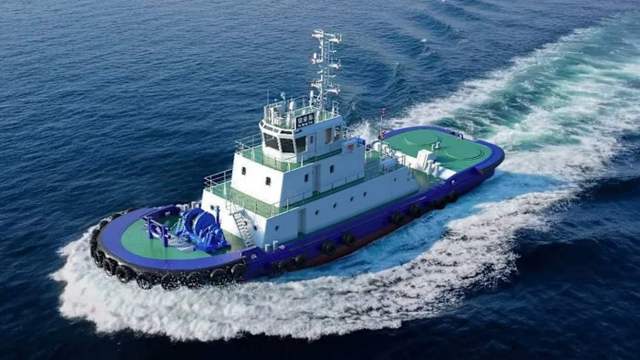
A rendering of a fully-electrified Chinese vessel at the port of Suzhou – credit CATL ©
World’s Largest Battery Maker to ‘Spare No Effort’ in Electrifying Marine Cargo Industry
Today’s good news comes from the Good News Network
A Chinese conglomerate that controls 37% of the global market for EV batteries has recently said it will “spare no effort” to electrify parts of the marine shipping industry.
The cost of lithium ions has fallen by 90% over the past two decades, epitomizing the overall reductions in battery costs that have facilitated the resulting boom in EVs.
In all that, however, little has been done to investigate the use of battery-powered maritime systems. It’s for good reason: batteries produce lower-density energy than the heavy fuels used to power container ships or tugboats. Displacing water requires a lot more umph than displacing air.
Now, CATL, which also controls some 22% of the world’s energy storage systems, is planning to double its maritime applications division to pioneer early battery systems for near-shore vessels.
“We will spare no effort in investing in R&D, human resources, and materials to build the supply chain for this industry,” said Su Yi, who leads the group’s Maritime Business Unit.
The International Maritime Organization aims to halve the industry’s share of global shipping emissions to 1.5% from 3% by 2050, a goal that has so far been pursued through greener fuels such as green methanol and hydrogen.
In 2024, GNN reported that a consortium of Japanese firms successfully demonstrated the first-ever zero-emissions ship above 20 gross tons, with the pilot sailing it 30 kilometers (18 miles) out to an offshore wind farm and back.
A year earlier, GNN reported that global shipping leader Maersk had ordered a green methanol-powered ship two years earlier and had already placed an order for 25 more methanol-powered vessels, in addition to retrofitting existing ships with methanol engines and turbines.
Su told the Financial Times that the current focus is on producing batteries that meet the extreme requirements of powering large vessels near shore. In addition to requiring maximum discharge rate, the batteries would need to last long and remain safe in ocean conditions.
CATL reported impressive 2025 earnings, with 42% year-over-year revenue growth to $10 billion, driven by demand for data centers and energy storage. Su didn’t provide timelines or sales targets, but merely mentioned that she and her team were confident there’d be market demand.
Its existing strategy since 2017 has been a battery-swap model whereby near-shore vessels like tugs can swap their batteries at a station for a fully-charged one to enable ’round-the-clock operations.
The group had previously seen success with such a model in its long-haul trucking division. Previously, the company developed hybrid battery-fossil fuel solutions for still-water and near-shore vessels, as well as for cruise ships.
The good news in this story is that more resources are being invested in alternative power sources for the maritime industry. Today’s JohnKu talks about ongoing solutions to the world’s carbon problem. I hope you have a wonderful weekend.
Pressure by John W. Howell © 2026
Alternative ways,
Are continuously being sought . . .
To help Mother Earth.























 Fiction Favorites
Sounds like a good project and solution for certain vessels that are coastal rather than deep sea.. Interesting to see how it develops..thanks John.. hugsx
LikeLiked by 1 person
It will be interesting to see. Thanks, Sally. 😊
LikeLiked by 1 person
I’m old enough to remember when electric powered ships were considered a possibility for ferry boats and not much else. It’s amazing what a . . . wait for it . . sea change there has been across the industry.
LikeLiked by 1 person
I’m old enough to remember bare light bulbs in garages and basements. Sea lotta changes. 😀
LikeLike
This is a very interesting story. Great to see these solutions being sought for.
LikeLiked by 1 person
I agree, Esther. Thank you.
LikeLike
Such an odd phrase. Spare no effort sounds like you’re not going to do anything.
LikeLike
Very interesting, John. I wonder how things will go for the conversion to electric ships. We didn’t test electric engines in the engine laboratory I worked in but did test hybrid engines. I was very impressed with the hybrid engines, which used less gasoline.
LikeLike