
Today’s good news story comes from The Pulse and was sent to me by Noelle Granger.
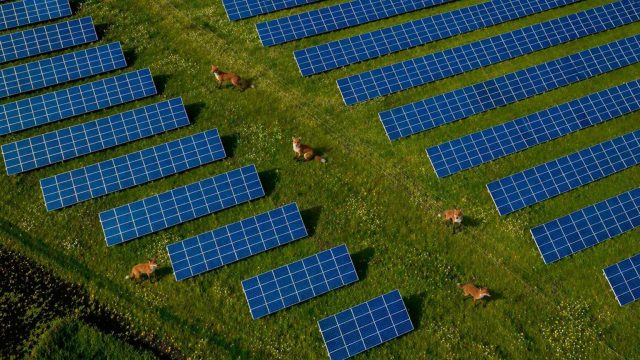
Foxes were allowed into a solar farm, and they ended up turning the panels into part of their habitat

It wasn’t part of the plan.
Solar farms were built to generate clean energy, not to host wildlife. Large, fenced-off areas filled with panels don’t exactly look like a natural habitat.
But when a small, endangered fox was allowed into one of these sites, something unexpected happened.
Instead of struggling to survive, it adapted—quickly. And what researchers saw next began to change how these spaces are understood.
How solar farms started behaving like ecosystems
At first glance, solar farms seem simple. Rows of panels. Open land. Minimal human presence. But that last detail turned out to matter more than expected. Because once construction ends, these areas become relatively undisturbed. No heavy traffic. No constant noise. Limited human activity.
Over time, that creates stability. Vegetation begins to grow beneath the panels, often encouraged by design. Native plants take hold, insects follow, and small prey species begin to appear. It doesn’t happen overnight.
But slowly, these sites begin to resemble something else. Not just infrastructure—but a habitat. And for some species, that shift is enough to create an opportunity.
A species on the edge finds an unlikely refuge.
The San Joaquin kit fox has been struggling for decades. Native to California’s Central Valley, this small canid has lost more than 95% of its natural habitat due to agriculture and development. Survival has become increasingly difficult. It relies on space, cover, and access to prey. And it moves constantly, often using dozens of dens to avoid predators.
So when conservationists began exploring whether solar farms could support wildlife, the idea seemed uncertain. Could a human-made environment really replace what had been lost? The only way to know was to try. And when the foxes entered these sites, their behavior was closely monitored.
What researchers found wasn’t hesitation. It was an adaptation.
What actually happened inside the solar farms
The foxes didn’t just pass through these areas. They started using them. Solar farms provided something rare: protection and resources in the same place. The perimeter fencing, originally designed to secure the site, acted as a barrier against larger predators. Inside, the environment was rich with small animals—rodents and insects that thrive under the panels. That meant food was readily available.
The panels themselves created shade, helping regulate ground temperature and making conditions more stable during extreme heat. And perhaps most importantly, human disturbance was minimal. The foxes began establishing dens within the solar farms, using the land as part of their regular territory.
In some cases, according to the Bren School of Environmental Science & Management, they returned repeatedly, treating these sites as reliable habitat. What was meant to be an energy facility had become something more.
Why this changes how we think about how energy and wildlife interact
For years, one of the biggest concerns about renewable energy projects has been land use. Building large-scale solar farms requires space—and that space often overlaps with natural habitats. But this example suggests a different possibility. With the right design and management, these sites don’t have to displace wildlife. They can support it. That doesn’t mean every solar farm will have the same effect. Conditions matter. Location matters. Planning matters. But the success of the San Joaquin kit fox shows that coexistence is possible. And in some cases, it may offer a second chance for species that are running out of options.
The idea is still evolving.
But one thing is becoming clear. What looks like a field of solar panels from the outside might be something very different on the inside—a place where technology and nature are starting to share the same ground.
The good news in this story is that conservation of resources does not have to come at the expense of native species. Today’s JohnKu talks about smart conservation. I hope you have a wonderful weekend.
Co-Existance by John W. Howell © 2026,
Clean energy has,
Risks to the animal world . . .
That can be reduced.























fabulous foxy fix!
LikeLiked by 1 person
Thank you, Annette.
LikeLiked by 1 person
Clever foxes. That photo makes me happy knowing they’re protected and have found a new home. Happy Friday, John!
LikeLiked by 1 person
Thank you, Teri. I certainly agree.
LikeLiked by 1 person
human disturbance was minimal. Fantastic win for the foxes.
LikeLiked by 1 person
It is fantastic. Thanks, Lois. 😊
LikeLiked by 1 person
This is a great good news story John and good to know that progress does not have to come at the expense of wildlife… hugsx
LikeLiked by 1 person
When I think of all the birds sacrificed for wind power, I love this solution more.
LikeLiked by 1 person
Absolutely John… hugsx
LikeLiked by 1 person
Foxes are amazingly adaptable and I’m so happy to see this!
LikeLiked by 1 person
I enjoyed it, Too. Thanks for sharing it, Noelle.
LikeLiked by 1 person
That was really interesting. The more I read about foxes, the more convinced I am of their intellect.
LikeLiked by 1 person
They are amazing animals. We have one in our neighborhood, and he is beautiful. Thanks, Jacqui.
LikeLiked by 1 person
WOW! I actually felt excited as I read this.
LikeLiked by 1 person
Thank you, Liz. I did, too.
LikeLike
Oh, I love this post, John. What hope! Thank you for sharing it with us. 🌞
LikeLiked by 1 person
It does bring a warm feeling of hope, Gwen. Wishing you a lovely weekend.
LikeLiked by 1 person
The foxes being in the solar farm is very interesting, John. It looks like the panels are a good place for them to view the area from. I suppose they don’t do any damage to the panels.
LikeLiked by 1 person
No their was no mention of them bothering the panels. Thanks, Tim
LikeLiked by 1 person
😊
LikeLiked by 1 person
Fascinating.
LikeLiked by 1 person
Very. Thanks, Joy.
LikeLike
A great side effect. Wonder if the solar farms near me will be used like this too.
LikeLiked by 2 people
Now this? This is how humans can do both good for humans and wildlife. This is fantastic, John. Perfect JohnKu, too!
LikeLiked by 1 person
Thank you, Dale. I so agree.
LikeLiked by 1 person
This is encouraging. To realize that solar farms can be much more than an “eyesore” — that they can actually save a species — is great news. Thanks, John, for sharing it!
LikeLiked by 1 person
I agree, Debby. Also, these methods don’t kill birds like wind farms do.
LikeLiked by 1 person
Fantastic! I love that the solar farm became a sanctuary.
LikeLiked by 1 person
Me too.. Seems like a better way to create electricity than wind farms
LikeLiked by 1 person
Places like this could help restore endangered species’ populations.
LikeLiked by 1 person
And keep the lights on at the same time. Thanks, Pete.
LikeLiked by 1 person
This win for the foxes makes me practically giddy with excitement. LOVE that the technology is helping in two ways-providing solar energy and providing a safe habitat for the foxes. Thanks for sharing, John. This made my day!
LikeLiked by 1 person
I’m so glad, Monika. It is a terrific way to meet energy needs and improve wildlife conditions.😀
LikeLiked by 1 person
Solar panels improving the life of foxes and other wildlife is certainly a nice bonus. This is a great story.
LikeLiked by 1 person
It is. Thank you, Thomas.
LikeLiked by 1 person
This is amazing! You would never think it. It just shows how animals and nature adapt. Thanks for the good news story, John.
LikeLiked by 1 person
Thanks for reading, Esther. I enjoyed the story, too.
LikeLiked by 1 person
That’s cool. Way to go, little foxes.
LikeLiked by 1 person
They are very smart. Next, they’ll be calling DoorDash.
LikeLiked by 1 person
Lol!
LikeLiked by 1 person
I appreciate your Friday posts, as you know, and found this one fascinating and encouraging. Isn’t nature incredible! Finding a path to survival, whenever possible. Thank you for the good news, John and a lovely weekend to you.
“this example suggests a different possibility” ✨
LikeLiked by 1 person
Thank you, Michelle. 😊
LikeLiked by 1 person
😊
LikeLiked by 1 person
I like this idea.
LikeLiked by 1 person
Me too. 😀
LikeLiked by 1 person
Clean energy is the way to go. There’s not much planet left to dirty.
Love this story. It does show us we can have a symbiotic relationship with nature, as we advance through tech.
Thanks for the cool JohnKu!
🦊𝓧 🦊𝓧 🦊𝓧
LikeLiked by 1 person
“Not much planet left to dirty.” Love that.
😀X😀x😀X😀X
LikeLiked by 1 person
Sigh! 😀X😀x😀X😀X
LikeLiked by 1 person
🙄X
LikeLiked by 1 person
That is such a cool story. How come David Muir doesn’t find things like this?
LikeLiked by 1 person
Hard knowing. Eternity is a busy place. 😁
LikeLiked by 1 person
This is such good news, John.
LikeLiked by 1 person
Thank you, Robbie. 😊 I agree
LikeLike
Love it
Go foxes.🦊🦊🦊
LikeLiked by 1 person
Smart little buggers.
LikeLiked by 1 person
I thought I commented on this story already but I probably forgot. Anyway, what I basically said was that nature ALWAYS finds its way. We just have to give nature some elbow room is all.
LikeLiked by 1 person
Great comment worth repeating
LikeLiked by 1 person
Sis Boom Bah!
LikeLiked by 1 person
😀
LikeLiked by 1 person
Worth repeating. 😀
LikeLiked by 1 person
Indeed
LikeLiked by 1 person
Foxes are right! The Earth is for everybody. Thank you for the news, dear John!🍤🍤🍤🍻
LikeLiked by 1 person
Always, Maria. 😀
LikeLiked by 1 person