
Today’s story comes from the Times of India and was sent to me by Reporter-at-large Noelle Granger. Thanks Noelle
Meet Roy Kim, the 13-year-old Oregon student who designed a chamber that turns moisture in the air into water for drought-hit farms.

“Do what you can do tomorrow, today,” says Roy Kim, a 13-year-old Oregon student who has solved the water crisis for numerous farmers in the region. The teenager developed a device that turns moisture in the air into water, helping farmers access a sustainable and reliable water source in drought-prone areas, according to a report by Young Scientist Lab. As global warming continues, farming becomes increasingly difficult for farmers who rely on water to irrigate their crops. Most of the time, they rely on sources such as groundwater, surface water, and rainfall for this, but over the years, these sources can become depleted. This is why Kim created a device that uses the Peltier Module to turn moisture present in the air into water.
Understanding the module
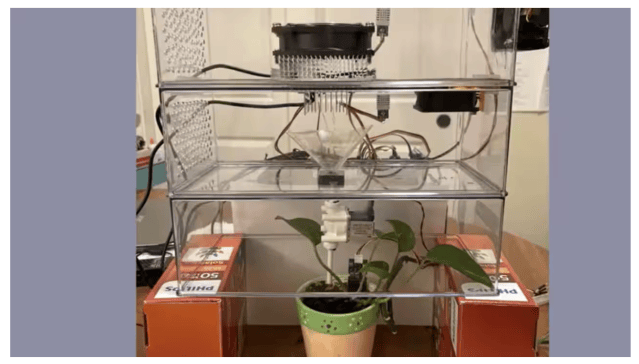
Kim created a device that uses the Peltier Module to turn moisture present in the air into water.
According to Kim, a Peltier module creates a temperature difference when electricity is applied, making one side hot and the other side cold. “This allows warm air to cool rapidly when it reaches the cold surface, causing water vapor in the air to condense into liquid drops,” he explained. After multiple tests and improvements, Kim finalized the device’s design. The air enters the chamber through the hot side, where a heating element connected to a filter module warms it. The warm air then moves through the fan to the cold side. Water droplets formed here sink due to the temperature difference between the surface and the air.
The collected water then flows into a funnel and is distributed to the plants through a valve. To ensure the plants get the right amount of water, not too much, a soil moisture sensor is placed in the soil to determine when the plants need water. “In addition, temperature and humidity sensors monitor the environment, and if conditions become too extreme, they automatically adjust the airflow to maintain efficient water production,” said Kim. After testing, the device produced 10ml of water in two hours. Its highest efficiency was 135.8 g per kilowatt-hour. “Through this project, I didn’t just create water. I combined natural processes with engineering to develop a sustainable solution for farming,” he added.
Entering competition
Roy Kim, a student of Whitford Middle School in Beaverton, Oregon, entered the 3M Young Scientist Challenge, an annual top middle school science competition in the US run by 3M and Discovery Education, which challenges students in grades 5 to 8 to use problem-solving and innovation to fix everyday issues. When asked about why he wanted to enter the challenge, Kim said, “I entered the 3M Young Scientist Challenge because I wanted to showcase my invention to people around the world. If more people are aware of this problem and the potential solution, the problem might be able to de-escalate.”According to the US Department of Agriculture, between 2010 and 2020, agriculture was a major user of ground and surface water in the US, with irrigation accounting for 47% of the nation’s total freshwater withdrawals. Approximately 212,714 farms in the country depend on natural water sources for irrigation. But with Kim’s invention, the number can be decreased gradually. 15 years from now, he hopes to develop even more such solutions, as he wants to become a successful engineer who solves pressing problems across the globe, specializing in environmental engineering. He is currently among the top 10 national finalists in the challenge. The final event and winner announcement will take place on October 12-13, 2026.
The good news in this story is that an intelligent person converted known technology into a practical solution for water conservation. Today’s JohnKu talks about finding solutions. I hope you have a beautiful Weekend.
Answers by John W. Howell © 2026
When you need answers,
Investigate already knowns . . .
They may surprise you.























Seems like such an obvious device to invent.
LikeLiked by 1 person
I thought the same thing. Takes a kid, I guess.
LikeLike
How brilliant and if he can achieve this at 13 goodness knows how far he will go… thanks for sharing John and Noelle..hugsx
LikeLiked by 1 person
Thank you, Sally. 😊
LikeLike
I agree with Sally. Having figured this out at the age of 13? He’s likely to solve even more of the world’s problems.
LikeLike