

with John W. Howell


Waking with a pent-up demand for caffeine, a surprising pant left my chest. At first, it was in reaction to the machine’s slowness to wake. My brain immediately began searching for a plan B should a punt away from our beloved coffee maker be necessary. To my relief, a button punch delivered a whole pint of the steaming stuff. Maybe too much for a sitting, but certainly enough to take on the road. Some other refreshments would be necessary. A hunk of “Pont l’Évêque cheese and a baguette should do.
The clock is set for June 6th, 1925. The location is Highland Park, Michigan. The duration is an hour. We find ourselves standing in front of the Maxwell Motor Company building when the plunger is pulled. Walter Chrysler, an employee, is on the steps announcing to the press that, through a reorganization, Maxwell is now the Chrysler Corporation, headed by Walter Chrysler. He outlines plans to produce cars that people want to buy. Walter Chrysler had come to the Maxwell Motor Company in the 20s with the mandate to turn the company around. He introduced the Chrysler automobile in 1924, which featured many improvements, and the company was renamed. The questions from the press begin, and our alarm sends us back to the couch where the cheese waits.
There is a text from Linda Hill. It reads. Your Friday prompt for Stream of Consciousness Saturday is “pant/pent/pint/pont/punt.” Use one, use ’em all, any way you’d like. Bonus points if you use more than one. Enjoy!
To see what others have done with the prompt, visit Linda’s post. Here is the link. https://lindaghill.com/2025/06/06/the-friday-reminder-and-prompt-for-socs-june-7-2025/
“Pant/Pent/Pint/Pont/Punt” by John W. Howell © 2025
“That must have been fun being there at the founding of Chrysler Corporation.”
“There was a lot of excitement, too.”
“Were the employees happy?”
“I think most saw the handwriting on the wall since the Maxwell wasn’t selling well and were glad Walter was taking over.”
“You mentioned innovations in that 1924 Chrysler.”
“A carburetor air filter, high compression engine, full pressure lubrication, and an oil filter.”
“Anything else?”
“Well, they developed hydraulic brakes later, a real innovation. It took less pedal pressure to stop the car over shorter distances.”
“Innovation is a wonderful thing. Speaking of innovation.”
“Just order the Uber.”
“I did. It’s over there.”


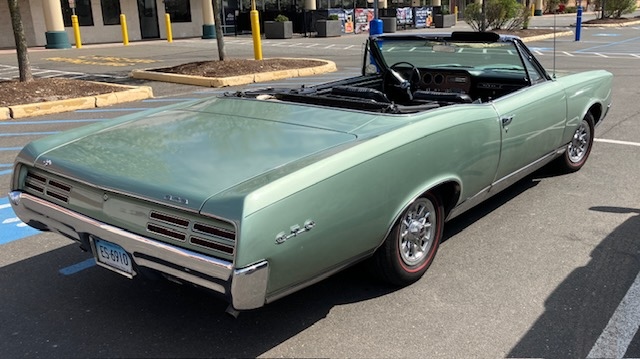
“That is a 1967 Pontiac GTO convertible. Now we’re talking.”
” Yes, we could get used to that kind of machine.”
“Just one thing though.”
“There is always a thing.”
“We have to go with the driver to the drag strip.”
“Huh?”
“Yeah, this is one of those three carburetor jobs with a six-liter engine. The owner has entered it in a drag race.”
“Do we need to be in the car during the race?”
“No, we can watch. They have Voo Doo Rangers at the track.”
“Why didn’t you lead with that? Let’s go.”

Today’s good news story comes from Twisted Sifter and was sent to me by Noelle Granger.
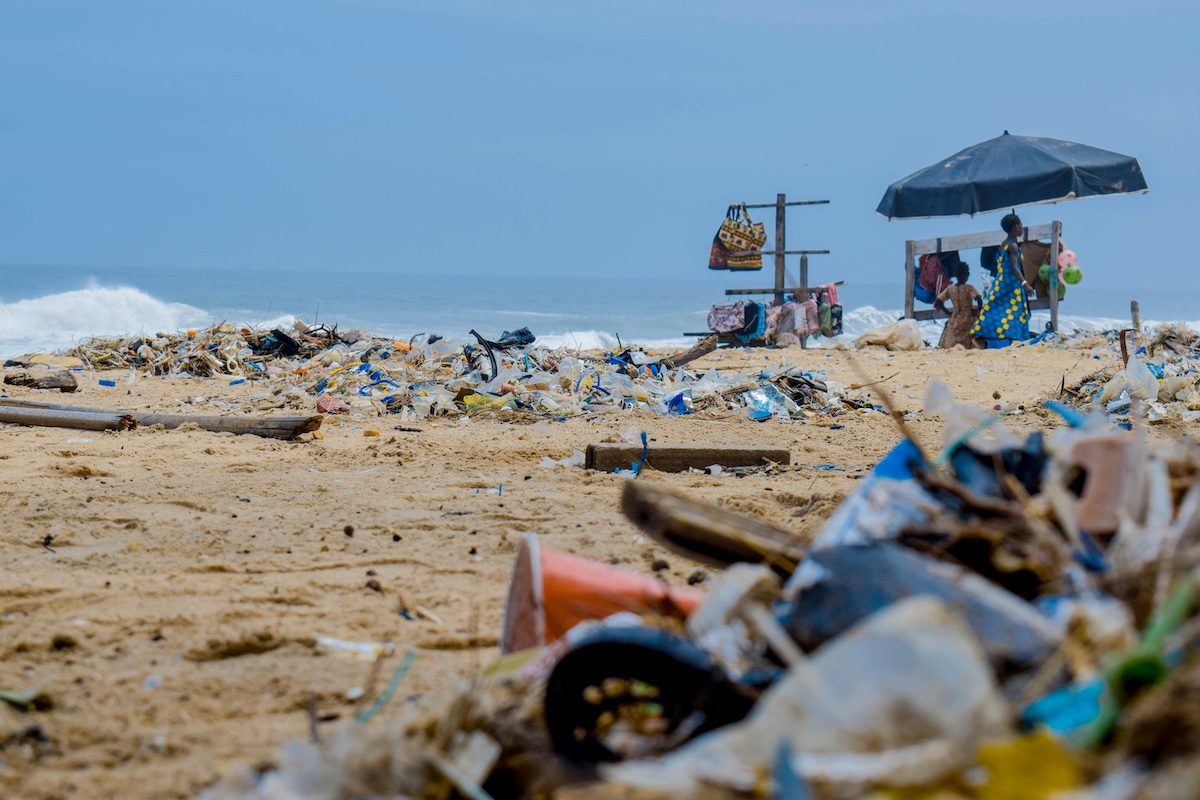
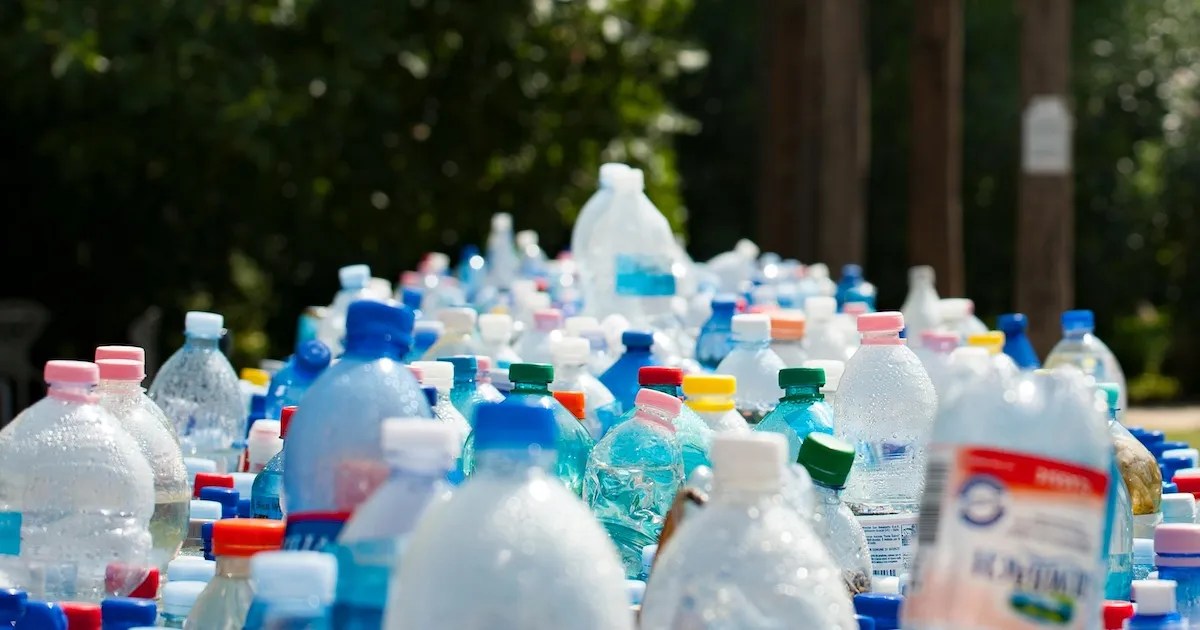
Anyone who has had their heart broken by images of dolphins or sea turtles struggling or even dying because they got tangled up in plastic waste will know exactly why single-use plastics are hated.
Not only are these materials wasteful, they are also highly polluting and difficult to dispose of. If it ever does break down, it can take hundreds or even thousands of years, after which time microplastics still remain.
And what’s worse is the sheer volume of plastic that isn’t properly disposed of, meaning that it often drifts out in our waterways and ends up in our oceans.
It’s no wonder that 99% of the Great Pacific Garbage Patch is comprised of plastic.

Plenty of plastic alternatives have been rolled out, and that’s definitely a good thing.
From paper and cardboard packaging replacing the plastic that has proliferated our stores for decades, to refill stores selling loose items with the ability to fill your own containers, it’s great to see manufacturers and retailers doing their bit to help our planet and its valuable, vulnerable ecosystems.
But there are still some situations in which plastic is needed, for example where liquids are involved. And thus, researchers in Japan have been working on creating viable biodegradable alternatives to plastic in order to fill this gap in the market.
And according to their paper, which has been recently published in the journal Science Advances, they’ve had a breakthrough.
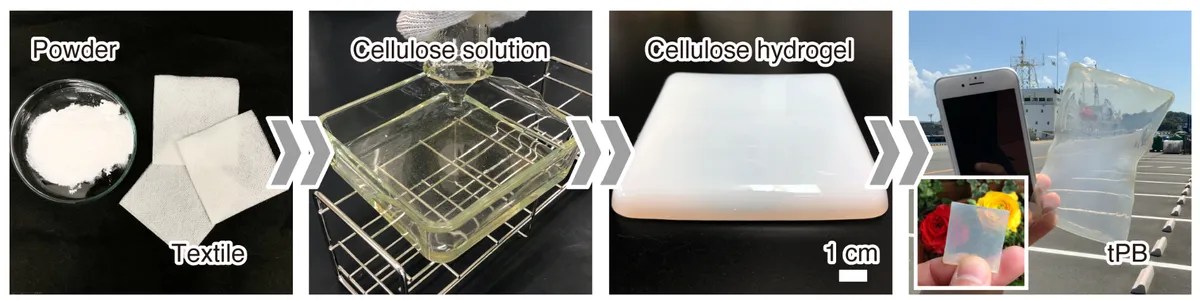
Isobe et al/Science Advances
When it came to the creation of their replacement plastic product, the team were driven by the acknowledgement that even with the best intentions, some waste items are still likely to end up in our oceans. As such, they explain in their paper, they created a material suitable for this:
“To mitigate marine pollution from single-use plastics, it is crucial to transition to next-generation commodity materials that are derived from biomass and are recyclable and marine biodegradable even at abyssal depths in case of the accidental release to the ocean.”
Thus the product that they have created – known as transparent paperboard (tPB) – has been proven to fully disintegrate even in the most challenging of aquatic conditions in under a year.
But if this is the case, would it still be effective in holding liquids? Well, as the researchers explain, the transparent paperboard (which, like paper, is made of cellulose from plants) is capable of carrying boiling water for hours without leaking:
“The tPB is made entirely of pristine cellulose and compositionally identical to paper. A cup-shaped tPB can hold just-boiled water without an internal film coating because of its high wet tensile properties and anisotropic thermal properties.”
And with a thin coating, this transparent material can hold all kinds of liquids for even longer.
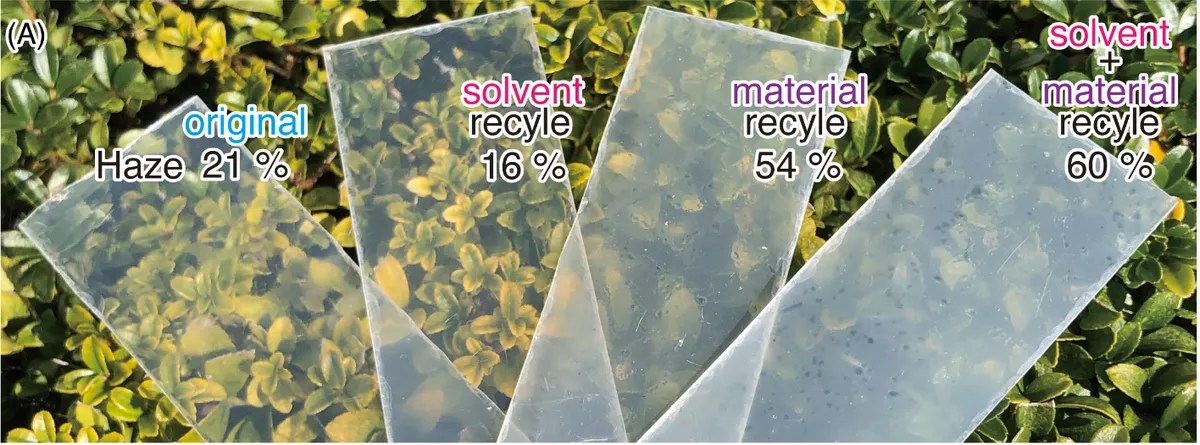
Isobe et al/Science Advances
The real cherry on top of their sustainable product is the fact that the product not only breaks down into harmless molecules in water, but that it is fully recyclable too:
“The spent tPB is material recyclable in a closed system, where all chemicals and water are also recyclable. Furthermore, the marine biodegradability of tPB across shallow to abyssal depths is confirmed by on-site degradation tests and metagenomic analyses. Hence, tPB is expected to serve as a key fully circular commodity material in sustainable societies of the future.”
There is one small downside to the recycling of tPB, and that is that the recycled material is a little less transparent that its predecessor.
But in a world in which our climate and all of our most vital ecosystems are at risk, is fully clear packaging really a priority?
Thanks to the hard work of this team, for whom further testing is underway, we might be a whole lot closer to being free from single-use plastics forever.
The good news in this story is that there is more work being done to eliminate single use plastics. Today’s John Ku looks forward to the day when single use plastics are a thing of the past. I hope you have a beautiful weekend.
Single Use by John W. Howell ©2025
Imagine the sea,
With no plastic any where . . .
Healthy is the norm.

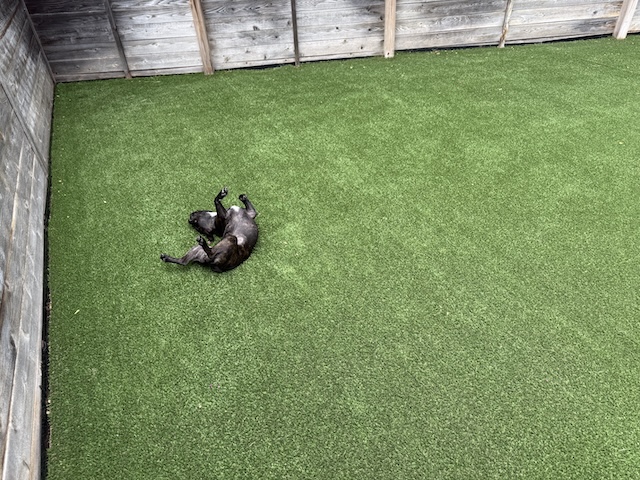
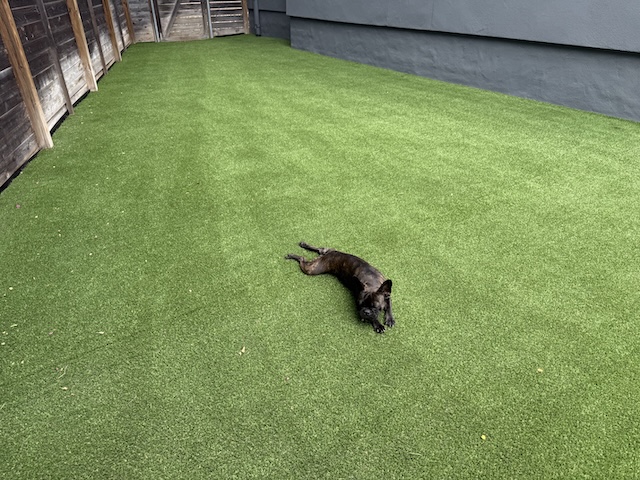
“Twiggy. Dad opened the yard. Want to go play?”
“Still pretty hot for me.”

“It isn’t even a hundred. What’s the problem?”
“No problem. I just like to go out when it’s cooler.”

“Well, okay. I’m going out to see what’s what.”

“Okay. I thought you and Mom were going to the plant store.”
“We are. But I have time.”

“This is a big place.”

“Feels good on the back.”

“I wonder if I can run the whole yard.”

“Or maybe lie around in the whole yard.”

Okay, Mom. I’m coming.

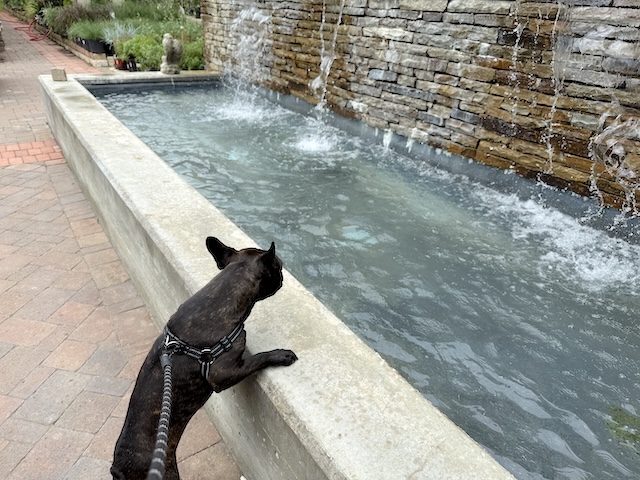
“This is a pretty waterfall. Do all plant stores have these?

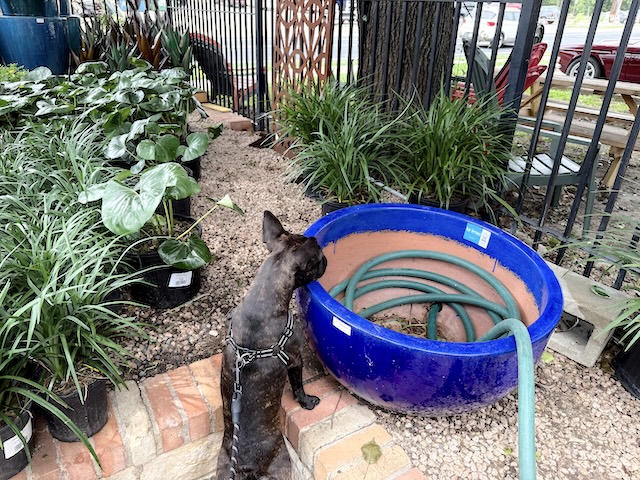
These smell good. I could see these in our yard.

Okay, this I understand. I’m not one for hoses.

“Well, how did it go?”
“The plant store was interesting, but it is good to be home.
“Yeah. Home is like that.

Today I opened My GRL to page 121 and with my eyes closed pointed to the page. My finger landed near the word margaritas. This is our prompt today.
Margaritas by John W. Howell © 2025
“You know if you drink too much of that, you might fall.”
“Yeah, but it tastes so good.”
“Me, I can’t get past the salt on the rim.”
“You have to brush it off.”
“And that lime juice can be a little sour.”
“Oh, come on. There is enough agave nectar in there to offset the lime.”
“Only if it is made right.”
“Well, I’ve been coming to this place a long time, and they make them right.”
“I like the orange hint.”
“That’s a full measure of orange liqueur talking.”
“The cocktails out on the patio aspect of this place is nice.”
“Yeah. Fresh air and margaritas. Can’t beat it. I could spend the rest of the day with this glass.”
“You know, we do have to get back to work.”
“Sadly, I suppose you’re right.”
“Oh, oh.”
“What?”
“That couple is coming over to their table.”
“Means we need to adios. You know how those women scream when they see a bee.”
“I do have a question.”
“Shoot.”
“Do you think the honey tastes like a margarita after we have had a few. sips.”
“Naw. More like orange blossom. Let’s take off before that guy swats us into oblivion.”

This list was published by Marie Ann Bailey and me in August 2013. It might be handy if you plan to visit an undeveloped country.
Top Ten Things Not To Do When Traveling Through the Countryside of An Underdeveloped Country
10. When traveling through the countryside of an underdeveloped country, do not forget to bring flip-flops or some such protection for your feet if you choose to stay at quaint inns. Often, you will find yourself in a long line of other travelers and locals waiting to use the single shower in the multi-story building. Besides standing in other people’s wet dirt, you may also encounter microscopic critters that tend to linger along the tiled floors and are happy to ride your feet back to your country of origin.
9. When traveling through the countryside of an underdeveloped country, do not forget to practice squats several times a day to build up your quadriceps to prepare you for the inevitable pit toilet located in the backyard of the local inn. Do not assume that you will always have the advantage of something to hang onto while you try to find that happy balance of getting your bum directly over the pit without getting it directly into the pit.
8. When traveling through the countryside of an underdeveloped country, do not forget to carry at least two rolls of toilet paper with you. One roll for the inevitable pit toilets that never have toilet paper anyway, and the other roll for when you do manage to find a private bathroom where you can spend the next several hours wishing you hadn’t drunk that tap water, even though you were outrageously thirsty at the time and nothing else was available.
7. When traveling through the countryside of an underdeveloped country, do not drink tap water (see #4). You may drink anything in a bottle, which means you may be drinking a lot of beer, leading us to the following item on the list.
6. When traveling through the countryside of an underdeveloped country, do not allow yourself to be over-served even if you are feeling only mildly inebriated at the time and dining on a full-course meal. Chances are, some amoebas are lingering on your plate (which was probably washed with tap water) or within the food, and you may eventually find yourself in the predicament of trying to balance your bum over a pit toilet while simultaneously trying not to throw up on your flip-flops.
5. When traveling through the countryside of an underdeveloped country, do not expect that everyone will speak English, and you will not have a need to know the local language. For example, learn to ask “Where is the bathroom?” If you’ve read this far into the list, you know why you need to know this.
4. When traveling through the countryside of an underdeveloped country, do not take a room in a hotel or inn directly across from a church. After a few days of church bell ringing to announce the time (6 AM, noon, 6 PM), funerals and weddings (often on the same day), you may wind up with a loss of hearing to rival Quasimodo.
3. When traveling through the countryside of an underdeveloped country, do not forget to also practice squats several times a day to prepare yourself for the strenuous hikes you may encounter, especially on rainy days when the landscape becomes wet and muddy. You do not want a team of local boys to have to push on your bum to get you up the steep hill that was supposedly a shortcut to the inn where you’re staying.
2. When traveling through the countryside of an underdeveloped country, avoid spending the evening with a U.S. expat who grows and smokes his own marijuana. While it may seem safe at first, you run the risk of your host being a paranoid madman who may at any moment start ranting about the U.S. government and the CIA and the FBI and their collusion with the Peace Corps. You will suddenly be wishing you could slip away during those few all-too-brief moments when your host is not staring at you with wide, bloodshot eyes while sharpening his machete.
1. When traveling through the countryside of an underdeveloped country, beware of clear liquids served by young children at a roadside stand, especially at night. Chances are they are not selling lemonade, but instead are selling “firewater.” The upside is that the firewater may kill all the amoebas that have taken up residence in your stomach. The downside is you may become too quickly inebriated to appreciate it.


It is a long walk from the bedroom to the kitchen. Well, let’s say it seems like a long walk when the caffeine-deprived brain is screaming behind the eyeballs for immediate relief. To quiet the banshee inside my head, I choose two cups of that second export from Colombia. A finger touch is all it takes, and the steaming frothy cup is delivered post haste.
The first sip quelled the roaring neurons, and the room color went from pink to white. The realization that my burning eyes were giving the room the pink hue dawned on me just as the doorbell tripped the Westminster chimes. The quiet air was shattered with what sounded like a 747 in dire trouble, only to realize that a knuckle bone would be needed to restore the peace. Said bone was tossed into the soundproof room, followed by the Baskerville hounds and a door slam. Once the chimes finished their routine, the quiet almost made the ears hurt.
Checking the camera, a lone Rooster image holding a sign that reads Message from Linda Hill greets the eye. “Just leave it,” is the instruction through the intercom. “Can’t,” came the reply. “It’s verbal.” “Then say it,” is the response. “Can’t. Need to verify your identity.” A big sigh while moving to disengage the security system. The SWAT team needs to be put on standby. A quick text to the leader confirms that status. Also, the flight of A-10 Warthogs must be diverted. Another call to the commander puts that worry to rest. The control panel makes the shutdown of the security system process simpler. The boiling oil vats are put on standby, the Trebuchet on safety, the concertina wire rolled, the Claymore mines reset, the tower Gattling guns disengaged, the moat net dropped, the alligators fed, the IEDs and shoulder-held rockets put away. The locks on the door are thrown.
The tall thing before me looks very much like Fog Horn Leghorn. He goes on about needing an ID before stating the message. Showing him my driver’s license finally gets him talking. “I say. I say there, John, your Friday prompt for Stream of Consciousness Saturday is “walk.” Use it any way you’d like. Have fun, I say.” A quick thank you and a ten-dollar tip send the rooster on his way.
If you would like to see what others have done with the prompt, visit Linda’s post. Here is the link. https://lindaghill.com/2025/05/30/the-friday-reminder-and-prompt-for-socs-may-31-2025/
Walk by John W. Howell © 2025
“Well, that was a pleasant visitor.”
“I wish they would knock. I guess none of them read.”
“But then we would miss the fun of Twiggy and Tempeste barking.”
“I suppose.”
“Why no clock again this week?”
“The only thing going on was the May 30th incident in 1925 China.”
“The what?”
“Yeah, in China, there was a riot of workers, and the British killed thirteen of them in Shanghai.”
“Not something we want to see or walk through.”
“No, but it did give rise to the Communist Party in China. After the incident, membership went from 200 to 2000; the rest is history.”
“Now we know. Any history on Voo Doo Rangers.”
“You are about as subtle as a falling Mosler safe on that segway. There will be history after we get to the pub.”
“Now you’re talking. Uber is over there.

“Wow, that’s an oldy but goodie.”
“What do you figure a 1949 Chevy Truck?”
“Hard to say. The 49 through 53 looked pretty much the same. Anyway, it will be fun to take a ride.”
“It’s free, too.”
“What’s the catch?”
“We have to go through the paint shop on the way.”
“You gotta be kidding me. That will take a week.”
“Oh no, not for painting, just to pick out the color.”
“Well, that’s better. Let’s go.

Today’s good news story comes from the Good News Network.
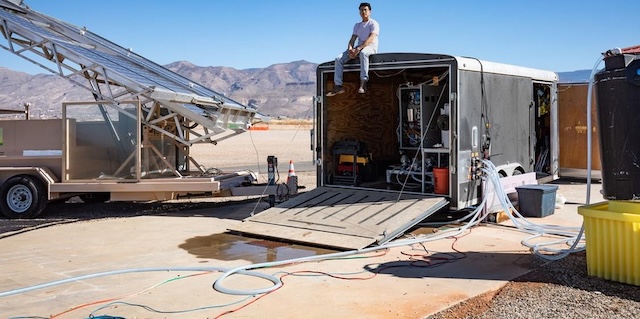
Envisioned as a way to provide water to communities whose groundwater is too brackish to drink, the device’s real trick is adjusting its desalination activity in response to the amount of solar power it produces.
Multiple times every second, the central control module takes readings of the strength of the sunlight and pumps correspondingly more or less water through the electrodialysis membrane stack. This innovation allows the whole package to skip the necessity for battery storage for times when the panels are producing more energy than the system is using.
No batteries means much lower costs and shipping weight, making it ideal for rural communities in arid parts of the Global South or southern United States with ample yearly sunshine and brackish groundwater.
Electrodialysis is one of two methods for desalinating water, with the other being reverse osmosis. Both have drawbacks at both the micro and macro scale, and in the case of electrodialysis, it requires electricity, which is typically produced by fossil fuels. Renewables have replaced them before, but challenges persist.
“The majority of the population actually lives far enough from the coast that seawater desalination could never reach them. They consequently rely heavily on groundwater, especially in remote, low-income regions,” says Jonathan Bessette, MIT PhD student in mechanical engineering and co-author on the project.
“[U]nfortunately, this groundwater is becoming more and more saline due to climate change. This technology could bring sustainable, affordable clean water to under-reached places around the world.”
For Bessette and the team behind the invention, their biggest challenge was establishing feedback mechanisms in the system that were sharp enough to detect minute changes in sunlight, for example, if a whisp of cloud passes by.
Over months of testing and improvements, their “flow command-current control” module gradually reached the point at which 94% of the solar power generated by the panels was utilized immediately to pump water through the desalination system without any lag and any transfer of power to a battery.
During a 6-month field trial at the Brackish Groundwater National Desalination Research Facility in Alamogordo, New Mexico, the system produced 5,000 liters of water per day despite large swings in weather and available sunlight.
“Conventional desalination technologies require steady power and need battery storage to smooth out a variable power source like solar,” explains Amos Winter, a decorated professor of mechanical engineering at MIT. “Being able to make drinking water with renewables, without requiring battery storage, is a massive grand challenge. And we’ve done it.”
Amos and Bessette are now looking to form a company to develop the technology into a product to help water-stressed communities worldwide.
The good news about this story is that fresh water can be made without using fossil fuels. Today’s JohnKu talks about chipping away at innovation. I hope you have a wonderful weekend.
Perseverance by John W. Howell © 2025
Big problems exist,
Continued working on them . . .
produces results.

Tempeste. Look out the window, there is a lot to see.”
“I like to keep things under control by looking down.”

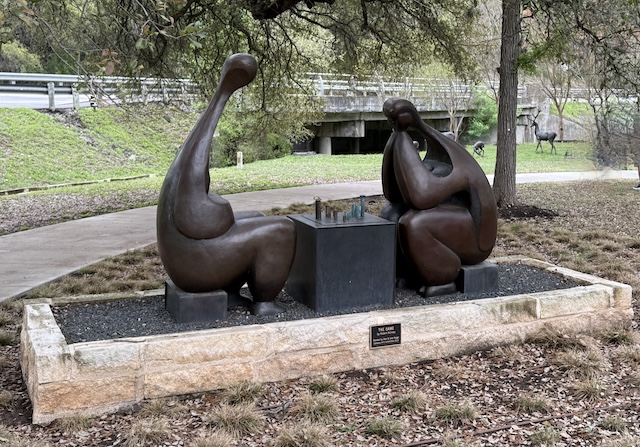
“This is a great park. Let’s go to the chess players.”
“What are chess players?”

“It’s a sculpture of two beings involved in a chess game.”
A game of chest. That sounds odd.”

“It is an ancient game of strategy. And it’s chess, not chest.
“Looks pretty boring if you ask me.”

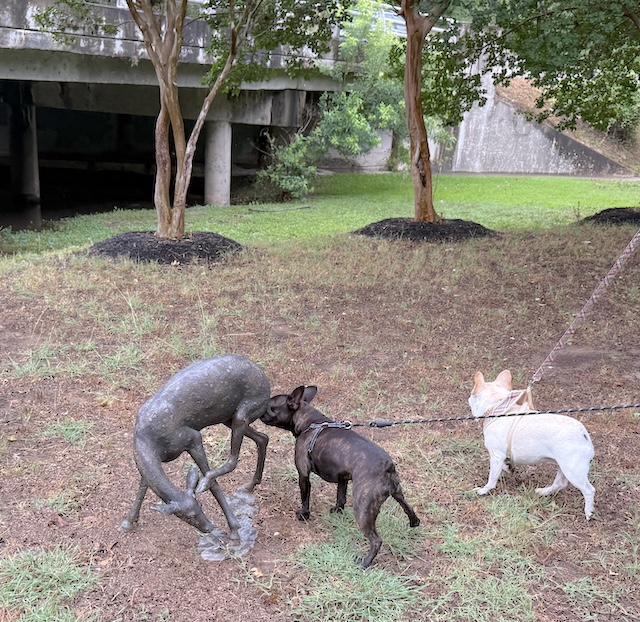
These elk sculptures look life-like, don’t they?”
“That is a serious set of antlers.”

Tempeste. Quit that.”
“I just want to see if it is anyone I know.”

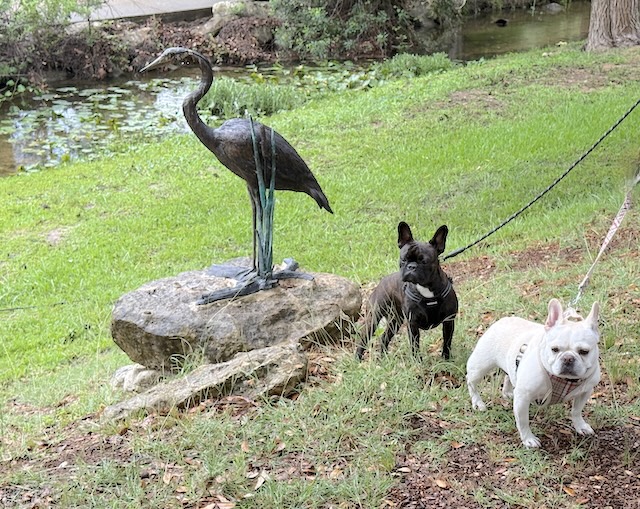
Let’s head over to the heron.
“We should be quiet and not scare him.”

“He’s made of bronze and not going anywhere.”
“That is good to know. I like him.”

“How about that old log over there?”
“There could be some interesting creatures in it.”

“Well, that was a bust. Not even a spider.”
“You would at least expect some hapless ant.”

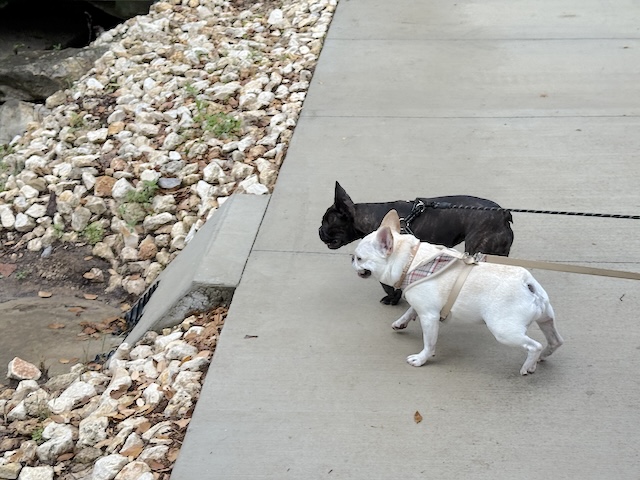
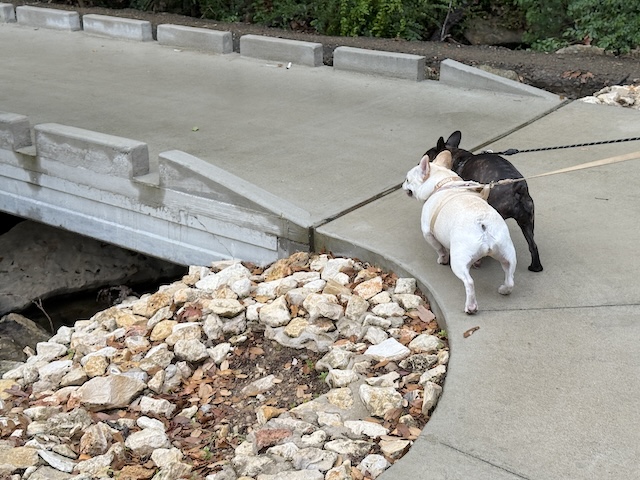
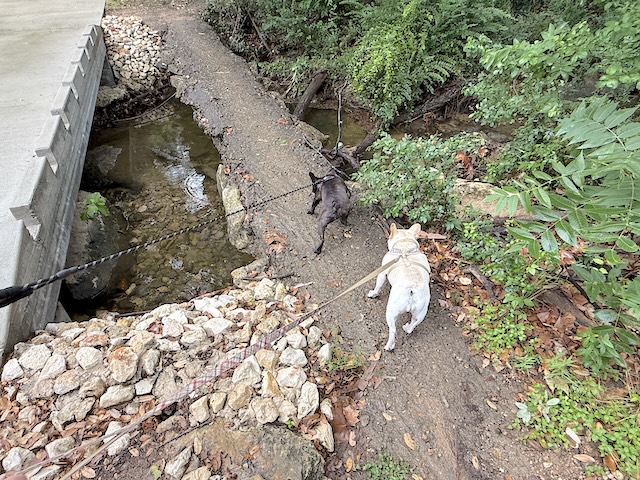
“I want to show you the bridge and creek.”
“This has been a great walk so far.”

“Some of the creek flows through the culvert.”
“Yeah, I see that.”

“Some also flows under the bridge.”
“This looks new.”

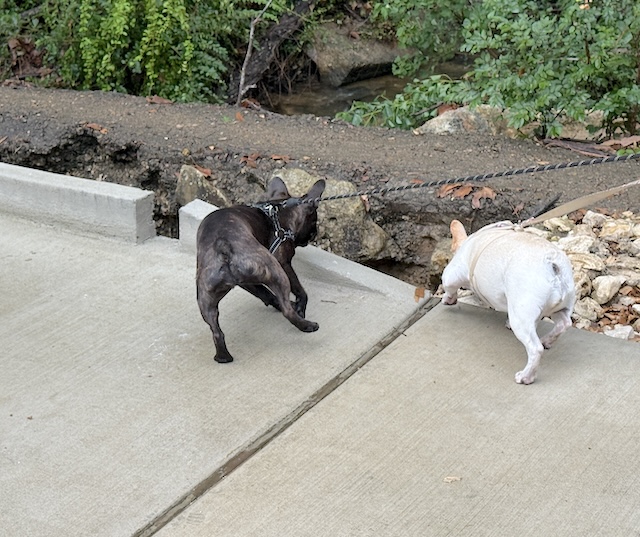
“It is. You can see the old foot path crossing.”
“I want to go down there.”

“Be careful. You don’t want to slip off the footpath.”
“This is much more interesting than the bridge.”

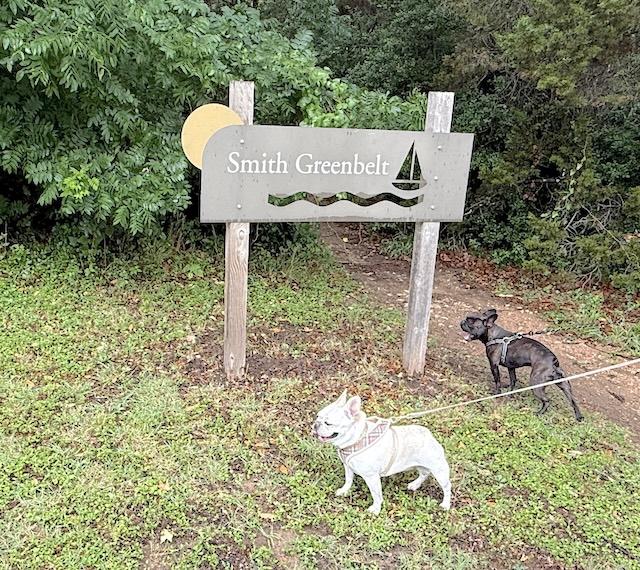
“Yes, it is, and more dangerous. Let’s go to the greenbelt entrance.”
“Okay. Hey wait. I see something in the water.”

“What did you see?”
“A black dog looking back at me.”

You are kidding me, right?”
“Yes, I am. This is beautiful.”
“A favorite place.”